
This site is supported by our readers. We may earn a commission, at no cost to you, if you purchase through links.

You’re not buying a goldfish. Snakes can outlive your car loan, your mortgage, and possibly your marriage—some species coast past 30 years without breaking a sweat. That ball python staring at you from the pet store glass represents decades of frozen mice, humidity checks, and explaining to houseguests why there’s a heat lamp in your living room.
The species you choose determines whether you’re signing up for a forgiving, handleable companion or a temperamental escape artist that turns feeding time into a strategic operation. Your lifestyle, space, and honest assessment of your commitment level matter more than which snake looks coolest on Instagram.
Table Of Contents
- Key Takeaways
- Is a Snake The Right Pet for You?
- Key Factors in Choosing a Snake Species
- Comparing Popular Pet Snake Options
- Matching Snake Needs to Your Experience Level
- Essential Housing and Enclosure Setups
- Feeding and Ongoing Care Requirements
- Legal, Ethical, and Financial Considerations
- Frequently Asked Questions (FAQs)
- Conclusion
Key Takeaways
- You’re committing to 15–30+ years of daily temperature checks, frozen rodent orders, and humidity monitoring—not a short-term novelty pet that fits into a busy lifestyle without serious adjustment.
- Corn snakes and ball pythons dominate the beginner lineup because they tolerate handling mistakes and environmental fluctuations better than advanced species like large constrictors, which demand custom enclosures and expert-level husbandry.
- Your snake won’t bond with you emotionally, but consistent handling reduces stress responses through habituation—expect to support its full body weight during brief sessions twice weekly, skipping the 48 hours post-feeding to prevent regurgitation.
- Initial setup costs ($200–$1,500) are just the entry fee—you’ll face ongoing expenses for electricity, frozen prey, substrate replacements, and potential vet bills that can hit $800 in emergencies, so budget accordingly before you buy.
Is a Snake The Right Pet for You?
Before you bring home a snake, you need to honestly assess whether this unconventional pet fits your life. Many people assume snakes are low-maintenance decorations, but the reality involves decades of commitment, specific care requirements, and responsibilities that extend far beyond feeding time.
Let’s examine three critical areas that determine whether snake ownership aligns with your lifestyle and values.
Assessing Your Lifestyle and Commitment
How much freedom do you really have to commit? Time commitment matters: over 40% of snake owners check enclosure temperature daily, and you’ll face potential vet visits averaging $40–80 per checkup.
Financial planning extends beyond the initial $120–1,500 setup—you’re signing up for 15 to 30 years of responsibility.
Space availability and owner readiness determine whether choosing the right pet snake leads to thriving companionship or regrettable surrender. Understanding reptile care basics is essential for a successful and healthy pet snake experience.
Common Misconceptions About Snake Ownership
Before choosing the right pet snake, let’s dismantle the myths holding you back. Snake fear factors distort reality—you’re far likelier to face a dog bite than a snakebite. Beyond handling, reptile hygiene and proper setup determine safety, not temperament.
Consider these truths about snake ownership:
- Dogs caused 18 times more injuries than venomous reptiles in Australian data
- Salmonella risk drops dramatically with basic handwashing protocols
- Energy costs routinely exceed initial setup budgets
- Pet release ethics matter—abandoned snakes suffer or become invasive
- Exotic pet laws vary widely by jurisdiction
Responsible pet ownership means confronting real demands, not Hollywood danger. Many owners are struggling with rising energy costs that affect their ability to care for their pets.
Understanding Long-Term Responsibilities
Your new ball python won’t just crash on your couch for a few years—it’ll outlive most dogs, living 20 to 30 years or more.
Your ball python will outlive most dogs, living 20 to 30 years or more—not just a few years on your couch
Long-term care means decades of feeding schedules, cleaning protocols, and housing stability through every move or life change. Financial commitment runs into thousands over that lifespan, and relinquishment risks spike when owners underestimate reptile ownership responsibilities before signing on.
Key Factors in Choosing a Snake Species

Not all snakes are created equal, and picking the wrong species can turn your journey into a frustrating mess. Your choice should match your experience level, the amount of hands-on interaction you want, and how much space and time you’re willing to commit.
Let’s break down the three factors that’ll guide you toward the right match.
Beginner-Friendly Vs. Advanced Species
Not all snakes are created equal—care complexity separates beginner-friendly pets from species that demand serious husbandry expertise. Corn snakes, king snakes, and ball pythons dominate the starter lineup, with manageable 3–5 foot adult lengths and straightforward environmental needs. In contrast, large constrictors like Burmese pythons routinely exceed 10–15 feet, requiring custom enclosures, advanced handling techniques, and prey as large as rabbits.
Species comparison for beginners vs. advanced keepers:
- Beginner breeds: Corn snakes, kingsnakes, and ball pythons thrive in 20–60 gallon tanks with simple heat gradients (75–85 °F), offering docile snake temperament and low mortality rates under proper reptile care and maintenance.
- Advanced species: Large constrictors demand oversized custom caging, precise temperature control, and sturdy safety protocols—multiplying setup costs and handling risk several-fold.
- Welfare outcomes: Studies link perceived care difficulty with higher mortality in private homes, underscoring that advanced husbandry should match your experience level to guarantee successful snake ownership for beginners progressing to complex species.
Temperament and Handling Requirements
Temperament defines your daily reality—defensive mechanisms vary wildly across species. Over 70% of UK keepers rate corn snakes and ball pythons as “very docile,” while ball pythons curl defensively rather than strike in 90% of threat scenarios.
Handling techniques matter: support the body fully, limit sessions to 5–15 minutes twice weekly, and skip the 48 hours post-feeding to reduce stress and regurgitation risk during routine snake care and maintenance.
Size and Lifespan Considerations
Snake size dictates your enclosure planning—corn snakes reach 3–5 feet and need 30–40 gallons, while ball pythons often hit 4–5 feet and demand larger footprints.
Lifespan expectations are sobering: corn snakes average 15–20 years, ball pythons 20+, and some individuals top 30. Growth rates peak in the first two years, so you’ll upgrade housing fast.
Longevity factors in snake breeds mean two decades minimum for most pet snake care commitments.
Comparing Popular Pet Snake Options
You’ve narrowed it down to wanting a pet snake, but now comes the real decision: which species fits your life?
Each popular option brings its own quirks, temperament, and care demands that can make or break your experience as an owner.
Let’s compare the top contenders so you can figure out which snake is actually right for you.
Corn Snakes: Pros and Cons

If you want a forgiving first reptile that won’t box you into a tiny enclosure, corn snakes deliver. Their 4–6 foot adult length suits standard 40-gallon setups, and you’ll find hundreds of stunning corn morphs to fuel your collecting instinct.
They’re active, feed reliably on frozen prey, and can live 15–20 years with straightforward snake care—no drama, no fuss, just solid reptile keeping fundamentals.
Ball Pythons: Pros and Cons

Ball pythons anchor many collections because they’re calm, compact at 4–5 feet, and built for the long haul—up to 30 years of reptile keeping. Before you commit, weigh these realities:
- Feeding refusal can test your patience, requiring adjustments in prey type and habitat conditions.
- Forty-gallon minimum enclosures give adults proper thermal zones and security.
- Docile snake handling makes them beginner-friendly once feeding routines stabilize.
- Python behavior leans sedentary, suiting keepers who value observation over high activity.
King and Milk Snakes: Pros and Cons
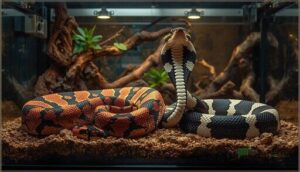
King snakes and milk snakes bring beginner-friendly appeal with a catch: their restless energy demands more floor space than you’d expect. These active hunters need 48 × 24-inch minimums, escape-proof latches, and consistent handling to manage stronger feeding responses. Their docile snake temperament balances high activity, making king snake care and milk snake handling rewarding once you master feeding techniques and respect their space.
| Aspect | King and Milk Snakes |
|---|---|
| Adult Size | 4+ feet; space-intensive |
| Enclosure Formula | Length × half-length floor |
| Snake Temperament | Active, exploratory feeders |
| Beginner Fit | Yes, with secure housing |
| Pet Snake Activity | High; needs enrichment |
Hognose Snakes: Pros and Cons

Compact rebels looking to break the mold: Western hognose snakes stay under two feet but deliver outsized personality with dramatic bluff displays—loud hissing and body inflation that’s all show. Their fast metabolism and rear-fanged venom risks mean hognose care suits confident keepers, not absolute beginners. You’ll master feeding tips, precise habitat design, and local venom restrictions.
- Active hunters with frequent feeding schedules for high-energy metabolism
- Defensive theatrics—hissing and puffing—rarely escalate to actual bites
- Temperature precision prevents respiratory issues; shedding problems signal habitat errors
- Rear-fanged venom and legal limits make hognose snakes intermediate reptile keeping
Matching Snake Needs to Your Experience Level

Your confidence with snakes will shape which species thrives in your care. Beginners need forgiving setups and docile temperaments, while experienced keepers can handle complex requirements and specialized environments.
Let’s break down what matters most at each skill level.
First-Time Owner Considerations
Stepping into reptile keeping for beginners demands honesty about your readiness. First-time owners frequently underestimate long-term commitments—ball pythons can live 30 years, corn snakes 15–20. Beginner mistakes include skimping on setup costs (usually $200–300), ignoring reptile health risks like respiratory infections, and relying on pet shop advice alone. Understanding snake care basics and pet ownership costs upfront prevents regret. Choosing the right pet snake means matching temperament, space needs, and your lifestyle to snake species selection.
| Consideration | Typical Reality | Common Beginner Mistake |
|---|---|---|
| Lifespan | 15–30+ years | Assuming short commitment |
| Initial Setup | $200–300 minimum | Buying undersized enclosure |
| Annual Feeding | ~$100 (frozen prey) | Unplanned recurring expense |
| Veterinary Access | $60–120 per visit | No exotic vet located |
| Health Monitoring | Weekly checks required | Ignoring early symptoms |
Space and Housing Requirements
Once you’ve committed to the years ahead, you need the space to back it up. Adult corn snakes demand at least a 4 × 2 × 2-foot enclosure for proper thermal gradients and snake climbing behavior. Ball pythons require similar footprints; hognose snakes fare well in 40-gallon setups with deep substrate. Reptile enclosure setup isn’t negotiable—furnishing density, vertical space, and room for temperature zones define success in snake housing.
- Enclosure size scales with adult length—a 4-foot corn snake needs 4+ feet of horizontal space.
- Thermal gradients require floor length—hot end (90–95°F) and cool side (70–75°F) zones need distance.
- Vertical space matters—corn snakes climb enthusiastically; provide 24-inch height with branches.
- Furnishing density must balance security and movement—multiple hides, plants, and décor without crowding.
- Larger enclosures reduce stress behaviors—restricted snake enclosures suppress natural exploration and activity.
Handling and Socialization Needs
Your snake won’t crave friendship, but handling shapes stress tolerance. Corn snakes usually calm with consistent, brief sessions—start with minutes, not marathons. Avoid handling during shedding or digestion. Most owners handle several times weekly once acclimated. Watch for frantic movement or defensive posturing; these signal you’re pushing too hard. Handling snakes isn’t socialization—it’s stress reduction through predictable, gentle interaction and environmental enrichment that mimics natural security.
| Species | Handling Frequency | Stress Indicators |
|---|---|---|
| Corn Snake | 2–3× weekly | Hissing, rapid escape |
| Ball Python | 1–2× weekly | Tight coiling, hiding |
| Hognose | 2× weekly | Mock strikes, hooding |
| King Snake | 2–3× weekly | Defensive posturing |
| Milk Snake | 2× weekly | Frantic movement |
Essential Housing and Enclosure Setups

Your snake’s enclosure isn’t just a box—it’s the foundation of its health, security, and long-term well-being. Getting the setup right from day one prevents escapes, stress, and costly mistakes down the road.
Let’s break down the three critical elements you need to master: escape-proofing, environmental controls, and interior design that keeps your snake comfortable.
Escape-Proofing Your Snake Enclosure
Your snake’s enclosure demands fortresslike security—escape attempts happen regularly, even in well-maintained setups. Commercial glass or PVC snake enclosures with integrated locking mechanisms prevent the vast majority of escapes, especially when you verify every latch after handling snakes.
Check for gaps exceeding two millimeters along doors, seal cable ports with solid grommets, and add weather stripping to eliminate flex points that clever reptiles exploit.
Temperature and Humidity Control
Beyond locks, your snake’s survival hinges on precise temperature control. Create a thermal gradient from 30–32°C in warm hides to 22–27°C at cool ends using thermostats and multiple heat sources.
Ball pythons demand 70–85% humidity levels, while corn snakes thrive near 65–75%. Position probe-based thermometers at snake level in both zones, pair them with hygrometers, and adjust ventilation systems to prevent respiratory disasters from stagnant air.
Substrate, Hides, and Enrichment
Layer at least 7.6 cm of loose substrate to support burrowing behavior and humidity control in snake enclosures and housing—deeper bioactive systems with soil and leaf litter offer even better moisture gradients.
Place two snug hides at warm and cool ends; your snake will choose tight refuges over open spaces.
Add climbing branches and varied textures as environmental enrichment—complexity drives exploration, reduces stereotypic behaviors, and supports ideal reptile husbandry across all snake species characteristics.
Feeding and Ongoing Care Requirements

Once your enclosure is dialed in, the real rhythm of snake ownership begins with feeding schedules and routine upkeep. You’ll need to understand what your snake eats, how often it sheds, and what normal health looks like for your species.
Let’s break down the daily and weekly tasks that keep your snake thriving.
Diet and Prey Options for Common Species
Feeding your captive snake doesn’t mean wrestling live rodents in your living room—frozen-thawed prey is the preferred method. You’ll match prey size to body girth, feed hatchlings every 5–7 days, and space out meals as your snake matures.
- Corn snakes thrive on appropriately sized mice every 7–21 days depending on age
- Ball pythons prefer rats or mice at 10% body mass, fed every 5 days to 6 weeks
- King and milk snakes accept diverse vertebrate prey but standardize well on rodents
- Hognose snakes respond best to frozen-thawed mice presented with subtle movement
Shedding, Cleaning, and Routine Maintenance
Your snake’s shedding patterns tell you when humidity control matters most—expect juveniles to shed every 4–6 weeks, adults closer to quarterly.
Daily spot cleaning keeps enclosure maintenance simple: remove waste, refresh water, and watch for stuck shed on tails or eyes. A full substrate swap and disinfection every few weeks protects skin health and prevents infections.
Regular reptile care routines make snake handling and safety second nature.
Signs of Health and When to Seek Help
Healthy snakes display smooth scales, silent breathing, and alert responses to their surroundings—anything less demands your attention. Watch for these emergency signs requiring immediate veterinary care:
- Open-mouth breathing or audible wheezing
- Persistent refusal to eat beyond normal shed cycles
- Thick discharge from mouth, nose, or eyes
- Neurological symptoms like stargazing or seizures
Routine annual exams catch subclinical problems before they escalate into crises.
Legal, Ethical, and Financial Considerations

Before you bring a snake home, you need to know what you’re getting into beyond just care sheets and feeding schedules. Local regulations can restrict or outright ban certain species, startup costs add up faster than most people expect, and where you source your snake matters more than you might think.
Let’s break down the legal, financial, and ethical realities that separate prepared owners from those who hit roadblocks they didn’t see coming.
Local Laws and Ownership Restrictions
You don’t own a snake until the law says you can. Before you bring home that corn snake or ball python, confirm permit requirements and exotic regulations in your state and city.
Species restrictions vary—some jurisdictions ban venomous reptiles or large constrictors outright, while zoning laws may prohibit exotic pet ownership in certain neighborhoods. Enforcement actions can mean confiscation, so verify reptile ownership legality first.
Budgeting for Setup and Veterinary Care
Your wallet decides what happens next. Initial costs for enclosures, heating, and equipment run $120 to $1,500—and that’s before the snake.
Ongoing expenses for food, substrate, and electricity add $10 to $30 monthly, while veterinary fees for routine checkups start at $40. Emergencies can top $800.
Budget planning means setting aside emergency funds now, because reptile ownership doesn’t pause when your bank account does.
Ethical Sourcing and Responsible Ownership
Money spent doesn’t guarantee ethics. Between 2000 and 2019, over 58% of internationally traded reptiles came from wild populations—many harvested unsustainably from biodiversity hotspots.
Captive breeding protects wild source populations and improves animal welfare outcomes. Choose responsibly:
- Buy captive-bred snakes from traceable breeders
- Avoid newly described or rare locality-specific species
- Verify legal documentation and CITES compliance
- Support reptile conservation through sustainable trade practices
Responsible pet keeping starts before you bring your snake home.
Frequently Asked Questions (FAQs)
Can snakes recognize their owners over time?
Your pet snake can distinguish your scent from strangers’ after living in enriched housing, research shows. This olfactory recognition reflects habituation and learned association with feeding routines—not emotional attachment like dogs display.
How do I introduce my snake to guests?
You should gauge guest comfort first—around half of adults fear snakes.
Then demonstrate calm Snake Handling with proper Safety Protocols, support the body completely, enforce clear Interaction Tips, and supervise constantly for best Reptile Etiquette.
What happens if my snake refuses food?
When your snake refuses food, don’t panic—it’s not always a red flag. Refusal causes range from normal fasting patterns to stress-related anorexia signs, so first check your husbandry before assuming illness.
Do different morphs have different care needs?
Most morphs don’t require morph-specific care—environmental adaptations and husbandry adjustments stay species-specific.
However, some morphs carry genetic health risks (like spider wobble in ball pythons) requiring specialized reptile husbandry attention beyond standard snake care.
Should I get tank mates for my snake?
No—you shouldn’t. Solitary housing is best for pet snake health and welfare.
Cohabitation challenges include tank mate risks like disease transmission, feeding competition, cannibalism, snake stress, and injury, with no real benefit to snake socialization or snake behavior.
Conclusion
Don’t put the cart before the horse—research your species before you fall for a face. Choosing the right snake for you hinges on matching temperament, care demands, and lifespan to your actual capacity, not your enthusiasm.
A well-chosen snake becomes a low-maintenance, fascinating companion; a poor match becomes a decades-long burden. Commit to the habitat, the feeding protocol, and the reality that this animal will outlast most of your major life decisions. Choose deliberately.
- https://www.wisconsinherps.org/educational-articles/top-10-beginner-reptiles-and-amphibians-snakes
- https://www.allanglescreatures.com/blogs/news/ball-python-behavior-what-every-owner-needs-to-know
- https://en.wikipedia.org/wiki/Corn_snake
- https://animals.howstuffworks.com/pets/otherpets/pet-snakes.htm
- https://usark.org/reptile-ownership-laws-by-state/