This site is supported by our readers. We may earn a commission, at no cost to you, if you purchase through links.

Most snake owners nail the basics—fresh water, appropriate feeding schedule, secure enclosure—then unknowingly sabotage everything with a single heating mistake.
A corn snake slowly refusing meals, a ball python sitting motionless for days, a boa that seems perpetually lethargic: these problems often trace back not to disease or stress, but to a misunderstood distinction between belly heat and ambient heat.
These two heat types aren’t interchangeable, and treating them that way creates a thermal environment that leaves your snake physiologically stuck. Understanding how each one functions—and why your snake’s body depends on both working together—transforms guesswork into confident, species-appropriate care.
Table Of Contents
- Key Takeaways
- What is Belly Heat Vs. Ambient Heat?
- Benefits and Drawbacks of Belly Heat
- Importance of Ambient Heat for Snakes
- Choosing The Right Heating Method
- Top 3 Products for Safe Snake Heating
- Frequently Asked Questions (FAQs)
- Do snakes need belly heat?
- What is the best heat source for snakes?
- Can snakes get burns from belly heat pads?
- How do I heat a snake enclosure in winter?
- What thermostat works best with under-tank heaters?
- How often should I check enclosure temperatures daily?
- Do hatchling snakes need different heating than adults?
- Conclusion
Key Takeaways
- Belly heat warms your snake from the ground up through direct contact, fueling digestion by nearly doubling enzyme activity—without it, a ground-dweller like a ball python can stall on meals entirely.
- Ambient heat isn’t just background warmth; it creates the thermal gradient your snake actively navigates to regulate its own body temperature, immune function, and stress levels.
- Using belly heat without a thermostat is a real burn risk—unregulated pads can spike past 120°F and blister your snake’s ventral scales before it moves away.
- Nailing your snake’s thermal setup means matching both heat types to your specific species, since a kingsnake’s 70°F cool night and a ball python’s 95°F basking zone are not interchangeable.
What is Belly Heat Vs. Ambient Heat?
Regarding heating your snake’s enclosure, belly heat and ambient heat play different roles.
If you’re curious about how different heat sources affect your setup, this guide comparing heating pads and heat lamps for snakes breaks down their unique benefits.
Understanding how each type works is key to creating a healthy environment.
Let’s look at the options you’ll use to provide the right temperatures.
Definition of Belly Heat for Snakes

Belly heat is exactly what it sounds like — warmth your snake receives through direct ventral warming when it presses its belly scales against a heated surface. That contact drives substrate conduction straight into the digestive organs, making heat mat placement critical for digestive support and overall snake health.
Studies highlight overhead heat effectiveness as a more natural method for reptile digestion.
| Belly Heat Feature | Details |
|---|---|
| Source | Under-tank heater or heat mat |
| Target | Ventral scales and gut |
| Ideal surface temp | 85–90°F |
| Primary benefit | Digestive support |
Definition of Ambient Heat in Enclosures

When you manage ambient heat, you’re setting the air temperature range throughout your snake’s enclosure. Unlike belly heat, ambient air temperature fills the space, forming a thermal gradient. This lets your snake choose its comfort zone. Accurate temperature monitoring and safety protocols matter, since enclosure temperature impacts reptile thermoregulation and health. Implementing a proper heat gradient provides natural thermoregulation support for your snake.
| Air Temp Range | Heat Source Types | Monitoring Tools |
|---|---|---|
| 75–85°F | Halogen bulbs | Digital probes |
| 70–80°F | Ceramic emitters | Infrared guns |
| 85–90°F | Heat panels | Multiple probes |
| 75–80°F | Incandescent lamps | Mid-enclosure checks |
| 70°F (night) | Deep heat projectors | Safety controls |
How Each Heat Type Works

Think of your snake’s enclosure as a miniature weather system.
Conduction transfer from belly heat pads warms the substrate, letting your snake absorb heat directly. Radiant emission from heat lamps or panels bathes the air and surfaces, while convection circulation moves warmth throughout. Together, these create a heat gradient mechanics—controlled by thermostats—to support natural thermoregulation.
| Method | Effect | Control Tool |
|---|---|---|
| Conduction | Surface heat | Thermostat |
| Radiant Emission | Air/surface | Heat lamp |
| Convection | Ambient temp | Digital probe |
| Heat Gradient | Choice zones | Multiple sensors |
| Thermostat Control | Stable temps | Safety shutoff |
Benefits and Drawbacks of Belly Heat

Belly heat isn’t just a nice extra — for many snakes, it’s a core part of how they digest food and stay comfortable.
Without enough belly heat, a snake’s metabolism slows down and digestion can stall — something worth keeping in mind when you’re setting up the right thermal environment for a baby snake.
But like most things in reptile care, it comes with real trade-offs worth understanding.
Here’s a closer look at what belly heat actually does for your snake, where it falls short, and which species tend to rely on it most.
Direct Warming for Digestion
Direct contact with a warm surface is where snake digestion actually begins.
When your snake presses against belly heat at 88–92°F, enzyme activation kicks into high gear — pepsin production rises, gastric acid increases, and digestion speed nearly doubles compared to cooler spots.
Belly heat at 88–92°F jumpstarts your snake’s digestion, rapidly boosting enzyme activity and nearly doubling digestive speed
Post-meal thermophily isn’t just instinct; it’s biology.
Following species-specific protocols and consistent temperature monitoring ensure your snake’s thermoregulation works exactly as nature intended.
Risks of Localized Heating
Localized belly heat sounds simple, but it carries real risks when used without care. Unregulated heat pads can spike past 120°F, causing burn injuries before you even notice reddened scales.
Equipment malfunction — like a displaced thermostat probe — silently allows dangerous overheating. Dry substrate near the heat source creates dehydration risks and gradient distortion, undermining your snake’s ability to regulate body temperature across a proper thermal gradient.
Species Preferences for Belly Heat
Every snake species has its own belly heat sweet spot. Here’s what the science shows:
- Ball Python Preferences — belly surfaces at 88–90°F enhance digestion inside warm hides.
- Corn Snake Needs — warm hides at 80–85°F satisfy their ground‑hugging thermal gradient habits.
- Kingsnake Belly Heat — 85°F pads support crepuscular digestion without overhead basking.
- Hognose Digestion Heat — substrate‑absorbed warmth at 86–88°F fuels their burrowing metabolism.
- Garter Gravid Heat — 84°F belly zones help gravid females regulate embryo development successfully.
Species‑specific temperature needs aren’t optional — they’re the foundation of solid snake care and health.
Importance of Ambient Heat for Snakes
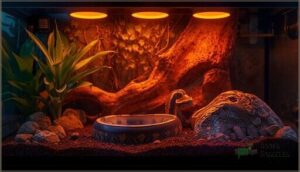
Ambient heat isn’t just background warmth—it’s the foundation for your snake’s health and daily routine. Getting it right means your snake can move, digest, and behave naturally.
Let’s look at the main ways you can create a safe, steady environment in your enclosure.
Creating a Thermal Gradient
A proper thermal gradient starts with smart heat source placement — anchor your primary heat source at one end, never the center. This shapes a natural warm-to-cool slope across the enclosure.
Aim for a warm side around 88–92°F, dropping to 75–80°F on the cool side. Place hides in both temperature zones, then use gradient monitoring techniques to confirm the slope stays smooth.
Supporting Natural Thermoregulation
Think of your snake as a tiny commuter — it shuttles between warm and cool zones all day long. That’s thermoregulation in action.
Ambient temperature drives this behavior by creating a thermal gradient, your snake can actually use. Microhabitat hides placed at opposite ends, paired with smart substrate insulation effects and a solid humidity‑temperature balance, let your snake self‑regulate exactly like it would in the wild.
Impacts on Snake Health and Behavior
Ever notice a snake glued to its heat mat, barely moving?
That’s a sign ambient temperature isn’t right.
When thermoregulation strategies break down, metabolic rate slows, immune suppression creeps in, and stress behaviors spike.
Without a healthy thermal gradient, belly heat alone risks thermal burns and disrupts activity rhythms—hurting snake health far more than you’d expect.
Choosing The Right Heating Method

Getting your snake’s heat setup right comes down to knowing what your specific species actually needs. Once you match the method to the animal, balancing belly and ambient heat becomes much more straightforward.
Here are the key things to get right when choosing your heating approach.
Species-Specific Temperature Needs
Did you know kingsnakes need cooler nights than ball pythons, while boas thrive with warmer night cooling?
Your species-specific temperature needs shape everything—Tropical vs Temperate setups, belly heat placement, and ambient temperature control. For example:
- Ball Python Range: 95–104°F basking, 75–82°F cool
- Corn Snake Gradient: 75–90°F
- Kingsnake Night Temps: 70–78°F
- Boa Night Cooling: 68–80°F
Balancing Belly and Ambient Heat
After mapping out species-specific needs, your next step is Gradient Calibration—blending belly heat and ambient temperature for a thermal gradient snakes can use.
Thermostat Synchronization helps you control both sources, while Heat Source Placement shapes the gradient.
Seasonal Adjustments and Monitoring Frequency keep temperature control steady, supporting reptile thermoregulation and healthy movement from warm hides to cool zones.
Common Mistakes in Heat Management
Even with good calibration, small oversights can quietly undermine your setup. The most common pitfalls include:
- Thermostat Probe Placement errors — a loose probe lets your snake move it, sending false readings and driving heating elements dangerously hot
- Direct Lamp Overheating from unguarded bulbs; snakes can approach too closely
- Inadequate Gradient Design — centering heat sources eliminates the cool retreat snakes need for reptile thermoregulation
- Unsecured Heat Mats creating uncontrolled belly‑heat contact surfaces
- Irregular Night Temperature drops disrupting ambient temperature stability
Top 3 Products for Safe Snake Heating
Getting the right gear makes all the difference between guessing and actually knowing your snake is safe.
These three products cover heating, light, and temperature monitoring — the core trio every keeper needs.
what’s worth your money.
1. Simple Deluxe Reptile Heat Lamp Guard

If you’re looking to keep your snake safe from burn hazards, the Simple Deluxe Reptile Heat Lamp Guard steps in as a sturdy solution. Its heavy metal mesh cover blocks direct contact with hot bulbs, so your reptile won’t get scalded during those curious moments.
The quick-access door lets you swap bulbs without fuss, and installation is straightforward with four screws. It fits standard E26 sockets and accommodates a range of bulb types, making it a practical barrier for terrarium safety.
| Best For | Reptile and amphibian owners who want a simple, reliable way to protect their pets from accidental burns caused by heat lamps. |
|---|---|
| Primary Use | Reptile enclosure guard |
| Material | Metal |
| Color | Black |
| Weight | 11.7 oz |
| Installation | Screw-mount setup |
| Brand | Simple Deluxe |
| Additional Features |
|
- Heavy metal mesh construction feels solid and holds up well over time
- Quick-access door makes changing bulbs fast and easy — no tools, no hassle
- Fits a range of standard bulbs and sockets, so it works with most setups
- The included screws run small, so you might need to grab replacements
- Not rated for extreme heat — pushing it too hard can cause melting or smoking
- May not play nice with every bulb type, so double-check compatibility before buying
2. REPTI ZOO 75W UV Heat Lamp
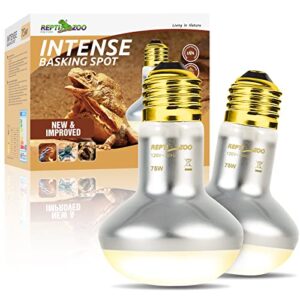
Once your lamp guard is secured, the heat source behind it matters just as much. The REPTI ZOO 75W UV Heat Lamp pulls double duty — it throws focused basking heat while emitting UVA rays that help stimulate your snake’s appetite and activity.
Running at 75 watts with a 6200K color temperature, it mimics natural daylight convincingly. It fits standard E26 porcelain sockets and supports voltages from 110V to 220V.
Just remember to replace it annually, since UV output fades before the bulb actually burns out.
| Best For | Reptile owners who want an affordable, easy-to-install bulb that handles both basking heat and UVA light in one. |
|---|---|
| Primary Use | Reptile heat source |
| Material | Aluminum |
| Color | White |
| Weight | 3.84 oz |
| Installation | E26 socket |
| Brand | Unspecified |
| Additional Features |
|
- Pulls double duty with focused heat and UVA rays that support appetite and activity
- Fits standard E26 sockets and works on both 110V and 220V — no adapter needed
- Long service life of up to 3,000 hours makes it a solid value for the price
- UV output fades before the bulb burns out, so annual replacement is a must even if it still looks fine
- Fragile build means one accidental bump can cut its life short
- Some buyers have received defective or incorrect products straight out of the box
3. Etekcity Infrared Thermometer Laser Gun
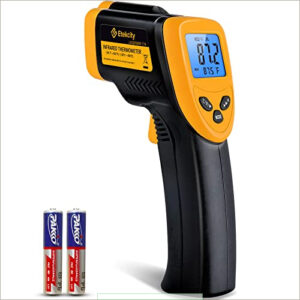
Your heating setup isn’t complete without a reliable way to check it. The Etekcity Infrared Thermometer Laser Gun reads surface temperatures instantly — just point, pull the trigger, and get a reading in under half a second.
That 12:1 distance ratio means you can check belly‑heat contact points without opening the enclosure and stressing your snake. It covers -58°F to 842°F with ±2% accuracy, which is more than enough for verifying corn snake warm sides or ball python basking zones.
| Best For | Reptile owners, grillers, and anyone who needs fast, non-contact surface temperature readings for cooking, pet care, or equipment checks. |
|---|---|
| Primary Use | Reptile temp monitor |
| Material | Plastic |
| Color | Black |
| Weight | 4 oz |
| Installation | Handheld, battery-powered |
| Brand | Unspecified |
| Additional Features |
|
- Reads temps in 0.5 seconds with a 12:1 distance ratio — no need to open the enclosure and stress your snake
- Works across a huge range (-58°F to 842°F), so it handles everything from reptile tanks to pizza ovens
- Backlit display and laser targeting make it easy to use in dim setups or tight spaces
- Only reads surface temps — you’ll still need a probe thermometer if you want internal readings
- Accuracy drops if you’re measuring from farther than 14 inches away
- Emissivity needs manual adjustment for different surfaces, which adds a small learning curve
Frequently Asked Questions (FAQs)
Do snakes need belly heat?
Not always. Many snakes thrive with just a proper ambient gradient and a warm basking spot.
That said, ground-dwelling species like ball pythons genuinely benefit from belly heat to support digestion.
What is the best heat source for snakes?
Radiant heat panels mounted overhead win the top spot for most snakes.
They warm both air and surfaces evenly, mimicking natural sunlight and supporting the full thermal gradient your snake needs to thrive.
Can snakes get burns from belly heat pads?
Yes, snakes can get burns from belly heat pads. Without a thermostat, pads can reach 120°F — hot enough to blister ventral scales before your snake even thinks to move away.
How do I heat a snake enclosure in winter?
Winter actually makes heating simpler: combine a thermostat-controlled ceramic emitter overhead with an under-tank pad beneath one-third of the floor.
Together, they keep your warm side near 88°F and cool side around 78°F.
What thermostat works best with under-tank heaters?
A pulse proportional thermostat is your best match for under-tank heaters.
It sends rapid power pulses to hold the floor temperature steady, avoiding the wild swings that basic on/off models cause.
How often should I check enclosure temperatures daily?
Check enclosure temperatures at least once daily — twice is better. A quick morning and evening glance catches most problems before your snake feels them.
Do hatchling snakes need different heating than adults?
Hatchlings do need extra care.
Their small bodies heat up fast and cool down just as quickly, so keeping nighttime temps around 78–80°F is essential — never let them drop below 75°F.
Conclusion
Think of your snake’s enclosure like a kitchen stove: the burner beneath the pan is belly heat—direct, targeted, essential for cooking (digesting) a meal—while the oven’s surrounding warmth is ambient heat, keeping everything at the right temperature throughout.
Mastering the difference between belly heat and ambient heat for snakes means you’re no longer guessing why your animal won’t eat or move. Get both right, and your snake finally has the thermal environment it’s been waiting for.
- https://reptifiles.com/corn-snake-care-guide/corn-snake-temperatures-humidity/
- https://pubmed.ncbi.nlm.nih.gov/12794677/
- https://www.snakehaus.com/frontpage/education/climate-control/
- https://www.wilbanksreptiles.com/blogs/wilbanks-advanced-radiant-heat-panel/why-is-a-radiant-heat-panel-best-for-reptile-tanks
- https://cdnsciencepub.com/doi/10.1139/cjz-2021-0135