
This site is supported by our readers. We may earn a commission, at no cost to you, if you purchase through links.

Your ball python just burned its belly on an improperly placed heating pad—a scenario that sends roughly 15% of snake owners scrambling to their vet each year. The difference between heat pads and heat lamps for snakes isn’t just about personal preference; it’s about matching your heating source to how your snake naturally thermoregulates in the wild.
Heat pads deliver steady conductive warmth from below, mimicking sun-baked rocks and burrow floors, while heat lamps broadcast infrared radiation from above, replicating open basking under desert sun. Ground-dwelling species like corn snakes thrive on belly heat, but arboreal climbers need overhead warmth to properly digest their meals.
Getting this choice wrong doesn’t just waste money—it compromises your snake’s metabolism, immune function, and long-term health.
Table Of Contents
- Key Takeaways
- Heat Pads Vs Heat Lamps: Key Differences
- Pros and Cons of Heat Pads for Snakes
- Pros and Cons of Heat Lamps for Snakes
- Choosing The Right Heating for Your Snake
- Safety Tips and Best Practices for Heating
- Frequently Asked Questions (FAQs)
- Do snakes need a heat lamp and heat mat?
- What is the best heating for snakes?
- Is a heat plate better than a heat lamp?
- Can I use both heat sources together safely?
- What wattage heat lamp does my snake need?
- Do heat pads increase my electricity bill significantly?
- How often should I replace my heating equipment?
- Will a heat lamp disturb my snakes sleep?
- Conclusion
Key Takeaways
- Heat pads deliver conductive warmth from below (mimicking sun-baked rocks) and work best for nocturnal, ground-dwelling snakes like ball pythons, while heat lamps provide overhead infrared radiation ideal for diurnal baskers and arboreal species that need vertical thermal gradients.
- Roughly 68% of captive snake thermal burns happen in the first six months of ownership, primarily from unregulated heat pads placed directly under hides without proper thermostat control or substrate barriers.
- Heat pads increase substrate humidity and require moderate ventilation to prevent mold, whereas heat lamps dry the air and demand higher ventilation to avoid heat buildup—each method fundamentally reshapes your enclosure’s microclimate beyond just temperature.
- A quality thermostat isn’t optional equipment but lifesaving technology that prevents deadly temperature swings, and you must use separate thermostats if combining both heat sources to avoid dangerous hot spots.
Heat Pads Vs Heat Lamps: Key Differences
Heat pads and heat lamps work in fundamentally different ways, and understanding these differences will help you choose the right option for your snake. Each heating method creates distinct thermal patterns in your enclosure and affects your snake’s behavior differently.
If you’re setting up a heat pad, make sure you understand proper substrate layering and thermostat placement to prevent burns and maintain safe temperatures.
Let’s break down exactly how each system operates and what that means for your setup.
How Heat Pads Work
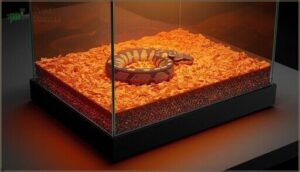
A heating pad converts electrical current into thermal energy through a resistive element embedded beneath your snake’s enclosure. Conduction transfers warmth directly from the undertank heating pad through substrate layers, creating stable floor-level heat.
This energy-efficient process maintains consistent thermal regulation without lighting disruptions, making heat mats ideal for nocturnal species requiring predictable ground warmth. Heat pads are also used in therapeutic settings to provide relief for muscle pain.
| Component | Function | Impact on Heat Transfer |
|---|---|---|
| Resistive element | Converts electricity to heat | Direct conduction to substrate |
| Insulation layer | Prevents heat loss downward | Redirects warmth into enclosure |
| Contact surface | Touches enclosure floor | Maximizes conduction efficiency |
How Heat Lamps Function

When you flip the switch on a heat lamp, tungsten filament technology converts electrical energy into infrared radiation through resistance heating. The filament glows above 2500°F inside an inert gas-filled bulb, emitting both visible light and radiant heat.
Reflectors focus infrared emission onto your snake’s basking zone, creating concentrated warmth that mimics natural sunlight better than other heat sources can achieve. Many pet owners and reptile keepers rely on animal heat lamp uses for proper temperature regulation in enclosures.
| Heat Lamp Design Element | Technical Function | Your Snake’s Experience |
|---|---|---|
| Tungsten filament | Resists current, heats to 2500°F+ | Receives strong infrared radiation |
| Reflector housing | Directs radiant heat downward | Gets defined warm basking spot |
| Wattage rating (40W-150W+) | Controls energy efficiency and output | Experiences adjustable thermal regulation |
| Quartz or glass envelope | Withstands high temps, retains warmth | Benefits from sustained heat emitters |
| Mounting distance | Determines intensity at surface | Accesses safe, species-appropriate warmth |
Types of Heat Each Provides
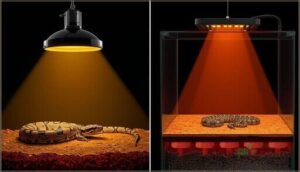
Your snake experiences two fundamentally different forms of warmth depending on which heating method you choose. Heat lamps emit infrared radiation that travels through air, delivering radiant heat from above to create defined thermal gradients.
Heating pads produce conductive warmth through direct contact with enclosure floors, transferring conductive heat upward through substrate layers with minimal heat distribution beyond the pad’s surface area.
Proper placement and wattage selection depend on enclosure size and species needs, which beginners can explore in detail through heating pad fundamentals.
| Heat Source | Heat Type Delivered |
|---|---|
| Heat lamp | Infrared radiation creates radiant heat through air, warming surfaces and objects |
| Heating pad | Conductive heat transfers through direct contact with glass or plastic |
| Heat lamp gradient | Strong vertical thermal gradients with defined basking zones |
| Heating pad gradient | Horizontal heat distribution across substrate with limited air warming |
| Combined sources | Radiant heat plus conductive warmth for complex thermoregulation needs |
Impact on Enclosure Environment

Beyond the type of warmth they deliver, your choice of heating method reshapes the entire enclosure microclimate—from humidity levels to airflow patterns.
Heating pads raise substrate temperatures by 5 to 15 degrees Fahrenheit, creating localized warm zones that increase humidity underneath and require careful enclosure ventilation to prevent mold.
Heat lamps dry the air while warming surfaces, promoting airflow but demanding fan adjustments to maintain temperature control.
| Heating Method | Temperature Gradients | Humidity Control | Enclosure Ventilation Needs |
|---|---|---|---|
| Heating pad | Horizontal thermal gradients across floor with stable substrate warmth | Increases substrate humidity in warm zones; risk of mold without airflow | Moderate ventilation required to balance moisture buildup |
| Heat lamp | Vertical thermal zoning with basking spots above ground level | Reduces ambient humidity through evaporation and air circulation | Higher ventilation needed to prevent heat buildup in upper zones |
| Combined sources | Complex microclimate management with multiple thermal gradients | Balanced humidity through strategic heat placement and monitoring | Specialized airflow to maintain even conditions across enclosure setup |
| Heating pad with poor ventilation | Limited air movement traps moisture near substrate surface | Excessive humidity under warm patches can promote fungal growth | Dense foliage or sealed tops create localized fogging at night |
| Heat lamp with inadequate control | Uneven air temperatures cause thermal stratification issues | Rapid substrate drying requires frequent misting or water features | Open-top designs lose heat quickly, destabilizing temperature control |
Pros and Cons of Heat Pads for Snakes
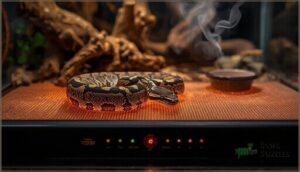
Heat pads offer several real advantages for snake keeping, but they’re not perfect for every situation.
You need to understand both their strengths and their limitations before making your choice. Let’s break down what works, what doesn’t, and which snakes benefit most from under-tank heating.
Advantages of Heat Pads
You’ll appreciate how heat pads deliver consistent thermal support directly where your snake rests. They offer exceptional heat distribution across the enclosure floor, maintaining steady temperature control without light disturbance.
Energy efficiency stands out—these heating solutions consume less power than most lamps while providing reliable warmth. Their discreet design fits seamlessly into any snake enclosure setup, supporting natural reptile heating needs and ensuring ideal snake comfort.
Limitations and Safety Concerns
Despite their reliability, heating pads carry real heat source risks you can’t ignore. Direct contact with malfunctioning pads creates burn hazards on your snake’s underside, while poor thermostat calibration leads to thermal stress that disrupts thermoregulation.
Electrical safety matters—faulty cords near damp substrate pose fire prevention challenges. Without vigilant temperature control, even quality reptile heating equipment can fail, leaving your animal vulnerable.
Ideal Snake Species for Heat Pads
Terrestrial snakes benefit most from heat pads that mimic the substrate warmth they’d find in nature. When you’re selecting species-specific heating, consider these burrowing species with distinct thermoregulation needs:
- Ball pythons thrive with belly heat for digestion and comfort
- Kenyan sand boas burrow naturally, preferring ground-level warmth
- Rainbow boas need consistent tropical substrate temperatures
- Hognose snakes dig frequently and appreciate conductive heat
- Corn snakes adapt well, though they’ll also use heat lamps
Proper reptile heating enhances essential snake care and long-term health.
Pros and Cons of Heat Lamps for Snakes

Heat lamps bring a different set of advantages and challenges to your snake’s enclosure. They excel at creating visible basking zones and natural light cycles, but they also require more careful monitoring than heat pads.
Let’s break down what you need to know about their benefits, limitations, and which species respond best to this heating method.
Benefits of Using Heat Lamps
Heat lamps excel at creating defined basking zones with precise temperature control—you can adjust wattage and distance to hit your snake’s exact needs. They deliver focused heat distribution that establishes proper thermal gradients essential for thermoregulation.
Modern heat sources often include dimmers for pinpoint accuracy, and when paired with thermostats, they optimize energy efficiency while supporting natural snake care and maintenance routines in your reptile heating setup.
Drawbacks and Common Issues
Bulbs burn out unexpectedly, leaving your snake without critical warmth until you notice the heat failure.
You’ll also face these common challenges:
- Burn risks from direct contact if your snake climbs too close to the lamp
- Electrical shock and fire hazards from faulty wiring or water exposure
- Temperature drift when ambient room conditions change throughout the day
- Higher energy costs compared to heating pads or mats
Best Snake Species for Heat Lamps
Diurnal species thrive when you provide radiant basking zones that mimic their natural sunbathing behavior. Corn snakes, gopher snakes, and ball pythons all benefit from focused infrared warmth that creates proper thermal gradients.
Desert dwellers like Kenyan sand boas adapt well to heat lamps too. Your species selection should match habitat replication needs—choose lamps for snakes that naturally seek elevated temperatures for digestion and thermoregulation.
Choosing The Right Heating for Your Snake

You can’t pick the right heat source without understanding what your snake actually needs. The best approach starts with your species’ natural behavior and moves from there to practical setup decisions.
Here’s how to match your heating equipment to your snake’s biology.
Assessing Your Snake’s Natural Habitat
Your snake’s natural home tells you exactly what it needs. Tropical ground dwellers like rainbow boas thrive in humid microclimates with stable substrate warmth, making heat pads ideal.
Desert species adapt to sunlit rocks and thermal gradients, so heat lamps work well. Research your snake’s native habitat—temperature ranges, shelter types, and behavioral patterns—to guide your terrarium design and reptile heating options for ideal snake health and wellness.
Matching Heating to Species Needs
Once you’ve identified your snake’s native environment, species research reveals precise thermal regulation demands. Ball pythons, for instance, need floor-level warmth around 88-90°F—heat pads excel here. Corn snakes require overhead basking zones near 85°F, making heat lamps the better choice for habitat replication and temperature control.
Match these reptile heating options to snake behavior:
- Nocturnal burrowers (ball pythons, Kenyan sand boas) thrive with heat pads providing stable substrate warmth
- Diurnal baskers (corn snakes, milk snakes) need heat lamps creating vertical thermal gradients
- Semi-arboreal species (green tree pythons) require elevated heat sources on branches
- Desert dwellers tolerate either option but benefit from overhead radiant heat mimicking sunlit rocks
- Tropical ground snakes (rainbow boas) depend on consistent floor warmth for snake health
Combining Heat Sources for Optimal Results
Some species benefit most from pairing both heat sources together. When you integrate a low-wattage heat pad beneath a hide with a calibrated heat lamp overhead, you create ideal heating through layered thermal gradients.
This dual approach maximizes energy efficiency while maintaining precise temperature control—the pad delivers stable floor warmth while the lamp establishes vertical thermal balance for exceptional heat distribution across your snake’s entire enclosure.
Safety Tips and Best Practices for Heating
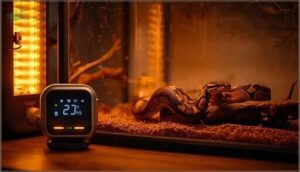
Setting up your snake’s heat source correctly is only half the battle—keeping it safe and running smoothly is where the real work begins.
Without the right monitoring tools and regular checks, even the best heating equipment can malfunction and put your snake at risk. Here’s what you need to do to maintain a safe thermal environment.
Using Thermostats and Thermometers
Your thermostat isn’t optional—it’s lifesaving equipment. Connect your heating pad or heat lamps to a quality thermostat with sensor placement at the basking zone for accurate heat source control.
A thermostat isn’t optional for snake heating—it’s lifesaving equipment that prevents deadly temperature swings
Digital thermometers with probes enable continuous temperature monitoring, while infrared units work for quick surface checks. Calibrate weekly to maintain thermal gradient management and prevent dangerous temperature swings in your enclosure.
Preventing Overheating and Burns
Proper temperature control slashes burn risk by 40 percent when you insulate heating elements and maintain a thermal gradient—85-90°F warm zones with 75-80°F cool retreats.
Position heat sources away from resting areas and install heating pads under barrier substrate to prevent direct contact. Mount heat lamps at adjustable heights and use guard rails to separate your snake’s body from hot spots during thermoregulation.
Regular Equipment Maintenance and Checks
Weekly visual checks keep your heating solutions running safely—inspect thermal monitoring probes, thermostat wiring, and heat mat surfaces for wear or damage. Establish maintenance schedules with monthly equipment calibration and temperature logging to catch drift before it harms your snake.
- Document safety inspections with dates and temperature control readings
- Replace frayed cords on heat lamps immediately
- Test thermostat cutoffs quarterly
- Clean heat mats to maintain efficient contact
- Verify alarm systems trigger at preset limits
Frequently Asked Questions (FAQs)
Do snakes need a heat lamp and heat mat?
Most snakes thrive with just one heat source—either a heat lamp or heat mat—when you pair it with a thermostat for temperature control and proper tank design for thermal regulation.
What is the best heating for snakes?
The best heating for snakes depends on species behavior and natural habitat.
Nocturnal burrowers thrive with heating pads for substrate warmth, while diurnal baskers need heat lamps for proper temperature control and thermal regulation.
Is a heat plate better than a heat lamp?
Neither heating solution wins outright—your choice hinges on your snake’s natural behavior and enclosure design.
Heat plates excel at stable, localized warmth, while heat lamps create broader thermal gradients with enhanced temperature control.
Can I use both heat sources together safely?
You can combine heat pads and heat lamps if you use separate thermostats for each source and position them in distinct thermal zones.
Monitor temperature gradients daily to prevent dangerous hot spots and burns.
What wattage heat lamp does my snake need?
Most snakes need a 60 to 100 watt heat lamp for smaller enclosures, while larger setups or cold rooms may require 100 to 150 watts to maintain proper basking temperatures around 85 to 90°F.
Do heat pads increase my electricity bill significantly?
Heat pads consume minimal electricity—usually 20 to 250 watts depending on size. A mid-sized pad costs less than a dollar monthly with thermostat control, making energy consumption negligible for most budgets.
How often should I replace my heating equipment?
Your heating solutions need attention every 6-12 months for heat lamps and 5-7 years for heat mats.
Watch for temperature drift, flickering, or hot spots—these signal it’s time for replacement to maintain proper thermal efficiency and safety.
Will a heat lamp disturb my snakes sleep?
Yes, if you leave it on at night. Bright light disrupts sleep patterns and nocturnal temperature needs.
Use a thermostat-controlled heat source without visible light to preserve natural activity patterns and support animal welfare.
Conclusion
Approximately 68% of captive snake thermal burns occur within the first six months of ownership—most from unregulated heat pads placed directly under hides.
The difference between heat pads and heat lamps for snakes ultimately hinges on your species’ behavioral thermoregulation: terrestrial hunters need belly warmth for digestion, while climbers require overhead gradients. Pair either source with a quality thermostat, verify temperatures with an infrared gun, and you’ll eliminate the guesswork that lands snakes in emergency clinics.
- https://www.veterinary-practice.com/article/wound-management-in-reptiles
- https://doi.org/10.3390/ani6100059
- https://www.reptifiles.com/wp-content/uploads/2020/01/Why-Infrared-Matters-by-Roman-Muryn.pdf
- https://reptifiles.com/
- https://www.jaye-heater.com/info/what-is-the-power-consumption-of-the-heating-p-90323180.html