This site is supported by our readers. We may earn a commission, at no cost to you, if you purchase through links.

An unregulated heat pad can hit 130 °F. Your snake won’t know that’s dangerous until it has already curled up on top of it.
The difference between heat pads and heat lamps for snakes comes down to how each one delivers warmth. A pad heats only the spot your snake touches, while a lamp spreads radiant heat across the enclosure and builds a warm-to-cool gradient. That choice also shapes your humidity, your power bill, and your snake’s safety.
Ball pythons and corn snakes don’t want the same setup. Here’s how to match the heat source to your animal and your tank.
Table Of Contents
- Key Takeaways
- Heat Pads Vs. Heat Lamps for Snakes: Key Differences
- Pros and Cons of Heat Pads for Snakes
- Pros and Cons of Heat Lamps for Snakes
- Choosing Heat Pads or Heat Lamps for Your Snake
- Safe Snake Heating: Installation, Thermostats, and Burn Prevention
- Frequently Asked Questions (FAQs)
- Are heating pads or lamps better for snakes?
- What is the best heat source for a snake?
- Which is better, a heat lamp or a heat plate?
- Does a snake need a heating pad?
- Do snakes need a heat lamp and heat mat?
- What is the best heating for snakes?
- Is a heat plate better than a heat lamp?
- Can I use both heat sources together safely?
- What wattage heat lamp does my snake need?
- Do heat pads increase my electricity bill significantly?
- Conclusion
Key Takeaways
- A pad warms only the spot your snake touches, while a lamp warms the whole enclosure and builds a warm-to-cool gradient, so that difference shapes humidity, power use, and safety.
- Match the heat source to your snake: ball pythons and small enclosures do best with pads, while corn snakes and large enclosures do best with lamps.
- You can run both together in big enclosures, cool rooms, or during illness recovery, as long as each has its own thermostat.
- Every heat source needs a reptile-rated thermostat, because an unregulated pad can hit 130°F and burn your snake, and lamps also need a guard.
Heat Pads Vs. Heat Lamps for Snakes: Key Differences
Heat pads and heat lamps both keep your snake warm, but they don’t work the same way. You’ll see how each one moves heat, then how each one affects your power use and your enclosure’s conditions. Knowing these key differences now makes your final choice much easier.
If you want a closer look at how each option heats your enclosure, this heat lamp vs. heat mat comparison breaks down the real-world tradeoffs.
Heat Transfer and Thermal Gradients
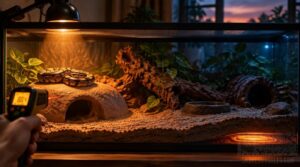
Contact decides everything. Heat pads deliver conductive heat only where your snake touches them, while heat lamps spread radiant heat across the enclosure and build a true thermal gradient.
Mounting heat lamps outside the enclosure, ideally with a proportional thermostat for control, prevents burns and keeps temperatures stable.
| Source | Heat type |
|---|---|
| Heat pads | Conductive, local |
| Heat lamps | Radiant, broad |
| Pad zone | Single hot spot |
| Lamp zone | Warm-to-cool thermal gradient |
Check both zones with a digital surface thermometer, not guesswork.
Once your temperatures are dialed in, this guide to making a snake terrarium feel natural shows how hides, substrate, and decor can help your snake use both zones comfortably.
Energy Use and Enclosure Conditions

Your heat source also shapes energy efficiency and your enclosure microclimate. Pads sip power, while lamps dry the air faster.
| Source | Wattage | Humidity |
|---|---|---|
| Pad | 8-40W | Holds better |
| Lamp | 50-150W | Drops faster |
A 24W mat costs about $1.60 monthly. A 100W lamp runs near $6.67. Lamps also lift air temperature, so check your thermal gradient and watch humidity with screen tops.
Pros and Cons of Heat Pads for Snakes
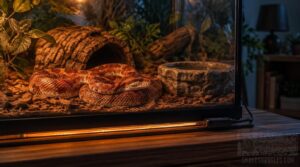
Heat pads give your snake steady belly warmth, much like sun-baked ground, and that aids digestion. They also hold humidity better than lamps. Undertank heating has limits, though:
Since snakes rely on external warmth to break down meals, it helps to understand how heating pads help snakes digest food and why a steady temperature matters after feeding.
- Always use a thermostat, or a heat mat can burn your snake.
- Add overhead warmth when your room runs cool.
- Avoid adhesive backing, since removing it later can damage your whole enclosure.
Pros and Cons of Heat Lamps for Snakes

Need overhead warmth? Heat lamps fill that gap. Their biggest pros: they create a true basking spot and support snake thermoregulation, letting your snake move between warm and cool zones.
The cons? Lamps dry out the air fast, so mist often, and nocturnal snakes may get restless under constant light. For heat lamp safety, use a thermostat and a guard.
Choosing Heat Pads or Heat Lamps for Your Snake

You’ve seen how pads and lamps differ, so now it’s time to pick the one that fits your snake. The right choice comes down to your species’ natural habits and the size of your enclosure. Below, you’ll find the two points that matter most: matching your setup to your snake, and knowing when to use both heat sources together.
If you’re still weighing wattage against tank size, this buyer’s guide to the best heat lamp for snakes breaks down which bulbs suit which enclosures.
Matching Species and Enclosure Needs
Your snake’s species decides the heat source, not the pet store’s default.
Start with what you keep and where you keep it:
- Ball pythons: heat pads, 88-92°F floor
- Corn snakes: heat lamps, 85-90°F basking
- Boas: either, 82-88°F
- Small enclosure: heat pads
- Large enclosure: heat lamps
Match these, and your snake’s thermoregulation stays natural and predictable, which keeps you in control.
When to Combine Heat Sources
When should you combine heat pads and heat lamps? Whenever one source can’t hold your thermal gradient control alone, like in large enclosures, cool rooms, or during illness recovery.
Smart heat source selection matters. Put heat pads under a hide for ventral warmth and let heat lamps cover the basking zone.
Run both on separate thermostats. That’s basic heat safety.
Safe Snake Heating: Installation, Thermostats, and Burn Prevention
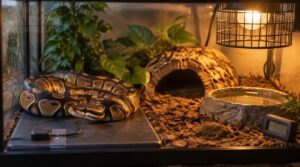
Imagine this: you plug in a new heat pad, walk away, and come back to a belly-down ball python resting on a surface that’s hit 130°F. Unregulated heat pads climb fast, and that’s how thermal burns happen.
Plug in an unregulated heat pad and walk away, and your snake may return to a surface hot enough to burn
Every heat source needs a reptile-rated thermostat. Tape the probe to the mat surface where your snake will lie, never in ambient air or under substrate. Then confirm the reading with a second thermometer before your snake goes in.
Mount heat pads under the tank on one end, following the manufacturer’s directions. With heat lamps, keep fixtures wattage-rated, shield the bulb with a cage so your snake can’t touch it, and clear flammable materials away.
Check cords and plugs often for heat safety.
Frequently Asked Questions (FAQs)
Are heating pads or lamps better for snakes?
Pick the wrong heat source and your snake might as well be living on Mars. For ground-dwelling species like ball pythons, heat pads win. For basking species, heat lamps do. Regulate either one with a thermostat for safety.
What is the best heat source for a snake?
The best heat source depends on your species, but for most snakes, heat pads on a reliable thermostat win. They’re efficient and gentle on humidity. Choose heat lamps only for baskers, and always control temperature.
Which is better, a heat lamp or a heat plate?
Neither wins outright. Your snake’s species decides. Heat pads suit ground-dwelling, nocturnal snakes, while heat lamps suit baskers.
Whichever you choose, temperature control with a thermostat is your safety net, so burns can never happen.
Does a snake need a heating pad?
Not always, but your snake needs a reliable heat source. Heat pads work well for most species, while heat lamps can replace them in warm rooms. Both support thermal regulation and a proper temperature gradient.
Do snakes need a heat lamp and heat mat?
Think of your snake’s enclosure as a tiny landscape, not a room to heat evenly. One heat pad or one heat lamp builds that landscape, and a thermostat keeps temperature control steady for proper thermal regulation.
What is the best heating for snakes?
The best heating matches your snake’s habits. Burrowers like ball pythons need heat pads for belly warmth, while baskers need heat lamps.
Always use thermostats for temperature control, prevent thermal burns, and protect snake health.
Is a heat plate better than a heat lamp?
Expecting a clear winner? Not quite. Heat pads give your snake steady belly warmth, while heat lamps build wider gradients.
Choose by species and enclosure, and add thermostats for safety, temperature control, and snake health.
Can I use both heat sources together safely?
Yes, you can run heat pads and heat lamps together, and it’s often smart. Give each its own thermostat, place them in separate zones, and check gradients daily. That keeps hot spots and thermal burns away.
What wattage heat lamp does my snake need?
Roughly 60 to 100 watts covers most snake enclosures.
Larger setups or cold rooms may need 150 or a heat pad. Choose heat lamp wattage holding 85 to 90°F, with temperature control and thermal monitoring.
Do heat pads increase my electricity bill significantly?
No, your bill won’t notice. Most heat pads run 8 to 24 watts, and a heat pad thermostat cycles that wattage down. Smart thermal management means real energy efficiency, usually under $2 monthly, even 24/
Conclusion
A pad warms one spot, but a lamp warms the whole enclosure. That’s the real difference between heat pads and heat lamps for snakes, and it decides everything else.
Pick the source that fits your species, your enclosure size, and your humidity targets. Then protect that choice with a reliable thermostat, secure mounting, and a thermometer you actually check. Your snake can’t judge heat for itself, so you have to. Nail the gradient and relax.