This site is supported by our readers. We may earn a commission, at no cost to you, if you purchase through links.
Your skin cells can’t tell the difference between a sunny afternoon and a tanning bed, but they respond very differently to the two types of ultraviolet radiation hitting them. UVA rays slip past your outer defenses and target the deeper layers where collagen lives, while UVB burns the surface and triggers your body’s vitamin D production—a process reptile keepers have borrowed to keep their pets healthy.
Understanding the difference between UVB and UVA lighting matters whether you’re protecting yourself from premature aging, preventing skin cancer, or creating the right environment for a bearded dragon. The wavelength gap of just 35 nanometers separates these two bands of invisible light, yet that tiny difference determines whether you’re building bones or breaking down elastin.
Table Of Contents
- Key Takeaways
- What is Ultraviolet (UV) Light?
- UVA Lighting: Wavelength and Properties
- UVB Lighting: Wavelength and Properties
- Key Differences Between UVA and UVB
- Role of UVA Lighting in Reptile Care
- Role of UVB Lighting in Reptile Care
- Health Effects of UVA Versus UVB Exposure
- Choosing The Right UV Lighting for Snakes
- Safe Use and Handling of UV Lighting
- Common Myths About UVA and UVB Lighting
- Frequently Asked Questions (FAQs)
- Conclusion
Key Takeaways
- UVA penetrates deeper into your skin’s dermis layer and drives collagen breakdown and premature aging, while UVB stays at the surface causing sunburn but also triggering the vitamin D3 production your body needs for calcium absorption.
- The 35-nanometer wavelength difference between UVA (315-400 nm) and UVB (280-315 nm) determines their biological impact—UVB carries higher energy per photon despite penetrating less deeply, making it more reactive with surface tissues and DNA.
- For reptile care, you’ll need both types of UV lighting: UVA supports natural behaviors and circadian rhythms, while UVB is non-negotiable for preventing metabolic bone disease through vitamin D3 synthesis.
- Both UVA and UVB contribute to skin cancer risk and eye damage through different mechanisms, so broad-spectrum protection matters whether you’re protecting yourself outdoors or safely handling UV equipment for snake enclosures.
What is Ultraviolet (UV) Light?
You’ve probably heard about UV light in the context of sun exposure, but understanding what it actually is can help you make smarter choices about protection. Ultraviolet radiation sits just beyond visible light on the electromagnetic spectrum, which means your eyes can’t detect it even though it’s constantly affecting your skin.
Understanding how reptile lighting solutions balance UVB output with safety can help you apply similar protective thinking to your own sun exposure habits.
Let’s break down where UV light fits in the bigger picture and how scientists categorize it into distinct types.
UV Light in The Electromagnetic Spectrum
Ultraviolet light sits between visible violet light and X-rays in the electromagnetic spectrum, making it part of a family of electromagnetic waves you can’t see but definitely feel. UV radiation spans wavelengths from roughly 100 to 400 nanometers, and here’s what sets it apart:
- UV wavelengths are shorter than visible light, so photon energy levels run higher.
- Frequencies range from about 800 to 30,000 terahertz.
- Photon energy spans approximately 3 to 30 electron volts.
- UV carries more punch than visible light but less than X-rays. The is essential in filtering out the most harmful UV radiation before it reaches Earth’s surface.
Categories of UV Radiation
Scientists sort UV radiation into three main types based on wavelength and electromagnetic properties: UVA, UVB, and UVC. Each category brings distinct radiation effects you’ll want to understand:
| UV Type | Wavelength Range | Energy Level | Reaches Earth? | Primary Effects |
|---|---|---|---|---|
| UVA | 315–400 nm | Lowest | Yes, majority | Skin aging, deep penetration |
| UVB | 280–315 nm | Moderate | Partially | Sunburn, vitamin D synthesis |
| UVC | 100–280 nm | Highest | No (absorbed by atmosphere) | Germicidal, sterilization |
For a deeper explanation of these categories and their impacts, see this overview of the electromagnetic spectrum properties.
Understanding this UV spectrum helps you protect yourself and use ultraviolet light safely.
UVA Lighting: Wavelength and Properties
UVA light sits at the longer end of the ultraviolet spectrum, which means it behaves differently than its shorter-wavelength cousins. Understanding its specific wavelength range and how it interacts with skin and materials helps you make informed decisions about exposure and protection.
Let’s break down the two key properties that define UVA radiation.
UVA Wavelength Range
When you think about the UVA spectrum, picture the longer stretch of UV radiation spanning 315 to 400 nanometers. This wavelength range sits right at the edge of visible light, making UVA rays the most abundant type of ultraviolet radiation reaching you outdoors. Here’s what defines this specific band:
- UVA wavelength falls between 315 and 400 nm on the electromagnetic spectrum
- It represents the longest wavelength among all radiation types in the UV family
- UVA accounts for roughly 95% of UV radiation penetrating Earth’s atmosphere
- The light frequency remains lower than UVB, resulting in gentler immediate effects
Penetration and Energy Levels
Now that you know UVA’s wavelength range, let’s explore how deeply these rays actually reach. UVA radiation penetrates your skin more effectively than UVB because its longer wavelength carries lower energy levels—around 3.10 to 3.94 electron volts. Think of it like this: lower energy doesn’t mean harmless. UVA reaches the dermis, affecting collagen and elastin fibers, while UVB primarily impacts your epidermis with higher UV intensity but shallower orbital ordering in tissue layers.
For reptiles like boa constrictors, UVB exposure becomes essential for calcium absorption—something you can optimize by understanding proper UVB lighting requirements for boa constrictors.
| UV Type | Penetration Depth |
|---|---|
| UVA | Dermis (deep skin layers) |
| UVB | Epidermis (surface layer) |
| UVA | Lower energy, deeper reach |
| UVB | Higher energy, surface impact |
| UVA | 3.10–3.94 eV energy range |
UVB Lighting: Wavelength and Properties
UVB occupies the middle ground of the UV spectrum, packing more energy per photon than UVA while still allowing enough atmospheric penetration to reach your skin—and your reptile’s habitat. The wavelength range of 280 to 315 nanometers carries photon energy between 3.94 and 4.43 electron volts, making UVB rays particularly reactive with biological tissues.
Here’s what sets UVB radiation apart:
- Moderate penetration: UVB doesn’t dig as deep as UVA, but it impacts your skin’s outer layers enough to trigger sunburn and vitamin D synthesis.
- Higher energy output: The shorter wavelength delivers more punch per photon, explaining why brief UVB exposure causes noticeable effects.
- Germicidal properties: UVC gets the spotlight for sterilization, but UVB applications include certain disinfection tasks.
- Critical for metabolism: UVB lighting allows vitamin D3 production in both humans and reptiles.
You’ll find UVB spectrum technology in medical phototherapy, horticulture, and specialized animal enclosures where metabolic processes depend on this specific UV radiation band.
Key Differences Between UVA and UVB
Understanding the difference between UVA and UVB isn’t just about wavelength numbers—it’s about how each type of light behaves in your skin and what that means for your health.
These two forms of ultraviolet radiation work in fundamentally different ways, from how deeply they penetrate to the specific damage they cause.
Let’s break down the key distinctions you need to know.
Wavelength Comparison
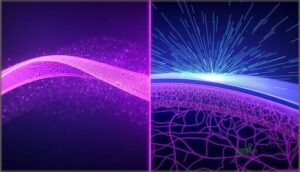
When you compare UVA and UVB across the ultraviolet spectrum, wavelength tells the whole story. UVA lighting operates between 315 and 400 nanometers, while UVB wavelength sits shorter at 280 to 315 nanometers.
That difference in electromagnetic properties drives everything else—photon energy, UV penetration depth, and how UV radiation interacts with skin or materials. Shorter UVB wavelengths pack more punch per photon, making them more reactive than their longer UVA cousins.
Biological Effects
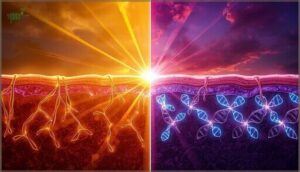
Your body reacts to UVA and UVB in fundamentally different ways. UVA penetrates deep into your dermis, triggering skin aging through collagen breakdown and oxidative stress, while UVB works at the surface, causing sunburn and directly forming DNA lesions like cyclobutane pyrimidine dimers.
- Vitamin synthesis: UVB converts 7-dehydrocholesterol into vitamin D3 in your skin cells
- Cell damage pathways: UVA generates reactive oxygen species; UVB creates direct DNA damage
- Skin health timeline: UVA accelerates chronic photoaging; UVB causes acute inflammation
- Eye protection needs: UVB threatens your cornea more; UVA stresses deeper structures over time
Role of UVA Lighting in Reptile Care
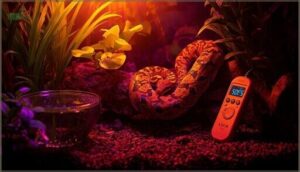
UVA lighting plays a bigger role in reptile care than many snake owners realize, particularly regarding natural behaviors and daily rhythms. While UVB gets most of the attention for vitamin D3 synthesis, UVA wavelengths help your snake regulate activity patterns and respond to environmental cues the way it would in the wild.
Let’s look at two key ways UVA lighting aids your snake’s overall well-being.
Behavioral Benefits for Snakes
UVA lighting acts as a subtle catalyst for natural behaviors in your snake’s enclosure. When you provide UVA exposure, snakes demonstrate increased exploratory movement and investigative behaviors—checking scent cues, traversing thermal gradients, and engaging with enrichment items like movable hides or climbable branches.
This UV radiation enhances snake enrichment by encouraging foraging strategies and problem-solving activities. Compared to UVB, UVA stimulates activity without the metabolic demands, supporting handling techniques by promoting confidence and reducing stress-related behaviors during interaction.
| Behavioral Response | With UVA Lighting | Without UVA |
|---|---|---|
| Exploration Frequency | Daily investigative movements | Reduced activity patterns |
| Foraging Engagement | Active problem-solving sequences | Passive feeding only |
| Stress Indicators | Fewer defensive postures | Increased startle responses |
UVA and Circadian Rhythms
Your snake’s internal clock relies on consistent light cues to regulate its circadian cycle. UVA exposure during dawn and dusk mimics natural twilight transitions, signaling biological rhythms that govern sleep patterns and activity phases.
This light therapy approach facilitates gradual phase adjustments without the abrupt circadian shocks that disrupt rest cycles. When you combine UVA with UV radiation safety protocols and proper UV technology timing, you’re creating a stable light environment that promotes long-term circadian health and predictable behavioral routines.
Role of UVB Lighting in Reptile Care

While UVA facilitates behavior and daily rhythms, UVB fulfills a more critical physiological function in reptile care. Without adequate UVB exposure, many reptiles can’t produce the vitamin D3 their bodies need to absorb calcium properly.
Let’s look at how UVB directly influences snake health through two essential mechanisms.
UVB and Vitamin D3 Synthesis
When UVB rays hit your snake’s skin, they trigger a striking chain reaction. UVB exposure in the 290 to 315 nanometer range converts 7-dehydrocholesterol into previtamin D3, which rapidly transforms into vitamin D3 production within hours.
This skin conversion pathway delivers essential vitamin D benefits by supporting calcium absorption and bone health.
The right UVB dosage matters—moderate exposure maximizes synthesis without risking overexposure, balancing UV radiation and skin health effectively.
UVB’s Impact on Snake Health
Beyond vitamin D production, UVB radiation effects ripple through your snake’s entire system. Proper exposure promotes calcium metabolism, helping bones stay strong and preventing metabolic disease. Immune function benefits too—adequate UVB may reduce respiratory infections.
Consider these health monitoring essentials:
- Track 25-hydroxy vitamin D levels through regular blood tests
- Watch for behavior boost in activity and feeding response
- Adjust lighting based on species needs and individual variation
- Balance health risks by providing gradient basking zones
Health Effects of UVA Versus UVB Exposure

Understanding how UVA and UVB affect your skin and eyes isn’t just academic—it’s critical for protecting yourself and anyone exposed to UV lighting. Both types of ultraviolet radiation pose distinct health risks, from surface-level damage to deep tissue changes that accumulate over time.
Let’s break down the specific risks you need to know about, starting with immediate effects on your skin and eyes, then moving to what happens with prolonged exposure.
Skin and Eye Health Risks
Your skin and eyes face different threats depending on the type of UV radiation hitting them. UVA penetrates deep into your skin, accelerating photoaging effects like wrinkles and collagen breakdown, while UVB causes immediate sunburn and raises your skin cancer risk. Both contribute to eye inflammation and vision loss over time.
UV protection isn’t optional—your thin eyelid skin is especially vulnerable to damage, making broad-spectrum sunscreen and UV-blocking eyewear essential safeguards for skin health.
Long-Term Exposure Concerns
When you think months and years instead of minutes, UV radiation effects shift from annoying to alarming. Chronic exposure accelerates DNA damage in your exposed tissues, depleting natural antioxidant defenses and triggering immunosuppression factors that weaken your body’s ability to fight abnormal cells—that’s how skin cancer risks escalate over time.
- Photoaging concerns intensify as repeated UVA and UVB exposure breaks down collagen faster than your body repairs it
- Eye damage prevention becomes critical since cumulative UVB can cause cataracts and photokeratitis in sensitive individuals
- UV radiation and skin health connect through oxidative stress that fuels chronic inflammation throughout exposed areas
- Skin aging and DNA damage compound when you skip protective measures during peak sun exposure periods
Choosing The Right UV Lighting for Snakes
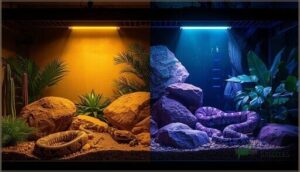
Not every snake needs the same UV setup, and picking the wrong lighting can affect their health over time. You’ll want to think about your species’ natural habitat, the size of the enclosure, and how much UVB output actually reaches your snake.
Let’s look at the key factors that’ll help you make the right choice.
Factors for Snake Enclosures
When you’re setting up UV lighting for your snake, you need to match your choices to the specific species you’re keeping. Enclosure design plays a big role—arboreal snakes benefit from vertically positioned UV lamps, while terrestrial species need horizontal placement.
Your lighting cycles should mirror natural day-night patterns with 12-hour intervals to support healthy snake behavior. Don’t forget that temperature control and humidity levels interact with UV sanitation systems, so use shielded fixtures that won’t disrupt your thermal gradient or create unwanted hotspots.
Lamp Selection Tips
Your choice of UV lamp types can make or break your snake’s health, so focus on these priorities:
- Match UVA and UVB output to your species—diurnal snakes need stronger UVB fixtures than nocturnal ones.
- Choose LED or fluorescent UV lamps for energy efficiency and consistent output over 12,000 hours.
- Verify safety features like shielded UV fixtures to protect both you and your snake.
- Check lighting controls for programmable timers that automate day-night cycles.
- Skip dimming options for UV lighting—they reduce therapeutic wavelengths.
Safe Use and Handling of UV Lighting
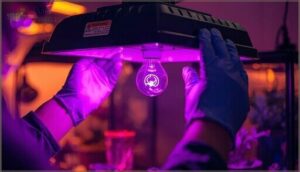
UV lighting can pose real risks if you don’t handle it properly, whether you’re using it for snake care or other applications. The good news is that a few straightforward protective measures and usage guidelines can greatly reduce your exposure to harmful radiation.
Let’s walk through the essential safety practices you should follow when working with UV lamps.
Protective Measures
Don’t forget eye protection when you’re working around UV lamps—safety glasses with side shields block harmful radiation. You’ll want to shield your skin with protective gloves and long sleeves, much like applying sunscreen outdoors.
Proper enclosure shielding prevents direct UV exposure that contributes to skin damage and skin cancer over time. Think of these measures as your first line of radiation protection and sun protection whenever handling or maintaining UV equipment.
Recommended Usage Guidelines
Consistently following usage standards protects both you and your reptiles from UV radiation exposure limits. Position your UVA and UVB lamps 12 to 18 inches from the basking area to balance health benefits with UV safety, and install lighting timers to deliver 10 to 12 hours of photoperiod daily.
- Create shaded zones where snakes can retreat from all UV exposure
- Replace lamps every 6 to 12 months as UVB output declines
- Monitor the UV index within enclosures to prevent health risks associated with excess sun protection needs
Common Myths About UVA and UVB Lighting
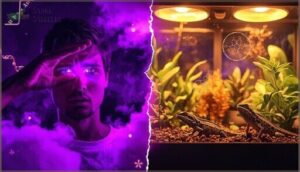
You’ve probably heard plenty of conflicting advice about UV lighting, especially if you’re caring for reptiles or thinking about UV exposure in general. Some people claim all UV light is dangerous, while others insist certain types are completely harmless.
Let’s clear up the most common misconceptions so you can make informed decisions based on facts, not fiction.
Misconceptions in Snake Care
Many snake keepers believe all species need identical UVA and UVB lighting setups, but that’s simply not how reptile nutrition and snake behavior work in practice. Understanding proper enclosure design means recognizing that UV lighting requirements vary considerably, and UV sterilization doesn’t replace routine cleaning protocols.
You’ll find misinformation claiming UV radiation is always harmful or completely unnecessary for every snake habitat, ignoring species-specific needs. Some owners think desert species don’t need hides or that venomous species make good beginner pets—both dangerous assumptions.
Facts Versus Fiction
Let’s clear up UV myths once and for all. You don’t need to fear all UV radiation—understanding light safety means knowing UVA and UVB serve different roles. Science debunked the idea that UVA causes immediate skin damage like UVB sunburn does, yet both contribute to health risks over time.
UVA and UVB serve different biological roles, and while UVA doesn’t cause immediate sunburn like UVB, both contribute to long-term health risks
UV radiation effects depend on wavelength, intensity, and exposure duration. The real radiation facts? Proper use minimizes harm while supporting your snake’s wellbeing when species-appropriate lighting is matched correctly.
Frequently Asked Questions (FAQs)
What’s better, UVA or UVB?
Neither stands alone as “better” — think of them as two hands working together.
Your snake needs both UVA for behavioral cues and UVB for vitamin D3 synthesis to maintain ideal UV balance and species-specific needs.
What is the difference between UVA and UVB lighting?
UVA and UVB differ primarily in wavelength and energy. UVA spans 315 to 400 nanometers with deeper penetration, while UVB covers 280 to 315 nanometers with higher energy affecting surface tissues.
How to tell if it’s UVA or UVB?
If your UV bulb came with a manual you’ve already recycled, don’t panic—check the packaging for wavelength specs (315–400 nm for UVA, 280–315 nm for UVB) or invest in a UV meter for reliable spectral identification and radiation testing.
Can UVA or UVB lighting treat human diseases?
Phototherapy using UVB and UVA radiation can manage certain skin conditions like psoriasis under medical supervision, but you won’t see effective disease management for internal or systemic illnesses—UV therapy targets specific dermatological problems only.
How do UVA and UVB affect aquatic animals?
In marine ecosystems, UV radiation affects aquatic life through water penetration differences. UVB causes direct DNA damage in shallow zones, while UVA penetrates deeper, triggering photoreactivation and UV stress responses that alter community resilience.
Do indoor plants need UVA or UVB light?
Most houseplants thrive on visible light alone for photosynthesis, but brief UVA or UVB exposure can strengthen defenses and boost flavor in herbs—think of it as a gentle nudge toward resilience.
How often should UV bulbs be replaced?
Most UV bulbs need replacement every 12 months, even if they still glow, because UV output declines sharply after roughly 9,000 operational hours, reducing disinfection effectiveness and compromising your system’s performance.
Conclusion
Shedding light on the difference between UVB and UVA lighting isn’t just wordplay—it’s essential knowledge for protecting your skin and caring for reptiles properly. UVB penetrates less but drives vitamin D3 synthesis, while UVA reaches deeper to affect collagen and cellular function.
Whether you’re selecting sunscreen or outfitting a snake enclosure, remember this: wavelength determines biological impact. Don’t let invisible radiation catch you unprepared—understanding these distinctions allows you to make informed choices for health and habitat management.
- https://www.cancer.org/cancer/cancer-causes/radiation-exposure/uv-radiation.html
- https://www.aad.org/media/stats/prevention-and-care/sunscreen-faqs
- https://jamanetwork.com/journals/jama/fullarticle/2759002
- https://scied.ucar.edu/learning-zone/atmosphere/ultraviolet-uv-radiation
- https://gamma-sci.com/2021/09/01/electromagnetic-spectrum-101-ultraviolet/