
This site is supported by our readers. We may earn a commission, at no cost to you, if you purchase through links.
Your snake’s survival hinges on a heat source it can’t generate itself—unlike mammals, which burn calories to stay warm, reptiles depend entirely on their environment to maintain critical body functions. Without proper heating, even a well-fed snake can suffer from respiratory infections, digestive shutdown, or immune system collapse within days.
Setting up a heating pad for your snake tank isn’t just about comfort; it’s about replicating the thermal conditions that allow your snake to digest food, fight off illness, and regulate everything from metabolism to muscle function. The right setup creates a temperature gradient that lets your snake choose its ideal warmth, while poor placement or missing safety controls can lead to life-threatening burns or dangerous cold spots that compromise health.
Table Of Contents
- Key Takeaways
- Why Snakes Need Heating Pads in Tanks
- Setting Up Temperature Monitoring Devices
- Adjusting Heating Pad Settings for Snake Species
- Preventing Overheating and Burns
- Maintaining and Troubleshooting Your Heating Pad
- Common Mistakes to Avoid With Heating Pads
- Frequently Asked Questions (FAQs)
- Conclusion
Key Takeaways
- Snakes are ectothermic and can’t generate their own body heat, so they depend entirely on external heating sources to maintain metabolism, digestion, and immune function—without proper temperature control, they risk respiratory infections, digestive shutdown, or organ failure within days.
- A thermostat isn’t optional equipment but a critical safety device that prevents heating pads from overheating and burning your snake, maintains precise temperature control within 1-2°F, and automatically shuts off during malfunctions to protect against thermal injury.
- Your heating pad should cover only one-third of the tank surface to create a proper temperature gradient (warm side at 88-92°F, cool side at 78-82°F for most species), allowing your snake to thermoregulate by moving between zones rather than being trapped in uniform heat.
- Daily temperature monitoring with multiple digital probes placed at snake head-height—not stuck to glass or touching the heat source directly—is essential to catch dangerous fluctuations, verify your thermostat is working correctly, and prevent life-threatening overheating before your snake shows visible symptoms.
Why Snakes Need Heating Pads in Tanks
Snakes can’t generate their own body heat the way you do, so they depend entirely on their environment to maintain the right temperature for survival. Without a proper heat source, your snake’s metabolism, digestion, and immune function can all shut down, leading to serious health problems or even death.
Understanding why controlled heating matters will help you create a safe, stable home that keeps your snake thriving.
Ectothermy and Thermoregulation
Unlike mammals, your snake can’t generate its own warmth—it’s an ectothermic animal that depends entirely on external heat sources for thermal regulation. That’s why temperature control in your tank isn’t optional; it’s essential for survival.
Proper thermoregulation strategies rely on:
- Temperature gradients that let your snake shuttle between warm and cool zones
- Consistent heat sources mimicking natural sunlit environments
- Stable conditions supporting digestion, immunity, and activity levels
To ensure the well-being of your snake, it’s essential to understand the importance of methodological rigor in maintaining a healthy environment.
Risks of Improper Temperature
When your snake’s tank falls outside its species’ temperature range, you’re opening the door to serious health problems. Thermal shock from sudden temperature fluctuations can trigger regurgitation and stress behaviors, while prolonged heat stress leads to dehydration and organ failure. Cold exposure slows digestion and weakens immunity, leaving your snake vulnerable to infections. Without a proper temperature gradient controlled by a thermostat and heating pad, metabolic disorders become inevitable—turning minor oversights into life-threatening conditions.
| Temperature Error | Physical Impact | Behavioral Warning Signs |
|---|---|---|
| Overheating (>95°F) | Dehydration, heat stroke, organ damage | Excessive basking, escape attempts, lethargy |
| Cold exposure ( A heating pad without a thermostat can’t stop itself from overheating and burning your snake |
Here’s how to integrate one safely and set it up for consistent, species-appropriate heat control.
Why a Thermostat is Essential
Precision heating in your snake tank depends on a thermostat to prevent thermal injury and maintain consistent temperature regulation. Without one, heating pads can overheat unpredictably, causing burns or stress. A thermostat automatically adjusts power output, creating stable heat regulation across the warm side while protecting your snake from dangerous temperature spikes that manual adjustments can’t prevent.
| Thermostat Benefit | Without Thermostat Risk |
|---|---|
| Precise temperature control within 1-2°F | Fluctuations of 10-15°F or more |
| Automatic shutoff during faults | Continuous heating during malfunctions |
| Stable thermal gradient maintenance | Uneven or excessive heat zones |
| Reduced burn and stress risk | Direct contact burns possible |
Setting Safe Temperature Limits
Your thermostat’s temperature thresholds define heat safety and protect your snake from thermal injury. Set warm-side limits to match species thermoregulation needs—88–92°F for ball pythons, 85–90°F for corn snakes, and similar ranges for boas—while programming a high-temperature cutoff at 95°F to prevent dangerous overheating. Configure your thermostat to maintain gradient control by cycling heating pad output within your snake’s preferred temperature range, ensuring stable temperature regulation across the enclosure.
- Target warm-side temperatures that align with your species’ natural basking behavior
- Program a fail-safe cutoff 3–5°F above your set point to halt heating during malfunctions
- Adjust settings seasonally if your snake requires cooler winter temperatures for brumation cycles
Thermostat Probe Placement Tips
When positioning your thermostat probe, place it at your snake’s head height on the warm side, away from direct contact with the heating pad or heat lamp—a misstep here disrupts thermal mapping and gradient control.
Use at least three sensor placement points across the snake tank to verify temperature control accuracy, securing probes with heat-resistant materials to maintain probe calibration between checks and prevent shifting near the heat source.
Setting Up Temperature Monitoring Devices

Once you’ve installed your heating pad and thermostat, your next job is to verify that temperatures stay stable across the enclosure. Accurate monitoring devices give you real-time data on both warm and cool zones, so you can catch problems before they harm your snake.
Here’s how to choose and position thermometers that deliver reliable readings throughout the tank.
Choosing Accurate Thermometers
You can’t rely on guesswork when your snake’s life depends on accurate temperature control. Digital thermometers with probe cables give you the precision you need to verify thermal gradients and maintain thermoregulation. Here’s what matters:
- Use calibrated digital probes designed specifically for reptile enclosures to guarantee reliable readings across your heating pad zones.
- Place at least two probes in different snake tank locations to capture the full temperature gradient from warm to cool.
- Cross-check your primary thermometer against an independent device regularly to confirm digital accuracy and catch calibration drift early.
Placing Temperature Probes Effectively
You’ll get accurate thermoregulation data only if you position sensors where your snake actually regulates temperature—at mid-body height, not stuck to the glass.
Place at least two probes to map your thermal gradient: one on the warm side near your heating pad and another on the cool end.
Keep probes away from direct contact with heat sources to avoid falsely high readings, and log temperatures at consistent times for reliable heat mapping and sensor calibration.
Using Multiple Monitoring Points
A single probe won’t reveal whether your heating pad creates safe temperature gradients across the entire enclosure. Install at least three sensors—warm end, cool end, and center—to verify heat distribution and catch dangerous hot spots before your snake does.
- Place probes at substrate level, mid-tank height, and near water dishes to map vertical thermal variation
- Check readings morning, afternoon, and evening to detect diurnal shifts in temperature control
- Cross-verify with both digital and infrared thermometers for reliable monitoring systems and accurate thermoregulation data
Adjusting Heating Pad Settings for Snake Species
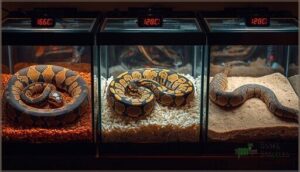
Not all snakes thrive at the same temperature, so you’ll need to adjust your heating pad settings based on the species you’re keeping. Ball pythons, corn snakes, and boa constrictors each have distinct thermal preferences that directly affect their digestion, activity levels, and overall health.
Let’s look at the specific temperature ranges these popular species require so you can dial in your thermostat with confidence.
Ball Python Temperature Needs
Your ball python’s thermoregulation depends on a precise thermal gradient between 78–82°F on the cool side and 88–92°F where the heating pad warms the snake tank’s basking zone.
Temperature control is critical—never exceed 95°F, as this jeopardizes snake health. Use a thermostat to maintain stable heat sources, and monitor both ends daily so your python can regulate its body temperature by moving freely between zones.
Corn Snake Temperature Preferences
Corn snakes thrive when you design a thermal gradient with a basking zone at 88–92°F and a cool retreat near 78–82°F, allowing natural snake thermoregulation through temperature regulation across the enclosure. Position your heating pad under one-third of the snake tank, then monitor these critical zones:
- Warm side: 85–90°F daytime ambient
- Cool side: mid-70s to low 80s
- Nighttime drop: 5–10°F reduction, never below 70°F
- Humidity control: 40–60% relative humidity
Use multiple probes to confirm consistent reptile heating and prevent temperature fluctuation that stresses your corn snake.
Boa Constrictor Heating Requirements
Boa constrictors require a more substantial thermal gradient than corn snakes. Position your heating pad to deliver 88–92°F on the warm side while maintaining the cool zone at 78–82°F. Install a thermostat-controlled heat source under one-third of the snake tank to prevent overheating, and verify substrate temperatures with multiple probes before introducing your reptile.
| Zone | Daytime Target | Nighttime Minimum |
|---|---|---|
| Warm side | 88–92°F | 80–85°F |
| Cool side | 78–82°F | 75–78°F |
| Ambient air | 75–85°F | 72–78°F |
| Humidity | 50–60% | 50–60% |
Monitor your snake’s behavior daily. If your boa avoids the heated area, reduce the temperature by two degrees and recheck with your thermostat probe to ensure proper temperature regulation across all heat sources.
Preventing Overheating and Burns
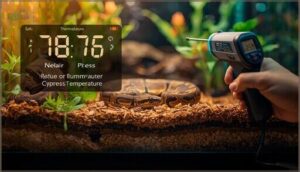
Even with a thermostat in place, heating pads can create hot spots that injure your snake if you’re not careful about substrate choice and maintenance. You need to watch for early warning signs that your heating system is running too hot or that your snake is showing stress from excessive warmth.
The following strategies will help you prevent burns and keep your snake safe throughout its life.
Recognizing Signs of Overheating
Vigilance is your best defense against heat stress in reptile enclosures. Watch for lethargy, open-mouth breathing, or thermal burns on your snake’s belly—all overheating symptoms that demand immediate action.
If your snake refuses food, shows excessive basking, or develops skin blistering near the heating pad, you’re likely exceeding safe limits. Temperature monitoring devices help, but snake behavior reveals what numbers can’t always capture about thermoregulation struggles.
Using Substrate and Tank Liners Safely
The barrier between your heating pad and snake determines burn risk. Choose reptile-safe substrates like coconut fiber or aspen that insulate without trapping excessive moisture, which can cause scale rot.
Tank liners from food-grade vinyl simplify cleaning and prevent substrate from muffling thermal gradients.
Avoid silica sands—ingestion causes impaction, and dense layers over heat sources create unpredictable hotspots that compromise snake health in reptile enclosures.
Regularly Checking Pad Condition
Even safe substrate won’t protect your snake if the heating pad deteriorates. Weekly pad inspection tips should include checking for cracks, fraying wires, or peeling surfaces—especially after moisture exposure in your snake tank.
Heat output testing with an infrared thermometer helps you catch uneven warming before burns occur. Your maintenance schedules must include:
- Inspecting pad surfaces and connectors monthly for wear detection methods
- Verifying secure attachment to non-slip surfaces
- Confirming thermostat integration remains functional for temperature regulation for reptiles
- Documenting findings on safety checklists to track heating sources for reptile enclosures
Replace any pad showing damage immediately—thermoregulation and temperature control depend on reliable equipment.
Maintaining and Troubleshooting Your Heating Pad
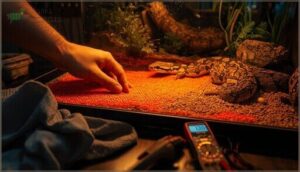
A heating pad won’t last forever, and regular upkeep is your best defense against sudden failures or safety hazards. You’ll need to monitor its condition, respond quickly to any signs of trouble, and know when it’s time to swap it out for a new one.
The following steps will help you keep your heating system reliable and your snake safe.
Cleaning and Inspecting The Pad
You need to clean your heating pad after visible contamination or every one to two weeks during heavy use to maintain safe temperature regulation in your snake tank.
Wipe the surface with mild soap and warm water—never submerge the reptile heating unit—and inspect for cracks, fraying, or peeling insulation during each cleaning session.
Replace the pad immediately if moisture penetrates the seams or heating elements show damage.
Addressing Malfunctions
Recognizing malfunction signs early protects your snake from heat source failure and electrical issues. If your thermostat-controlled heating pad stops warming or shows temperature drift beyond set limits, unplug it immediately and verify power connections, then test the thermostat with a backup probe.
Inspect heating elements for scorching or burnt odors—both indicate compromised reptile heating systems requiring immediate replacement to maintain safety protocols.
When to Replace Your Heating Pad
Vigilance in wear detection determines when your reptile heating pad no longer provides reliable thermal safety. Replace your heat source immediately if you spot visible cracks, exposed wiring, or inconsistent thermostat-controlled heating after recalibration attempts.
Most reptile heating and lighting components degrade within 2–3 years—longer use risks enclosure damage and compromises your snake’s controlled environment despite maintenance tips.
Common Mistakes to Avoid With Heating Pads

Even experienced snake owners sometimes overlook critical heating pad setup details that can compromise their snake’s health and safety. These errors often seem minor at first, but they can lead to serious problems like thermal burns, metabolic issues, or equipment failures.
Understanding the most common mistakes will help you avoid preventable hazards and maintain a stable, safe environment for your snake.
Skipping The Thermostat
Running your heating pad without a thermostat is like driving without brakes—you’re gambling with your snake’s safety. Uncontrolled heating elements create thermal risk through dangerous heat fluctuation and temperature drift, turning what should be regulated reptile heating into a burn hazard. Here’s why thermostat controlled heating isn’t optional:
- Pads can spike to unsafe temperatures during room warmth changes.
- You’ll face constant manual monitoring to catch dangerous deviations.
- Burn prevention becomes nearly impossible without automated shutoff.
- Heat emitters lack feedback loops to maintain species-specific ranges.
- Safety protocols demand controlled output to protect your animal.
Covering Too Much Tank Surface
When your heating pad sprawls across more than half the tank surface, you’ve eliminated your snake’s ability to escape the heat—a setup that can cause burns and chronic stress. This heat source management error disrupts thermal gradient control by creating uniform warmth instead of distinct temperature zones.
Safe heating practices demand localized heating that covers roughly one-third of your reptile heating and lighting system, preserving cool retreats that protect snake health impacts.
Neglecting Temperature Monitoring
Skipping regular temperature checks leaves you blind to heat stress building inside your enclosure—sudden spikes or drops slip past unnoticed until your snake shows signs of illness. Without monitoring tools tracking your temperature gradient, thermostat-controlled heating systems can fail silently, creating thermal safety hazards.
Reptile heating setups demand daily readings; health risks from temperature fluctuations escalate quickly when you rely on guesswork instead of data from your heating pad and heating and lighting zones.
Frequently Asked Questions (FAQs)
Can I use a heating pad with a glass tank?
Yes, you can use a heating pad with a glass tank, but heat transfer is slower through glass. Always pair the pad with a thermostat-controlled heating system to prevent overheating and guarantee proper thermal gradient control.
Do snakes need heating at night or just daytime?
Your snake needs warmth around the clock because thermoregulation never stops—metabolism, digestion, and circadian rhythms depend on stable nocturnal temperature.
A heating pad maintains thermal cycles while preventing cold stress overnight.
What wattage heating pad should I buy for my tank?
Most small to medium tanks work well with 10 to 25 watts, while larger enclosures may need 25 to 60 watts. Always pair your choice with a thermostat to guarantee reptile safety and stable thermal gradients.
Can heating pads be used with bioactive substrate setups?
Heating pads work well with bioactive systems when you pair them with a thermostat and monitor substrate moisture carefully, preventing microbial imbalance while maintaining proper thermal gradients for your snake’s health and comfort.
Should I turn off the heating pad during summer months?
Think of seasonal shifts as nature’s thermostat. When your enclosure maintains safe temperature gradients during summer heat, you can temporarily disable the heating pad to prevent overheating while supporting natural thermal cycles.
Conclusion
Like the ancient principle that fire must be both harnessed and respected, learning how to set up a heating pad for a snake tank demands precision and vigilance. Your snake’s life depends on the thermal environment you create—proper pad placement, thermostat integration, and consistent monitoring aren’t optional extras but foundational requirements.
Master these fundamentals, verify your temperatures daily, and you’ll provide the stable warmth your snake needs to thrive rather than merely survive.