
This site is supported by our readers. We may earn a commission, at no cost to you, if you purchase through links.
The first time you face a venomous snake, your senses sharpen to a fine edge—every breath measured, every motion deliberate. Fear isn’t the problem; overconfidence is. These animals don’t forgive hesitation or guesswork, and the line between control and chaos is thinner than a fang’s width.
Learning to handle venomous snakes properly isn’t a thrill-seeker’s stunt—it’s a disciplined craft built on repetition, calm thinking, and respect for danger. Master handlers earn their steadiness through practice and procedure, not luck. If you’re ready to understand what safe control really means, it begins with preparation long before the first cage opens.
Table Of Contents
- Key Takeaways
- Preparing to Work With Venomous Snakes
- Assessing Your Experience With Non-venomous Species
- Psychological Readiness and Realistic Risk Assessment
- Setting Goals for Professional Versus Private Handling
- Choosing Appropriate Beginner Venomous Species, if Legal
- Understanding Venom Types and Their Medical Impacts
- Creating a Dedicated, Escape-proof Snake Room
- Legal and Ethical Duties for Handlers
- Researching State, Local, and Facility Regulations
- Permit and Licensing Requirements for Venomous Ownership
- Housing Standards and Secure Enclosure Requirements
- Liability, Insurance, and Neighbor Safety Considerations
- Ethical Limits of Private Venomous Snake Keeping
- Conservation Status and Species Protection Obligations
- Documenting Compliance and Record-keeping Best Practices
- Core Safety Gear and Handling Tools
- Choosing Puncture-resistant Gloves, Boots, and Snake-proof Pants
- Protective Eyewear, Long Sleeves, and Bite-resistant Fabrics
- Selecting Snake Hooks by Length and Weight Rating
- When and How to Use Tongs Safely and Humanely
- Transport Tubes, Secure Containers, and Shift Boxes
- Setting Up Bite Kits and Clearly Labeled Antivenom Storage
- Hygiene, Handwashing, and Preventing Cross-contamination
- Stepwise Venomous Snake Handling Techniques
- Approaching The Enclosure Calmly and Planning Every Movement
- Safely Opening Enclosures and Establishing a Working Zone
- Using Hooks to Lift, Guide, and Position The Snake
- Controlling The Head Without Unnecessary Restraint or Stress
- Moving Snakes Between Enclosures and Into Transport Containers
- Techniques for Cleaning and Maintenance Without Free-hand Contact
- Special Considerations for Young, Fast, or Arboreal Species
- Emergency Response and Ongoing Skills Training
- Building a Written Venomous Bite Response Protocol
- Recognizing Early and Late Symptoms of Envenomation
- First Aid Priorities, Limb Positioning, and What to Avoid
- Coordinating With Hospitals and Antivenom-capable Facilities
- Conducting Regular Emergency Drills With Team Members
- Finding Accredited Venomous Handling Courses and Certifications
- Mentorship, Supervised Practice, and Periodic Skills Refreshers
- Incident Reviews and Continuously Improving Safety Procedures
- Frequently Asked Questions (FAQs)
- How much do venomous snake handlers make?
- How do people handle venomous snakes?
- What does the Bible say about handling snakes?
- Can you build up a tolerance to snake bites?
- How can stress or fear affect handling safety?
- What are signs a snake may soon strike?
- How do handlers safely photograph venomous snakes?
- What routines help maintain calm during handling sessions?
- How should venomous snakes be transported between facilities?
- Conclusion
Key Takeaways
- Safe venomous snake handling demands steady training, strict discipline, and respect for risk—not adrenaline.
- Preparation starts long before contact with solid nonvenomous handling skills, mental control, and a secure environment.
- Legal compliance, ethical accountability, and neighbor safety are as vital as physical control and protective gear.
- Real mastery comes from written protocols, constant drills, and continuous learning under professional supervision.
Preparing to Work With Venomous Snakes
Before you ever work with venomous snakes, you need a solid foundation. That means understanding your limits, setting goals, and building a controlled environment that minimizes risk.
For guidance on creating that kind of safe, disease-preventing setup, check out this expert guide to snake skin problems and habitat care.
Here’s what to focus on before taking that first serious step.
Assessing Your Experience With Non-venomous Species
Before you touch anything venomous, ask yourself one honest question: how well do you really know nonvenomous snakes?
True venomous readiness starts with proven snake handling skills across multiple species. Corn snakes, kingsnakes, ball pythons — each teaches you something different about snake behavior and handling techniques. Mastering species familiarity and reading body language through reptile handling isn’t a warm-up. It’s your risk assessment.
As you progress, study safe snake handling techniques to learn how proper tools, protective gear, and full body support minimize danger for both you and the snake.
Psychological Readiness and Realistic Risk Assessment
You didn’t just need good hands in that last section—you also need a steady mind. Psychological Preparedness starts with Emotional Awareness: notice if your heart races or your palms sweat just seeing a viper.
Those fear signals shape your Risk Perception and your Situational Planning in real venomous snake handling. In the United States, thousands of people are bitten by venomous snakes each year, so grounding your training in common venomous snake species can sharpen your risk perception before you step into the field.
- You practice Fear Management now, or panic will practice you.
- You treat every interaction as risk management, not a stunt.
- You rehearse emergency response until safety protocols feel like muscle memory.
That’s your mental preparation before you ever crack a hot enclosure.
Setting Goals for Professional Versus Private Handling
Your mental prep is only useful if you aim it at clear, written Goal Setting Strategies. As a future professional, your Venomous Snake Handling goals tie to public safety, incident‑free relocations, strict Safety Protocols, and documented Handler Certification through professional reptile training programs and herpetological education and certification.
As a private keeper, your goals stay narrower: stable husbandry, zero escapes, zero bites, and never acting like unlicensed pest control while handling venomous reptiles.
Choosing Appropriate Beginner Venomous Species, if Legal
Your goals only matter if your Venomous Snake Selection respects the law and your limits. As a Beginner Species keeper, you’re not “choosing a pet,” you’re managing Handling Risks and Species Compatibility.
In many regions, highly venomous snakes like mambas or cobras are banned, so realistic “first hots” often mean rear‑fanged colubrids or, in North America, relatively predictable copperheads with readable Snake Temperament and snake behavior that support safer venomous snake handling and species identification when you’re still learning to work hands‑off with handling venomous reptiles.
Understanding Venom Types and Their Medical Impacts
Venom classification starts with venom toxinology—know your venomous snakes’ tricks. Neurotoxic effects hit nerves fast, causing paralysis from ptosis to breathing failure in elapids like cobras. Hemotoxic venoms wreck clotting, sparking bleeds and shock. Cytotoxic types destroy tissue; myotoxic ones shred muscle.
Spot envenomation symptoms early for right medical responses and antivenom timing—your life depends on it.
Creating a Dedicated, Escape-proof Snake Room
Room Design Principles start with control—solid walls, sealed floors, and tight Secure Door Systems for real Snake Escape Prevention. Add a vestibule for Secondary Containment Methods and mesh-screened vents as Ventilation Safety Measures.
Keep the space uncluttered for clear movement when using snake hooks or protective gear. These venomous snake safety protocols define professional snake handling and safety equipment standards.
Legal and Ethical Duties for Handlers

Working with venomous snakes isn’t only about skill—it’s about responsibility. Before you ever touch a hook, you need to understand the laws and ethics that keep you and the animals protected.
Here’s what you’re required to know before moving forward.
Researching State, Local, and Facility Regulations
Think laws are just paperwork? They’re your first safety barrier. Regulation Compliance starts with research—state codes, Local Ordinances, and Facility Standards all shape how you work. Review:
- Wildlife management and safety laws.
- Facility-level Safety Protocols.
- Local restrictions on venomous species.
- Antivenom and signage requirements.
Proper knowledge ensures ethical, lawful venomous snake handling.
For practical tips on building calm, confident interactions, the complete snake handling guide from Snake Snuggles covers proven methods to reduce stress for both you and your snake.
Permit and Licensing Requirements for Venomous Ownership
Before touching a venomous snake legally, you need papers—real ones. Legal permits cover every step: Application Process, License Fees, and Insurance Requirements prove responsibility. Many states demand verified venomous snake handling training and qualifications plus clean records. Renewal Procedures maintain standards stay sharp.
Species Restrictions emphasize wildlife management and safety within the ethical boundaries of venomous snake ownership.
Housing Standards and Secure Enclosure Requirements
Your enclosure design is your first line of defense. Every cage housing venomous snakes needs secure locks that can’t be vibrated loose. Escape proofing means sealed gaps, screened ventilation systems, and double containment rooms with close-fitting doors.
Environmental controls maintain proper thermal gradients and humidity. Without these standards, you’re not just risking your snake — you’re risking everything around it.
Liability, Insurance, and Neighbor Safety Considerations
You aren’t just managing reptiles here; you’re managing risk and liability. Exotic Pet Laws, Insurance Requirements, and HOA rules can restrict venomous ownership, and many homeowners policies exclude snake-related Liability Coverage or cancel you if you don’t disclose animals. If a bite occurs, you may be personally on the hook for medical costs, lawsuits, and animal control or emergency response expenses. That’s why you treat Neighbor Notifications and written safety protocols like another layer of containment: they protect wildlife safety, reassure the people living next door, and give you a paper trail when something goes wrong.
- You could lose your home insurance overnight if your snakes “appear” after a claim.
- A single bite to a visitor can bury you in six-figure medical bills.
- One escaped viper may bring police, fire, and animal control to your street.
- Terrified neighbors can push landlords, HOAs, or councils to force removal.
- Detailed logs, Emergency Protocols, and clear Neighbor Notifications can prove you acted responsibly.
Ethical Limits of Private Venomous Snake Keeping
You’re not just protecting your insurance company here; you’re deciding where Welfare Concerns, animal welfare, and Public Risks outweigh your curiosity about venomous snakes and the Venomous Trade.
Private Ownership without years of non-venomous practice, structured private training, antivenom access, and escape-proof rooms crosses the ethical line.
When you can’t meet pro-level venomous reptile safety and handling standards, you don’t keep them. That’s the hard edge of your legal and ethical considerations, no matter how strong your fascination or how small you believe your Conservation Impact really is.
If you can’t uphold professional venomous reptile safety standards, the only ethical choice is not to keep them
Conservation Status and Species Protection Obligations
You’re not just avoiding bites; you’re now responsible for Venomous Snake Conservation and Wildlife Conservation Efforts every time you choose a species. That means you know which snakes sit under Endangered Species listings, which are ESA threatened, and which sit on CITES Appendix I or II. You treat Species Identification and Classification as a safety skill and a Biodiversity Management tool.
For instance, the eastern massasauga carries both IUCN threatened and U.S. ESA protection, so your Wildlife Management and Safety plan must prioritize Habitat Preservation and zero wild collection. King cobras sit as Vulnerable, with CITES‑regulated trade, so you support captive-bred stock and align your Species Protection and Conservation and Research work with wider Wildlife Conservation programs instead of feeding the illegal market.
In practice, you only keep legally allowed, non‑threatened species, avoid pulling Appendix II vipers from the wild, and make your collection strategy answer one hard question: “Does this help or hurt global Venomous Snake Conservation and Biodiversity Management?”
Documenting Compliance and Record-keeping Best Practices
Every keeper who backs conservation also proves it on paper. Proper Record Keeping isn’t busywork—it’s your defense during Regulatory Audits and your map during an emergency response. Keep neat Compliance Logs, secure Incident Reports, and guard Data Security like you guard your hands in protective gear.
- Maintain daily snake handling notes
- Record venomous snake safety checks
- Store emergency protocols visibly
- Back up digital logs safely
Core Safety Gear and Handling Tools

Before you even crack an enclosure door, your gear needs to be squared away. The right gloves, clothing, and tools create a buffer between you and a very bad mistake.
In this section, you’ll see exactly which protective equipment and handling tools you should have in place before working a single venomous snake.
Choosing Puncture-resistant Gloves, Boots, and Snake-proof Pants
Your hands and legs are prime targets. Pick puncture-resistant gloves with Glove Ratings like EN 388 level 4 or ASTM F2878 for fang defense—think Kevlar weaves over plain leather. Boots meet Boot Standards such as ASTM F2413, paired with gaiters for full Gaiter Coverage up to the knee.
Prioritize Material Choices like ballistic nylon, but nail Fit Importance to seal gaps. Thick gloves cut dexterity, so use them wisely in your protective gear arsenal.
Protective Eyewear, Long Sleeves, and Bite-resistant Fabrics
Eye Protection isn’t optional with venomous snakes; spitting species can hit your eyes from several feet away, so sealed goggles or full-face shields should be standard personal protective equipment.
Pair that with long sleeves in tough denim or high-denier Cordura to add real Bite Resistance; those fabrics show strong Fabric Durability and act as quiet, Snake Proof Safety Gear during serious snake handling.
Selecting Snake Hooks by Length and Weight Rating
Hook selection is the quiet foundation of safe snake handling. Match length to the snake — 24 to 30 inches for small species, 36 to 40 for most adult venomous snakes, and 48 inches when working with large elapids. Weight ratings matter just as much as length.
- Short hooks (24–30″) suit small venomous snakes under 2 feet
- Mid-length hooks (36–40″) handle most cobras and vipers
- Long hooks (40–48″) keep mambas and large elapids at safe distance
- Aluminum Handle Design reduces fatigue during long sessions
- Always match Weight Ratings to your snake’s mass — overloading bends shafts
When and How to Use Tongs Safely and Humanely
In controlled snake handling, tongs are a specialist tool, not a shortcut. You use Proper Tong Size—usually 40–60 inches—to stay outside strike range of venomous snakes while your protective gear and snake hooks manage the rest of the movement techniques.
Apply a Humane Grip at mid-body, lift only a few centimeters, avoid thin-bodied juveniles, and rely on strict tool maintenance to keep that “Appropriate Use” truly humane.
Transport Tubes, Secure Containers, and Shift Boxes
Think of your containment systems as life support for your margin of error. For Tube Material Choices, use clear, thick-walled snake tubes sized just wider than the body—Ideal Tube Sizing stops turnarounds and reduces strike angles.
Pair them with buckets that have real Container Security Features, then rely on dark, anchored shift boxes for quiet, voluntary moves—maximum Shift Box Utility with minimum drama during transport and routine handling equipment use in secure containment.
Setting Up Bite Kits and Clearly Labeled Antivenom Storage
Your bite kit is your emergency response lifeline, not an afterthought. Stock clear Kit Contents: a broad 10–15 cm elastic bandage for limb snake bite pressure, sterile gauze, tape, scissors, wipes, gloves, marker, splint, and a printed protocol.
Use a strict Placement Strategy near exits and in corridors, plus monthly Maintenance Checks.
Store antivenom under stable Antivenom Conditions (2–8 °C) in a locked, labeled fridge with species‑specific shelves and an up‑to‑date Inventory so any trained person can grab the right vials fast when snake handling with venomous snakes goes wrong.
Hygiene, Handwashing, and Preventing Cross-contamination
Hygiene and disease prevention separate professionals from risk-takers. Start each session with a strict Pre-handling Cleanse—wash hands for twenty seconds, removing scents that could trigger strikes.
Follow Glove Protocols and execute Tool Dis between snakes to block disease transmission.
End every interaction with a full Post-handling Wash. Clean hands protect both you and your captive venomous reptiles.
Stepwise Venomous Snake Handling Techniques
Every move you make around a venomous snake should be deliberate, never rushed. The right technique keeps both you and the animal safe from harm. Here’s how to handle each step with focus and control.
Approaching The Enclosure Calmly and Planning Every Movement

Awareness comes first. Before moving closer, use Risk Assessment Strategies to steady your focus and confirm you’re fully alert.
Safe Approach Techniques demand slow, deliberate steps—never rush. Study the snake’s behavior through the glass, plan every hand and hook placement, and confirm Enclosure Preparation before acting.
Calm Handling Methods depend on purposeful Movement Planning.
Safely Opening Enclosures and Establishing a Working Zone

You’ve already slowed your breathing and mapped each movement; now you set the stage. Start with strict Lid Security: confirm locks engaged, no gaps over 6 mm, and repeat your Visual Checks before you touch anything.
Step into your marked Working Radius wearing full protective gear, with snake hooks staged and Tool Placement neat, Escape Barriers closed, and only one enclosure open for venomous snake safety.
Using Hooks to Lift, Guide, and Position The Snake

Keep your movement smooth—confidence counts here. Use proper Hook Placement about one-third behind the head to maintain Balanced Support. With snake hooks, focus on Gentle Guiding, not control. Keep the curve upward and the body low for stability.
Master Transfer Positioning to move venomous snakes safely, minimizing Stress while refining your handling techniques and safety equipment use.
Controlling The Head Without Unnecessary Restraint or Stress
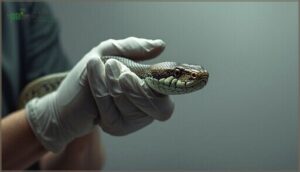
Once you’ve used snake hooks to line up the body, head work becomes fine control, not a power move. With venomous snakes, you aim to Minimize force while keeping a Stable Head Grip and solid Body Support using low-stress handling techniques and careful Reading Cues from their defensive postures:
- Use a Gentle Approach from mid-body toward the neck during snake handling.
- Form a Stable Head Grip just behind the occiput, fingers creating a tripod so the head can’t whip sideways while the neck stays straight and un-crushed, matching its spine alignment and letting you feel each breath and swallow for feedback.
- Keep the head level with or slightly below your heart, while other hands or handlers provide Body Support along the length so weight never hangs from the restrained head alone.
- Watch for Reading Cues like tight coiling, rigid “rope” muscle tension, or repeated pulling and gaping; these defensive postures mean “ease up now” if you want to Minimize panic and keep control.
- Treat this as a short, necessary hold—plan your handling techniques in advance, finish the task within minutes, then slowly soften your grip and let the snake flow back into normal movement to keep long-term stress low.
Moving Snakes Between Enclosures and Into Transport Containers

During Snake Transfer Methods, you work slowly, not timidly. Position the Transport Container close—one or two steps from the source cage—to shorten handling time.
Use snake hooks, protective gear, and Safe Relocation Techniques that prioritize Enclosure Security.
Guide venomous snakes forward, not upward, letting them move willingly into containment for low-stress, controlled Venomous Snake Handling.
Techniques for Cleaning and Maintenance Without Free-hand Contact

Routine cleaning is where your venomous snake safety habits either hold or crack. You avoid free-hand snake handling completely by combining Shift Box Workflow, Temporary Contain methods, and strict reptile handling and safety protocols backed by protective gear and snake hooks. Use Tool-Assisted Spotting to manage waste while the animal stays controlled and distant.
- Stage hooks, tongs, and containers before opening any door.
- Shift or temporarily contain the snake before deep cleans.
- Use long tools only: no fingers inside the working zone.
- Disinfect tools and wash hands between enclosures, every time.
Special Considerations for Young, Fast, or Arboreal Species

Unforgiving speed changes the rules with young, fast, or arboreal species. You treat juvenile venomous snakes as high-risk: their Juvenile Venom is built for small prey, but their defensive biting and tiny escape gaps demand tighter Arboreal Enclosures and strict species-specific considerations.
Use shorter hooks, Fast Snake Tubes, and controlled, low-angle handling techniques so arboreal species and other venomous snakes never share your airspace uncontained.
Emergency Response and Ongoing Skills Training

When a snakebite happens, every second counts, and panic helps no one. You need a clear plan, practiced steps, and steady coordination with others.
The points below walk you through what to prepare, how to respond, and how to keep your skills sharp long-term.
Building a Written Venomous Bite Response Protocol
When a venomous snake bite happens, seconds count. Your written bite response protocol defines Incident Triggers, outlines clear First Aid Steps, and guides smooth Hospital Coordination.
It also details Antivenom Management, chain-of-command, and documentation rules. A solid plan turns chaos into controlled snake bite management—saving lives through precise emergency response and first aid procedures.
Recognizing Early and Late Symptoms of Envenomation
You can’t control a bite, but you can recognize danger early. Watch how Venom Effects unfold—pain flares first, then swelling and reddening creep outward. Know these Envenomation Signs before Toxicity Levels rise:
- Rapid swelling or bruising
- Vision changes or muscle weakness
- Dizziness, nausea, or chest tightness
Swift Emergency Response and antivenom readiness save lives.
First Aid Priorities, Limb Positioning, and What to Avoid
Your Immediate Response sets the outcome. Call emergency services, stay still, and remove jewelry before swelling locks it on.
For Pressure Bandaging with neurotoxic species, wrap firm from the bite upward — Limb Immobilization matters. Ideal Positioning keeps the limb near heart level.
Avoid Errors that cost you: no tourniquets, no cutting, no ice. Smart first aid and antivenom access define venomous snake safety.
Coordinating With Hospitals and Antivenom-capable Facilities
Speed and calm buy time, but coordination saves lives. Keeping a direct line to hospitals that follow Antivenom Protocols strengthens your Emergency Planning. Update your Hospital Networking plan yearly and share your Venomous Species sheet with ER contacts. Reliable Medical Collaboration enables real Snakebite Management through:
- Confirmed antivenom stock.
- Poison center coordination.
- Shared Venom Toxinology updates.
Conducting Regular Emergency Drills With Team Members
Good coordination only matters if your team can act on it. That’s where regular Emergency Response drills come in.
Schedule realistic Simulation Training three or four times a year to test Team Communication, Snake Safety Protocols, and First Aid response.
Treat each rehearsal seriously, document timing, adjust Emergency protocols, and hold an honest Incident Review afterward.
Finding Accredited Venomous Handling Courses and Certifications
Once your team drills run smoothly, it’s time to formalize your skills. Enroll in an accredited Level 1 Venomous Handling Certification Course through a recognized Venomous Snake Training Program.
Check Course Accreditation and Instructor Qualifications, review Training Formats, and weigh Certification Benefits through honest Program Evaluations.
Proper Venomous Reptile Training builds confidence—and proves competence in Reptile Handling and Safety.
Mentorship, Supervised Practice, and Periodic Skills Refreshers
Once you’ve got that certificate, you’re not done—you’re ready for Mentor Guidance. Under Supervised Training, Qualified Mentors keep you on safe Snake Handling Techniques, often pairing you one-on-one and logging specific Handling Procedures and Emergency Drills for Venomous Snake Safety and Skill Assessment. Refresher Courses keep your reactions sharp when it actually counts.
- Train under a named mentor before any solo Expert Venomous Snake Handling.
- Practice repeatedly on defined tasks until mentors sign off your competence.
- Schedule yearly Refresher Courses and Emergency Drills to prevent skill fade.
Incident Reviews and Continuously Improving Safety Procedures
Reflection keeps you alive. After every bite, near-miss, or shaky Emergency Response and First Aid, you log detailed Incident Reporting, then run structured Root Cause Analysis with your team to separate human error, weak Snake Handling Techniques, and gaps in Safety Protocols.
Those findings feed new drills, tighter Emergency Preparedness for Snake Bites, and Continuous Improvement in overall Venomous Snake Safety and Reptile Handling and Safety.
Frequently Asked Questions (FAQs)
How much do venomous snake handlers make?
Handler income for venomous snake handling covers Salary Ranges: USD 30,000–40,000 in snake handling or Wildlife Removal with venomous snakes, up to USD 80,000–100,000+ in Venom Extraction, Snake Milking, and specialized herpetology supporting wildlife conservation.
How do people handle venomous snakes?
Safe venomous snake handling appears oddly calm and choreographed. You read Snake Behavior, recognize defensive postures, and employ hooks and tubes as core Handling Techniques.
Strict Safety Protocols, coupled with drilled Emergency Response for any snake bite and severe Venom Effects, ensure the rest.
What does the Bible say about handling snakes?
The Bible links snake symbolism with temptation, judgment, and God’s protection, but it doesn’t command ritual Biblical Snake Handling as a Religious Practice. Christian Faith teaching treats Paul’s viper event and Mark 16 as rare signs, not a safety guarantee for deliberate snake handling with venomous snakes or reckless tests of Spiritual Safety.
Instead, Scripture warns about hidden danger, deceptive voices, and presumption, so you respect real snake behavior, defensive postures, and the reality of snake bite risk rather than treating venomous snakes as proof props of belief.
Can you build up a tolerance to snake bites?
Like chasing fire with bare hands, building true venom resistance doesn’t work. Your immune system might recognize small venom doses, but tolerance limits stay unpredictable.
Every snake bite needs urgent hospital care and proven antivenom effectiveness.
How can stress or fear affect handling safety?
Stress or fear quietly strips away safety in venomous snake handling. Physiological stress shakes your grip, slows fine motor control, and narrows attention, so you miss stress signals, defensive postures, and escape paths, undermining Safety Protocols, Handling Techniques, and Risk Perception.
What are signs a snake may soon strike?
A coiled body, S-shaped neck, and locked gaze are clear strike warnings. Tail vibrations, defensive posture, and tense muscles signal aggression. Read that snake body language fast — hesitation costs you.
How do handlers safely photograph venomous snakes?
A coiled viper under your lens should feel like a loaded firearm: you respect distance, plan every step, and never relax.
Handlers rely on telephoto Photo Equipment, strict Camera Safety, constant Snake Behavior checks, clear communication, and disciplined venomous snake handling Techniques during Venomous Encounters and reptile handling sessions to keep venomous reptile safety and handling fully under control.
What routines help maintain calm during handling sessions?
You maintain calm through deliberate Mental Preparation, slow Breathing Techniques, and a structured Room Setup.
Consistent Handling Sequences and practiced Emergency Planning anchor focus, keeping defensive postures and snake behavior predictable for safe snake handling practices.
How should venomous snakes be transported between facilities?
Sooner or later, Snake Transport tests every system you’ve built for venomous reptile safety and handling. You use Secure Containers only: escape‑proof buckets or boxes, dark bags, clear tubes, tight lids, and bold Venomous Shipping labels that meet Transport Regulations, while temperature, ventilation, handling environment, and species-specific considerations stay under your direct Safe Handling control for truly safe transportation of venomous snakes and compliant venomous snake handling between facilities.
Conclusion
Of course, you could skip training and trust your reflexes—nature loves that kind of arrogance. Real control comes from quiet rooms, written protocols, and boring repetition.
Every checklist, drill, and deliberate hook movement buys you more margin. You’re not chasing adrenaline; you’re engineering predictability around an unpredictable animal.
Treat learning to handle venomous snakes properly as a lifelong, methodical craft. When the cage finally swings open, your preparation should speak louder than your pulse alone.
- https://www.riversidereptileseducationcenter.com/venomoushandlingcourse
- https://www.savethebuzztails.org/training
- https://www.medicalalgorithms.com/personal-protective-equipment-ppe-for-venomous-snakes
- https://pmc.ncbi.nlm.nih.gov/articles/PMC6073535/
- https://verwaltungsportal.hessen.de/en/leistung?leistung_id=L100001_8981580®schl=064370005005