This site is supported by our readers. We may earn a commission, at no cost to you, if you purchase through links.
A snake that won’t shed cleanly is telling you something important. That dull, patchy skin and those stubborn eye caps aren’t random—they’re a direct response to the environment you’ve built.
Low humidity shedding problems rank among the most preventable health issues in captive snakes, yet they’re also one of the most common reasons keepers end up at the vet.
The old skin needs moisture to separate cleanly from the new layer beneath it, and when your enclosure runs dry, that process breaks down fast.
Getting humidity right isn’t complicated, but it does require knowing exactly where things go wrong—and how to fix them.
Table Of Contents
- Key Takeaways
- Causes of Low Humidity Shedding Problems
- Recognizing Shedding Issues From Low Humidity
- Optimizing Enclosure Humidity for Healthy Shedding
- Hydration and Nutrition for Shedding Success
- Step-by-Step Solutions for Shedding Problems
- When to Seek Veterinary Care for Shedding Issues
- Frequently Asked Questions (FAQs)
- Conclusion
Key Takeaways
- Humidity dropping below 35% breaks the bond between old and new skin, making clean shedding nearly impossible—and common culprits like screen-top enclosures, dry indoor heating, and cheap hygrometers (which can read 20 points off) quietly drain moisture before you notice a problem.
- Retained eye caps and tail tip shed are your most urgent warning signs, since stuck eye scales can cause permanent corneal damage and constricted tail shed cuts off circulation, eventually leading to tissue death.
- Coconut coir layered 5–10 cm deep, a snug opaque humid hide packed with damp sphagnum moss, and timed misting twice daily form the most reliable combination for maintaining species‑correct humidity between 50–80 % through a shed cycle.
- When home fixes—warm soaks, humidity chambers, corrected substrate—don’t resolve the problem across two or more shed cycles, a reptile vet visit isn’t optional; chronic dysecdysis often signals parasites, infection, nutritional deficiency, or an underlying illness that humidity alone can’t fix.
Causes of Low Humidity Shedding Problems
Low humidity is one of the most common — and most fixable — reasons snakes struggle to shed cleanly.
Most snakes do best around 50–70% humidity, though checking species-specific humidity needs for clean shedding can help you dial in the right range for your snake.
Several factors can quietly work against your enclosure’s moisture levels before you even notice a problem.
Here’s what’s usually behind it.
How Humidity Affects The Shedding Process
Think of shedding like peeling a sticker — moisture is what loosens the bond. When humidity drops below 35%, the interface between old and new skin dries out, making clean separation nearly impossible. This natural process, known as snake skin shedding, is essential for growth and removing parasites.
- Scale Hydration Mechanics — moisture hydrates basal cells so scales lift outward cleanly
- Eye Cap Moisture — levels between 50–70% prevent spectacles from sticking to corneas
- Tail Tip Dryness — below 50%, thin tail skin retains shed longest, risking circulation loss
- Hormonal Trigger Interaction — adequate moisture lets hormonal signals work effectively to initiate ecdysis
Environmental Factors Contributing to Low Humidity
Your enclosure doesn’t exist in isolation — the room around it shapes moisture levels more than most keepers realize. Dry indoor heating, poor Substrate Water Retention, and Ventilation Design flaws all drain humidity fast.
Here’s what’s working against you:
| Environmental Factor | Effect on Humidity |
|---|---|
| Room Air Dryness (winter heating) | Drops ambient humidity below 30% |
| Screen-top Ventilation Design | Humidity falls within hours of misting |
| Heat Source Placement near substrate | Accelerates evaporation from water bowls |
| Non-absorbent substrate materials | Eliminates moisture buffering between mistings |
Consider adding misting systems to boost enclosure humidity.
Common Mistakes in Humidity Management
Even when you fix the room environment, humidity management can still go sideways. These mistakes catch keepers off guard:
- Miscalibrated hygrometers give false readings — cheap dial gauges can be off by 20 points.
- Excessive misting spikes moisture for 20 minutes, then drops low again.
- Improper hide placement on the warm side makes snakes avoid the humidity box entirely.
Inconsistent routine timing and ignoring substrate moisture make all three worse.
Recognizing Shedding Issues From Low Humidity
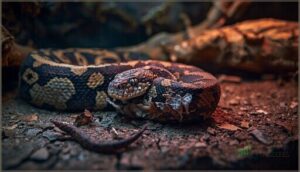
Low humidity doesn’t always announce itself loudly — sometimes your snake is already struggling before you notice anything’s wrong.
Knowing what to look for makes all the difference between catching a problem early and dealing with something much harder to fix.
A solid Mandarin rat snake care guide walks you through the subtle warning signs that are easy to miss if you don’t know what’s normal.
Here are the key signs that low humidity is affecting your snake’s shed.
Signs of Incomplete or Patchy Sheds
A clean shed should come off in one long, inside-out tube.
When humidity runs low, you get patchy shedding instead — random dull patches, texture roughness across the midbody, and retained scale rings that circle the tail like tight bracelets.
Constriction bands and limb joint patches are red flags.
Patchy coloration where old skin overlaps new scales is your clearest early warning sign.
Retained Eye Caps and Tail Tips
Retained eye caps and tail tips are two of the most serious warning signs of dysecdysis.
Low humidity causes the spectacle — the clear eye scale — to dry and stick, leading to vision impairment and corneal damage if layers build up.
Meanwhile, retained shed on the tail tip tightens like a tourniquet, causing blood flow restriction and eventual tail tip necrosis.
Retained shed on a snake’s tail tip tightens like a tourniquet, cutting off circulation until necrosis sets in
Parasite interference can worsen both issues.
Behavioral Changes Linked to Shedding Problems
Your snake’s behavior often speaks before its skin does. During a troubled shedding cycle, watch for these stress-driven changes:
- Increased Hiding — spending hours pressed into the tightest hide, barely moving
- Reduced Appetite — skipping meals even when temps and prey are normal
- Irritability and Restless Rubbing — striking at hands, or frantically scraping against décor to loosen retained shed
Lethargic Behavior alongside retained eye caps warrants a reptile veterinarian visit.
Optimizing Enclosure Humidity for Healthy Shedding

Getting humidity right is less about luck and more about knowing your snake’s specific needs.
Once you understand the baseline, the right tools and setup choices make all the difference.
Here’s what to focus on when building an enclosure that facilitates a clean, healthy shed.
Ideal Humidity Levels by Snake Species
Ball pythons need 55–65% daily, spiking to 80%+ during a shed cycle.
Corn snakes do well at 65–75%, while kingsnakes and milk snakes prefer a drier 40–60%. Boa constrictors land in the middle at 55–75%.
Nail these species‑specific ranges with a reliable hygrometer, and you’re already ahead of most shedding problems.
Using Substrates Like Coconut Coir
Coconut coir is one of the hardest‑working tools in humidity control for snakes prone to incomplete sheds. Its substrate moisture retention comes from a fibrous structure that releases water slowly, maintaining stable moisture levels without soaking the enclosure floor.
Here’s how to use it effectively:
- Coir Preparation Techniques: Soak compressed bricks in warm water, then wring until damp — not muddy.
- Mixing Ratios: Blend 3 parts coir to 1 part bark chips to fine‑tune surface dryness.
- Depth Matters: Layer 5–10 cm deep so snakes can burrow into a humid microclimate during the reptile shedding process.
- Cleaning and Replacement: Spot‑clean daily; do a full swap every 4–6 weeks to prevent bacterial buildup under warm environmental conditions.
- Safety and Toxicity: Coir is non‑toxic and soft — reducing belly abrasions — but feed snakes separately to avoid accidental ingestion.
Misting, Humidifiers, and Water Bowls
Three tools do the heavy lifting for humidity control: misting, humidifiers, and water bowls. For mist timing, aim for once or twice daily — more during a shed cycle, targeting 70–80%. Focus mist distribution techniques on walls and décor, not the snake directly.
Pair any misting system or humidifier placement setup with a hygrometer to track moisture levels accurately. A water bowl size large enough for soaking adds steady passive humidity, too.
Hide Design for Moisture Retention
Your humid hide’s design matters more than most keepers realize.
For material porosity, choose opaque plastic or smooth resin — porous wood wicks moisture away fast.
Keep the entrance placement small and away from vents for better ventilation control.
Pack it with wrung-out sphagnum moss for lasting substrate moisture.
A snug hide shape maximizes skin contact, making every shed cleaner.
Hydration and Nutrition for Shedding Success
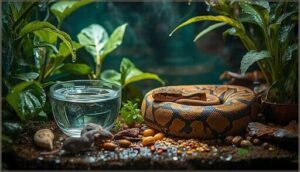
Humidity isn’t the only thing standing between your snake and a clean shed — what’s happening inside their body matters just as much. Proper hydration and a nutrient-rich diet directly affect how well their skin loosens and releases.
support healthy shedding from the inside out.
Importance of Proper Hydration
Keeping your snake properly hydrated is just as critical as managing humidity levels. Water maintains skin elasticity, aids kidney function, and promotes healthy blood circulation — all essential for clean skin shedding. During pre‑shed, snakes may soak up to 18 hours to soften the old layer.
- Prevents retained eye caps and tail tip sticking
- Aids kidney function and uric acid filtration
- Maintains blood circulation to developing skin layers
- Provides digestive support during the shedding cycle
- Speeds up post‑shed recovery and next feeding readiness
Impact of Diet on Skin Health
What your snake eats directly shapes how well it sheds. Whole prey enhances protein quality, delivers essential fatty acids, and keeps skin flexible enough to peel cleanly.
Poor prey variety or inconsistent feeding frequency leaves skin thin and prone to retained skin patches.
Balanced nutrition and diet — matched to your snake’s species and size — enhances metabolic health and reliable, complete sheds.
Addressing Vitamin and Mineral Deficiencies
Nutrition and diet gaps go deeper than just prey type. Low vitamin A is one of the sneakiest causes of repeated shedding issues — it thickens skin and causes dull, incomplete sheds.
A poor calcium-phosphorus ratio stresses the body over time and can progress toward metabolic bone disease. Improving dietary prey variety fixes most mild deficiencies, while vitamin A supplementation and careful supplement dosing, help correct what food alone can’t rebuild.
Step-by-Step Solutions for Shedding Problems
Once you’ve spotted a shedding problem, the next move is fixing it — and the good news is most cases respond well to hands‑on intervention.
Knowing what to do, in what order, makes all the difference between a quick fix and a worsening situation.
Here’s what to work through when your snake’s shed isn’t going as it should.
Safe Removal of Retained Shed
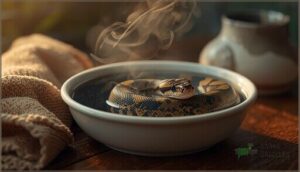
Retained skin won’t budge on its own — it needs moisture and patience. Start with gentle soaking in lukewarm water (28–30°C) for 20–60 minutes, keeping depth shallow so your snake stays comfortable.
After soaking, use damp textiles to wipe from head to tail, following scale direction.
For eye caps, humidity control often resolves them naturally.
Friction techniques should stay gentle — if anything resists, stop.
Persistent retained skin or eye caps mean it’s time to call a reptile veterinarian.
Creating Temporary Humidity Chambers
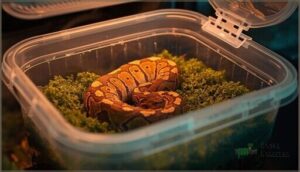
Building a humidity box takes about five minutes and can save you a frustrating retained skin battle later.
Here’s what you need:
- Container Materials: Use a food-safe polypropylene tub — opaque, snug-fitting, with a snap lid
- Ventilation Holes: Drill small, smooth-edged holes so air circulates without humidity crashing
- Substrate Options: Damp sphagnum moss or coconut fiber, moist but never dripping
- Placement Strategies: Set the humid hide inside the main enclosure so your snake enters voluntarily
- Hygiene Protocols: Disinfect between every use — warm, damp spaces breed bacteria fast
When to Increase Humidity Interventions

Timing matters as much as technique. Start increasing humidity levels the moment you notice blue eye onset or scale separation cues — don’t wait for a stuck shed. Seasonal humidity shifts catch many keepers off guard, so watch your hygrometer closely year‑round. Temperature‑humidity interplay is real: warmer enclosures dry out faster. Behavioral moisture seeking — like excessive soaking — means your humid hide and moisture sprays are overdue.
| Trigger Sign | Recommended Action | Target Humidity |
|---|---|---|
| Blue eye onset | Add humid hide immediately | 70% (ball pythons) |
| Scale separation cues | Increase moisture sprays | 60–70% |
| Behavioral moisture seeking | Check hygrometer, mist enclosure | Species baseline +20% |
| Patchy retained shed | Build humidity chamber | 75–80% |
| Seasonal humidity shifts | Adjust substrate moisture weekly | Maintain species threshold |
When to Seek Veterinary Care for Shedding Issues
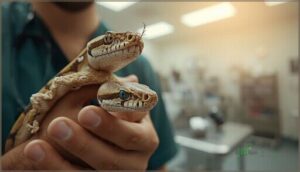
Home care fixes most shedding problems, but sometimes your snake needs more than a humidity boost and a warm soak.
If you’re doing everything right and things still aren’t improving, that’s your cue to call a vet. Watch for these three situations where professional care becomes necessary.
Persistent Retained Skin or Eye Caps
Some problems don’t fix themselves — and with retained skin or retained eye caps, waiting too long makes everything worse.
Dysecdysis that persists across multiple molt cycles signals something deeper than a humidity dip.
Call your vet when you notice:
- Stacked retained eye caps causing hazy, frosted vision
- tight shed bands restricting tail tip circulation
- Recurring retained skin despite corrected humidity levels
Signs of Infection or Skin Damage
Infected skin doesn’t whisper — it shouts. Red swelling, blister formation, and discolored patches around old shed lines are your clearest warning signs that shedding complications have crossed into infectious diseases territory.
| Warning Sign | What It Means | Urgency |
|---|---|---|
| Lesion ulceration | Bacteria entered damaged skin | High |
| Painful behavior | Skin health severely compromised | High |
| Retained eye caps with redness | Dermatological issues deepening | Immediate |
Shedding Problems Unresponsive to Home Care
Sometimes, humidity control just isn’t the whole story. If you’ve done everything right and your snake still can’t shed cleanly, a deeper problem may be driving chronic dysecdysis.
- Two or more consecutive abnormal sheds despite corrected environmental conditions
- Retained eye caps that won’t release after soaking
- Suspected parasite infections or skin infections
- Declining appetite or activity alongside shedding issues
- Underlying illnesses affecting circulation or immunity
Frequently Asked Questions (FAQs)
Can shedding problems affect a snakes lifespan?
Yes, shedding problems can genuinely cut a snake’s life short. Tail necrosis, chronic infection, and vision loss from poor sheds can reduce a lifespan from 25 years down to 10–
Do seasonal changes impact shedding frequency?
Absolutely — seasonal changes can flip your snake’s shedding schedule upside down.
Light cycle effects, brumation influence, hormonal cycles, temperature gradients, and shifting humidity levels all interact to speed up or stall sheds throughout the year.
How does stress influence the shedding cycle?
Chronic stress raises corticosterone levels, triggering metabolic delay that slows skin renewal.
Behavioral avoidance of humid hides, combined with hormone impact on immune suppression, makes clean shedding nearly impossible — especially when temperature instability is already present.
Can medications interfere with normal shedding patterns?
Medications can absolutely interfere with normal shedding patterns.
Antibiotics, painkillers, antiparasitics, and hormonal therapies all risk shedding complications — making veterinary care and reptile veterinarian oversight essential when your snake is undergoing any treatment.
Does age affect how often snakes shed?
Age absolutely shapes juvenile shedding frequency versus adult shedding intervals. Young snakes shed every 2–4 weeks; adults slow to every 1–3 months as growth-age correlation declines naturally with maturity.
Conclusion
What if every difficult shed your snake experiences is just a gap in your setup waiting to be closed? Low humidity shedding problems don’t appear out of nowhere—they build quietly through small oversights in substrate choice, enclosure design, and hydration.
Now you have the tools to spot the warning signs early, correct the environment before damage occurs, and step in safely when a shed goes wrong. Your snake’s next clean shed starts with the adjustments you make today.
- https://petexpertise.com/blogs/news/dry-skin-shedding-and-collagen-solving-seasonal-skin-issues-with-chews-3
- https://www.northrich.com/post/why-proper-humidity-levels-matter-for-your-health-home-and-pets
- https://paw-swing.com/blogs/cat-health-grooming/indoor-cats-shedding-photoperiod-humidity-hvac-guide
- https://companion-animals.extension.org/shedding-management-for-companion-reptiles/
- https://www.petmd.com/reptile/conditions/skin/dysecdysis-reptiles