This site is supported by our readers. We may earn a commission, at no cost to you, if you purchase through links.
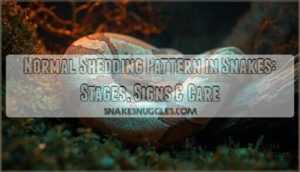
Most snake owners see shed skin on the enclosure floor and feel a quiet relief—proof that everything’s working. What they don’t realize is that the process began weeks earlier, set in motion by a hormonal cascade invisible to the naked eye.
Ecdysis, the complete replacement of a snake’s outer epidermal layer, isn’t just growth—it strips parasites, resets body scent, and clears the spectacle covering each eye.
Understanding the normal shedding pattern in snakes means reading signals most keepers miss until something goes wrong. Get it right, and every shed becomes a report card on your husbandry.
Table Of Contents
- Key Takeaways
- What is The Normal Shedding Pattern in Snakes?
- Stages of The Shedding Cycle
- Shedding Frequency in Healthy Snakes
- Signs of a Healthy Shedding Process
- Environmental Factors Affecting Shedding
- Nutritional Needs for Proper Shedding
- Common Shedding Issues and Their Causes
- Best Practices for Supporting Shedding Snakes
- Frequently Asked Questions (FAQs)
- Conclusion
Key Takeaways
- Shedding isn’t just skin-deep — it’s a full biological reset that strips parasites, clears eye caps, and resets your snake’s scent, all triggered by a hormonal cascade that starts weeks before you see any visible sign.
- Humidity between 60–80% is the single biggest factor separating a clean, complete shed from a stuck, problematic one — drop below 50% and the fluid layer separating old from new skin simply can’t do its job.
- Your snake’s behavior is a reliable early warning system: hiding more, refusing food, and cloudy blue eyes aren’t problems to solve — they’re normal pre-shed signals telling you to back off and optimize the enclosure, not handle it.
- Shedding frequency naturally drops as snakes age — juveniles may shed every two to six weeks while adults settle into two to six times yearly — so a slowdown isn’t a red flag, it’s just biology keeping pace with a slower growth rate.
What is The Normal Shedding Pattern in Snakes?
Every snake keeper needs to understand one fundamental process: ecdysis, the biological mechanism behind skin shedding. It’s not random — it’s a precisely timed cycle driven by growth, hormonal shifts, and your snake’s overall health.
Snakes often soak more frequently during this cycle, and understanding why snakes soak in water bowls can tell you a lot about where they are in the shedding process.
Here’s what’s actually happening inside your snake’s body, and why it matters for how you care for them.
Definition of Ecdysis
Ecdysis — the technical term for your snake’s shedding process — is a complete epidermal renewal event, not just casual skin flaking. Hormonal triggers signal the stratum germinativum to generate fresh tissue, while lymphatic fluid infiltrates between old and new layers, enabling clean scale separation. Even the spectacle shedding. This isn’t cosmetic; it’s fundamental snake health.
- Ecdysis replaces the entire outer keratin layer in one continuous piece
- Hormonal triggers initiate the cycle before any visible signs appear
- Lymphatic fluid dissolves enzymatic bonds between old and new epidermis
- Spectacle shedding clears the eye caps alongside body scales
- Successful epidermal renewal confirms your reptile care environment is working
Snakes shed to accommodate growth in snakes([https://www.livescience.com/animals/snakes/why-do-snakes-shed-their-skin), creating space for their expanding bodies.
Why Snakes Shed Their Skin
So why does your snake go through this? Growth is the obvious answer — unlike mammals, snake skin doesn’t stretch.
But ecdysis also delivers Sensory Renewal, clearing eye caps and heat pits for sharper perception. It manages Parasite Removal, stripping mites and ticks with the old layer. It’s a Camouflage Refresh, a Healing Benefit, and a full reset — driven entirely by Hormonal Regulation.
The the ecdysis process is essential for growth and health.
Biological Purpose of Shedding
Each shed provides a precise biological purpose — not just one, but five distinct functions working together:
- Skin Renewal — replaces the full outer epidermal layer, restoring your snake’s protective barrier
- Parasite Removal — strips mites and ticks clinging between scales
- Sensory Maintenance — clears clouded eye caps for sharp vision
- Chemical Crypsis — resets body scent, improving camouflage from predators
- Growth Accommodation — allows the body to expand without restriction
That’s reptile biology doing exactly what it’s designed to do.
Stages of The Shedding Cycle
Shedding doesn’t happen all at once — your snake moves through a series of distinct biological stages before that old skin finally comes off.
Each stage gives you clear signals about where your snake is in the process and what it needs from you right now.
Here’s what’s actually happening, step by step.
Hormonal Triggers and Skin Separation

Everything starts deep inside snake’s endocrine system. Thyroid Signaling from the pituitary‑thyroid axis launches the shedding cycle, triggering a Growth Hormone Surge that tells the body the current skin is too tight. From there, Enzymatic Fluid Release separates old from new skin at the cellular level.
Seasonal Hormone Shifts and Stress‑Induced Hormonal Suppression can accelerate or stall this ecdysis process entirely — directly impacting reptile health and skin renewal.
Blue Phase and Opacity
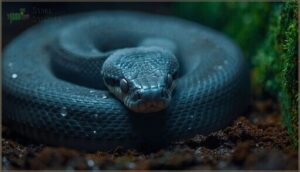
The first visible proof that ecdysis is underway is the blue phase. Lymphatic fluid pools beneath the old skin, including under each eye spectacle — turning those normally sharp eyes a cloudy grey‑blue. Your snake isn’t ill; it’s mid‑cycle.
During this blue phase, your snake may also go off food and hide more than usual — all perfectly normal behavior you can read about in detail in this milk snake shedding and feeding cycle guide.
Watch for these blue phase signals:
- Eyes shift from clear to milky
- Body colors look dull, almost dusty
- Activity drops noticeably
- Feeding interest fades
- Defensive behavior increases
Humidity management — keeping levels between 60–80% — and appropriate substrate roughness are your two best tools for supporting smooth skin renewal here.
Sloughing and Post-Shed Appearance
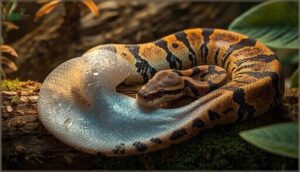
Once the blue clears, sloughing kicks off fast — often wrapping up within 30 to 60 minutes.
Your snake pushes against décor, peeling old skin from nose to tail like a sock turning inside out.
A complete shed skin signals successful ecdysis: look for shed skin integrity, eye cap clarity, and color brightness on the new scales — glossiness included.
Shedding Frequency in Healthy Snakes
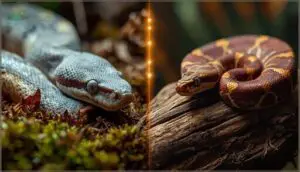
How often your snake sheds depends on few key factors — species, age, and how fast it’s growing. A juvenile ball python and an adult corn snake are on completely different schedules, and that’s perfectly normal.
Here’s what you can expect across different species and life stages.
Species and Growth Rate Differences
Not all snakes follow the same shedding cycle — and that difference starts with age and species. Juvenile vs adult shedding patterns diverge sharply: young snakes shed far more often because rapid animal growth demands it.
Colubrid shedding frequency often outpace python growth patterns, since colubrids stay more active early on. Size-dependent molting is real — bigger, slower‑growing snakes simply need fewer molts for reptile care and snake health.
Typical Shedding Timelines
Timing the shedding cycle isn’t guesswork — it’s biology running a tight schedule. A healthy adult completes ecdysis every 4–8 weeks; juveniles push faster. Watch for Pre-shed Dullness, then the Opaque Eye Phase, then Eye Clearing Period before sloughing begins.
- Hatchling Shedding Schedule: first shed within 8–11 days post-birth
- First Postnatal Shed triggers chemical crypsis for survival
- Full shedding process spans 10–14 days
- Stable humidity levels (60–80%) and temperature prevent delays
Signs of a Healthy Shedding Process
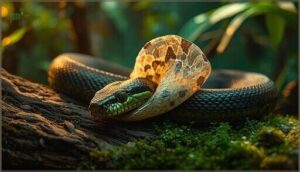
Knowing what a healthy shed looks like makes all the difference between confident keeping and unnecessary panic.
Your snake’s body sends clear signals throughout the process — if you know what to watch for, you’ll catch problems early.
Here’s what normal actually looks like, from first behavioral shifts to that final, clean reveal.
Behavioral Changes Before Shedding
Your snake is telling you something — you just have to read the signals.
Days before shedding begins, behavior shifts noticeably. Increased hiding, appetite suppression, reduced activity, and heightened irritability are all textbook pre‑shed indicators tied to animal behavior and psychology. Humidity seeking — soaking, burrowing — also spikes as ecdysis approaches.
| Behavior | Timing | What It Means |
|---|---|---|
| Increased hiding | 1–2 weeks prior | Vision impairment, vulnerability |
| Appetite suppression | Up to 2 weeks | Energy redirected to skin renewal |
| Heightened irritability | 7–15 days | Discomfort, poor eyesight |
| Humidity seeking | 3–7 days pre-slough | Loosening old skin layers |
Visual Indicators of Normal Shedding
Your snake’s body is a progress report — learn to read it. Dull skin and Blue Eye Opacity mark the early shedding cycle, while Skin Wrinkles signal proper layer separation. Watch for these visual cues in sequence:
- Dull skin: matte, faded coloration with a rough texture
- Blue Eye Opacity: milky, clouded pupils lasting 3–7 days
- Clearing Eyes: sharp clarity returning, sloughing imminent
Reptile care starts with observation.
Complete Vs. Incomplete Sheds
Once your snake’s eyes are clear, the shed itself tells the story. Complete shed — nose to tail, eye caps intact — signals strong scale integrity and healthy ecdysis.
An incomplete shed, or dysecdysis, means the humidity thresholds likely dropped below 60%. Retained eye caps and stuck shed patches are your primary shedding diagnostics. Post-shed health checks confirm everything came off cleanly.
Environmental Factors Affecting Shedding

Your enclosure setup matters more than most keepers realize — especially when your snake is mid-shed.
The difference between a clean, complete shed and a frustrating stuck shed often comes down to three environmental factors you can control.
Here’s what to focus on.
Importance of Humidity Levels
Humidity is the single variable most likely to make or break your snake’s shedding process. During ecdysis, that moisture softens the keratin layer, letting old skin peel cleanly away. Drop below 40%, and you’re looking at stuck shed, eye cap retention, and potential circulation problems. Species-specific needs matter here — ball pythons need 70% during shedding; corn snakes shed cleanly around 55–60%.
Humidity determines every shed: drop below 40% and stuck skin, retained eye caps, and circulation damage follow
- Humidity Benefits: Facilitates lymph fluid buildup between skin layers for clean separation
- Stuck Shed Prevention: Keep levels above 50% to avoid retained patches on snout and eyes
- Eye Cap Retention: Boosting to 70–80% resolves most retained caps naturally
- Hydration Support: Humid air prevents dehydration, directly supporting snake health throughout ecdysis
Temperature and Lighting Requirements
Beyond moisture, heavy lifting does the heavy lifting in ecdysis. Your basking zone temps should hit 88–92°F — that heat drives the enzyme activity separating old skin from new.
Keep the cool side range at 75–80°F so your snake can thermoregulate freely.
Nighttime temp drops of 5–10°F mirror natural cycles.
A consistent photoperiod cycle and optional UVB light dose further stabilize shedding hormones.
Enclosure Setup for Optimal Shedding
Get the enclosure itself right, and everything else falls into place. Match your vivarium’s length to your snake’s full body length — cramped spaces cause stress, and stress causes shedding problems.
Place a moist hide on the warm side, packed with damp sphagnum moss, for skin loosening.
Substrate moisture retention, ventilation flow, and hide diversity round out a setup that makes clean ecdysis almost automatic.
Nutritional Needs for Proper Shedding

What your snake eats — and drinks — plays a bigger role in shedding than most keepers realize.
Hydration, calcium levels, and overall diet quality all influence how cleanly and completely a shed comes off.
Here’s what to keep in mind nutritionally.
Role of Hydration
Water is the engine behind ecdysis. During shedding, your snake relies on lymph fluid production — enzymes dissolved in that fluid literally dissolve the bond between old and new skin.
Dehydration cuts that supply short. Watch for dehydration indicators like wrinkled skin or dented eye caps.
Boost humidity levels to 60–80%, encourage soaking behavior, and always provide fresh water.
Importance of Calcium and Vitamins
snake’s entire shedding process from the inside out. Deficiencies don’t announce themselves — they show up as stuck shed, retained eye caps, and weakened scales.
- Maintain a 2:1 Calcium‑Phosphorus Ratio for Bone Metabolism Support
- Dust prey with D3‑Enhanced Absorption calcium every other feeding
- Address Calcium Deficiency before it causes tremors or incomplete sheds
- Use Vitamin A Supplementation — retinol form, not beta‑carotene
- Prioritize Skin Health Nutrition through consistent Reptile Care routines
Balanced Diet Recommendations
Think of your snake’s diet as the scaffolding behind every clean shed. Match prey size to your snake’s widest girth, feed juveniles every 5–7 days, adults every 14–21 days.
Rotate between mice, rats, and quail for nutrient variety. Frozen-thawed prey eliminates parasites. Gut-load feeder insects with collard greens to boost calcium transfer — because calcium deficiency quietly destroys skin integrity before you notice.
Common Shedding Issues and Their Causes
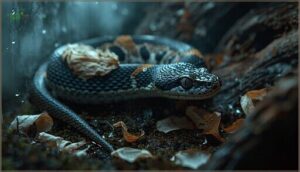
Even with the best husbandry, shedding problems still happen — and when they do, the cause is almost always environmental. Two issues come up more than any others: stuck shed and retained eye caps.
Here’s what drives them and what you can do about it.
Stuck Shed and Retained Eye Caps
Stuck shed — also called dysecdysis — happens when patches of old skin cling instead of releasing cleanly.
Retained eye caps are the most serious version: layers accumulate, pressing against the cornea and eventually causing permanent damage.
Your first move is a 20–30‑minute lukewarm soak.
Skin moisture management and consistent humidity between 60–80% make veterinary intervention largely unnecessary — but if caps remain, don’t wait.
Causes of Incomplete or Problematic Sheds
Almost every case of dysecdysis — stuck shed, retained eye caps, partial sheds — traces back to something environmental.
Low humidity is the top culprit: drop below 50% and the fluid layer separating old from new skin simply dries out.
Temperature fluctuations disrupt metabolic timing.
Nutritional deficiencies weaken skin integrity.
Skin infections thicken keratin layers.
Chronic stress suppresses the hormonal triggers that start the whole process.
Best Practices for Supporting Shedding Snakes

Supporting a shedding snake comes down to a few straightforward adjustments — small changes that make a big difference.
Most problems are husbandry problems, and most solutions are husbandry solutions.
Here’s what you should focus on during the shedding cycle.
Adjusting Husbandry During Shedding
Your enclosure becomes mission-critical the moment the shedding cycle begins. Small husbandry tweaks make the difference between a clean shed and a frustrating stuck situation.
- Substrate Swap – Switch to cypress mulch or coconut husk for better moisture retention.
- Humidity Levels – Raise to 60–70% or 70–80% for tropical species.
- Water Bowl Size – Upgrade to one large enough for full-body soaking.
- Mite Prevention – Refresh humid hides every 2–3 days to block mold and parasites.
Stress reduction and seasonal lighting adjustments round out solid reptile care husbandry.
When to Avoid Handling
Once husbandry is dialed in, your hands stay out of the enclosure. Blue Phase Vision impairment alone is reason enough — your snake literally can’t see you coming.
| Phase | Avoid Handling Because |
|---|---|
| Blue Phase | Vision impaired; startle bites likely |
| Active Sloughing | Tears shed; causes stuck shed |
| Post‑Feeding Recovery | Triggers regurgitation; stresses digestion |
| Stress Indicators Present | Escalates dysecdysis; worsens snake health |
When to Seek Veterinary Help
Keeping your hands out helps — but sometimes hands-off isn’t enough. If retained eye caps remain after a warm soak, call your vet.
Three or more repeated incomplete sheds signal dysecdysis beyond basic reptile care fixes.
Watch for post-shed infection signs: redness, blackened tail tips, or discharge. Persistent lethargy past seven days or prolonged appetite loss after shedding? That’s a snake health emergency, not a wait-and-see situation.
Frequently Asked Questions (FAQs)
What does a healthy snake shed look like?
A perfect shed emerges like a ghost of the snake itself — intact single piece, translucent dull texture, uniform scale imprint, length matches snake precisely.
Post shed skin gleams healthy, confirming successful ecdysis.
Can shedding snakes coexist safely with tank mates?
Short answer: no. A shedding pet snake is blue-phase vulnerable, irritable, and nearly blind — tank-mate aggression spikes fast. Separate housing is always the safest call for reptile health and wellness.
Does shedding frequency decrease as snakes age?
Yes — shedding frequency decreases as snakes age. Growth rate decline and metabolic slowdown mean adult snakes shed 2–6 times yearly, while young snakes may shed every 2–6 weeks.
How does brumation affect a snakes shedding cycle?
Brumation slows your snake’s metabolism to nearly 5% of normal — shedding halts entirely. Hormonal delays suspend ecdysis triggers, and low humidity risks retention. Expect resumed cycles two to four weeks post-warming.
Can stress from relocation trigger an abnormal shed?
Absolutely — relocation hormone surges can trigger transport-induced dysecdysis, causing stuck shed and stress-related eye caps.
During the acclimation period, the handling stress impact worsens humidity levels and shedding problems, directly threatening your snake’s health.
Conclusion
Every shed is a verdict—and your enclosure either passes or fails the test. When you understand the normal shedding pattern in snakes, you stop reacting and start anticipating: the dull eyes, the behavioral withdrawal, the blue phase that signals something notable is already underway.
Miss those cues, and problems compound quietly. Catch them, and you become the keeper your snake’s biology was counting on—methodical, informed, and always one step ahead.
- https://forpetessnakes.ca/2021/05/06/the-snake-shedding-cycle/
- https://www.beginnersnakes.com/snake-shedding-process-explained/
- https://www.wilbanksreptiles.com/blogs/mastering-ball-pythons-expert-insights-for-ultimate-care/the-mysterious-shedding-habits-of-ball-pythons
- https://animalhotels.com/gb/blog/reptiles-and-amphibian/snake-skin-why-and-how-often-do-snakes-shed-their-skin
- https://www.cbreptile.com/corn-snake-shedding/