
This site is supported by our readers. We may earn a commission, at no cost to you, if you purchase through links.

The rainbow boa doesn’t just look different—it defies the way we normally think about color in the animal kingdom. While most vibrant creatures rely on pigments like melanin or carotenoids, this South American constrictor creates its signature shimmer through microscopic ridges that bend light itself. The effect is striking: a snake that shifts from deep crimson to electric blue depending on where you’re standing.
If you’re considering keeping one of these medium-sized constrictors, you’ll need to recreate the humid tropical conditions they’ve evolved for. Their care isn’t complicated, but it requires precision with temperature gradients, humidity levels, and feeding schedules that change as they mature.
Table Of Contents
- Key Takeaways
- What is a Rainbow Boa?
- Physical Characteristics of Rainbow Boas
- Natural Habitat and Enclosure Needs
- Diet and Feeding Guidelines
- Health, Care, and Breeding
- Frequently Asked Questions (FAQs)
- Can a rainbow boa be a pet?
- Are rainbow boas venomous?
- How hard is it to take care of a rainbow boa?
- Is a rainbow boa endangered?
- What color is a rainbow boa?
- Where do rainbow boas come from?
- What is a Brazilian rainbow boa?
- Are rainbow boas easy to keep?
- How much does a rainbow boa cost?
- Why are rainbow boas so beautiful?
- Conclusion
Key Takeaways
- Rainbow boas create their signature shimmer through microscopic scale ridges that refract light like prisms—not pigments—making them one of nature’s most striking examples of structural coloration.
- These medium-sized constrictors demand precision care with 70-75% humidity, temperature gradients from 75-90°F, and spacious enclosures (minimum 75 gallons for adults), making them suitable for keepers with some reptile experience rather than beginners.
- Proper feeding follows a strict size-to-girth ratio (prey should match the snake’s width at mid-body) with frequency decreasing from weekly for juveniles to biweekly or monthly for adults, always using frozen-thawed rodents to prevent injury and disease.
- Most health problems stem from environmental control failures—respiratory infections from incorrect humidity, parasites from poor sanitation, and nutritional deficiencies from improper feeding—making consistent enclosure maintenance the foundation of successful rainbow boa care.
What is a Rainbow Boa?
Rainbow boas are medium-sized, non-venomous snakes that have earned their name through one of nature’s most stunning optical tricks. These reptiles are native to Central and South America, where they’ve adapted to warm, humid environments.
What really sets them apart isn’t just their vibrant base colors—it’s the way their scales refract light to create an iridescent, holographic shimmer that shifts as they move.
Species Description
The rainbow boa (Epicrates cenchria) is a medium-sized constrictor in the Boidae family, celebrated for its iridescent skin—a genetic trait where microscopic scale ridges refract light like prisms. This species classification includes several subspecies, most prominently the Brazilian rainbow boa (E. c. cenchria).
Key features defining this snake species:
- Slender body, usually 4–6 feet long
- Arrow-shaped head with vertical pupils
- Smooth scales creating rainbow shimmer
- Dark rings and lateral blotches along back
- Heat-sensing pits for nocturnal hunting
To care for these snakes properly, understanding their natural habitat needs is essential for creating an appropriate environment.
Origin and Distribution
These snakes claim territories across the Neotropical region, stretching from Nicaragua through Central America into South America’s heart.
The Brazilian rainbow boa dominates the Amazon River basin, thriving in humid woodland forests from sea level to 1,640 feet elevation. You’ll find distinct subspecies scattered between 0° and 15° South latitude—the Peruvian variant in Amazonian Peru, the Argentine in Gran Chaco, and coastal populations along Brazil’s Atlantic rainforests. Their conservation status remains stable across this geographic range.
To replicate their natural habitat, keepers must understand the importance of a suitable temperature gradient for their pets.
Unique Iridescent Appearance
Beyond their geographic range, what truly captivates keepers is the snake’s signature shimmer. The Brazilian Rainbow Boa’s iridescent sheen comes from microscopic ridges on each scale—structural coloration that refracts light like natural prisms. This color shifting effect creates vivid rainbow hues that change with viewing angle.
- Blue and green wavelengths dominate around 450-530 nanometers
- Humidity levels between 70-90% intensify the visual effect
- Light refraction produces gold and purple tones under direct illumination
Physical Characteristics of Rainbow Boas
Rainbow boas aren’t just beautiful—they’re built with features that make them stand out in the snake world. From their rich color patterns to the science behind that signature shimmer, understanding what makes these snakes tick helps you appreciate what you’re working with.
Let’s break down the key physical traits that define these fascinating reptiles.
Color Patterns and Markings
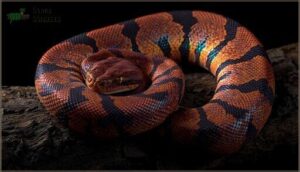
If you’ve ever wondered what makes these constrictors look like they’ve been dipped in a kaleidoscope, it all starts with their distinctive color patterns and unique scale structure. The Brazilian Rainbow Boa displays a brown or reddish-brown base color with three parallel black stripes running across the head. Large black rings cascade down the back, creating what look like dorsal blotches, while round lateral markings feature black centers with orange or reddish crescents.
| Pattern Element | Description |
|---|---|
| Head Stripes | Three parallel black lines |
| Dorsal Markings | Large black rings forming blotches |
| Lateral Spots | Black centers with orange/red crescents |
The real magic happens with their iridescent sheen. Tiny ridges on each scale act like miniature prisms, refracting light to produce that signature rainbow-colored effect. This structural coloration means the shimmer factors change depending on your viewing angle—you’ll see blues, greens, and purples dancing across their skin in different lighting conditions.
While color morphs exist in captivity, the wild-type Brazilian Rainbow Boa remains the most sought-after for its natural marking variations and unrivaled iridescence effects.
Size, Weight, and Lifespan

You’re looking at a snake that’ll stretch between 4 and 6 feet in captivity, with females often outgrowing males by a foot or more. Brazilian Rainbow Boas generally weigh 2 to 9 pounds, depending on their diet and care requirements.
With proper husbandry, these constrictors can live 20 to 25 years—some even pushing past 30, making them a genuine long-term commitment.
Structural Coloration and Iridescence
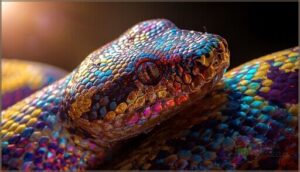
The rainbow-colored effect you see isn’t pigment—it’s structural coloration. Tiny ridges on your Brazilian Rainbow Boa’s scales act like prisms, creating light interference at the nanoscale.
The rainbow shimmer isn’t from pigment—it’s structural coloration where microscopic scale ridges refract light like prisms
These iridophores diffract incoming light, scattering specific wavelengths based on viewing angle. That’s why colors shift when you move around your snake.
Bright sunlight amplifies this nanostructure analysis into something truly electric.
Natural Habitat and Enclosure Needs

Understanding where rainbow boas come from shapes everything about how you’ll care for them. These snakes thrive in warm, humid environments across Central and South America, which means recreating those conditions at home isn’t optional—it’s essential.
Let’s break down what your rainbow boa needs to feel secure and stay healthy.
Wild Habitat and Environmental Preferences
These snakes make their home deep in the Amazon and coastal rainforests of Central and South America, thriving in humid woodland forests from Peru to Brazil. You’ll find them traversing tropical environments and ecosystems at sea level up to 1,000 meters, adapting between dense vegetation and open savannas.
Their geographic distribution reflects exceptional climate adaptation, though habitat destruction threatens these wildlife habitat zones that tropical ecosystem preservation and conservation efforts now protect.
Ideal Enclosure Size and Materials
Your snake’s enclosure setup is its entire world—getting the size and material selection right sets the foundation for healthy reptile care. For juveniles up to 2 feet, start with at least a 20-gallon terrarium (30″ L x 12″ W x 12″ H). Adults need serious space optimization: minimum 75 gallons, ideally 6′ x 3′ x 3′ for natural movement and snake care and maintenance.
Material choices for enclosure design:
- PVC – Best for humidity control and thermal insulation
- Glass – Excellent visibility but poor heat retention
- Melamine – Affordable, easy-to-clean with decent insulation
- Wood – Excellent insulation but moisture-vulnerable
Strategic ventilation systems with cross-flow vents maintain ideal conditions while preventing stagnation in your reptile habitat design.
Temperature, Humidity, and Substrate Requirements
Think of environmental parameters as your boa’s life support system—nail the temperature monitoring, and everything else follows. You’ll need thermal gradients from 75°F (cool end) to 85-90°F (basking spot), humidity control at 70-75%, and substrate options like cypress mulch or coconut fiber at 4-inch depth.
Your reptile care success hinges on consistent enclosure setup with proper temperature and humidity levels.
Diet and Feeding Guidelines
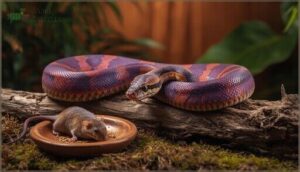
Getting your rainbow boa’s diet right is simpler than you might think. These snakes are straightforward eaters with predictable nutritional needs, but a few smart practices will keep them healthy and thriving.
Here’s what you need to know about feeding your rainbow boa properly.
Recommended Prey Types and Sizes
Choosing the right food for your rainbow boa isn’t rocket science, but precision matters for their health and longevity. Your carnivorous diet should focus on appropriately sized rodents that match your snake’s girth at mid-body—think of it as the Goldilocks principle for snake nutrition.
Prey Size Guidelines for Rainbow Boas:
- Neonates: Pinky mice (about 10% of body weight, matching the snake’s girth)
- Juveniles: Fuzzies to small rats (10-15% body weight, roughly double the girth)
- Adults: Medium to large rats (10% body weight, up to 1.5x girth)
- General rule: Prey width should never exceed the snake’s widest point
- Dietary variety: Offer mice, rats, chicks, or quail for balanced snake nutrition
Rodent selection becomes straightforward once you master these feeding techniques—frozen-thawed prey provides safer, more humane meals than live food.
Feeding Frequency by Age
Sizing meals is only half the equation—timing matters just as much. Hatchling diet demands pinky mice every 5-7 days to fuel rapid growth rates, while juvenile feeding shifts to weekly intervals with fuzzies or hoppers.
Once your snake hits subadult nutrition territory around 18 months, stretch feedings to every 10-14 days. Adult feeding frequency drops to biweekly or even monthly for larger females, preventing obesity while maintaining ideal snake diet and nutrition.
Safe Feeding Practices and Supplements
Once you’ve nailed timing, how you actually deliver meals makes all the difference for digestive health and overall reptile health and wellness. Thaw frozen rodents in the fridge overnight, then warm them to 100-104°F—proper prey selection and feeding techniques prevent bacterial nasties. Use tongs instead of fingers to avoid accidental bites.
- Dust prey with calcium carbonate 2-3 times weekly for proper nutrient balance
- Add vitamin D3 supplements 1-2 times weekly to prevent metabolic bone disease
- Wait 48 hours post-feeding before handling to support ideal boa diet digestion
Smart supplement dosage and snake care and maintenance practices keep your rainbow boa thriving for decades.
Health, Care, and Breeding
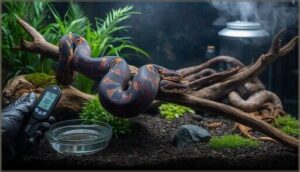
Keeping your rainbow boa healthy takes more than just feeding—you need to stay on top of cleanliness, watch for warning signs, and understand what these snakes need to thrive long-term. Regular maintenance prevents most common health problems before they start.
If you’re thinking about breeding, you’ll also need to know the specific requirements that trigger reproduction and support a successful cycle.
Common Health Issues and Prevention
Your rainbow boa’s health hinges on vigilance—catching problems early makes all the difference. Respiratory issues plague up to 25% of captive boas, often stemming from incorrect humidity or temperatures. Watch for open-mouth breathing or mucus discharge as potential warning signs. Parasite control is equally crucial, as mites and internal worms can significantly weaken your snake. Additionally, mouth rot, shedding problems, and nutritional deficiencies are common threats to reptile health and wellness.
| Health Issue | Key Signs | Prevention Strategy |
|---|---|---|
| Respiratory Infections | Labored breathing, nasal discharge, rattling sounds | Maintain 70-75% humidity, proper temps, clean enclosure |
| Parasites (Mites/Worms) | Tiny moving specks, weight loss, lethargy, poor appetite | Regular fecal exams, quarantine new animals, sanitize habitat |
| Mouth Rot (Stomatitis) | Swollen gums, pus, difficulty eating, asymmetry | Keep substrate clean, avoid injury, address mites promptly |
Proper snake care and maintenance begins with your enclosure setup. Maintaining consistent humidity, stable temperatures, and fresh substrate is essential—environmental control is key to preventing most diseases in herpetology and reptile research. Feeding appropriately sized frozen-thawed prey helps avoid nutritional deficiencies, such as metabolic bone disease. Annual vet checkups are vital for catching issues before they escalate, supporting reptile conservation efforts by keeping captive populations healthy.
Cleaning and Maintenance Routines
Keeping your rainbow boa healthy means staying on top of cleaning—it’s where reptile care meets freedom from disease. Daily waste removal with tongs prevents bacterial buildup in your snake’s habitat, while weekly enclosure sanitizing with F10 disinfectant confronts pathogens head-on.
Replace substrate every three months, scrub water dishes thoroughly, and maintain strict humidity control. These disinfection methods aren’t just herpetology protocol—they’re your snake’s lifeline.
Breeding Requirements and Reproductive Cycle
Breeding your rainbow boa means mastering environmental cues. Drop temperatures to 75-85°F during late fall to trigger mating habits naturally. Males reach sexual maturity at four feet, females at 4.5 feet, usually between 2.5-4 years.
After a five-month gestation period, expect 12-25 live neonates needing 95-100% humidity immediately. Snake breeding success hinges on precise reproductive health monitoring and expert neonate care protocols.
Frequently Asked Questions (FAQs)
Can a rainbow boa be a pet?
Yes, with dedication. These striking serpents thrive under your care when you master humidity control, proper feeding schedules, and gentle handling techniques—though their exotic pet ownership demands aren’t for casual keepers.
Are rainbow boas venomous?
No, these snakes rely on constrictor methods instead of venom to subdue prey. Brazilian rainbow boas lack venom glands entirely, making them nonvenomous constrictors that use defensive postures like striking when threatened.
How hard is it to take care of a rainbow boa?
Looking for a low-maintenance pet? Rainbow boa care challenges include strict environmental control—80-85°F temps, 70-80% humidity—plus weekly feeding difficulties, monthly enclosure cleaning, and vigilant health monitoring for respiratory infections and parasites.
Is a rainbow boa endangered?
The rainbow boa isn’t endangered—its conservation status sits comfortably at “Least Concern.” Wild populations remain stable across Central and South America, though habitat loss and the pet trade create localized pressure worth watching.
What color is a rainbow boa?
The Brazilian Rainbow Boa displays brown or reddish-brown base colors with striking black rings and lateral blotches.
Its iridescent skin refraction creates dazzling rainbow hues and a shimmer appearance through microscopic ridges that act like natural prisms.
Where do rainbow boas come from?
From steamy rainforests to drier woodlands, these iridescent serpents call South America home.
The Brazilian Rainbow Boa’s native habitat spans tropical regions across Brazil and neighboring territories, thriving in warm, humid environments throughout their geographic range.
What is a Brazilian rainbow boa?
This South American serpent, Epicrates cenchria, captivates keepers with its striking iridescence and distinctive Brazilian rainbow boa characteristics.
Snake behavior patterns, boa morphs, and color genetics make it a fascinating species for reptile conservation and snake husbandry enthusiasts.
Are rainbow boas easy to keep?
You’ll find these snakes manageable if you’re committed to proper snake husbandry and exotic pets care.
They demand precise humidity control and consistent handling techniques, making them ideal for keepers with some reptile care experience.
How much does a rainbow boa cost?
Pet snake ownership starts with understanding market trends. Expect to pay $300 to $500 for standard specimens, while rare morph prices and breeder fees push exotic pets like anerythristic rainbow boas toward $1,600, reflecting true ownership expenses.
Why are rainbow boas so beautiful?
Nature’s optical illusion comes alive when light hits these serpents—it’s pure physics at play. Tiny ridges on their scales act as prisms, creating that signature rainbow-colored effect through light refraction, making Brazilian Rainbow Boas living kaleidoscopes.
Conclusion
The rainbow boa thrives in captivity precisely because it’s so demanding—its specific needs force you to master the fundamentals that apply to dozens of other species. Once you’ve dialed in the humidity gradients, temperature zones, and feeding rhythms this snake requires, you’ve fundamentally built a template for expert herpetoculture.
Think of it as earning your credentials through one of nature’s most visually stunning teachers. The iridescence is just the bonus for doing the work right.