This site is supported by our readers. We may earn a commission, at no cost to you, if you purchase through links.

Most snake health problems trace back to a single culprit that owners overlook until their pet stops eating or shows signs of respiratory infection: improper temperature. Your snake’s body can’t generate its own heat, which means every biological function—from digestion to immune response—depends entirely on the thermal environment you provide.
A ball python kept at 72°F might refuse food for weeks, not out of stubbornness, but because its metabolism has practically shut down. The difference between a thriving snake and a chronically stressed one often comes down to a few degrees and the quality of your heating setup.
Getting regulating snake temperature needs right requires more than plugging in a heat lamp and hoping for the best.
Table Of Contents
Key Takeaways
- Improper temperature causes most snake health problems because snakes are ectothermic and rely entirely on external heat sources to regulate metabolism, digestion, and immune function—even a few degrees off can trigger metabolic shutdown, immune suppression, and organ damage.
- You need to create a thermal gradient with species-specific warm zones (typically 90–95°F for ball pythons) and cool zones (76–80°F), using thermostats with every heat source to prevent deadly temperature spikes that can exceed 140°F and cause severe burns.
- Digital thermometers with probes placed at basking surfaces and inside hides give you the accuracy you need (±1–2°F), while analog gauges can read 5–7°F off and fail to catch dangerous hot spots or cold zones.
- Seasonal adjustments aren’t optional—winter can drop enclosure temps by 5–11°F without wattage increases, summer heat can erase cool zones entirely, and power outages create thermal shock risk within four hours unless you have backup heating and insulation ready.
Why Proper Temperature Regulation Matters for Snakes
Getting your snake’s temperature right isn’t just about comfort—it’s the foundation of everything from digestion to immune function. When temperatures drift outside their ideal range, snakes can’t regulate their metabolism properly, and health problems follow quickly.
Let’s look at exactly why temperature control matters so much and what goes wrong when you get it off track.
Effects of Incorrect Temperatures on Snake Health
When your snake’s enclosure drifts from its preferred temperature range, you’re triggering a cascade of problems that go far beyond simple discomfort. Metabolic impairment sets in first—digestive rate can drop by half at suboptimal temperatures, leaving meals sitting unprocessed.
Incorrect temperatures trigger metabolic impairment in snakes, slowing digestion by half and leaving meals unprocessed
Immune suppression follows closely behind, as temperature fluctuations measurably reduce bacteria-killing ability and increase disease susceptibility. Meanwhile, chronic stress responses boost corticosterone levels, compounding organ damage and growth stunting in developing animals.
Snakes require specific temperatures because they’re ectothermic, relying on external sources for heat.
Species-Specific Temperature Needs
Each species brings its own temperature blueprint. Ball pythons thrive with basking zones at 90–95°F and cool sides around 76–80°F, while corn snakes, adapted to temperate North America, do well with slightly cooler ranges—basking near 90°F and cool zones between 75–82°F. Consider these species-specific needs:
- Boa constrictors prefer daytime ambients of 75–85°F, reflecting tropical lowland origins
- Rainbow boas require low-80s°F temperatures paired with 75–90% humidity
- General ranges across pet snakes span approximately 75–95°F depending on native ecology
Boa constrictors need humidity between 60-70% for proper shedding.
Risks of Improper Heat Regulation
Straying from those ranges doesn’t just make your snake uncomfortable—it triggers a cascade of physiological breakdowns. Metabolic impairment slows digestion, leaving meals to rot internally. Immunosuppression risk climbs, opening the door to respiratory infections and mouth rot. Temperature extremes bring dehydration effects, thermal burns from unregulated surfaces, and chronic stress that shortens lifespan. Thermal shock during power outages can prove fatal within hours.
| Health Risk | Temperature Trigger & Consequence |
|---|---|
| Metabolic Impairment | Suboptimal temps reduce enzyme activity, stalling digestion and nutrient uptake |
| Immunosuppression Risk | Persistent cold weakens immune defenses, inviting bacterial and fungal infections |
| Dehydration Effects | Excessive heat without cool zones accelerates water loss, causing sunken eyes and lethargy |
| Thermal Burns | Unregulated mats or lamps create hot spots that cause full-thickness skin necrosis |
| Chronic Stress | Inadequate gradient forces hiding and defensive behavior, compounding disease vulnerability |
Designing a Thermal Gradient in Snake Enclosures
Your snake can’t just pick up a jacket when it gets cold or find shade when it overheats. Instead, you’ll need to build a temperature gradient into the enclosure—a setup that gives your snake both warm and cool zones to move between as needed.
Getting this right means thinking about where you place heat sources, what substrate you use, and how to create smaller temperature pockets that let your snake fine-tune its comfort.
Warm and Cool Zone Placement
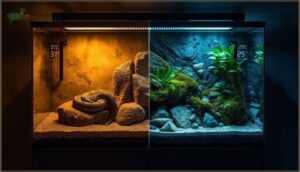
Creating thermal gradients starts with smart zone function—you’ll position your primary heat source at one short end of the enclosure, not the center, to achieve gradient stability across the length.
For most species-specific placement needs, warm zones should reach about 30–32°C while cool zones stay near 24–27°C, with enclosure size and layout design dictating the actual spacing between these critical temperature areas.
Substrate Selection for Heat Retention

Beyond zone placement, substrate choice dramatically influences heat retention and enclosure environment. Paper transmits warmth rapidly—within 1–2°C of the heater—while coconut husk at 5–8 cm depth drops surface temperatures by 3–6°C, showcasing substrate thermal inertia.
Moisture retention effects matter too: damp coco-fiber cools surfaces through evaporation.
Species substrate needs vary—hognoses need 7.5–10 cm for burrowing depth impacts, while heating method compatibility determines whether you pair deep substrates with overhead heat or thin layers with mats.
Creating Microclimates for Behavioral Thermoregulation
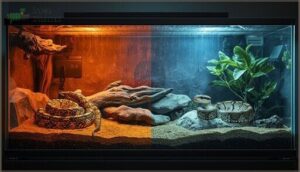
When your snake chooses between hides at different temperatures—say, 30–32°C versus 22–27°C—you’re witnessing behavioral thermotaxis in action.
Spatial scale matters: even small enclosures support distinct microclimates if you position hides, decor, and thermal gradient ranges strategically.
This microhabitat selection mirrors natural refuge use, letting your snake fine-tune energy balance and thermoregulation across cool zones and warmer microsites throughout the day.
Choosing The Right Heating Solutions
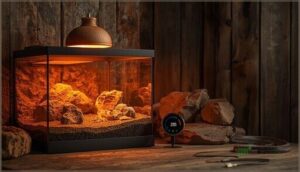
You’ve got your thermal gradient designed—now it’s time to pick the right heat sources to bring it to life.
The heating equipment you choose will directly affect your snake’s ability to thermoregulate, digest food properly, and stay healthy.
Let’s look at the main heating options and how to use them safely.
Heat Mats, Pads, and Tape
When you’re choosing heating pads or heat tape for your snake, wattage selection matters—unregulated heat mats can spike past 140°F and cause severe burns. Always pair undertank heaters with thermostat control to cap surface temperatures around 90°F, preventing thermal injury.
Substrate impact is real: bedding insulates heat, so you’ll need to adjust settings accordingly. Cover roughly one-third of your enclosure floor to establish a proper gradient while ensuring installation safety on glass only.
Ceramic Heat Emitters and Radiant Panels
Ceramic heat emitters and radiant heat panels offer distinct advantages for round-the-clock warmth without light disruption. A 60 W ceramic emitter suits 10–20 gallon tanks, while 200 W units handle larger setups—but wattage selection demands careful thermostat pairing to prevent overheating.
Radiant heat panels distribute infrared heat evenly across broad areas, reducing hot spots and preserving humidity better than point-source bulbs, making panel placement and safety features critical for stable temperature control.
What makes these heat sources work for your snake:
- Emitter lifespan reaches up to five years of continuous use when properly regulated
- Humidity impact stays minimal with radiant panels, ideal for moisture-dependent species
- Safety features include UL-tested ceramic construction and flush-mount designs preventing direct burns
- Temperature control requires pulse-proportional thermostats to avoid rapid cycling and thermal swings
- Heat source flexibility allows 24-hour operation without disrupting nocturnal behavior patterns
Heat Lamps and Basking Spots
Heat lamps create a focused basking spot that anchors your thermal gradient, but lamp wattage and basking distance determine whether you’re providing comfort or risking burns. A 75 W bulb positioned 12 inches away delivers roughly 88°F—ideal for corn snakes—while closer placement or higher wattages exceed safe limits.
Pair your heat source with shaded zones and monitor photoperiod needs to prevent overheating during daily basking cycles.
Integrating Thermostats for Safety
A thermostat isn’t optional—it’s the difference between a stable enclosure and a deadly spike. On/off models cycle power fully, creating measurable swings, while dimming thermostats modulate output for tighter control.
Probe placement determines accuracy; secure yours at the basking surface where your snake’s body contacts heat.
Pair automated temperature control with independent thermometers on both zones to catch sensor drift before it becomes fatal.
Monitoring and Adjusting Enclosure Temperature
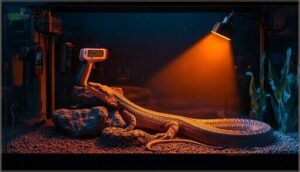
Setting up your heating equipment is only half the battle—you need reliable tools to track what’s actually happening inside the enclosure. Without accurate monitoring, you’re basically guessing whether your snake is getting the temperatures it needs.
Let’s look at the essential monitoring tools and techniques that’ll help you maintain consistent, safe conditions year-round.
Selecting Accurate Thermometers and Hygrometers
How do you know your snake’s enclosure really sits at the right temperature? Analog thermometers can read 5–7°F off—or worse—compared to calibrated digital thermometers, which offer precision within ±1–2°F.
Pair a digital hygrometer for humidity accuracy around ±3–5% RH. Add an infrared thermometer to spot-check basking surfaces instantly.
Cross-referencing multiple temperature sensors catches errors before they compromise your snake’s health.
Probe Placement and Gradient Monitoring
Once your digital thermometers are ready, probe placement determines whether you’re reading what your snake actually experiences. Fix probes where your animal spends time—on basking surfaces or inside hides—not loose in mid-air.
For gradient hotspots around 90°F at the warm end, position one probe there; place another in the cool zone (75–82°F). Midpoint strategies help, but verify both extremes independently for accurate readings and real gradient effectiveness.
Automated and Smart Temperature Control Systems
Building on your probe setup, automated temperature control offers precision you can’t match with constant manual tweaking. Smart thermostats maintain zones within roughly 0.5°C using temperature sensors, while remote monitoring systems send alerts when parameters drift. Integrated platforms coordinate heating and lighting from a single dashboard.
Key benefits include:
- Wi‑Fi controllers with dual outlets managing two independent heat sources
- Dimming thermostats that reduce temperature swings through modulated power
- Cloud-based data logging accessible from your phone anytime
- Safety redundancy pairing independent digital thermostats with backup monitors
Preventing Overheating and Cold Spots
Even precise automation can’t prevent overheating or cold spots if you’ve chosen the wrong equipment or positioned heat sources poorly. Unregulated heat rocks and tightly focused lamps create dangerous thermal extremes—veterinary reports link these point‑source devices to severe burns requiring months of treatment. Gradient monitoring with multiple thermometers catches problems before they harm your snake.
| Risk Factor | Prevention Strategy |
|---|---|
| Hot rocks and localized heaters | Use overhead ceramic emitters with guards |
| Insufficient substrate over heat mat | Add barrier layer; verify internal surface temp |
| Narrow basking zone under high-wattage bulb | Lower wattage; increase distance; widen heat spread |
Adapting to Seasonal and Environmental Changes

Your snake’s enclosure doesn’t exist in a vacuum—it’s affected by your home’s heating and cooling systems, seasonal weather shifts, and unexpected events like power failures. You’ll need to adjust your setup throughout the year to maintain that critical thermal gradient, especially during temperature extremes.
Let’s look at the practical strategies you can use to keep your snake comfortable and safe no matter what environmental challenges come up.
Adjusting for Seasonal Temperature Shifts
Your snake’s enclosure doesn’t exist in a vacuum—ambient temperatures shift with the seasons, and you’ll need to respond. Winter can drop your enclosure by 5 to 11°F if you don’t adjust heating output, while summer may erase cool zones entirely.
Here’s how to stay ahead of seasonal changes:
- Increase wattage or insulation in winter to preserve basking zones when room temperatures fall to 64-70°F.
- Lower thermostat set points in summer or reduce lamp photoperiods when ambient temperatures push enclosures above safe ranges.
- Plan brumation temperature control carefully by cooling gradually to 46-50°F over several weeks for species that require it.
- Monitor multiple zones year-round using digital thermometers to catch seasonal heat spikes or cold spots before they compromise your snake’s health.
Adjusting seasonal temperature changes isn’t optional—it’s essential for maintaining the thermal gradient your snake depends on. Environmental conditions fluctuate, and your heating strategy must flex accordingly.
Summer heat mitigation might mean relocating enclosures to cooler rooms, while winter enclosure insulation with blankets can slow heat loss during cold snaps. Seasonal thermostat adjustments keep your system responsive, ensuring your snake can thermoregulate properly regardless of what’s happening outside the glass.
Managing Humidity and Ventilation
When temperature control pairs with faulty humidity management, you risk respiratory disease, incomplete sheds, and mold outbreaks that compromise your snake’s health. Most captive species thrive between 50–70% relative humidity, but ventilation design determines whether you maintain that range or breed pathogens.
Here’s how humidity levels affect respiratory health, shedding issues, and enclosure hygiene:
| Humidity Range | Ventilation Need | Health Impact |
|---|---|---|
| Below 30% | Low airflow acceptable | Dysecdysis, retained eye caps, thickened mucus |
| 50–70% best | Cross-ventilation essential | Normal sheds, clear airways, stable microbial loads |
| Above 80% | High airflow critical | Respiratory infections, mold blooms, fungus gnat surges |
| Saturated (condensation visible) | Immediate ventilation increase | Epithelial damage, anaerobic substrate, pest explosions |
| Localized wet zones | Targeted exhaust vents | Fungal outbreaks on décor, waterlogged substrate failure |
Effective humidity monitoring starts with digital hygrometers placed mid-wall and inside humid hides—analog gauges lack the precision you need. Cross-ventilation with low intake and high exhaust vents prevents stagnant pockets without stripping necessary moisture, while short misting intervals keep plants hydrated without waterlogging the substrate.
Mold prevention hinges on balancing moisture and airflow; persistently foggy glass signals saturation and demands immediate ventilation adjustments. Poor ventilation amplifies bacterial loads, turning manageable humidity into a respiratory hazard. Managing humidity ventilation isn’t secondary to temperature—it’s equally critical for keeping your snake healthy year-round.
Preventing Thermal Shock During Power Outages
When power failures strike, you have a narrow window before thermal shock threatens your snake’s wellbeing—most species tolerate brief drops, but outages exceeding four hours demand immediate action. Backup heating and insulation methods form your first line of defense against temperature fluctuations, protecting species resilience through preparedness planning:
- Deploy battery power stations or portable generators to restore heat mat and ceramic emitter function within minutes.
- Wrap enclosures in blankets while maintaining ventilation gaps to slow convective heat loss during extended outages.
- Move snakes into smaller, insulated containers with chemical heat packs rated for 40–72 hours of output.
- Stock emergency heat supplies before winter storms hit—testing backup power ensures your response works when it counts.
Cooling Strategies for Extreme Heat
When summer heat soars past safe limits, your snake’s survival depends on swift environmental cooling. Relocating the enclosure to shaded, ground-floor rooms can drop internal temperatures by 3–5 °C, while increasing ventilation with mesh lids or small fans enhances convective airflow. Cool hides with damp sphagnum moss create microclimates several degrees below ambient peaks, and evaporative cooling through lightly misting enclosures aids hydration during extreme events. Reducing heat sources and temporarily relocating snakes to cooler spaces prevents mortality when temperatures approach the high 30s Celsius.
| Cooling Methods | Implementation & Impact |
|---|---|
| Shading Techniques & Ventilation Methods | Move enclosures away from windows; use screen lids and fans to lower temps by 3–5 °C through airflow |
| Cool Hides & Hydration Tactics | Provide ground-level hides with damp substrate; increase water access to aid thermoregulation |
| Evaporative Cooling & Heat Reduction | Lightly mist enclosures; remove secondary heat sources; relocate snakes to cooler rooms when ambient temps near 38 °C |
Frequently Asked Questions (FAQs)
Can I use household heating devices safely?
Most household heaters and hot rocks risk severe burns—thermal injuries account for up to 50% of reptile skin damage.
You’ll need reptile-specific equipment with thermostat control to keep your snake safe.
How do I transport snakes in cold weather?
When shipping heat packs and insulated containers aren’t enough, pre-warming vehicles protects your snake from cold stress and respiratory infection. Species vulnerability varies, but preventing thermal shock requires careful temperature management throughout transit.
What are signs of thermal burns in snakes?
Early skin changes include reddened or darkened scales. Blistering lesions, necrosis discoloration, and systemic signs like lethargy follow.
Husbandry warnings—exposed heat sources, malfunctioning thermostats—help prevent burns and safeguard snake health against thermal injury from temperature extremes.
Do baby snakes need different temperature settings?
Baby snakes don’t need different temperature settings than adults of the same species. Research shows neonate thermal needs match adult ranges, but hatchling vulnerabilities demand tighter gradient control to prevent rapid overheating or chilling in smaller bodies.
Should nighttime temperatures drop for all species?
Not all snake species need nighttime temperature drops. Tropical species thrive with minimal fluctuations, while temperate species benefit from cooler nights that support brumation needs and natural circadian rhythms within safe minimums.
Conclusion
A survey of reptile veterinarians found that 68% of snake health cases involved temperature-related issues that owners didn’t recognize until symptoms appeared. Your success in regulating snake temperature needs depends on precision: accurate monitoring tools, properly placed heat sources, and consistent adjustments as conditions change.
The thermal environment you create determines whether your snake simply survives or genuinely thrives. When you control the heat, you control nearly every aspect of your animal’s physiological well-being and long-term health.
- https://pubmed.ncbi.nlm.nih.gov/9798255/
- https://www.journals.uchicago.edu/doi/abs/10.1086/515979
- https://talis-us.com/blogs/news/optimal-temperature-ranges-for-ball-pythons
- https://www.reddit.com/r/snakes/comments/m5csmw/best_temp_for_ball_python/
- https://community.morphmarket.com/t/problem-of-temperature/8313