
This site is supported by our readers. We may earn a commission, at no cost to you, if you purchase through links.

Most keepers underestimate thermal drift until they lose an animal. A half-degree variance in one tank compounds across four or five enclosures, turning minor sensor error into metabolic stress for your collection.
Managing multiple reptile habitats demands precision instruments that maintain ±0.3°C consistency—not budget gauges that read differently tank to tank. You need devices with remote probes, accurate dual-function monitoring, and mounting systems that won’t shift during routine maintenance.
The right thermometers eliminate guesswork and prevent the cascade failures that occur when basking zones creep too high or nighttime temperatures drop unnoticed across your setup.
Table Of Contents
- Key Takeaways
- Best Reptile Thermometers for Multiple Tanks
- 1. Reptile Tank Thermometer And Hygrometer
- 2. Repti Zoo Reptile Thermometer Hygrometer
- 3. Jedew Digital Hygrometer Thermometer
- 4. Paizoo Reptile Thermometer Hygrometer
- 5. Oasirep Reptile Thermometer Hygrometer
- 6. Mini Digital Hygrometer Thermometer
- 7. Digital Reptile Thermometer Hygrometer
- 8. SunGrow Reptile Thermometer Hygrometer
- 9. Weewooday Reptile Thermometer Hygrometer
- 10. Repti Zoo Digital Thermometer Hygrometer
- Key Features to Look For
- Digital Vs. Dial Thermometers
- Combining Thermometers and Hygrometers
- Proper Placement and Setup Tips
- Common Mistakes and How to Avoid Them
- Maintaining Stable Tank Conditions
- Selecting The Right Thermometer for Your Setup
- Frequently Asked Questions (FAQs)
- Conclusion
Key Takeaways
- Accuracy within ±0.3°C matters critically because even half-degree sensor drift compounds across multiple enclosures, causing metabolic stress that often goes undetected until symptoms appear.
- Position at least two sensors per tank at animal height—one at the basking zone and one at the cool end—to capture the actual thermal gradient your reptile experiences rather than misleading air temperatures near glass or substrate.
- Calibrate your thermometers monthly against verified reference standards because consumer-grade sensors drift 0.5–2.0°C over weeks, and humidity readings can be off by 5–15% without regular verification.
- Choose dual-function thermometer-hygrometer units with remote probes and species-specific range compatibility to reduce clutter while maintaining the precise environmental control that prevents respiratory infections and shedding complications.
Best Reptile Thermometers for Multiple Tanks
Managing multiple reptile enclosures means you need thermometers that deliver consistent accuracy without creating a tangled mess of wires and sensors. The right devices let you monitor thermal gradients across several tanks while maintaining species-specific temperature ranges for everything from desert-dwelling bearded dragons to humidity-loving ball pythons.
Here are ten thermometers designed to handle multi-tank setups with the precision your collection demands.
1. Reptile Tank Thermometer And Hygrometer
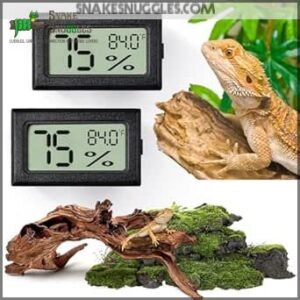
A thermometer hygrometer combo measures both temperature and humidity in a single device, streamlining tank monitoring for multi-tank setups. You’ll want accuracy within ±1–2°C and humidity precision around ±5–10% relative humidity to protect reptile health.
Digital displays with backlighting and memory functions track minimum and maximum readings, helping you spot harmful fluctuations early. Look for mounting options like suction cups or adhesive pads that position sensors at representative heights.
Regular thermometer calibration against a known standard ensures sensor accuracy across all your enclosures, reducing stress and respiratory issues in your animals.
| Best For | Reptile owners managing multiple tanks who need reliable dual readings to maintain proper basking zones and humidity levels for healthy shedding and respiration. |
|---|---|
| Display Type | Digital LED |
| Power Source | Battery |
| Temperature Accuracy | ±0.9°F |
| Humidity Measurement | Yes |
| Installation Method | Adhesive |
| Unit Count | 2 |
| Additional Features |
|
- Digital displays with backlight and min/max memory help you catch dangerous temperature swings before they harm your animals
- Multiple sensor options let you monitor different zones across several tanks from one central display
- Mounting flexibility with suction cups or adhesive pads makes it easy to position sensors at the right height in any enclosure
- Accuracy can drift over time, requiring regular calibration checks against a known standard to stay reliable
- Battery life varies widely by model, and some units drain faster than expected with backlight use
- Water resistance isn’t always sufficient for high-humidity setups, risking sensor damage in heavily misted enclosures
2. Repti Zoo Reptile Thermometer Hygrometer
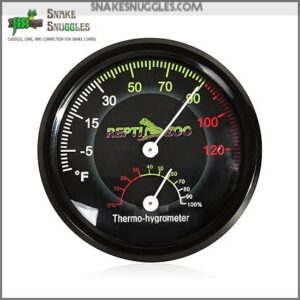
The REPTI ZOO Reptile Terrarium Thermometer Hygrometer offers dial-based readings for both temperature and humidity control in your terrarium. No battery means zero maintenance, though you’ll need to verify sensor accuracy during initial device calibration—some keepers report inconsistent humidity readings. If you keep reptiles in high-humidity setups, check out thermometer-hygrometers designed for humid environments to compare sensor reliability across different moisture levels.
You’ll mount it using the included adhesive pad, placing it where your reptile spends most of its time to capture accurate thermal gradients. At 2.9 inches, the color-coded display remains visible from several feet away, making multi-tank checks efficient while monitoring reptile health across your collection.
| Best For | Reptile owners who want a simple, battery-free monitoring solution for their terrarium and don’t mind occasional accuracy checks. |
|---|---|
| Display Type | Analog |
| Power Source | None |
| Temperature Accuracy | Analog |
| Humidity Measurement | Yes |
| Installation Method | Sticky Pad |
| Unit Count | 1 |
| Additional Features |
|
- No batteries needed means zero ongoing maintenance and no power costs
- Color-coded dial makes it easy to read temperature and humidity at a glance from across the room
- Affordable dual-function device that measures both metrics in one compact unit
- Humidity readings can be inconsistent and may require verification against a reference device
- Adhesive backing tends to weaken over time, causing the unit to fall off the glass
- Some users report accuracy issues that require periodic calibration checks
3. Jedew Digital Hygrometer Thermometer
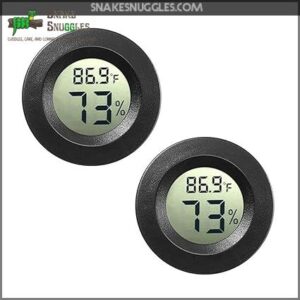
For keepers managing multiple enclosures, the JEDEW Mini Digital Hygrometer Thermometer delivers compact sensor accuracy without compromising readability. Its LCD digital displays show temperature (0°C to 70°C, ±1°F) and humidity (10% to 99% RH, ±3%) through a responsive 24-vent design that updates conditions quickly.
You’ll appreciate the LR44 battery lasting up to 10 months and simple Fahrenheit/Celsius conversion for temperature calibration. Mount this 1.73-inch reptile digital thermometer at animal level to track humidity control across terrariums—though some users report inconsistent readings requiring device durability checks against reference standards.
| Best For | Reptile keepers managing multiple enclosures who need an affordable, compact monitor to track temperature and humidity at animal level across different habitats. |
|---|---|
| Display Type | Digital LCD |
| Power Source | LR44 Battery |
| Temperature Accuracy | ±1°F |
| Humidity Measurement | Yes |
| Installation Method | Adhesive |
| Unit Count | 1 |
| Additional Features |
|
- Compact 1.73-inch design with clear LCD display fits easily in small terrariums without taking up valuable space
- Fast-responding 24-vent sensor design quickly updates readings so you can catch environmental changes before they stress your reptiles
- Long 10-month battery life means less maintenance and fewer interruptions to your monitoring routine
- Accuracy issues reported by some users, with humidity readings occasionally off by 5% requiring verification against reference devices
- Mixed durability feedback suggests quality control problems, including reports of dead or missing batteries on arrival
- Temperature accuracy of ±1°F and humidity accuracy of ±3% RH may not be precise enough for species requiring tight environmental control
4. Paizoo Reptile Thermometer Hygrometer
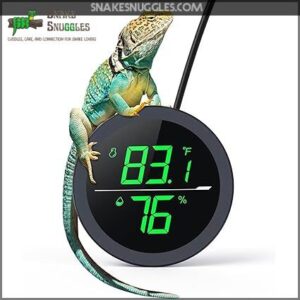
USB-powered convenience defines the PAIZOO Reptile LED Thermometer, which eliminates battery changes through its 140 cm cable—ideal for multi-tank arrangements requiring continuous monitoring. Its HD LED display provides clear readings of temperature and humidity levels, though thermometer accuracy varies in User Experience reports, with some keepers noting display failures after extended operation. For hobbyists managing multiple desert habitats, this reptile thermometer for desert species offers a practical USB-powered alternative to models requiring frequent battery replacements.
You’ll want to perform Device Calibration against reference instruments to verify Sensor Durability before relying on this PAIZOO Reptile Tank Thermometer for critical Reptile Health decisions across your collection. Many keepers cross-reference their readings with professional-grade reptile thermometers for ball pythons to establish baseline accuracy before trusting any new device.
| Best For | Reptile owners who want an affordable, USB-powered monitor for basic temperature and humidity tracking in single or multiple tanks, especially when continuous power access is available. |
|---|---|
| Display Type | LED |
| Power Source | USB |
| Temperature Accuracy | High Precision |
| Humidity Measurement | Yes |
| Installation Method | 3M Tape/USB |
| Unit Count | 1 |
| Additional Features |
|
- USB power means no battery replacements, and the 140 cm cable works well for multi-tank setups or distant outlets.
- Clear HD LED display makes it easy to check readings at a glance, even in dim lighting.
- Simple installation with included 3M adhesive tape lets you mount it quickly on tank walls.
- Accuracy can be inconsistent, with some users reporting incorrect readings or display failures over time.
- The adhesive may fail in high-humidity environments, requiring remounting or alternative methods.
- Requires access to a USB outlet, which limits placement flexibility compared to battery-powered options.
5. Oasirep Reptile Thermometer Hygrometer
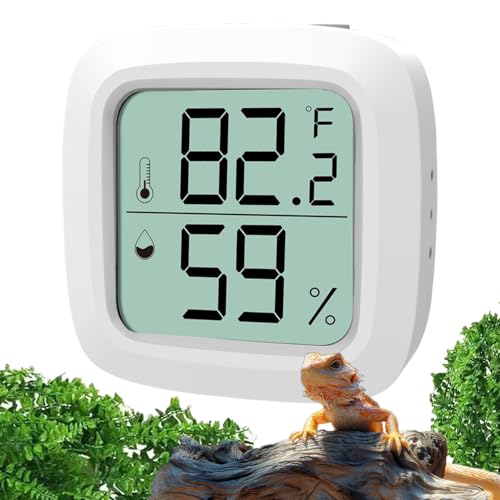
Compact design makes the Oasirep Reptile Thermometer And Hygrometer practical for crowded Tank Management scenarios. This Thermometer Hygrometer runs 12 months on a CR2032 battery, though Reptile Thermometer Reviews note it reads slightly cooler than reference instruments.
You’ll get ±1.8°F Sensor Accuracy and ±5% relative humidity readings on a clear LCD that displays both metrics simultaneously, supporting reliable Thermal Monitoring and Humidity Control without cluttering your work area. If you’re still figuring out the best way to measure reptile tank heat, placing one probe in the basking zone and another at the cool end gives you real-time confirmation that your gradient stays within that critical 15–35°F range.
Perform Device Calibration against known standards before integrating this unit into protocols requiring precise thermal data across multiple enclosures.
| Best For | Reptile keepers who need a reliable, budget-friendly way to monitor temperature and humidity across multiple enclosures without complicated setup. |
|---|---|
| Display Type | LCD |
| Power Source | CR2032 Battery |
| Temperature Accuracy | ±1.8°F |
| Humidity Measurement | Yes |
| Installation Method | Adhesive Pad |
| Unit Count | 1 |
| Additional Features |
|
- Runs for a full year on a single coin battery, so you’re not constantly swapping cells or dealing with dead screens mid-season.
- Displays both temperature and humidity at once on a clear screen, letting you check conditions in seconds without toggling between modes.
- Sticks right to glass with the included adhesive pad and fits in tight spots without blocking your view or taking up valuable tank real estate.
- Reads a bit cooler than some reference thermometers, so you’ll want to calibrate it against a known standard before trusting it for sensitive species.
- Not waterproof, meaning you need to keep it away from misters, water features, or any direct spray that could damage the electronics.
- Accuracy drifts to ±1.8°F and ±5% RH, which might not cut it if you’re working with animals that need tighter environmental tolerances.
6. Mini Digital Hygrometer Thermometer
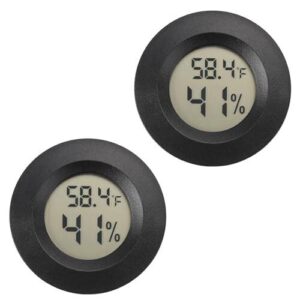
Button-cell operation extends working time to nine months per LR44 charge, making the Mini Digital Hygrometer Thermometer economical for Compact Designs where space and maintenance cycles matter.
Digital Displays update every ten seconds with ±1°F Sensor Accuracy and ±3% RH precision, delivering dependable Reptile Temperature and humidity data across terrariums, brooders, and quarantine enclosures. You can toggle between Fahrenheit and Celsius for standardized monitoring.
Check Battery Efficiency monthly in high-humidity setups above seventy-five percent to prevent sensor failure. Follow Calibration Tips against known references before deploying this Digital Hygrometer in sensitive herpetology protocols.
| Best For | Reptile keepers who need an affordable, space-saving way to monitor temperature and humidity in small terrariums, quarantine tanks, or multiple enclosures without dealing with complicated setup. |
|---|---|
| Display Type | Digital LCD |
| Power Source | LR44 Battery |
| Temperature Accuracy | ±1°F |
| Humidity Measurement | Yes |
| Installation Method | Adhesive |
| Unit Count | 1 |
| Additional Features |
|
- Updates readings every 10 seconds so you catch changes fast, and the battery lasts up to 9 months on a single LR44 cell
- Compact size fits easily in tight spaces like hatchling tubs or small vivariums where bigger gauges won’t work
- Switches between Fahrenheit and Celsius to match whatever measurement system you prefer
- Accuracy can drift by 1-2% over time, so you’ll want to check it against a reference thermometer occasionally
- The adhesive backing doesn’t hold up well in humid environments above 75% RH, and the sensor itself may short out in those conditions
- Small display can be hard to read from a distance, especially in dim lighting without a backlight
7. Digital Reptile Thermometer Hygrometer
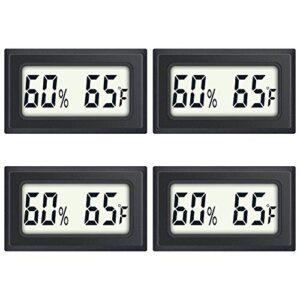
Precision matters when you’re juggling multiple enclosures, and these Reptile Thermometers deliver ±2°F Digital Accuracy alongside ±2% RH Humidity Tracking.
The Thermometer Hygrometer combination streams both metrics on a single LCD, simplifying Tank Monitoring without cluttering your vivarium walls. Button-cell power sustains eight months of readings, supporting Device Durability in demanding herpetology setups.
Run Sensor Calibration against verified standards before deployment to verify Reptile Health protocols remain tight.
Compact 1.89 × 1.14-inch footprints fit terrariums, brooders, and quarantine zones where space runs thin.
| Best For | Reptile keepers managing multiple enclosures who need reliable temperature and humidity readings without taking up much space. |
|---|---|
| Display Type | Digital LCD |
| Power Source | LR44 Battery |
| Temperature Accuracy | ±2°F |
| Humidity Measurement | Yes |
| Installation Method | Tape/Embedded |
| Unit Count | 4 |
| Additional Features |
|
- Accurate enough for most reptile care with ±2°F and ±2% RH precision that you can verify through calibration
- Compact design fits easily in terrariums, brooders, and tight spaces without blocking your view or taking up valuable real estate
- Long battery life means you’re not constantly swapping out power sources every few weeks
- Humidity display shows first on the left side, which some people find backwards or confusing at first glance
- Readings can take a bit to stabilize when you first set them up, so don’t panic if numbers seem off initially
- You might need to calibrate against another device to confirm accuracy since tolerances allow for some variance
8. SunGrow Reptile Thermometer Hygrometer
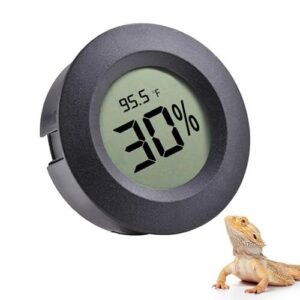
SunGrow’s round 1.8-inch display condenses Temperature and Humidity readings into a single digital view, streamlining Tank Monitoring across multiple vivariums. You’ll track ambient conditions with a 20–99% humidity range and 10-second sampling intervals—fast enough for Environmental Control adjustments during misting cycles.
The pre-installed LR44 battery powers startup immediately, though longevity averages two weeks under continuous use.
For Reptile Health protocols, conduct Device Calibration against laboratory-grade standards before placement. Position the Thermometer Hygrometer at substrate level in each enclosure to capture zone-specific Sensor Accuracy essential for Terrarium Temperature Control and Humidity Management for Reptiles.
| Best For | Reptile owners monitoring multiple enclosures who need quick temperature and humidity checks at an affordable price point. |
|---|---|
| Display Type | Digital |
| Power Source | LR44 Battery |
| Temperature Accuracy | Not Specified |
| Humidity Measurement | Yes |
| Installation Method | Compact Design |
| Unit Count | 1 |
| Additional Features |
|
- Dual readings on a compact 1.8-inch display make it easy to check both metrics at a glance without cluttering your tank setup.
- Fast 10-second updates let you catch environmental shifts quickly during misting or heating adjustments.
- Pre-installed battery means you can start monitoring right out of the package with no extra setup needed.
- Battery drains in about two weeks with continuous use, requiring frequent replacements that add up over time.
- Device auto-shuts off periodically, so you’ll need to press a button each time you want to check readings instead of glancing at a constant display.
- Accuracy can be inconsistent across units, and some devices fail completely, making calibration against a reliable standard essential before trusting the readings.
9. Weewooday Reptile Thermometer Hygrometer
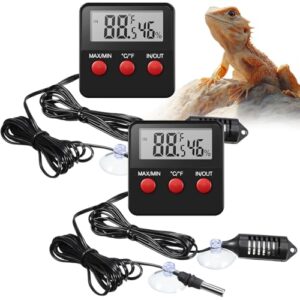
Weewooday’s dual-probe Thermometer Hygrometer monitors two Reptile Enclosure zones simultaneously with 1.5-meter cables—critical for mapping thermal gradients in larger Terrarium Temperature Control setups.
You’ll capture a -50℃ to 70℃ outdoor range and 10–95%RH humidity, though Temperature Accuracy drifts ±2℃ without regular Sensor Calibration against reference standards.
The magnetic mount and retractable clip bracket improve Device Durability across multi-tank arrays. Record min-max values automatically to track overnight fluctuations that compromise Reptile Health.
Verify Humidity Control readings weekly, as consumer-grade sensors lose precision in saturated environments without protective housings.
| Best For | Reptile keepers managing multiple enclosures or large terrariums who need affordable dual-zone monitoring with extended probe reach to track thermal gradients. |
|---|---|
| Display Type | Digital LCD |
| Power Source | AAA Battery |
| Temperature Accuracy | Not Specified |
| Humidity Measurement | Yes |
| Installation Method | Clip/Magnetic |
| Unit Count | 2 |
| Additional Features |
|
- Dual 1.5-meter probes let you monitor two zones or tanks at once, perfect for checking basking and cool spots without buying separate units.
- Wide temperature range (-50℃ to 70℃) and automatic min-max recording help you catch overnight swings that could stress your reptiles.
- Magnetic and clip mounting options make setup easy across different enclosure types, and the compact size keeps things tidy.
- Accuracy drifts by ±2℃ and humidity readings can be off by ±5-10%, so you’ll need to calibrate regularly against a reliable reference.
- No backlight means you’re squinting to read it in dim rooms or at night when most reptiles are active.
- Consumer-grade sensors lose precision over time in high-humidity environments, and the suction cups don’t hold well.
10. Repti Zoo Digital Thermometer Hygrometer
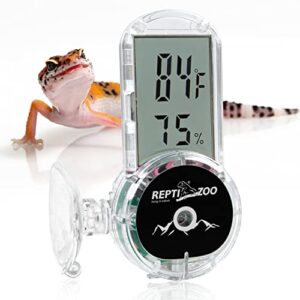
Repti Zoo’s four-sided mounting system fits glass, acrylic, or wire panels without compromising Device Durability over months of handling. You’ll track -10°C to 70°C with ±1°C Thermal Accuracy, though Sensor Calibration against a certified reference at 25°C verifies real-world performance.
The large LCD updates every ten seconds—essential for catching sudden drops that threaten Reptile Health in poorly insulated enclosures.
Combined temperature and Humidity Control (10–99% RH) in a single Digital Hygrometer reduces clutter when monitoring multiple habitats. Year-long battery life minimizes maintenance interruptions across extended breeding cycles.
| Best For | Reptile owners managing multiple enclosures who need reliable temperature and humidity tracking without constant battery changes. |
|---|---|
| Display Type | Digital LCD |
| Power Source | AAA Battery |
| Temperature Accuracy | Accurate |
| Humidity Measurement | Yes |
| Installation Method | 4-Sides Mounting |
| Unit Count | 1 |
| Additional Features |
|
- Four-sided mounting works on glass, acrylic, or wire without suction cups that fall off
- Wide temperature range (-10°C to 70°C) with ±1°C accuracy catches dangerous drops fast
- Year-long battery life means fewer interruptions during breeding seasons
- Some units arrive defective or drift from accurate readings over time
- Display can be hard to read in dim lighting despite the LCD screen
- Instructions don’t clearly explain how to switch between Celsius and Fahrenheit
Key Features to Look For
The right thermometer keeps your reptiles healthy, but not all devices deliver the same performance. When you’re monitoring multiple tanks, certain features become critical for accurate readings and reliable operation.
Let’s examine what separates effective multi-tank thermometers from basic models that might compromise your husbandry standards.
Accuracy and Temperature Range
You need your reptile thermometer to deliver reliable readings, and most quality models offer ±0.5°C to ±1.0°C temperature precision across typical enclosure ranges. That accuracy lets you maintain proper thermal gradients and respond quickly when heat source effects skew conditions. Check calibration methods regularly—sensor drift over 3 to 6 months can compromise temperature monitoring. Ensuring the thermometer’s readings are based on methodological rigor is essential for maintaining the health of your reptiles.
- Digital hygrometer thermometers often span 0°C to 50°C, covering bearded dragons to corn snakes
- Best reptile thermometers maintain consistency within ±0.3°C across multiple tanks
- Reptile digital thermometers near basking spots require shielded probes to avoid inflated readings
Humidity Measurement Capabilities
Your thermometer hygrometer combo should track humidity from 20% to 90% RH, with digital hygrometer accuracy at ±3% to ±5% RH for reliable reptile humidity monitoring across multi-tank setups. Look for models with temperature-compensated humidity sensors to reduce drift in varied conditions.
Calibration tips recommend checking sensor accuracy every 6 to 12 months—polymer capacitive hygrometers shift over time, so regular recalibration maintains consistent humidity ranges you can trust.
Display Readability and Backlighting
Your display clarity matters when you’re scanning five or more enclosures—high-contrast numerals on a large screen size improve legibility from across the room.
LED thermometer backlight options in white or blue light up readings in low-light conditions without disturbing nocturnal species.
Choose thermometer hygrometer combo units with adjustable brightness to reduce glare while maintaining color accuracy during night checks.
Power and Battery Life
After ensuring your displays stay bright through evening rounds, you need power sources that won’t fail mid-observation. Reputable reptile digital thermometer units run on AA or AAA battery types for up to 12 months under typical use, though continuous backlighting in reptile LED thermometer models increases power consumption. Look for devices with low battery alerts and energy efficiency features that extend charging cycles while maintaining accurate sensor technology performance across multiple enclosures.
- Wireless transmission drains batteries faster—Bluetooth-enabled units require more frequent replacements than standard wired models.
- USB-rechargeable lithium cells eliminate disposable waste—Full charging cycles complete in 2–3 hours for daily monitoring routines.
- Auto-dimming conserves power during overnight periods—PAIZOO reptile LED thermometer systems preserve battery life without sacrificing readability when you need it.
Mounting and Placement Options
Once you’ve secured reliable power, the physical installation determines whether your environmental monitoring for reptiles delivers meaningful data. Adhesive-backed strips rated for enclosure conditions attach sensors to exterior glass panels, while clamp-on probes secure to tank rims with silicone-coated brackets. Cable management clips organize sensor wires along racks, and modular arm mounts allow vertical adjustment across ceiling-mounted or wall-mounted setups.
| Mount Type | Best Application | Installation Method |
|---|---|---|
| Adhesive strips | Exterior glass panels | Peel-and-stick backing rated for humidity |
| Clamp-on brackets | Tank rims or lid edges | Silicone-coated grips for secure hold |
| Magnetic holders | Metal rack frames | Position at each tank corner for quick access |
| Modular arm mounts | Vertical rack systems | Adjustable arms spanning multiple enclosure heights |
Number of Sensors for Multi-Tank Use
Most reptile thermometer kits built for multi-tank setups supply two to four sensors per controller, though sophisticated environmental monitoring systems offer up to eight probes.
You’ll capture accurate thermal gradients across enclosures by positioning sensors at basking zones, mid-air points, and cool retreats in each tank.
Sensor calibration performed individually ensures consistent multi-tank monitoring, while proper sensor placement away from heating elements prevents skewed readings.
Digital Vs. Dial Thermometers
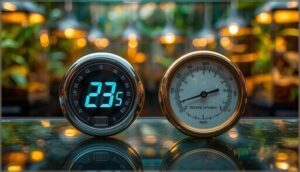
You’ll find two main options when choosing reptile thermometers: digital models with precise numerical displays and traditional dial gauges with analog readouts. Each type offers distinct advantages depending on your setup, budget, and monitoring needs.
Understanding the key differences between these formats helps you select devices that deliver reliable readings across all your tanks.
Pros and Cons of Digital Thermometers
You’re choosing between a device that gives you precision or one that requires almost nothing from you. Digital accuracy delivers readings within 0.1–1.0°C, often with automatic data logging and wireless monitoring. Battery life ranges from months to over a year, though humid enclosures can drain power faster.
Here’s what matters when evaluating a reptile digital thermometer:
| Advantage | Consideration |
|---|---|
| Fast sensor response (seconds) | Electronics sensitive to heat/humidity |
| Built-in hygrometer compatibility | Requires periodic calibration tips |
| Programmable alarms for safety | Error margins if battery dies unnoticed |
| Easy reptile enclosure maintenance tracking | Higher initial cost than dial models |
Sensor durability varies by model, so verify low-battery indicators before purchase.
Advantages of Dial Gauges
Battery failures won’t leave you guessing with dial gauges. You’ll appreciate their mechanical reliability in humid terrarium conditions where digital sensors often fail. Here’s what sets analog readings apart:
| Advantage | Practical Benefit |
|---|---|
| Zero power requirements | Works indefinitely without batteries |
| Immediate visual feedback | Spot temperature shifts at a glance |
| High humidity tolerance | Survives condensation in reptile enclosure design |
| Simple calibration tips | Adjust once using ice-water reference |
| Passes durability tests | Fewer failure points than electronics |
Dial accuracy remains stable across multiple tanks without firmware concerns.
When to Choose Each Type
Your multi-tank setup dictates which device delivers reliable temperature monitoring. Digital reptile thermometers excel when you need rapid readings across several enclosures, while dial units thrive in high-humidity terrariums where electronics falter. Sensor placement and device calibration determine accuracy regardless of type.
| Scenario | Best Choice | Reason |
|---|---|---|
| Rack systems with 6+ tanks | Digital multi-channel | Centralized humidity control and temperature data |
| Single naturalistic terrarium | Dial gauge | Survives moisture without battery concerns |
| Arid species enclosures | Separate hygrometer + digital | Precise thermometer selection for dry conditions |
| Breeding projects | Dual-sensor digital | Monitors distinct microclimates simultaneously |
| Budget-conscious setups | Analog dial | Lower cost, indefinite lifespan in reptile enclosure design |
Combining Thermometers and Hygrometers

When you’re managing multiple tanks, every piece of equipment matters. Combined thermometer-hygrometer units simplify your monitoring setup by tracking both temperature and humidity in a single device.
Understanding when to use these dual-function tools versus separate monitors helps you maintain ideal conditions without overcrowding your enclosures.
Benefits of Dual-Function Devices
Consolidating temperature and humidity measurement into one unit delivers synchronized readings that help you maintain consistent microclimates across multiple reptile enclosures. These dual gauges thermometers reduce clutter in your terrarium setup while providing at-a-glance environmental data.
Many integrated devices also offer data logging capabilities, allowing you to track trends over time and make proactive adjustments that keep your collection thriving.
Reducing Clutter in Multi-Tank Setups
When you manage several reptile enclosures, cable management and device mounting become essential for both functionality and aesthetics. A central hub with wireless sensors or short, routed leads minimizes visual noise while preserving accurate readings.
Sensor consolidation through multi-probe units keeps your terrarium setup simplified. Color-coded cables, flush-mounted probes, and shared power sources transform chaotic wiring into an organized monitoring system that facilitates effective reptile care and maintenance.
Separate Devices for Zone Monitoring
You’ll gain greater microclimate control by installing independent thermometers in each terrarium. Separate reptile thermometers prevent cross-tank heat influence and let you track zone temperature precisely within every reptile enclosure.
This approach simplifies tank calibration, captures distinct hot and cool zones that combined units miss, and enables multi-zone tracking when different species demand unique thermal gradients and sensor placement strategies.
Proper Placement and Setup Tips
Getting accurate readings from your thermometers depends on where and how you position them in each enclosure. Poor placement leads to misleading data that can put your reptiles at risk, while strategic sensor positioning gives you the full picture of your thermal gradients.
Here’s how to set up your devices correctly across multiple tanks.
Positioning Sensors for Thermal Gradients
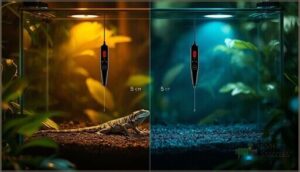
You’ll need at least two sensors per reptile enclosure to capture the full thermal gradient—one at the basking zone and another at the cooler end with a minimum 5 cm separation.
Position your reptile thermometer at the animal’s typical height, not against the glass or substrate, to guarantee accurate thermal mapping and effective microclimate management across your zones.
Avoiding Direct Heat and Moisture
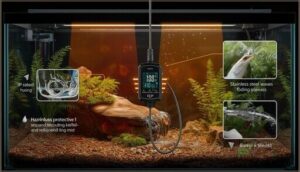
Once you’ve mapped your thermal zones, keep sensors away from direct radiant heat and splash zones. Position your reptile thermometer at least 10 cm from lamps to prevent skewed readings, and raise probes above substrate level to avoid moisture contact during cleaning. Shield temperature and humidity sensors from condensation by routing cables away from water features and misting areas.
- Install IP-rated housings around probes exposed to high humidity environments
- Use stainless steel or corrosion-resistant sensors for durability in moisture-heavy setups
- Place barrier materials between hygrometer faces and drip zones
- Inspect seals and cable entry points monthly for moisture intrusion
- Replace any corroded components immediately to maintain measurement integrity
Calibrating Devices for Accuracy
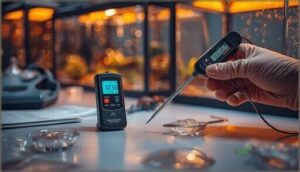
Precision matters when your animal’s health depends on a single degree. Start with sensor calibration by comparing your reptile thermometer against a certified reference device. Record temperature drift at multiple points—20°C, 25°C, and 30°C—to catch nonlinearities.
Run accuracy checks monthly using controlled environments, then verify hygrometer readings against saturated salt solutions. Document calibration methods and offsets for each device to maintain consistent readings across all your tanks.
Monitoring Hot and Cool Zones
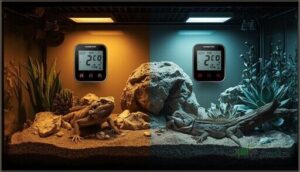
Thermal mapping reveals whether your reptile enclosure setup delivers the 5 to 10 degrees Fahrenheit difference needed for basking and retreat areas. Position one reptile thermometer near heat sources to track peak temperatures, then add a second at the cool end for gradient analysis.
- Mount sensors at animal eye level to capture representative zone control readings
- Check both temperature and humidity during environmental monitoring to correlate conditions with behavior
- Record data across multiple days to establish your terrarium maintenance baseline
Common Mistakes and How to Avoid Them
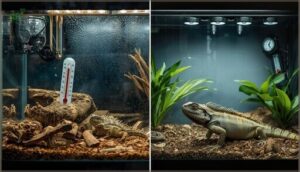
Even experienced keepers make basic monitoring errors that compromise their reptiles’ health. Poor thermometer placement, skipping calibration, and choosing unreliable devices create misleading readings that can stress or harm your animals.
Here’s what to watch for and how to keep your multi-tank setup running accurately.
Misplacing Thermometers in The Enclosure
Where you mount your thermometer determines whether you’re measuring air near the ceiling or the actual environment your reptile experiences. Position sensors at the animal’s typical body height—not at substrate level or under direct heat lamps—to capture accurate readings. Install units in fixed, labeled locations within each thermal zone to maintain consistency during feeding and cleaning routines.
| Correct Placement | Why It Matters |
|---|---|
| Mid-wall at reptile height | Reflects body-level temperature |
| Back corner of each zone | Prevents accidental removal |
| Away from direct heat | Avoids extreme, unrepresentative readings |
Calibrate your devices against a known standard periodically to detect drift and verify precision across all enclosures.
Relying on Inaccurate or Cheap Devices
Low-cost thermometers and hygrometers can drift several degrees from actual conditions, exposing your animals to undetected metabolic stress and respiratory issues. Cheap alternatives often lag behind rapid temperature shifts, delaying your response when basking sites overheat or ambient zones drop overnight.
- Inaccurate readings compromise species-specific thermal ranges
- Measurement errors undermine husbandry decisions across multiple tanks
- Poor sensor accuracy increases disease risk and handling stress
Verify every reptile digital thermometer against a calibrated reference to confirm precision. Regular device calibration catches temperature drift before it harms your collection, ensuring reliable temperature and humidity control throughout your reptile care routine.
Ignoring Calibration and Maintenance
Skipping quarterly accuracy checks allows sensor drift to silently compound calibration errors across your multi-tank setup. Without maintenance schedules, your reptile digital thermometer can underreport humidity by 5–15% or miss temperature shifts of up to 2°C, triggering metabolic stress that you won’t detect until symptoms appear.
| Neglect Consequence | Impact on Climate Control and Monitoring |
|---|---|
| Sensor Drift | Readings diverge 0.5–2.0°C over weeks |
| Calibration Errors | Thermostats over- or under-correct zones |
| Maintenance Gaps | Dust clogs sensor vents, reducing accuracy |
Establish verification protocols using a calibrated reference, clean sensor housings monthly, and log deviations to catch failures before your terrarium equipment and supplies compromise animal health.
Overlooking Species-Specific Needs
Generic thermometer placement ignores that your bearded dragon requires 95–110°F basking zones while tropical geckos need 75–85°F, risking organ dysfunction across mixed collections.
Species research reveals distinct thermal gradients—ball pythons tolerate 88–92°F hot spots versus 78–80°F ambient—so habitat design must match environmental factors to support reptile health.
Track species-specific ranges independently to prevent metabolic disease masquerading as behavioral quirks.
Maintaining Stable Tank Conditions
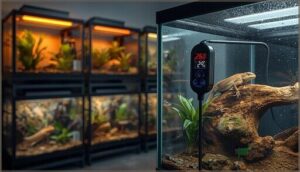
Stable tank conditions aren’t something you set once and forget—they require consistent monitoring and quick adjustments when readings drift. Temperature swings and humidity drops can stress your reptiles within hours, so catching problems early makes all the difference.
Here’s how to maintain the stability your animals need across multiple enclosures.
Preventing Harmful Temperature Fluctuations
Stability hinges on thermostatically controlled heating paired with automated alerts set to species-specific thresholds. You’ll want a dual-temperature approach—monitoring both substrate and ambient air—to catch rapid spikes before they harm your reptiles.
Position sensors across hot and cool zones, verify readings every 5–15 minutes, and maintain daily logs to guarantee consistent thermal monitoring and environmental stability across all tanks.
Monitoring Humidity for Healthier Reptiles
Track moisture levels with a calibrated hygrometer to support your reptile health and wellness goals. Species needs dictate whether you maintain 40% or 80% relative humidity—tropical inhabitants demand higher ranges than desert dwellers.
Consistent humidity control prevents respiratory infections and shedding complications in your tank environment. Pair your thermometer and hygrometer reviews with daily checks to catch swings before they compromise reptile habitat maintenance and overall reptile health.
Ensuring Consistent Readings Across Tanks
Once you’ve secured proper moisture levels, use the same thermometer model in every enclosure to simplify data comparison and thermal mapping. Calibration methods matter—align each digital hygrometer to a known reference before you deploy it. This approach aids reptile habitat maintenance by reducing sensor placement errors and meeting accuracy standards across your collection.
- Position probes at identical heights in each tank
- Record serial numbers and calibration dates for every device
- Compare readings weekly to catch drift early
- Adjust enclosure monitoring protocols when offsets appear
Consistent thermometer and hygrometer reviews confirm your reptiles receive uniform care.
Selecting The Right Thermometer for Your Setup
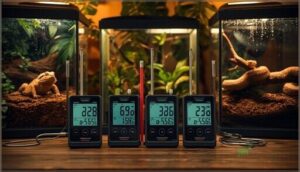
Your choice of thermometer depends on your specific setup and the species you keep. Enclosure type, number of tanks, and budget all play a role in determining which features you’ll actually use.
Let’s break down the key factors to help you match the right device to your monitoring needs.
Matching Thermometer Features to Enclosure Type
Your enclosure design directly shapes which reptile thermometer features you’ll need. Small terrariums with stable conditions require compact digital units featuring at least two sensors to track thermal gradient extremes.
High-humidity enclosures housing amphibian species demand sealed housings with integrated humidity control sensors to prevent corrosion.
Open-air racks benefit from backlit displays and flexible sensor placement that captures ambient temperature fluctuations across multiple zones.
Considering The Number of Tanks and Zones
When managing multiple tanks, you’ll need at least one reptile thermometer per enclosure to capture each terrarium’s unique thermal gradient. Tank size variations dictate sensor count—larger reptile enclosures require three probes for zone mapping strategies across basking, ambient, and cool areas.
Multi-tank calibration ensures consistency between readings, while sensor placement tips recommend positioning probes at reptile head height for thermal gradient analysis that reflects actual temperature and humidity exposure.
Budget and Long-Term Durability
Mid-range reptile thermometer models—priced $10 to $25 per unit—deliver the best cost analysis for multi-tank terrariums, with splash-resistant housings lasting two to three years in humidity-prone environments.
Durability tests confirm that devices using replaceable AA batteries and reinforced casings outperform budget options, reducing maintenance costs while safeguarding animal health through consistent temperature and humidity monitoring.
Longevity factors include IP44 ratings and corrosion-resistant materials that withstand frequent exposure.
User Reviews and Reliability
Consumer feedback routinely spotlights the REPTI ZOO Reptile Terrarium Thermometer Hygrometer and JEDEW Mini Digital Hygrometer Thermometer for sensor accuracy and product durability, though reliability tests reveal variability in long-term performance. User feedback on the PAIZOO Reptile Tank Thermometer notes straightforward setup, while Vodolo 2Pack Humidity Thermometers and REPTI ZOO Dual Gauges Thermometer draw mixed reviews on customer support responsiveness.
- Verified purchasers report sensor drift after six months in high-humidity vivariums.
- Battery longevity claims often underperform manufacturer specifications by 20–30 percent.
- Bundle pricing improves value, reducing per-unit costs for multi-tank installations.
Frequently Asked Questions (FAQs)
How often should I replace thermometer batteries?
Most digital thermometers run six to twelve months on standard batteries. Low battery alerts help prevent data gaps, but proactive swaps during routine tank maintenance guarantee continuous temperature and humidity monitoring.
Check display brightness monthly—dimming signals replacement time.
Can wireless thermometers work across multiple rooms?
Yes, wireless thermometers work across multiple rooms, though signal strength depends on wall materials and RF interference. Most RF-based units reliably transmit through two interior walls, while thicker concrete or metal structures may require additional sensor placement or Wi-Fi-enabled systems.
For accurate readings, consider using a smart temperature sensor to monitor conditions.
Do thermometers affect reptile behavior or stress?
Properly placed thermometers won’t stress your reptiles. However, invasive probes near basking sites or inaccurate readings can disrupt thermoregulation and trigger stress behaviors like glass surfing, lethargy, or reduced feeding in sensitive species.
Whats the ideal calibration schedule for accuracy?
You should verify your thermometer readings every one to two weeks during routine maintenance.
Calibration Intervals tighten to weekly during seasonal shifts, while Accuracy Checks prevent Sensor Drift from compromising Temperature Controls across your Maintenance Schedules.
Are smart thermometers compatible with automation systems?
Many Wi-Fi-enabled models integrate with Amazon Alexa, Google Home, and Home Assistant through cloud services or Tuya protocols.
These automation protocols enable remote climate control, though interoperability depends on manufacturer APIs and your chosen smart home platform.
Conclusion
You don’t need high-end laboratory equipment to protect your collection—just consistent accuracy across every enclosure. Investing in quality reptile thermometers for multiple tanks prevents the sensor drift and measurement gaps that compromise thermal gradients.
Choose devices with remote probes, verify calibration monthly, and position sensors where they’ll capture your animals’ actual basking and retreat temperatures. Precision instruments aren’t optional when metabolic health depends on microclimate stability.
Your reptiles can’t adapt to conditions you’re not accurately measuring.
- https://www.nature.com/articles/srep08861
- https://academichelpexpress.blog/2024/08/please-use-the-bulleted-points-and-the-rubric-below-to-guide-your-work-your-pa/
- https://www.sciencedirect.com/science/article/pii/S0749208123000268
- https://pmc.ncbi.nlm.nih.gov/articles/instance/9553038/bin/pone.0275964.s005.docx
- https://www.scribd.com/document/356795007/Research-Methods-Knowledge-Base