This site is supported by our readers. We may earn a commission, at no cost to you, if you purchase through links.

Your ball python refused its meal last week, and you noticed it huddling on the cool side of the enclosure instead of basking. You checked the thermometer—it read 78°F on the warm end, far below the 88-92°F your snake needs to digest properly. Temperature errors like this happen more often than keepers realize, especially when cheap analog gauges drift out of calibration or digital units fail in high-humidity environments.
Tropical snakes don’t have the luxury of adjusting their own body temperature; they depend entirely on the gradient you create, and even a few degrees off can trigger metabolic slowdowns, respiratory infections, or incomplete sheds.
Choosing the right reptile thermometers for tropical snakes means understanding which devices hold up in humid enclosures, where to place them for accurate readings, and how different models suit different species and setup sizes.
Table Of Contents
- Key Takeaways
- Best Reptile Thermometers for Tropical Snakes
- 1. Fluker’s Digital Thermometer Hygrometer
- 2. Zoo Med Dual Thermometer Humidity Gauge
- 3. Repti Zoo Digital Thermometer Hygrometer
- 4. ThermoPro Digital Hygrometer Thermometer
- 5. Inkbird Digital Thermometer Hygrometer Monitor
- 6. Paizoo Reptile Thermometer Hygrometer
- 7. Jedew Digital Hygrometer Thermometer
- 8. Exo Terra Reptile Thermometer
- 9. Reptile Tank Thermometer And Hygrometer
- 10. Repti Zoo Reptile Thermometer Hygrometer
- Key Features to Look For
- Types of Thermometers for Tropical Snake Enclosures
- Importance of Accurate Temperature Monitoring
- Optimal Placement for Thermometers
- Maintenance and Calibration Tips
- Species-Specific Temperature Requirements
- Maximizing Thermometer Effectiveness
- Frequently Asked Questions (FAQs)
- Conclusion
Key Takeaways
- Digital thermometers with external probes deliver ±1°F accuracy and are essential for tropical snakes because even small temperature errors (78°F instead of 88–92°F) trigger metabolic slowdowns, respiratory infections, and incomplete sheds.
- Proper thermometer placement requires separate devices in both warm and cool zones at snake head height—never directly under heat sources—to capture the actual temperature gradient your snake experiences as it moves between areas.
- Most tropical snakes need daytime gradients of 80–90°F with 60–80% humidity (species like ball pythons require 88–92°F basking spots), and combining temperature monitoring with humidity tracking in a single device simplifies maintenance while preventing health crises.
- Regular calibration every 1–2 months using ice baths or boiling water prevents sensor drift that can push readings off by several degrees, with high-humidity enclosures requiring checks every 2–4 weeks to maintain the precision tropical species demand for survival.
Best Reptile Thermometers for Tropical Snakes
Tropical snakes demand precise environmental control, and your thermometer acts as the foundation for maintaining those critical temperature gradients. After testing dozens of models in various enclosure setups, I’ve identified the units that deliver consistent accuracy in high-humidity conditions while remaining accessible for keepers at every experience level.
Here are the ten thermometers that consistently outperform their competitors for tropical snake habitats.
1. Fluker’s Digital Thermometer Hygrometer
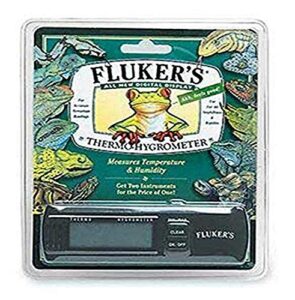
Fluker’s Digital Thermometer Hygrometer combines temperature monitoring and humidity sensors in a compact unit that measures just 4.5 x 0.5 x 6 inches. You’ll appreciate the easy-to-read digital displays showing both metrics simultaneously, which is essential for proper reptile care in tropical snake enclosures.
This battery-powered device mounts with adhesive strips, though some keepers report the adhesive doesn’t always hold securely.
While Fluker’s accuracy for temperature readings is generally reliable, several users note the hygrometer readings can be inconsistent. Thermometer calibration against a trusted reference device is recommended.
| Best For | Reptile and amphibian owners who need an affordable, straightforward way to monitor both temperature and humidity levels in terrariums and enclosures. |
|---|---|
| Display Type | Digital |
| Power Source | Battery |
| Measures Humidity | Yes |
| Material | Plastic |
| Mounting Method | Adhesive |
| Temperature Scale | Fahrenheit |
| Additional Features |
|
- Displays both temperature and humidity on a single digital screen, making it easy to check conditions at a glance
- Compact size fits neatly in most enclosures without taking up much space
- Simple battery-powered design means no complicated setup or wiring
- Hygrometer readings can be inconsistent or inaccurate according to multiple user reports
- Adhesive backing often fails to hold the device securely, causing it to fall off enclosure walls
- Pets may get stuck to the exposed adhesive if the unit detaches
2. Zoo Med Dual Thermometer Humidity Gauge
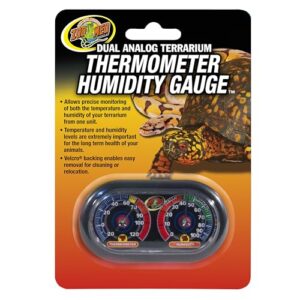
Zoo Med’s Dual Thermometer Humidity Gauge (model TH27) offers analog displays for both temperature and humidity monitoring in a single 6 x 1 x 4-inch unit. The Velcro backing is convenient for repositioning as your reptile enclosure setup evolves.
Several keepers report this gauge lacks digital accuracy compared to probe-based systems. Temperature readings in Fahrenheit help track ambient conditions, but calibration tips suggest verifying against a trusted digital device, as some users experience drift over time.
The dual displays provide quick reference points during routine maintenance checks. For keepers managing multiple enclosures, investing in reliable reptile thermometers for humidity control ensures each habitat stays within the precise parameters your animals need.
| Best For | Reptile keepers who want a budget-friendly way to monitor both temperature and humidity at a glance without needing digital precision. |
|---|---|
| Display Type | Analog |
| Power Source | Battery |
| Measures Humidity | Yes |
| Material | Plastic |
| Mounting Method | Velcro |
| Temperature Scale | Fahrenheit |
| Additional Features |
|
- Combines temperature and humidity readings in one compact unit, saving space in your enclosure
- Velcro backing makes it easy to move around as you adjust your setup
- No batteries needed for the analog display, so there’s nothing to replace
- Accuracy can be hit or miss—some users report temperature readings that drift over time
- Humidity measurements tend to be estimates rather than precise readings
- Not reliable for situations where you need exact numbers, like sensitive species or breeding setups
3. Repti Zoo Digital Thermometer Hygrometer
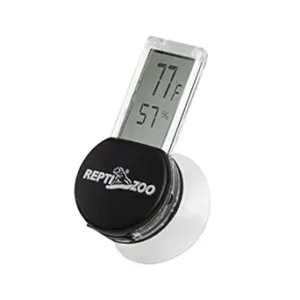
For keepers who want dependable digital accuracy without complicated setup, the Repti Zoo Digital Thermometer Hygrometer (model SH125B) delivers clear LCD readings through a battery-powered system that lasts up to 12 months before replacement. You’ll appreciate the dual mounting modes—suction cup or adhesive—that simplify thermometer placement in glass or plastic enclosures.
This thermometer hygrometer tracks both ambient temperature and humidity control with straightforward numeric displays, though you should verify sensor calibration every few months against a secondary device to confirm your tropical snake’s environment remains stable and healthful.
| Best For | Reptile keepers who need a straightforward, budget-friendly way to monitor both temperature and humidity in one device without dealing with complicated gauges or probes. |
|---|---|
| Display Type | Digital LCD |
| Power Source | Battery |
| Measures Humidity | Yes |
| Material | Glass/Plastic |
| Mounting Method | Suction Cup |
| Temperature Scale | Fahrenheit/Celsius |
| Additional Features |
|
- Clear LCD display shows both temperature and humidity at a glance, making it easy to check conditions without squinting at analog dials
- Dual mounting options (suction cup or adhesive) let you position it wherever you need in glass or plastic enclosures
- Battery lasts up to a year, so you won’t be constantly swapping out power sources
- Suction cup can be tricky to install and doesn’t always stick reliably, especially when trying to mount it sideways
- Not fully waterproof—exposure to water or heavy condensation can cause it to malfunction or stop working entirely
- Durability issues reported by some users, including fragile battery compartments and sensors that may drift over time without recalibration
4. ThermoPro Digital Hygrometer Thermometer
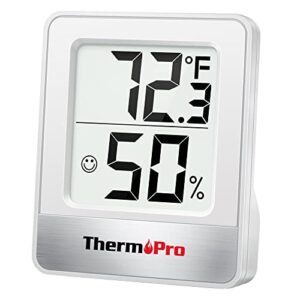
If you’re watching your budget without sacrificing digital accuracy, the ThermoPro Digital Hygrometer provides reliable temperature and humidity monitoring through its compact 2.6-inch display with large, readable digits. It’s especially useful if you’re working with smaller snake species that need precise environmental control in compact enclosures.
This reptile thermometer refreshes readings every 10 seconds, giving you near real-time temperature and humidity data for your reptile enclosure.
The included face icon comfort indicator helps you quickly assess whether conditions are too dry or too wet, though you’ll still want to reference species-specific thresholds for tropical snakes rather than relying solely on general comfort zones. Pairing these visual cues with proper airflow and temperature gradients can significantly reduce the risk of respiratory infections in captive snakes.
| Best For | Budget-conscious reptile keepers who need accurate digital monitoring for tropical snake enclosures without spending extra on advanced features. |
|---|---|
| Display Type | Digital LCD |
| Power Source | Battery |
| Measures Humidity | Yes |
| Material | Plastic |
| Mounting Method | Multiple Options |
| Temperature Scale | Fahrenheit/Celsius |
| Additional Features |
|
- Updates every 10 seconds so you catch temperature swings quickly before they stress your snake
- Accurate sensors (/-1°F and /-2-3% RH) give you reliable readings you can actually trust for maintaining proper humidity
- Multiple mounting options let you place it wherever you need it in your enclosure—magnet, stand, or hanging
- No backlight means you’ll need a flashlight for nighttime checks on nocturnal species
- Face icon comfort indicator is designed for human comfort, not reptile needs, so you’ll still need to know your snake’s specific requirements
- Outdoor accuracy suffers in direct sun or exposed spots, limiting placement flexibility if part of your setup gets natural light
5. Inkbird Digital Thermometer Hygrometer Monitor
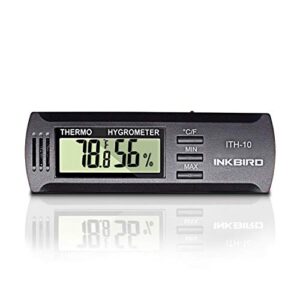
Compact dimensions—just 3.9 inches wide and 0.39 inches high—make the Inkbird ITH10 a space-efficient choice for smaller enclosures where every inch counts.
This digital thermometer hygrometer delivers temperature monitoring with ±1.8°F sensor accuracy and ±3% humidity precision, letting you track both metrics on clear digital displays.
Battery life extends up to 12 months on a single CR2032 cell, and the unit records maximum and minimum readings automatically.
While device calibration isn’t adjustable, the water resistance manages high-humidity tropical environments without compromising performance or reliability.
| Best For | Snake keepers with small tropical enclosures who need an affordable, compact monitor that tracks both temperature and humidity without taking up much space. |
|---|---|
| Display Type | Digital LCD |
| Power Source | Battery CR2032 |
| Measures Humidity | Yes |
| Material | Plastic |
| Mounting Method | Tabletop/Magnetic |
| Temperature Scale | Fahrenheit/Celsius |
| Additional Features |
|
- Compact 3.9-inch design fits easily in tight spaces without blocking views or taking up valuable enclosure room
- Records max and min readings automatically so you can track temperature and humidity swings even when you’re not watching
- Long 12-month battery life on a single CR2032 means fewer interruptions and less maintenance
- No calibration adjustment available, so if readings drift over time you can’t fine-tune accuracy
- ±1.8°F temperature accuracy is looser than some competing models, which may matter for species with narrow temperature tolerances
- Some users report display issues and variability in accuracy, requiring verification with secondary methods like a salt test
6. Paizoo Reptile Thermometer Hygrometer
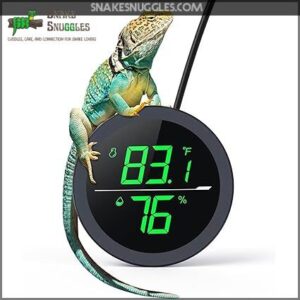
The PAIZOO Reptile LED Thermometer delivers dual temperature and humidity monitoring through a built-in high-precision chip that facilitates accurate environmental control for tropical snake habitats. The included 3M adhesive simplifies installation on glass or acrylic surfaces, though high-humidity environments may require periodic checks of device calibration to maintain paizoo accuracy for ideal reptile health.
You’ll appreciate the clear HD LED display paired with a 140 cm USB cable, which allows flexible thermometer placement without worrying about battery changes for up to 12 months in comparable battery-driven designs.
| Best For | Hobbyist snake keepers who want an affordable, easy-to-read digital monitor for tracking basic temperature and humidity in small to medium tropical enclosures. |
|---|---|
| Display Type | Digital LED |
| Power Source | USB |
| Measures Humidity | Yes |
| Material | Acrylic |
| Mounting Method | 3M Tape |
| Temperature Scale | Fahrenheit/Celsius |
| Additional Features |
|
- Clear LED display with dual readings makes it easy to check conditions at a glance without replacing batteries constantly
- Long USB cable and included adhesive give you flexible placement options inside or outside the tank
- Built-in precision chip delivers reliable measurements for everyday monitoring in reptile setups
- Some users report the display can stop working or show incorrect readings after several months of use
- The adhesive may lose grip in high-humidity environments, requiring remounting or alternative fasteners
- Lacks advanced features like data logging, wireless connectivity, or multiple probe zones found in premium monitors
7. Jedew Digital Hygrometer Thermometer
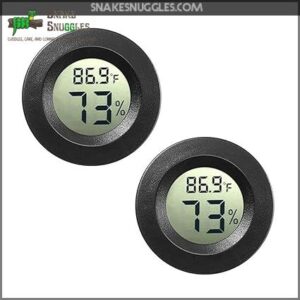
Budget-conscious keepers will find the Jedew Digital Hygrometer Thermometer combines practical temperature monitoring and humidity control in a portable design that suits smaller tropical snake enclosures. The digital displays refresh approximately every 10 seconds, showing temperature ranges from 0°C to 50°C with ±1°C sensor accuracy and humidity readings spanning 10% to 99% RH.
You’ll need to perform device calibration using the salt test method to verify readings, ensuring your reptile thermometers maintain reliable performance in high-humidity environments where digital thermometer precision directly impacts your snake’s health.
| Best For | Budget-conscious snake keepers who need a basic, portable monitor for smaller tropical enclosures and don’t mind doing manual calibration to get accurate readings. |
|---|---|
| Display Type | Digital LCD |
| Power Source | Battery LR44 |
| Measures Humidity | Yes |
| Material | Plastic |
| Mounting Method | Standalone |
| Temperature Scale | Fahrenheit/Celsius |
| Additional Features |
|
- Affordable price point makes it accessible for beginners or those monitoring multiple enclosures without breaking the bank
- Quick 10-second refresh rate and wide measurement ranges (0-50°C, 10-99% RH) give you timely data for most tropical snake habitats
- Compact and portable design lets you easily move it around or place it in tight spots within your enclosure
- Requires manual calibration using the salt test method to ensure accuracy, which adds extra setup time and effort
- Mixed user feedback on reliability, with some reporting the humidity readings can be off by 5% or more even after calibration
- Temperature accuracy of ±1°C and humidity accuracy of ±5% RH are less precise than higher-end models, which might matter for sensitive species
8. Exo Terra Reptile Thermometer
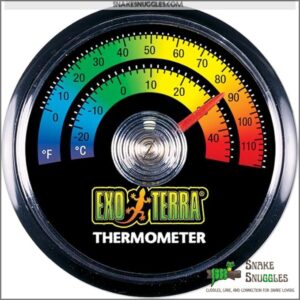
You can place the Exo Terra Reptile Thermometer’s analog dial on enclosure glass using the included adhesive dot. However, durability concerns and mixed feedback on sensor accuracy mean you’ll need regular thermometer calibration checks every few months.
The clear plastic design displays both Celsius and Fahrenheit readings for straightforward temperature monitoring. Yet, some keepers report difficulty reading the display in dimmer lighting conditions.
While the compact 4.1 × 0.7-inch unit suits smaller tropical snake terrariums, pairing it with a separate digital thermometer ensures reliable reptile health through accurate humidity control verification.
| Best For | Reptile keepers who want a budget-friendly backup thermometer for quick visual temperature checks in smaller terrariums. |
|---|---|
| Display Type | Analog |
| Power Source | None |
| Measures Humidity | No |
| Material | Plastic |
| Mounting Method | Adhesive Dot |
| Temperature Scale | Fahrenheit/Celsius |
| Additional Features |
|
- Displays both Celsius and Fahrenheit on a single analog dial for easy reading
- Includes adhesive backing for simple installation on glass surfaces
- Compact size works well in smaller tropical or desert enclosures
- Mixed reviews on accuracy and reliability, requiring frequent calibration checks
- Display can be difficult to read in low-light conditions
- Durability issues reported, with some units breaking or losing adhesion quickly
9. Reptile Tank Thermometer And Hygrometer
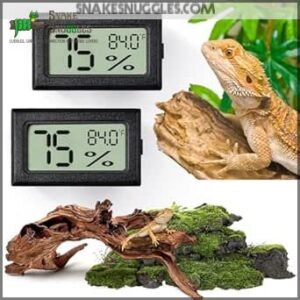
Your reptile tank benefits from dual-zone temperature monitoring when you install a combined thermometer hygrometer at both basking and cooling ends. Digital thermometer models with external probes deliver ±1°F accuracy for reliable environmental sensors that safeguard reptile health through precise humidity control and tank monitoring.
Battery-powered units offer flexible placement without electrical outlets cluttering your enclosure. Regular thermometer calibration against ice-water references ensures your temperature monitoring remains trustworthy, preventing the shedding issues and respiratory stress that plague tropical snakes in poorly regulated environments.
| Best For | Reptile owners who need an affordable way to track temperature and humidity in multiple zones of their tank without running extra wires. |
|---|---|
| Display Type | Digital LED |
| Power Source | Battery |
| Measures Humidity | Yes |
| Material | Plastic |
| Mounting Method | Double-Sided Adhesive |
| Temperature Scale | Fahrenheit/Celsius |
| Additional Features |
|
- Digital display with 0.9°F accuracy gives you reliable readings you can trust for your snake’s health
- Two-pack design lets you monitor both warm and cool sides so you catch gradient problems early
- Battery-powered setup means no messy cords or hunting for outlets near the enclosure
- Adhesive backing can lose grip over time and the unit might drop into the tank
- Water-resistant but not waterproof, so high-humidity setups could damage it eventually
- Some users report temperature readings drift off target and need recalibration
10. Repti Zoo Reptile Thermometer Hygrometer
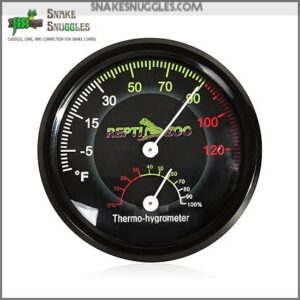
You won’t find many analog units competing with this digital thermometer hygrometer’s ±1–2–C accuracy and combined humidity tracking in the same compact housing. The Repti Zoo Reptile Thermometer delivers reliable temperature and humidity monitoring through a sensor probe that responds within minutes, making reptile care and maintenance straightforward for tropical species.
Device mounting uses adhesive backing, though longevity varies, and battery lifespan usually reaches 6–12 months with standard coin cells. Regular sensor calibration against known references keeps your temperature alerts dependable, preventing the costly health setbacks poor reptile thermometers cause.
| Best For | Reptile owners who need affordable, dual-function monitoring for tropical snake enclosures and want quick temperature response without complicated setup. |
|---|---|
| Display Type | Analog |
| Power Source | None |
| Measures Humidity | Yes |
| Material | Plastic |
| Mounting Method | Sticky Pad |
| Temperature Scale | Fahrenheit/Celsius |
| Additional Features |
|
- Combined temperature and humidity tracking in one compact unit saves space and money compared to buying separate devices
- Fast-responding sensor catches environmental changes within minutes, helping you maintain stable conditions for tropical species
- Simple adhesive mounting and straightforward digital display make it easy to install and read at a glance
- Accuracy feedback is mixed, with some users reporting inconsistent humidity readings that require calibration checks
- Adhesive backing may lose stickiness over time, causing the unit to fall off enclosure walls
- Battery replacements every 6–12 months add ongoing maintenance compared to analog alternatives
Key Features to Look For
Not all thermometers are built to handle the demanding conditions inside a tropical snake enclosure, where high humidity and precise temperature control are non-negotiable. You need equipment that won’t fog up, lose accuracy, or fail when your snake depends on it most.
Here are the essential features that separate reliable monitoring tools from devices that’ll leave you guessing about your enclosure conditions.
Digital Vs. Analog Accuracy
When you’re choosing between digital and analog models, precision matters. Digital thermometers deliver numerical readings with minimal measurement variance, often accurate to within 0.5°C, thanks to sensor calibration and electronic compensation. Analog limitations—parallax error, scale interpretation, and temperature fluctuations—can reduce repeatability.
For reliable temperature monitoring in tropical enclosures, digital precision outperforms analog designs, ensuring your snake’s environment stays stable. This emphasis on precision is similar to the importance of methodological rigor in scientific research, where accuracy and reliability are essential.
Water-Resistant and Humidity Tolerance
Tropical enclosures challenge your devices with frequent misting and high humidity, so look for models rated IP54 or higher for splash resistance and moisture protection.
Most digital hygrometer units maintain accuracy within ±2% RH at 75% relative humidity, using sealed housings and polymer capacitive humidity sensors that resist corrosion.
Water-resistant thermometers with environmental durability guarantee reliable thermal accuracy and long-term humidity tolerance in your snake’s habitat.
Mounting and Placement Options
You’ll find suction cups, magnetic mounts, and adhesive plates as your main mounting styles, each suited to different enclosure layouts.
For accurate sensor positioning, clip devices to branches at head height in warm and cool zones, keeping probes 2–3 inches above substrate to measure ambient air while avoiding direct heat lamps. Thoughtful thermometer placement facilitates zone monitoring and reveals your temperature gradient clearly.
Display Readability and Size
A clear display matters just as much as precise mounting—you won’t catch false readings if you can’t see your digital thermometer from across the room. Look for large font sizes and high-contrast screens that remain legible in dim light or bright sunlight.
Screen brightness and visual accuracy help you spot temperature swings quickly, keeping your tropical snake’s environment stable and your hygrometer readings easy to interpret.
Battery Life and Power Options
Most reptile thermometers run on coin-cell or AA batteries, delivering six to twelve months of reliable temperature monitoring before replacement. Digital sensors with low battery alerts prevent undetected drift, while power savings modes extend operation when readings stay stable.
USB charging and solar options suit permanent setups, though traditional battery types like CR2032 remain the standard for portable digital thermometer units tracking your snake’s environment.
Types of Thermometers for Tropical Snake Enclosures
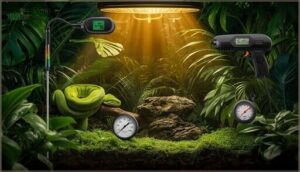
Choosing the right thermometer for your tropical snake’s enclosure means understanding the different types available and how each one fulfills a specific purpose. Some measure surface temperatures instantly, while others track ambient conditions over time or combine multiple readings in one device.
Let’s break down the five main types you’ll encounter so you can pick the best fit for your setup.
Digital Thermometers
When you need continuous temperature monitoring for your tropical snake, digital thermometers deliver reliable data every few seconds through built-in sensors and separate probes. These devices excel at tracking both ambient air and substrate conditions simultaneously:
- Built-in sensors display updated ambient readings every 10–30 seconds for real-time awareness
- External probes measure basking zone or floor temperatures with 0.5–1.0°F sensor accuracy
- Large backlit digital displays guarantee readability even in low-light environments
- Battery or USB power options provide flexibility, with some units offering 6–12 months of operation
Many models integrate humidity sensing for combined climate tracking, while temperature calibration features help maintain precision over time. Data logging capabilities allow you to review historical trends and spot environmental fluctuations before they impact your snake’s health—critical for species requiring stable 28–32°C daytime conditions.
Infrared Thermometers
Quick surface checks become straightforward with infrared thermometers—you simply aim and measure basking spots without disturbing your snake. These non-contact devices provide readings in seconds across typical enclosure ranges, though you’ll need proper emissivity settings for infrared accuracy on different substrates.
Digital infrared thermometer models offer reliable thermal imaging for temperature monitoring, yet they don’t track continuous ambient conditions or humidity unless paired with dedicated reptile thermometers.
| Feature | Capability | Limitation |
|---|---|---|
| Non-contact measurement | Instant basking spot verification | No continuous monitoring |
| Temperature calibration | Adjustable emissivity settings | Requires proper substrate configuration |
| Infrared thermometry range | Covers 20–60°C enclosure needs | No humidity tracking |
Probe Thermometers
When you need both precision and flexibility in temperature monitoring, probe thermometers deliver sensor placement exactly where it matters—substrate, hide boxes, or ambient zones.
These reptile thermometers feature digital displays with wired sensors that you position away from direct heat for probe accuracy, often supporting multiple probe ports for complete reptile temperature control.
Regular temperature calibration ensures reliable data logging, while proper wire management keeps your enclosure tidy and functional.
Smart Thermometers
Imagine checking your tropical snake’s environment from across town—that’s where Smart Thermometers shine. These digital thermometer units sync temperature monitoring data to your phone, sending temperature alerts when conditions drift beyond safe ranges.
You’ll access data analytics, adjust remote controls, and perform sensor calibration through mobile monitoring apps. Many thermometer hygrometer models log historical trends, helping you spot patterns before they threaten your reptile’s health.
Combo Thermometer-Hygrometers
When your tropical snake’s health hangs on both warmth and moisture, Combo Thermometer-Hygrometers deliver dual sensor convenience in one unit.
These reptile thermometers track temperature accuracy alongside humidity control with clear digital displays, often offering wall-mounted or probe-based sensing options.
You’ll monitor both parameters simultaneously, and many models include calibration tips plus min/max records for complete environmental management.
Importance of Accurate Temperature Monitoring
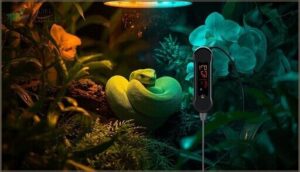
Temperature control isn’t just about keeping your snake comfortable—it’s about keeping them alive. When your thermometer readings drift even a few degrees outside the ideal range, you’re putting your tropical snake at risk for serious health problems, from failed sheds to fatal organ dysfunction.
Temperature control for tropical snakes isn’t about comfort—it’s about survival, where even minor thermometer drift can trigger fatal health crises
Getting accurate temperature monitoring right means understanding exactly what’s at stake and how precise control affects every aspect of your snake’s daily physiology.
Preventing Health Issues in Tropical Snakes
Precision in environmental monitoring shields your snakes from preventable snake health risks that stem from inadequate temperature gradients and humidity monitoring. When your reptile thermometers don’t capture accurate readings, you’re inviting environmental stress that manifests as metabolic disorders, shedding complications, and digestive failures.
Proper health monitoring through reliable devices promotes reptile health and wellness, preventing dehydration, bacterial infections, and the respiratory issues that compromise reptile care in tropical habitats.
Correct Ambient Vs. Basking Temperatures
Understanding the difference between ambient and basking zones prevents thermal shock while supporting your snake’s natural thermoregulation. Your reptile thermometers should confirm ambient control maintains stable baseline temperatures—usually 28–32°C during daylight—while basking spots reach several degrees higher near heat sources.
This temperature gradient lets tropical snakes move between zones freely, optimizing digestion and metabolism without stress. Regular temperature monitoring across both areas ensures proper reptile temperature control.
Impact on Shedding, Hydration, and Digestion
Proper temperature gradients and humidity control directly shape three essential processes tracked by your reptile thermometers:
- Shedding cycles rely on stable heat and 70–90% humidity levels to prevent retained shed on eyes and tails.
- Hydration levels depend on consistent moisture to avoid sunken eyes and wrinkled skin.
- Digestion rates improve when basking zones maintain metabolic efficiency after meals.
Accurate monitoring safeguards reptile health across all three fronts.
Optimal Placement for Thermometers
Getting an accurate reading means knowing where to put your thermometer in the first place. You can’t just stick it anywhere and expect reliable data—placement directly affects whether your tropical snake lives in a safe, stable environment or one that’s dangerously off-target.
Here’s how to position your devices for the most dependable temperature monitoring.
Positioning in Warm and Cool Zones
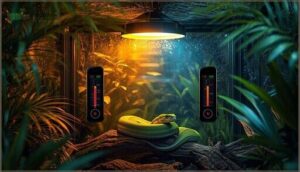
You’ll need to place one sensor near your basking spots to capture peak warmth from the heat source, while positioning a second reptile thermometer in the cool zones to verify ambient monitoring across the thermal gradients.
Mount both at snake height—not pressed against walls or directly beside the heat source—so sensor placement reflects the actual temperature gradient your tropical snake experiences as it moves between zones.
Monitoring Substrate and Ambient Temperatures
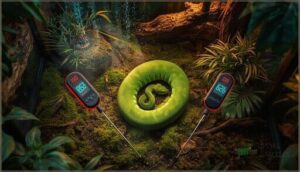
Your tropical snake needs reliable temperature monitoring at two critical levels: the surface where its body contacts the substrate and the air circulating throughout the enclosure. Use digital thermometers with probe attachments for substrate readings, plus standard units to track ambient temperatures in both warm and cool zones.
Sensor calibration every few months prevents dangerous temperature fluctuations that compromise thermal gradients essential for healthy thermoregulation.
Avoiding False Readings From Heat Sources
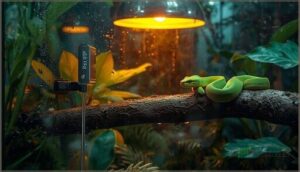
Radiant heat from basking lamps and heating pads can skew your reptile thermometers by 5–10°F, completely undermining thermal gradients your tropical snake depends on for thermoregulation. Reliable thermometer accuracy demands sensor shielding and strategic placement:
- Position digital thermometer probes 2–3 inches away from direct heat sources to measure true ambient conditions.
- Mount sensors at mid-enclosure height, avoiding substrate contact that amplifies heat conduction effects.
- Use infrared thermometers cautiously, as glossy surfaces reflect heat source interference into readings.
- Follow calibration protocols quarterly to verify your thermometer accuracy remains stable across zones.
Using Multiple Devices for Accuracy
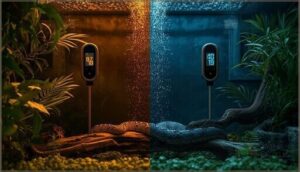
By cross-verifying readings from at least two digital thermometers positioned in warm and cool zones, you’ll detect localized variation that single-sensor setups miss entirely. Device calibration every three months against a traceable reference ensures data validation across your thermal profiling efforts.
When digital monitoring tools and thermometer and hygrometer reviews confirm concordant accuracy metrics within ±1–2°C, you’ve established reliable temperature gradient benchmarks for ideal sensor placement.
Maintenance and Calibration Tips
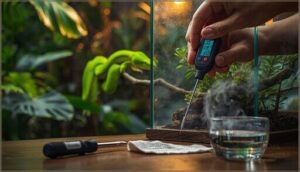
Even the best thermometer won’t serve you well if it drifts out of calibration or stops working when you need it most. Regular maintenance keeps your monitoring equipment reliable, which directly affects your snake’s health and comfort.
Here’s how to keep your thermometers accurate and functioning properly over the long term.
Regular Calibration Schedules
You’ll want to calibrate your reptile thermometers every one to two months to catch sensor drift before it compromises accuracy checks. Environmental factors like moisture exposure can push readings off by several degrees, and recalibrating after battery changes ensures your temperature and hygrometer readings stay within that critical ±1°F tolerance your snake depends on.
High-humidity tropical enclosures accelerate drift, so tighten your maintenance schedules to every two to four weeks in those conditions.
Battery Replacement Guidelines
Your digital thermometer won’t stay reliable if you let dead batteries linger, especially in humid tropical enclosures where corrosion accelerates.
Follow these replacement tips to maintain device calibration and temperature accuracy:
- Use only manufacturer-approved lithium coin cells or AA/AAA batteries to prevent chemical leaks and sensor drift.
- Replace at the first sign of reduced accuracy, corrosion, or swelling.
- Dispose of old batteries properly at hazardous waste facilities or recycling centers.
Cleaning and Care Best Practices
Keep your thermometer working properly by wiping surfaces monthly with a damp cloth and mild soap, and using 70% isopropyl alcohol on probes to prevent bacteria buildup. Remove batteries before cleaning to avoid short circuits in humid conditions, then dry all components thoroughly.
Schedule sanitization during substrate changes to maintain sensor durability and device calibration, ensuring accurate temperature and humidity readings for ideal reptile enclosure maintenance.
Troubleshooting Inaccurate Readings
Even after careful cleaning, sensor drift and reading inconsistencies can plague your reptile thermometers. When you notice temperature variance exceeding 2°C between devices in the same zone, run calibration checks using an ice bath (0°C) or boiling water (100°C at sea level).
Device validation every 2–4 weeks catches problems early, ensuring thermometer accuracy for your tropical snake’s health and well-being.
Species-Specific Temperature Requirements
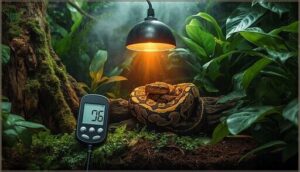
Your thermometer might be reading perfectly, but if you’re aiming for the wrong temperature range, your snake won’t thrive. Different species have evolved in distinct climates, which means their captive environments need to mirror those specific conditions.
Below, you’ll find the precise temperature and humidity parameters for popular tropical and semi-tropical snakes to help you dial in your setup correctly.
Ball Python Temperature and Humidity Needs
Ball pythons thrive when you maintain a temperature gradient from 75–85°F in the cool zone to 88–92°F at the basking spot, with nighttime temperatures staying above 72–75°F.
Your humidity control should hover between 50–60%, increasing to 60–70% during shedding to support snake health.
Reliable digital thermometers and humidity monitoring devices help you track these thermal cycles and guarantee environmental stability across different enclosure zones.
Corn Snake Preferred Ranges
Corn snakes need a cooler baseline than ball pythons, with the basking area holding steady at 82–90°F and the warm side ambient around 75–85°F. Your reptile thermometers should confirm nighttime drops to 68–75°F, mimicking natural thermal cycles. Humidity levels stay moderate at 40–60%, rising slightly during shedding to support healthy skin release.
- Position a thermometer hygrometer at both ends to track the temperature gradient across your snake enclosure
- Monitor substrate moisture to prevent excessive dryness without creating damp spots
- Adjust environmental factors seasonally to reflect subtle tropical shifts in your reptile temperature control setup
Boa Constrictor Environmental Demands
Boa constrictors demand warmer conditions than corn snakes, with ambient temperatures holding at 82–86°F and basking zones reaching 88–92°F. Reptile thermometers should track these temperature gradients carefully, since boas rely on precise thermal cycling for digestion and metabolism.
Humidity levels between 60–70% support healthy shedding, while substrate selection influences moisture retention across the enclosure design you’ve built for reptile care.
General Tropical Snake Guidelines
Most tropical snakes thrive when you maintain a temperature gradient between 80 and 90°F during daylight hours, dropping to 70–75°F at night. Pair this gradient with humidity levels between 60% and 90%, depending on species, to support snake health and proper shedding.
Accurate temperature monitoring through quality reptile thermometers ensures your enclosure design meets the physiological demands tropical snake care requires for long-term wellness.
Maximizing Thermometer Effectiveness
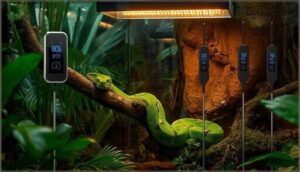
Owning a quality thermometer is just the first step—you need to use it strategically to maintain the precise conditions tropical snakes require. Smart setup, proper integration with your heating system, and awareness of common pitfalls will transform your monitoring from basic to bulletproof.
Here’s how to get the most from your temperature monitoring equipment and avoid the mistakes that compromise snake health.
Setting Up Alerts and Notifications
Smart thermometers with alert systems let you catch dangerous temperature or humidity swings before they harm your snake. Configure threshold settings that match your species’ needs—most digital thermometers allow custom notification rules via app or audible alarms.
Remote monitoring means you’ll receive alerts even when you’re away, while regular sensor calibration ensures your sensor technology triggers warnings at exactly the right moment.
Combining With Other Environmental Controls
When you integrate your thermometer with a multi-parameter control system, you’re creating a synchronized environment that responds automatically to your snake’s needs. Thermostat integration prevents dangerous overheating, while humidity monitoring paired with temperature control maintains the stable microclimate tropical species require.
- Use environmental synchronization to coordinate heating, lighting, and humidity systems
- Configure automated adjustments for natural day-night temperature cycles
- Position hygrometer accuracy sensors away from direct moisture sources
- Install fail-safe alerts for extreme temperature or humidity events
- Match substrate moisture monitoring to your species’ specific requirements
This terrarium maintenance approach transforms isolated readings into cohesive reptile habitat management.
Common Mistakes to Avoid
You’ll undermine your reptile care efforts if you rely on a single thermometer hygrometer to monitor the entire temperature gradient. Probe placement errors, calibration neglect, and sensor malfunctions produce inaccurate readings that jeopardize your snake’s health.
Temperature drift occurs when you skip the recommended 3-6 month calibration schedule, and positioning probes under substrate or inside hides creates misleading data that doesn’t reflect actual environmental conditions.
Understanding the importance of thermal gradient is essential for maintaining a healthy environment.
Upgrading for Larger or Multi-Zone Enclosures
When your reptile tank exceeds four feet, you’ll need at least two independent digital thermometers with multi-sensor capability to capture accurate thermal gradients across distinct zones.
Position probes at snake head height in warm, middle, and cool areas—never directly under heat sources—then calibrate every three to six months to verify your large enclosure maintains the precise temperature gradient tropical species require.
Frequently Asked Questions (FAQs)
How often should thermometer batteries be replaced?
Most digital thermometers need fresh batteries every six to twelve months. Watch for low battery alerts, and replace immediately if temperature monitoring becomes unreliable—calibration checks help confirm your device stays accurate between replacement schedules.
Can thermometers measure both day and night cycles?
Yes, many digital thermometers with data-logging features track thermal variation across day-night cycles, enabling circadian monitoring.
Smart models deliver continuous temperature monitoring and cycle accuracy, capturing complete temperature fluctuation patterns for reliable reptile care.
Do infrared thermometers work through glass enclosures?
Glass interference greatly limits infrared thermometers, as they measure the glass surface rather than your snake enclosure’s actual interior temperature. This causes optical distortion and inaccurate thermal accuracy despite their convenience for surface readings.
Whats the ideal humidity range for tropical snakes?
Most tropical snakes thrive in 60 to 80 percent relative humidity, though moisture-dependent arboreal species often need 70 to 90 percent. You’ll want calibrated hygrometers monitoring these levels continuously for ideal snake health.
Are wireless thermometers more accurate than wired ones?
Ironically, wireless thermometers don’t automatically win the accuracy race—signal interference and wireless drift can undermine precision. Wired sensors provide stable, continuous temperature monitoring with minimal data latency, though proper calibration methods and sensor placement matter most for thermometer accuracy.
Conclusion
Your snake’s health hinges on whether you can maintain precise thermal gradients—a truth underscored by every refused meal and incomplete shed you’ve witnessed.
Investing in reliable reptile thermometers for tropical snakes transforms guesswork into measurable control, letting you catch temperature swings before they trigger metabolic stress.
Place devices strategically, calibrate regularly, and monitor both zones consistently.
When your setup delivers stable warmth and accurate readings, your snake thrives with predictable digestion, perfect sheds, and long-term vitality.
- https://www.nature.com/articles/srep08861
- https://academichelpexpress.blog/2024/08/please-use-the-bulleted-points-and-the-rubric-below-to-guide-your-work-your-pa/
- https://www.amazon.com.be/-/en/Thermometer-Hygrometer-Humidifiers-Dehumidifiers-Black-4Pack/dp/B07GR67G1M
- https://manuals.plus/jedew/jedew-round-digital-hygrometer-thermometer-user-manual
- https://www.ubuy.tg/en/product/13LWG06O-jedew-4-pack-mini-hygrometer-thermometer-digital-lcd-monitor-indoor-outdoor-humidity-meter-gauge-for