This site is supported by our readers. We may earn a commission, at no cost to you, if you purchase through links.
A 36-inch tank looks roomy until your ball python hits four feet and can’t stretch out. Snakes don’t complain. They just curl up tight, stay stressed, and slowly stop thriving.
Most husbandry problems trace back to the enclosure itself. A loose lid becomes an escape route, a misplaced probe hides a cold basking spot, and a UVB bulb behind glass does nothing at all. Good reptile environment creation means getting size, heat, humidity, light, and security right together.
You’ll start with the enclosure, because every other choice depends on it. Here’s how to build a habitat your snake can actually live in.
Table Of Contents
- Key Takeaways
- Choose a Safe Reptile Enclosure for Your Snake’s Species and Size
- Set Up Species-Specific Temperature Gradients and Humidity
- Provide Appropriate UVB Lighting and Day–Night Cycles
- Design Your Snake’s Habitat With Substrate, Hides, and Enrichment
- Maintain Your Reptile Environment With Daily Checks and Cleaning
- Frequently Asked Questions (FAQs)
- What is the Holy Grail of reptiles?
- Can you give me 10 examples of reptiles?
- How much of human DNA is reptilian?
- How can I create a lizard habitat in my backyard?
- What makes a good reptile habitat?
- How do you make a reptile habitat scaly?
- What is a substrate for a reptile?
- How do I choose the perfect lighting for my reptile habitat?
- What is amphibian and Reptile Conservation?
- How do you care for a reptile?
- Conclusion
Key Takeaways
- Size your enclosure to your snake’s full adult length, since a tank that’s too short leaves it unable to stretch out, and lock the lid and mesh every vent so there’s no gap wider than its head.
- Build a temperature gradient with a warm basking spot and a cooler end, put the thermostat probe at basking level, and track humidity with a hygrometer at animal level in both zones.
- Mount any UVB bulb inside the enclosure or over a screen top, never behind glass or plastic, and keep it on a timer for a steady 12-hour day and night cycle.
- Give your snake the right substrate depth, at least two snug hides (one warm, one cool), and a quick daily check of waste, water, temperatures, and escape routes, with deeper cleans every few weeks.
Choose a Safe Reptile Enclosure for Your Snake’s Species and Size
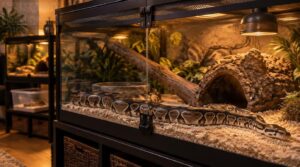
You’ll want to start with the right enclosure size, because even your substrate choice depends on it. Adult ball pythons need at least 48×24×24 inches, and corn snakes do best at 48×18×18 inches. A 36-inch tank leaves a mature snake unable to stretch out.
Once you’ve settled on a size, this ultimate snake habitat guide shows how to arrange heat gradients, hides, and humidity inside it.
Match tank size to growth. Hatchling corn snakes fit a 20-gallon long, juveniles move to a 40-gallon breeder, and adults need the full four-foot enclosure. Ball python hatchlings can start in a 10-gallon, and juveniles under three feet need 36×18×18 inches. Ball pythons also do best in an enclosure at least as long as they’re, so a 5′ snake needs a 5′ enclosure to stretch out fully.
Snakes are relentless escape artists, so you need a secure lid or a front-opening design with locking latches. Cover vents with fine mesh, because habitat safety compliance means no gaps wider than a head.
Snakes are escape artists, so lock the lid and mesh every vent until no gap is wider than a head
Set Up Species-Specific Temperature Gradients and Humidity
Your snake’s health depends on getting heat and moisture right, and species-specific temperature gradients are where you start.
You’ll work through two pieces below: how to heat and monitor the enclosure, then how to control humidity and airflow. Get both dialed in, and your setup will feel like a small slice of your snake’s native habitat.
If your snake is wheezing or breathing with its mouth open, this guide to treating snake parasitic respiratory infections explains which warning signs to watch for before your vet visit.
Heating, Thermostats, and Temperature Monitoring
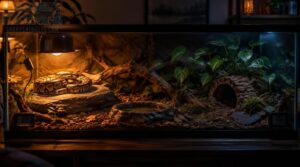
Why does heat matter so much? Your snake can’t warm itself, so temperature control is essential.
Build temperature gradients with a basking spot and a cooler end, so thermoregulation stays possible.
- Place the probe at basking level.
- Match thermostat wattage to your heater.
- Add thermometers at both ends.
- Run regular temperature checks.
Watch for thermal barriers that block warmth, too.
In classrooms, where lamps and heat mats often share a tight footprint, a set of reptile thermometers for classroom habitats helps you spot warm-air pockets that insulation or barriers might be trapping.
Humidity Control and Ventilation
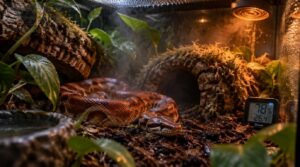
Heat is only half the climate. Your humidity levels matter just as much, and humidity level management starts with a digital hygrometer at animal level in both warm and cool zones.
Blood pythons and boas like 65-75%, rising to 80% during shed. Mist daily, use moisture-holding substrate, and cover half your screen top. Good ventilation prevents mold.
Provide Appropriate UVB Lighting and Day–Night Cycles
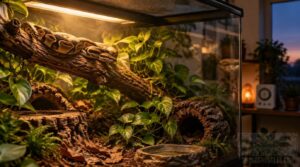
Once heat and humidity are steady, you can add light. Many snakes get by without it, but low-output UVB lighting often helps natural behavior and activity, especially for diurnal species.
Mount the fixture inside the enclosure or over a screen top, never behind glass or plastic, since both block UVB. Follow the manufacturer’s distance, usually 12 to 18 inches for a T5 HO bulb, and place it over the basking spot so your snake gets warmth and light together. Keep lighting intensity modest and add shaded hides for self-regulation.
Put everything on a timer for steady 12-hour day–night cycles. Consistent lighting cycles also support feeding and sleep. At night, use a ceramic heat emitter and keep the enclosure fully dark.
Design Your Snake’s Habitat With Substrate, Hides, and Enrichment

You’ll start with substrate, because it shapes everything else. Burrowing species like sand boas and hognose snakes need 3 to 4 inches so they can disappear completely. Larger burrowers need 4 to 6 inches. Layer leaf litter on top to hold humidity and give your snake something to explore.
Add at least two hiding spots, one warm and one cool. Keep them snug, so your snake feels secure when coiled. Tight-fitting hides also help shy eaters settle at mealtime.
Enrichment activities keep your snake sharp. Try a dig box of coconut fiber, cork rounds, and branches for climbers. Plant selection matters in bioactive setups, so choose hardy, non-toxic plants like bromeliads that tolerate humidity. Always keep habitat continuity in mind.
Maintain Your Reptile Environment With Daily Checks and Cleaning
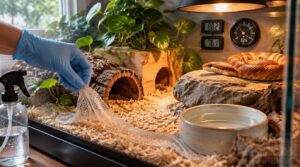
You’ll keep your snake healthy by making reptile enclosure maintenance a daily habit. It takes minutes, and it’s important.
Start with a quick walk-through. Pull on nitrile gloves, since reptiles can carry Salmonella. Then work through this list:
- Remove waste, uneaten food, and shed skin.
- Replace the water, and make sure it’s free of debris.
- Check both thermometers for warm and cool end readings.
- Read your hygrometer and adjust with misting or ventilation.
- Inspect for loose seals, damaged wires, or escape routes.
That’s reptile habitat monitoring in short.
Weekly, do partial substrate changes and stir loose aspen so it doesn’t compact. Your substrate choice affects how often you’ll need to swap it out. Deep clean every two to four weeks, and wash your hands before and after.
Frequently Asked Questions (FAQs)
What is the Holy Grail of reptiles?
The holy grail of reptiles is a habitat that mirrors the wild. You’ll need temperature gradients, proper UVB lighting, accurate humidity levels, natural substrate, and secure hiding spots. Get those right, and your snake thrives.
Can you give me 10 examples of reptiles?
Ready for ten reptiles? Try ball python, corn snake, Burmese python, bearded dragon, leopard gecko, green iguana, red-eared slider, Hermann’s tortoise, tuatara, and boa constrictor.
Each one needs proper enclosure size and custom temperature gradients.
How much of human DNA is reptilian?
None of your DNA is reptilian. You share common ancestry and conserved genes with reptiles, but no percentage applies. Like species specific needs in a habitat, each human genome is its own, shaped by evolution.
How can I create a lizard habitat in my backyard?
Ready to turn your yard into a lizard haven? Build a sturdy 2-foot-high frame with hardware cloth, add sunny temperature gradients, natural UVB lighting, stable humidity levels, loose substrate, and plenty of cozy hiding spots.
What makes a good reptile habitat?
A good habitat gives your reptile control over its own body. You’ll need temperature gradients with a warm basking zone and a cool retreat, plus proper humidity, UVB lighting, species-appropriate substrate, multiple hiding spots, climbing structures, clean water, and environmental enrichment.
How do you make a reptile habitat scaly?
Think of your snake’s enclosure as a tiny canyon. Carve partially cured spray foam into rough, matte rock texture, then seal it. Add hiding spots, a textured substrate, and UVB lighting, keeping temperature gradients intact.
What is a substrate for a reptile?
Substrate is the bedding you’ll spread across the floor of your snake’s enclosure. It cushions your pet, holds substrate moisture where needed, helps with burrowing, and soaks up waste. Smart substrate selection and substrate safety protect your snake’s health.
How do I choose the perfect lighting for my reptile habitat?
Wondering where to start? Match your snake’s species first. Choose a UVB bulb that suits its habitat, set lighting intensity at the basking spot, and keep temperature control steady. UVB bulb replacement matters too: swap yours yearly.
What is amphibian and Reptile Conservation?
You can spend hours perfecting a reptile habitat, yet wild herps still lose theirs daily. Amphibian and Reptile Conservation protects them through science, partnerships, and priority areas, guarding whole ecosystems, not just one pond.
How do you care for a reptile?
You’ll need a reptile enclosure that works like a climate zone. Support reptile thermoregulation with a warm basking spot, add UVB, and handle reptile humidity control. Offer substrate, multiple hides, clean water, and regular feeding.
Conclusion
Picture your snake at dusk, stretched full length along a warm slope of bark, one coil resting in a damp hide, eyes calm. That quiet scene is the goal of reptile environment creation.
You’ve sized the enclosure, dialed in heat and humidity, set the lights, and stocked the hides. Check temperatures daily, spot-clean waste, and trust your thermostat over your gut. A snake that thrives won’t announce it. It’ll eat, shed clean, and stay curious.