This site is supported by our readers. We may earn a commission, at no cost to you, if you purchase through links.

A snake that can’t thermoregulate will stop eating. One faulty design choice, undersized floor space or a missing cool zone, can trigger stress, immune suppression, and chronic disease. Most keepers underestimate how directly the enclosure controls their snake’s wellbeing.
Getting the details right from the start makes all the difference, which is why a thorough snake enclosure setup guide can help keepers avoid the subtle mistakes that compound into serious health problems.
Getting it right means thinking through ventilation rates, humidity microclimates, and substrate choices before your snake ever moves in. A ball python basking at the wrong temperature isn’t resting; it’s struggling. Every habitat detail signals safety or threat to an animal that reads its world through heat, moisture, and texture.
This thorough snake habitat guide walks you through each decision, from enclosure dimensions to species-specific care.
Table Of Contents
- Key Takeaways
- Choosing The Right Snake Enclosure: Size, Materials, Ventilation, and Security
- Controlling Snake Habitat Temperature, Humidity, and Lighting
- Choosing Safe Substrate, Hides, Water, and Enrichment
- Cleaning The Habitat and Monitoring Your Snake’s Health
- Tailoring The Habitat to Your Snake Species
- Frequently Asked Questions (FAQs)
- What are snakes most afraid of?
- What’s the friendliest snake to own?
- What are the best habitats for snakes?
- What food is toxic to snakes?
- How do snakes survive?
- What is a snake habitat?
- What makes a habitat suitable for snakes?
- How do I create an ideal snake habitat?
- How do urban snakes adapt?
- Why should you explore snake habitat map?
- Conclusion
Key Takeaways
- A snake’s enclosure must provide a reliable thermal gradient — warm basking zone to cool retreat — because without it, the animal stops eating, becomes immunosuppressed, and develops chronic disease.
- Humidity isn’t a single number but three distinct microclimates: a dry basking spot (60–70% RH), a mid-level gradient (45–65%), and a humid hide (70–85%) specifically for shedding cycles.
- Enclosure security requires more than a lid — mesh apertures must be 1.0 mm or smaller, latches must resist force for 60+ seconds, and hardware should be tamper-evident, because snakes exploit any weak point.
- Captive snakes kept in properly designed habitats with correct thermal gradients live up to 40% longer, making upfront setup decisions — substrate depth, hide placement, ventilation — directly tied to lifespan.
Choosing The Right Snake Enclosure: Size, Materials, Ventilation, and Security
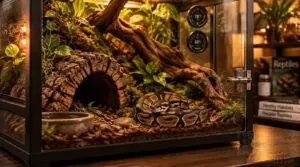
The enclosure you choose shapes everything that follows, from temperature control to your snake’s sense of security. Getting it right means thinking through size, materials, ventilation, and security before you buy. Here’s what to think about for each.
A close look at screen top options for snake tanks can help you weigh ventilation, humidity retention, and latch strength before committing to a setup.
Enclosure Size
Three measurements define a workable habitat: length, width, and height. Aim for an enclosure at least 1.5 times your snake’s body length so it can move and maintain a thermal gradient from warm to cool.
Ball pythons fit into 36x18x12 inches as adults; corn snakes need roughly 40x12x12.
Leave enough floor space for hiding spots and substrate without cramping movement.
Material Options
Once you’ve settled on size, pick your build material carefully. Polycarbonate panels resist warping; UV-stable acrylic offers visibility. For substrate options, coconut fiber suits humid species; aspen suits dry ones. Ecofriendly materials pair well with a bioactive setup. Coconut fiber’s moisture-holding properties make it especially popular for tropical reptiles — you can explore coconut fiber reptile substrate options to find a blend suited to your species’ humidity needs.
- Polycarbonate: rigid, lightweight, warp-resistant
- UV-stable acrylic: clear, light-diffusing
- Coconut fiber: humidity-retaining substrate
- Aspen: clean, dry substrate option
- Recycled PP: ecofriendly, chemical-resistant
Ventilation Requirements
Material choice directly affects your enclosure ventilation. Target 0.5 to 1.0 ACH for small snakes, directing air in low on one side and out high on the opposite to prevent stagnant zones.
A 60-75% open mesh lid helps passive convection without rapid moisture loss. For humid species, add a small adjustable fan, but keep the speed low to avoid stress.
Pairing good airflow with the right substrate makes a real difference — options like coconut fiber or cypress mulch, covered in this bioactive snake substrate and bedding guide, hold moisture evenly without creating the stagnant pockets that invite mold.
Escape-Proof Security
Good ventilation means nothing if your snake slips out. They’re natural escape artists, and enclosure security starts with a latch that resists force for 60+ seconds.
Snakes are natural escape artists, so enclosure security begins with a latch that resists force for over a minute
Keep these in check:
- Mesh aperture ≤ 1.0 mm blocks head extrusion
- Tamper-evident hardware flags interference within 24 hours
- Secure lids must pass a one-minute shake test
- Internal hinges should prevent all edge prying
Access And Maintenance
Since consistent access shapes how well you’ll maintain the habitat, design matters from the start. A front-opening setup lets you reach your snake without disturbing it much.
| Feature | Purpose |
|---|---|
| Dual-latch door | Strengthens enclosure security |
| Ground-level port | Helps with daily spot cleaning |
| Screw-in covers | Helps prevent escape |
Keep habitat maintenance routine and your snake will thrive.
Controlling Snake Habitat Temperature, Humidity, and Lighting
Getting the climate right inside your snake’s enclosure is one of the most important things you’ll do as a keeper. There are three key areas to understand: temperature gradients, humidity and microclimates, and lighting. Each one plays a distinct role in keeping your snake healthy and behaving naturally.
Alongside those environmental factors, keeping the enclosure clean and your snake well-hydrated is equally essential — snake tank maintenance tips can help you build a routine that prevents bacterial growth before it becomes a health issue.
Temperature Gradients and Heating
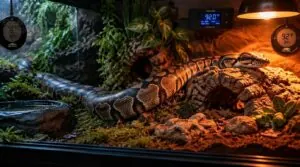
Your snake can’t generate its own body heat, so you need to build a reliable temperature gradient across the enclosure. Aim for a basking zone of 26-32°C at one end, dropping to 22-28°C on the cool side.
If you’d like the enclosure to look and function more naturally, this guide to setting up a bioactive vivarium for snakes explains how to layer substrate and keep humidity stable.
Pair a ceramic heater with a thermostat to hold those setpoints safely. Monitor both zones with two calibrated thermometers to catch any drift.
Humidity and Microclimates
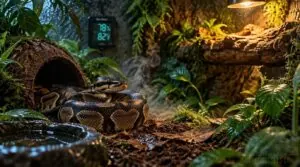
Rapid humidity shifts over 20 percentage points in one hour can stress your snake’s mucous membranes. Solid humidity control starts with three microclimates:
- A dry basking spot at 60–70% RH
- A mid-level gradient at 45–65%
- A humid hide at 70–85% for shedding cycles
Coconut fiber builds moisture retention naturally; check your humidity levels with sensors every six to twelve hours.
Lighting and UVB
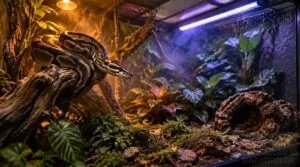
Research shows UVB output can drop 50% before a bulb dims, so replace yours every 6-12 months. Swapping out your bulb on schedule is easier when you stock up on a reliable UVB reptile bulb 290-320nm before the old one quietly fails your snake.
Position UVB lighting above the basking spot. A light spectrum of 290-320 nm aids calcium metabolism. Maintain a lighting schedule on a 12-hour lighting cycle.
| Species | UVB | Distance |
|---|---|---|
| Ball python | Optional | 12-18 in |
| Corn snake | Minimal | 12-18 in |
| Boa constrictor | Modest | 12-18 in |
Choosing Safe Substrate, Hides, Water, and Enrichment
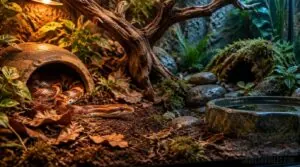
The floor beneath your snake tells a story. Substrate safety starts with avoiding quartz sand, which sheds silica dust and risks respiratory harm. Choose coconut fiber, reptile carpet, or tile instead.
Your snake needs at least two hiding spots, one on the warm side and one on the cool side. Size them so your snake fits snugly but isn’t cramped.
Keep the water bowl wide and shallow, positioned away from heat sources to slow bacterial growth. Replace the water daily.
- Use inert, mold-resistant substrate
- Provide warm-side and cool-side hides
- Place water away from basking zones
- Add branches for climbing enrichment
- Rearrange naturalistic decor periodically
Enrichment elements like branches and scent trails encourage natural behavior without creating escape routes.
Cork bark flats and sturdy reptile climbing branches give your snake surfaces to explore while keeping the setup secure and escape-proof.
Cleaning The Habitat and Monitoring Your Snake’s Health
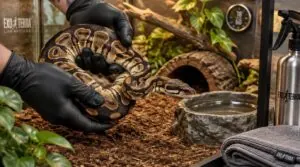
A clean enclosure is your first diagnostic tool. Daily spot cleaning removes feces and soiled substrate before bacteria take hold, so don’t let waste sit. Change the water bowl daily too; water quality degrades fast, and stagnant water invites bacterial growth.
For deeper enclosure cleaning, remove all accessories and give your disinfectant full contact time before rinsing. Wiping too soon leaves viable pathogens behind. Dry surfaces completely before reassembling, since damp conditions accelerate microbial growth.
Health monitoring pairs naturally with cleaning days. Check alertness, feeding response, and excretions each time you interact. Changes in urate color or stool frequency often precede visible symptoms. Watch for stress indicators like glass surfing or food refusal, and log every observation so patterns become clear.
Tailoring The Habitat to Your Snake Species
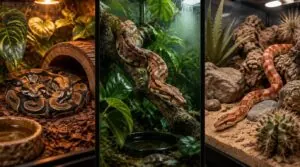
Every species has its own set of needs, and your setup should reflect that. Below, you’ll find habitat breakdowns for three of the most popular pet snakes: ball pythons, boa constrictors, and corn snakes. Use these as your species-specific starting point.
Once you’ve dialed in the right setup for your species, keeping things stable over time comes down to the habits covered in this guide to maintaining snake tank health.
Ball Python Habitats
Ball pythons do well in a 40–60 gallon enclosure as adults. Maintain a temperature gradient from 88–92°F on the warm side to 76–80°F on the cool end.
Keep humidity levels between 60–80% using coconut fiber or cypress mulch as substrate materials. Add two snug hiding spots, one per side, so your snake feels secure wherever it rests.
Boa Constrictor Habitats
Compared to ball pythons, boas need considerably more room. Aim for an enclosure with at least 2x your snake’s length in floor space, plus 36–48 inches of vertical clearance.
Maintain a warm zone of 88–92°F, a cool side of 78–82°F, and humidity around 50–60%. Add one warm hide and one cool hide, plus a hollow cork tube for full concealment.
Corn Snake Habitats
Corn snakes are more manageable than boas. A 40–55 gallon enclosure fits most adults. Keep a temperature gradient: 85–90°F warm, 75–80°F cool, with humidity levels at 40–60%. Four things to get right:
If you’re thinking about breeding down the road, these ball python breeding tips explain how to spot a breeding-ready snake and choose pairings that protect your hatchlings.
Live plants add hiding spots and help hold humidity steady, and this guide to safe plants for a corn snake terrarium covers pesticide-free options.
- Substrate materials: cypress mulch or aspen shavings
- Two hiding spots, one at each end
- A climbing branch for enrichment
- Monthly weight checks to catch illness early
Frequently Asked Questions (FAQs)
What are snakes most afraid of?
Snakes are most afraid of sudden sounds, rapid movements, and unfamiliar scents near their home. Predator odors and rough handling spike your snake’s stress fast. Secure hiding spots and calm, predictable interaction ease that fear.
What’s the friendliest snake to own?
For temperament alone, ball pythons consistently top the list. They’re naturally docile, rarely strike, and settle down quickly with your handling. Corn snakes follow closely behind, staying curious and remarkably calm through your frequent contact.
What are the best habitats for snakes?
The best habitats for snakes closely replicate their natural environment. You’ll need a proper temperature gradient, species-matched humidity levels, the right enclosure size, safe substrate materials, and multiple hiding spots for both security and comfort.
What food is toxic to snakes?
Avoid citrus, avocado, garlic, chocolate, and moldy or spoiled prey. Wild-caught animals may carry pesticide residue. Stick to pre-killed, frozen and thawed prey from reputable sources.
How do snakes survive?
Ever wonder what actually keeps a snake alive and thriving day to day? They survive through temperature regulation, drinking fresh water, hunting appropriately sized prey, and sheltering in spaces with stable humidity and secure microclimates.
What is a snake habitat?
A snake habitat is a controlled enclosure that closely replicates your snake’s natural environment. It combines the right temperature gradients, humidity levels, proper ventilation, hiding spots, climbing structures, and adequate space for naturally healthy behavior.
What makes a habitat suitable for snakes?
A suitable habitat combines precise temperature control, correct humidity levels, sufficient enclosure size for natural movement and behavior, secure hiding spots on both warm and cool sides, and a thermal gradient your snake can navigate.
How do I create an ideal snake habitat?
Think of it as building a miniature habitat. Set up a secure, ventilated enclosure sized correctly for your species, with a proper thermal gradient, two snug hides, the right substrate, and fresh water. Monitor daily.
How do urban snakes adapt?
Urban snakes exploit warmer city microclimates, masonry refuges, and dense prey populations to forage more efficiently, shifting activity to crepuscular hours and using infrastructure corridors to move safely between green spaces.
Why should you explore snake habitat map?
Picture a new keeper placing a heat mat in a cold draft corridor, triggering a serious health crisis. Habitat mapping reveals microclimates and airflow patterns, letting you design a safer enclosure suited to your species.
Conclusion
Research suggests that captive snakes with proper thermal gradients live up to 40% longer than those in poorly designed enclosures. That reframes every decision in this thorough snake habitat guide: substrate depth, hide placement, humidity zones.
Your snake can’t ask for what it needs, but it will show you through behavior, appetite, and activity. Build the habitat right from the start, and you’ll spend less time troubleshooting and more time watching a genuinely thriving animal.