This site is supported by our readers. We may earn a commission, at no cost to you, if you purchase through links.
Your corn snake just shredded a leaf and swallowed half of it. Now you’re staring at the plant, wondering if you just made a mistake.
Relax. Most gardening blunders in a snake enclosure come from a few bad matches, not from live greenery itself. The right safe plants for a corn snake terrarium hold humidity steady, give your snake shade to duck under, and make the whole habitat look like a slice of prairie.
Spider plants, bromeliads, and peperomias all earn their spot. A few popular picks, like pothos and snake plants, need a closer look before they go in. Here’s how to tell which is which.
Table Of Contents
- Key Takeaways
- Live Plant Options for Corn Snake Terrariums
- Plants to Avoid or Use With Caution in Corn Snake Terrariums
- How to Choose and Set Up Plants for a Corn Snake Terrarium
- Top 6 Products for a Planted Corn Snake Terrarium
- How to Maintain Live Plants in a Corn Snake Terrarium
- Frequently Asked Questions (FAQs)
- What plants can I put in my corn snake enclosure?
- What are the common causes of death in corn snakes?
- What plants are safe to put in a snake enclosure?
- What to put in a corn snake vivarium?
- What live plants can I put in a corn snake enclosure?
- What plants are safe for snake terrariums?
- What to put in a corn snake terrarium?
- Do corn snakes need real plants?
- Can corn snakes live in a terrarium?
- What plants can be planted in a corn snake terrarium?
- Conclusion
Key Takeaways
- Safe, low-risk picks like bromeliads, peperomias, Boston ferns, spider plants, orchids, and parlor palms give your corn snake cover and steadier humidity, as long as they’re pesticide-free.
- Plants like dieffenbachia, peace lilies, and English ivy are best avoided, and pothos and snake plants carry only mild ingestion risks but still deserve close supervision.
- Before any plant goes in, quarantine it for two weeks, rinse it and the substrate well, and anchor it firmly so your snake can’t topple it.
- Keep humidity around 50-70% with good airflow, and check weekly for mold, pests, and wilting so small problems don’t turn into health risks for your snake.
Live Plant Options for Corn Snake Terrariums
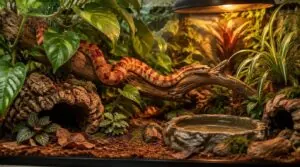
Live plants can turn your corn snake’s enclosure into a lush, living hideout. Below, you’ll find eight snake-safe options, from humidity lovers to hardy low-light picks. Two of them come with ingestion notes, so read those entries closely before you buy.
Once your plants are settled in, you can round out the setup with favorite accessories for pet snakes like hides and climbing branches that work well alongside the greenery.
Bromeliads
are the overachievers of your terrarium setup. Their rosettes create natural cover, and their leaf cups hold water that steadies humidity.
They’re generally non-toxic if your snake brushes or briefly chews them, but skip pesticide-treated plants and spiky fronds. Keep these basics in check:
- Keep your temperature gradient warm, 65–85°F, with humidity near 60–90%.
- Check substrate compatibility: orchid bark, sphagnum, perlite.
- Refresh cup water every 1–2 weeks.
Mount them on cork so rosettes stay upright, and ventilate to prevent mold.
Peperomias
If bromeliads are the overachievers, Peperomias are the easygoing roommates. They’re among the best nontoxic plant options for a bioactive terrarium, and compact species like P. obtusifolia won’t crowd your snake.
Thick leaves store water, so dry spells won’t faze them. Give them bright, indirect light and a well-draining mix. Your terrarium setup keeps plant care simple: avoid soggy roots.
Boston Ferns
Peperomias sip; Boston Ferns drink. These nontoxic plant options love moisture, so humidity regulation matters in your bioactive terrarium.
Keep these safe plants happy:
- Hold humidity near 50–70% with light misting.
- Space fronds so heat lamps aren’t blocked.
- Trim dead fronds monthly.
Boston Ferns are forgiving, but stagnant air invites mold. Let air circulate and your corn snake stays comfortable.
Spider Plants
Boston Ferns crave moisture; the spider plant is chill. This Chlorophytum comosum is one of the easiest nontoxic plant options for reptile enclosure enrichment, and it adds mild humidity regulation via flora.
| Need | Target |
|---|---|
| Light | Bright, diffused |
| Water | Top inch dry |
Skip overwatering, or roots rot. Mild stomach upset is possible if your corn snake chews it, so watch closely.
Orchids
add a splash of tropical drama to your reptile terrarium. They’re among the safer nontoxic plants for corn snakes, so you can relax. Mount them on cork bark to keep roots dry and airy.
- Pick phalaenopsis for low light.
- Skip fertilizers and pesticides.
- Avoid cedar-based or aromatic media.
- Keep humidity at 40–70%.
- Pair with UVB lighting and bioactive substrate.
Parlor and Ponytail Palms
Palms are nontoxic plant options that add height without drama. Both suit a bioactive substrate and your temperature gradient, but lighting requirements differ.
Before you buy, check this guide to snake-safe plants for your enclosure and anchor each pot firmly so heavy coils can’t topple it.
| Trait | Parlor | Ponytail |
|---|---|---|
| Light | Bright, indirect | Filtered, 3–6 hours |
| Water | Evenly moist | Dry between soakings |
| Humidity tolerance | Moderate | Dry-tolerant |
Keep fronds away from direct sun, which scorches growth. Use filtered water and check undersides for mites.
Pothos: Check Ingestion Risks
Isn’t pothos toxic?" To mammals, yes. To corn snakes, it’s a low risk. Pothos (Epipremnum aureum) holds calcium oxalate crystals, but reptiles lack the enzymes that trigger them.
Still, watch for ingestion risks. Snakes rarely nibble, though soft new growth tempts the curious. Check for regurgitation, lethargy, or skipped meals. Plant toxicity here stays mild.
Pothos is also considered an always good plant for enclosures because it adapts well to different temperature, watering, and humidity conditions.
Snake Plants: Check Ingestion Risks
Here’s the funny thing about Snake Plants: they’re named after your pet, yet your pet shouldn’t eat them. They’re tough, but plant toxicity is real. Their calcium oxalate can irritate a mouth and gut.
Snake plants share your pet’s name, yet your pet shouldn’t eat them, because their calcium oxalate can irritate the mouth and gut
Ingestion risks are low if you anchor plants firmly and skip loose leaf bits. Stick with nontoxic flora for snakes if your young corn snake tastes everything.
Plants to Avoid or Use With Caution in Corn Snake Terrariums
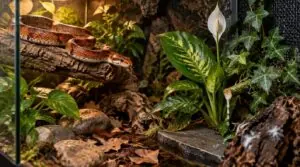
Not every pretty leaf belongs in your snake’s world. Some plants look innocent and still pack a punch.
Start with calcium oxalate offenders. Dieffenbachia and peace lilies carry needle-like crystals that irritate the mouth and throat, so their toxicity makes them a hard no. English ivy joins that list, and its fast, clingy growth can choke ventilation and trap waste.
Watch for sticky sap, too. Latex-like fluids can coat a tongue and put a snake off its food.
Then there’s mold. Plants that crave constant wetness turn soil and bark into a spore factory, and that’s trouble for lungs and skin.
If you’re unsure, skip it. A plant with fuzzy documentation isn’t worth the gamble, and bare, safe decor beats a risky jungle every time.
How to Choose and Set Up Plants for a Corn Snake Terrarium
A planted corn snake terrarium looks great and works hard, but only when you build it in the right order.
The five steps below walk you through choosing safe plants, matching your enclosure’s conditions, prepping, placing, and monitoring. Follow them and your snake gets a lush hideout instead of a leafy headache.
Choose Safe Plants
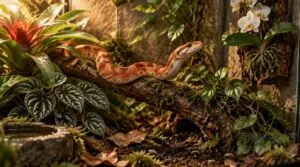
Think of your terrarium as a tiny jungle with one very opinionated resident. Plant safety comes first.
Stick with reptilesafe plants like bromeliads, peperomias, and orchids. Their nontoxic foliage won’t hurt your snake if it nibbles. Skip anything treated with pesticides, and keep pothos and snake plants supervised. Building a bioactive terrarium? Same rules apply. Inspect every leaf before it goes in.
Match Terrarium Conditions
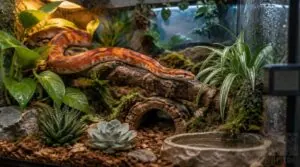
Once your safe plants are chosen, match them to your terrarium conditions. Keep humidity levels between 50 and 70 percent. Run daytime temps at 24 to 28°C, then let nights drop to 18 to 22°C for a natural temperature gradient.
Give plants a 12 to 14 hour photoperiod with diffuse LED light, and avoid hot spots. Good plant care starts here.
Prepare Plants and Substrate
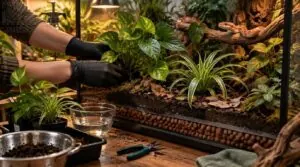
Your plants need prep before they meet your snake. Start with plant quarantine for two weeks.
- Isolate new plants and watch for pests.
- Give a chemical rinse for new plants, then flush well.
- Rinse substrate to cut mold spores.
- Build a bioactive substrate over coarse drainage.
- Keep temperature gradients in vivariums steady, manage plant growth rate by trimming fast growers.
Position and Secure Plants
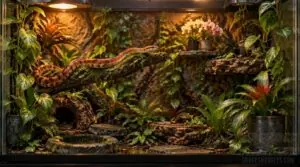
Once your plants are prepped and pest-free, it’s time to position and secure them. Tie tall stems to rigid stakes every 15 to 25 cm, and anchor heavy planters on non-slip bases. Put sturdy plants higher, so your snake can’t bulldoze them.
Trail vines along enclosure walls. Keep delicate orchids on inner shelves. Your enclosure aesthetics will thank you.
Monitor Plant and Snake Health
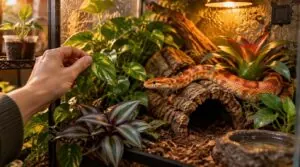
Your layout’s set, so keep watching it. Run a quick visual sweep daily, and always do plant quarantine before introduction for newcomers.
- Crispy edges or wilting leaves mean light, humidity, or watering needs tweaking.
- Mold, sap, or soil crumbs near hides need cleaning.
- Cloudy eye caps, mouth gaping, or odd stools mean calling your vet.
Catch problems early, then relax.
Top 6 Products for a Planted Corn Snake Terrarium
Ready to shop for your planted corn snake setup? These six picks cover lighting, live plants, substrate topping, and climbing gear, so you can build a safe, thriving habitat without guesswork. Check each one against your terrarium’s size and zones before you buy.
1. GooingTop Full Spectrum LED Grow Light
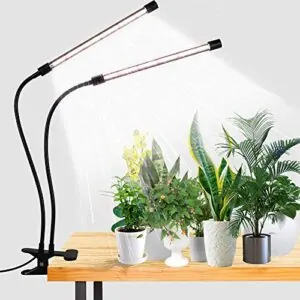
Lighting is the quiet hero of a planted terrarium.
The GooingTop Full Spectrum LED Grow Light packs 74 white LEDs and 10 red LEDs into a 10-watt bar, and it matches a 50W halogen. The 6000K output with 95 CRI mimics noon sunlight, so pothos, ferns, and bromeliads get the broad spectrum they crave.
A strong clamp and flexible gooseneck give you 360-degree positioning, and it runs on USB or an AC plug. Five dimming levels let you tame the glow for small plants, while the timer offers 4, 8, or 12-hour cycles.
One catch: the timer fires once per 24 hours and doesn’t repeat. Brightness can also fall short at close range, and durability reviews are mixed. At $21.79, it’s a budget-friendly supplement, not a total miracle.
| Best For | Indoor plant owners who want a flexible, clamp-on light to position over tabletop potted plants and shelf setups. |
|---|---|
| Price | $21.79 |
| Product Type | Clamp-on grow light |
| Ideal User | Indoor plant owners |
| Placement | Clamped over enclosure |
| Main Drawback | Timer doesn’t repeat |
| Customer Feedback | Mixed durability |
| Additional Features |
|
- Its 6000K, 95 CRI light, made from 10 red and 74 white LEDs, gives plants full-spectrum light similar to noon sunlight.
- The flexible gooseneck and strong clamp allow 360-degree positioning, and it runs on either USB or an AC plug.
- The timer offers 4, 8, or 12-hour daily on-cycles, so you don’t have to switch it on yourself.
- The timer runs the chosen duration only once per 24-hour cycle and does not repeat.
- Brightness may not be enough for some plants at close range.
- Reviews are mixed on long-term durability and how consistent the build is.
2. Sansevieria Superba Snake Plant
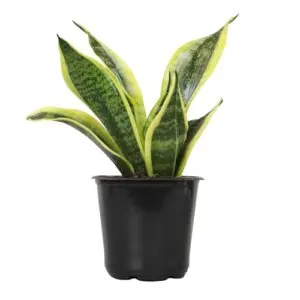
Low-light tolerance makes the Sansevieria Superba a standout. It tolerates dim corners, skipped waterings and the occasional corn snake bump without complaint.
It arrives rooted in a 4.25-inch grower pot, about 12 to 13 inches tall. Stiff, sword-shaped leaves with bright yellow edges stay compact and upright, so they won’t flop into your snake’s path.
Snake plants are often listed among nontoxic options, but chewed leaves can still cause mild stomach upset. Confirm it’s pesticide-free before planting, and rinse the leaves.
| Feature | Details | Why It Matters |
|---|---|---|
| Price | $16.44 | Easy on the budget |
| Size | 12 to 13 inches | Fits most reptile enclosure setups |
Among low-maintenance options, this one is hard to beat. Keep the soil on the dry side, set the pot in a shallow tray so it can’t tip, and dust the leaves.
| Price | N/A |
|---|---|
| Product Type | N/A |
| Ideal User | N/A |
| Placement | N/A |
| Main Drawback | N/A |
| Customer Feedback | N/A |
3. Altman Superba Snake Plant
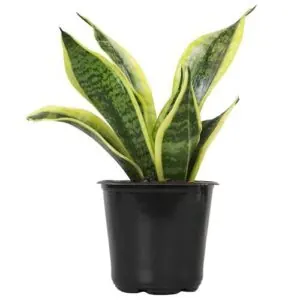
Ready to sharpen your terrarium game? The Altman Superba is a snake plant with serious edge.
Its upright, sword-like leaves wear golden or light green margins, which gives your enclosure a clean, architectural look. It arrives in a 4.25-inch compostable grower pot, stands about 12 inches tall, and grows slowly. Water sparingly. Overwatering and root rot are the real threats, so let the substrate dry between drinks.
It costs $15.70 and suits beginners and busy keepers.
A few cautions. Some buyers received smaller plants or leaves with damage, so inspect yours on arrival. Leaf tips are sharp, and it’s not a snack, so watch for curious chewing. Place it away from the basking zone. Give it a shallow ledge or rock base so it stays steady as your snake grows.
| Best For | Beginners and busy plant owners who want a low-maintenance, good-looking plant that tolerates any light level and adds a clean, modern touch to a bedroom, living area, or office. |
|---|---|
| Price | $15.70 |
| Product Type | Snake plant |
| Ideal User | Beginners and busy keepers |
| Placement | Shallow ledge or rock base |
| Main Drawback | Overwatering causes root rot |
| Customer Feedback | Mixed condition on arrival |
| Additional Features |
|
- Drought tolerant and durable, so it forgives missed waterings
- Thrives in low, medium, and bright light, with variegated leaves that have golden or light green margins
- Helps remove common indoor pollutants and comes in a compostable 4.25 in. grower pot
- Some customers report receiving plants smaller than the roughly 12 inches expected
- Feedback on condition is mixed, with reports of damaged or broken leaves
- Overwatering can cause root rot, so it needs careful watering
4. SunGrow Reptile Leaf Litter
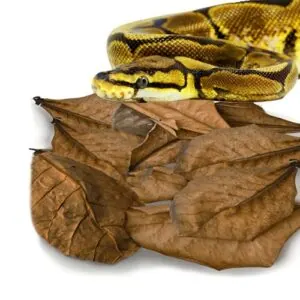
Ten leaves for $6.97 might sound skimpy. Fair. But these aren’t filler, they’re a cheap way to turn bare substrate into a forest floor your corn snake will actually use.
Each pack holds 10 dried leaves and weighs barely over an ounce. Scatter them across your substrate and you get instant cover, hide spots, and thermal humidity retention. Over time they break down, feeding isopods and springtails in bioactive builds. They also release tannins, which gently lower pH.
Prep matters. Rinse the leaves, then boil them for 5 to 10 minutes before use. Skip that step and you invite dust and unwanted hitchhikers.
One caution: leaves can arrive crushed. Treat that as a bonus, since smaller pieces fill gaps nicely. Watch for mold in damp corners and swap out soggy leaves fast.
| Best For | Reptile keepers and bioactive enthusiasts who want an inexpensive way to add natural cover, burrowing spots, and food for isopods and springtails to their enclosures. |
|---|---|
| Price | $6.97 |
| Product Type | Dried leaf pack |
| Ideal User | Reptile and bioactive keepers |
| Placement | Scattered on substrate |
| Main Drawback | Needs boiling before use |
| Customer Feedback | Mixed value |
| Additional Features |
|
- Provides cover, hide spots, and thermal protection for hibernation and estivation
- Breaks down over time to sustain microfauna like isopods and springtails
- Releases tannins that gently lower pH in aquatic setups
- Requires rinsing and boiling for 5 to 10 minutes before use
- May arrive crushed or damaged during shipping
- Some customers feel the value is mixed given the small size and quantity
5. AQUA KT Reptile Climbing Branch
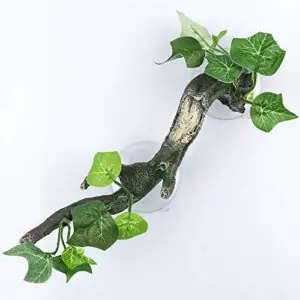
Once your floor layer is set, look up.
The AQUA KT Reptile Climbing Branch is a natural-looking corner perch that sticks to your glass with two suction cups, so it claims zero floor space. It measures 8.27 inches wide and 11 inches tall, which makes it a cozy fit for geckos, tree frogs, and baby corn snakes. The resin is easy to clean. Rinse it, dry it, and you’re done. At $12.99, it’s a budget-friendly vertical upgrade.
Here’s the catch. Some owners say the suction cups pop off, and others find it smaller than expected. Press cups onto clean, dry glass, and check grip weekly.
| Best For | Owners of small reptiles and amphibians, such as geckos and tree frogs, who want an inexpensive, natural-looking corner perch that saves floor space in a glass terrarium. |
|---|---|
| Price | $12.99 |
| Product Type | Climbing branch |
| Ideal User | Small reptile and amphibian owners |
| Placement | Suction-cupped to glass |
| Main Drawback | Suction cups pop off |
| Customer Feedback | Mixed quality and durability |
| Additional Features |
|
- Made of resin that is safe for reptiles and amphibians
- Attaches to glass with two suction cups and fits into a corner to save space
- Gives pets a natural-looking surface for climbing and basking
- Suction cups reportedly come off frequently
- Several users say it is smaller than expected
- Customer feedback on quality and durability is mixed
6. Altman Live Snake Plant Zeylanica
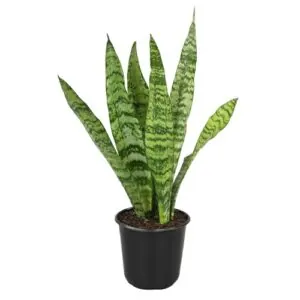
Want green that does more than sit pretty? The Altman Live Snake Plant Zeylanica brings sword-shaped, deep green leaves and serious toughness to your setup.
It arrives fully rooted in a 4.25-inch biodegradable pot and tolerates low to bright indirect light. Water it only when the top inch or so of soil dries out.
Here’s the catch: it isn’t fully non-toxic. Saponins in the leaves can cause mild stomach upset if your corn snake chews on them, so supervise early interactions and tuck the pot behind branches. It’s also toxic to cats and dogs.
Be realistic about size, too. Your plant may show up with just three leaves, and some buyers report smaller plants or broken stems. At $16.58, it’s still a fair deal if you inspect it right away. Give it room to grow.
| Best For | Beginners, busy people, and reptile owners who want a tough, low-maintenance plant for a desk or shelf and don’t mind inspecting it on arrival. |
|---|
- Tolerates low, medium, and bright indirect light
- Needs water only when the top inch or so of soil dries out
- Arrives fully rooted in a 4.25-inch biodegradable pot at a fair price of $16.58
- May arrive with only three leaves, and some buyers report smaller plants than advertised
- Some customers report broken stems or poor plant health on arrival
- Not fully non-toxic, since saponins in the leaves can upset the stomach of a corn snake, cats, or dogs
How to Maintain Live Plants in a Corn Snake Terrarium
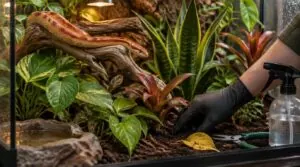
You’ve picked your plants and built the setup. Now let’s keep it all thriving.
Good plant maintenance comes down to a steady weekly rhythm. Stick to a simple watering schedule of once or twice a week, and check soil moisture first. If the top layer feels damp, skip a day. Mist only when the substrate is dry, since soggy soil invites root rot.
Prune dead leaves promptly to cut down on mold. Rotate your plants weekly so light exposure stays even and growth doesn’t stretch toward one side.
Picture your weekly check like this:
- A quick sniff for musty, swampy root odor
- A scan of leaf undersides for pests
- A gentle tug to confirm every plant stays anchored
Feed with half-strength fertilizer monthly during active growth. Quarantine anything new before it joins the terrarium.
Frequently Asked Questions (FAQs)
What plants can I put in my corn snake enclosure?
Your corn snake’s tank can become a jungle! Stick with safe plants like bromeliads, peperomias, and spider plants. These humidity-tolerant houseplants are reptile-safe foliage. Match your terrarium conditions, and always do plant quarantine before introduction.
What are the common causes of death in corn snakes?
Most deaths trace back to husbandry. Cool temps and poor ventilation invite respiratory infections, dry air causes shedding problems and dehydration, and skipped quarantine spreads parasites. Impaction, toxicity, and weak escape prevention add extra risk.
What plants are safe to put in a snake enclosure?
Your snake’s home can look like a jungle without any drama. Stick with nontoxic options like bromeliads, peperomias, Boston ferns, spider plants, and orchids. These reptile-safe foliage picks thrive in humidity and give you cover.
What to put in a corn snake vivarium?
Build a naturalistic habitat first. Add a secure hide on each end, a climbing branch, leaf litter, and a water dish. Toss in nontoxic options like bromeliads or spider plants, and keep humidity levels steady.
What live plants can I put in a corn snake enclosure?
Your reptile enclosure is a tiny, living rainforest. Pick safe greenery: bromeliads, Boston ferns, peperomias, spider plants. They’re lowlight terrarium plants matching humidity levels, with bioactive substrate compatibility.
Skip pothos entirely; it’s risky if nibbled.
What plants are safe for snake terrariums?
Pothos isn’t safe, despite the myth. Its calcium oxalate concerns are real. Stick with reptilesafe foliage like bromeliads, peperomias, ferns, and parlor palms. These humiditytolerant houseplants boost terrarium aesthetics and function, plus bioactive substrate compatibility.
What to put in a corn snake terrarium?
Your Corn Snake Terrarium needs a steady thermal gradient, snug hides, climbing branches, and solid ventilation.
Add Safe Plants like Humidity Tolerant Houseplants as Vivarium Plants, and you’ll nurture a Bioactive Environment. Simple, and rewarding.
Do corn snakes need real plants?
Nope, your snake won’t suffer with fake greenery. Artificial plants work great, and they skip the quarantine hassle.
Live ones can still add steadier humidity and richer exploring, especially in a bioactive terrarium. Just skip toxic varieties.
Can corn snakes live in a terrarium?
Yes, your corn snake can thrive in a vivarium. Give it a 48×24×24-inch enclosure, warm-to-cool gradient, and a lockable lid, since escape artists exist.
Keep humidity around 65–75%. Planning a bioactive terrarium? Plant safety matters.
What plants can be planted in a corn snake terrarium?
Your corn snake has plenty of leafy options. Try bromeliads, ferns, and peperomias for humid, snake-friendly greenery.
Pothos works too, but it’s toxic if nibbled, so quarantine new plants first and watch your snake closely.
Conclusion
Worried a live plant is too much work for a snake setup? It’s not. Pick a few of the safe plants for a corn snake terrarium, match them to your light and humidity, and the habitat looks after itself.
Your snake gets shade, moisture, and places to explore. You get a tank that looks like a prairie instead of a plastic box. Start with one plant, watch how your snake reacts, and build from there.