
This site is supported by our readers. We may earn a commission, at no cost to you, if you purchase through links.

Most people picture a reticulated python as a danger wrapped in scales—unpredictable, aggressive, a snake you manage rather than know. That reputation isn’t entirely wrong, but it tells only half the story.
These snakes can reach 20 feet and carry enough muscle to be genuinely hazardous, yet experienced keepers consistently describe well-socialized individuals as calm, curious, and almost methodical in how they interact with their environment. The difference between a defensive animal and a handleable one almost always comes down to understanding the reticulated python temperament profile—what shapes it, what shifts it, and how you work with it.
Table Of Contents
- Key Takeaways
- Reticulated Python Personality Traits
- Wild-Caught Vs. Captive-Bred Temperament
- Factors Influencing Temperament
- Handling and Safety With Reticulated Pythons
- Top 8 Products for Reticulated Python Care
- Frequently Asked Questions (FAQs)
- What is the temperament of a reticulated python?
- Are reticulated pythons friendly?
- What is the calmest python species?
- Can reticulated pythons recognize their owners over time?
- How do feeding responses affect daily temperament?
- Do retics show territorial behavior in captivity?
- What triggers sudden temperament changes in adults?
- Are certain morphs calmer than others genetically?
- How long do reticulated pythons typically live?
- What do reticulated pythons eat in captivity?
- Conclusion
Key Takeaways
- A reticulated python’s temperament is shaped more by early handling and environment than by the snake’s nature alone, so what you do in those first months sets the tone for life.
- Captive-bred pythons start calmer and more tolerant than wild-caught ones, making your choice of source one of the most important decisions you’ll make as a keeper.
- Reading your snake’s body language—S-coils, rapid tongue flicks, locked eye contact—gives you the warning you need before a defensive response escalates into a real problem.
- Health issues often show up as behavior changes first, so tracking shifts in feeding, handling response, or activity level is just as important as monitoring temperature and humidity.
Reticulated Python Personality Traits

Reticulated pythons aren’t one-size-fits-all animals — each one comes with its own set of quirks, habits, and boundaries. Understanding their personality traits is the foundation of keeping them safely and confidently.
Getting familiar with reticulated python temperament and behavior helps you spot the difference between a curious snake and one that’s genuinely stressed.
Here’s what you need to know about how these snakes usually think, learn, and vary from one individual to the next.
Typical Behavioral Characteristics
Reticulated pythons don’t have a single, fixed temperament — they’re layered, reactive animals with clear individual personalities. You’ll see snake behavior shift based on handling routines, habitat preferences, and enclosure conditions.
Their feeding behaviors are intense and deliberate, and their defensive behaviors can escalate fast if trust isn’t built. Snake socialization, environmental enrichment, and consistent handling are what separate a manageable reticulated python from a genuinely risky one.
Reticulated pythons become manageable only through trust, enrichment, and consistent handling—otherwise, their intense feeding and defensive behaviors quickly escalate
Proper care also relies on understanding their enclosure size requirements.
Intelligence and Problem-Solving Abilities
Beyond their reactive nature, these snakes show genuine cognitive abilities that surprise most keepers. Their memory retention is sharp — they learn feeding schedules, recognize handlers, and adapt to enclosure changes quickly.
Sensory adaptation drives their problem-solving, using heat pits and scent trails to locate hidden prey. Through consistent training, their learning behaviors and operant conditioning responses reveal real, measurable animal behavior and psychology at work.
Research underscores the importance of neural consequences in captive snakes for understanding cognitive adaptation and welfare.
Variation in Individual Temperament
No two reticulated pythons share the same snake personalities, even from the same clutch. Temperament testing reveals a wide range of individual traits — some show docile temperament from day one, while others carry defensive behaviors no amount of socialization fully softens. Their emotional intelligence and behavioral quirks are real:
- A calm snake that explores openly during handling
- One that freezes, signaling overload fast
- A bold feeder who charges the door every time
- A cautious clutchmate that watches and waits
Wild-Caught Vs. Captive-Bred Temperament

Where a reticulated python comes from matters more than most people realize. A wild-caught animal and a captive-bred one can look identical, but the difference in temperament is night and day.
Here’s what you need to know about how origin shapes behavior across three key areas.
Key Differences in Behavior
Wild-caught and captive-bred reticulated pythons are practically different animals regarding temperament. Behavioral adaptations shaped by environmental influences in the wild produce deeply defensive behaviors that don’t just disappear in captivity.
| Trait | Wild-Caught | Captive-Bred |
|---|---|---|
| Default Temperament | Reactive, defensive | Calm, exploratory |
| Feeding Strategies | Erratic, stress-driven | Consistent, reliable |
| Habitat Preferences | Seeks escape routes | Settles into enclosure |
| Defensive Behaviors | Frequent striking | Rarely triggered |
| Handling Response | High resistance | Generally tolerant |
Impact of Early Handling and Socialization
Early handling shapes everything. A reticulated python that’s calmly touched several times a week as a hatchling learns that your hands aren’t a threat. Short sessions, consistent timing, separate feeding spots — these build a temperament that stays manageable for life.
| Socialization Factor | Neglected Python | Well-Socialized Python |
|---|---|---|
| Handling Response | Defensive, strikes often | Calm, exploratory |
| Feeding Mode Confusion | Frequent mistaken bites | Rarely triggered |
| Long-Term Temperament | Unpredictable, high-stress | Stable, tolerant |
Temperament Variation Across Life Stages
A reticulated python’s temperament isn’t fixed — it shifts with every life stage. Hatchlings strike fast, juveniles surge with restless energy, and well-handled adults settle into calm, predictable routines. Understanding these life stage changes and growth patterns helps you adapt your socialization methods before problems start.
Feeding habits shift just as much as temperament, so brushing up on safe prey handling for neurologically sensitive snakes can sharpen your instincts across species.
| Life Stage | Reticulated Python Behavior | Handling Approach |
|---|---|---|
| Hatchling | Defensive, quick to strike | Short, gentle sessions |
| Juvenile | High energy, feeding-mode confusion | Consistent routines, hook training |
Factors Influencing Temperament

A reticulated python’s temperament doesn’t come out of nowhere — it’s shaped by a handful of real, identifiable factors. Knowing what drives their behavior puts you in a much stronger position as a keeper.
Here’s what actually matters.
Genetics and Morph Influence
Morph genetics shape more than just a reticulated python’s appearance — they can influence how that animal reacts to you. When selecting a reticulated python, understanding inheritance patterns gives you a real edge.
Three morph-linked temperament trends keepers consistently report:
- Tiger and Super Tiger morphs handle with minimal fuss
- Platinum and pied morphs often show faster, edgier reactions
- Ivory morphs tend toward skittish retreat behavior
Breed selection paired with temperament testing across generations is how serious keepers build calmer lines. Genetic diversity across the species means no morph guarantees a specific personality, but the patterns are worth knowing.
Environmental Stressors and Habitat Conditions
Your reticulated python’s enclosure design directly shapes its mood. A proper thermal gradient — warm side around 88–92°F, cool side around 76–80°F — gives it control over its own temperature regulation.
Poor humidity management below 65% triggers stress and defensive behavior. Spatial complexity, layered lighting systems, and environmental control aren’t luxuries — they’re the difference between a settled snake and a reactive one.
Health and Behavioral Correlations
A sick reticulated python doesn’t just feel bad — it acts differently, and that shift in snake temperament and behavior is your first real clue.
- Pain Signals: Flinching at light touch or staying tightly coiled signals discomfort, not attitude.
- Feeding Issues: Repeated meal refusals paired with lethargy often point to infection or organ stress.
- Respiratory Health: Wheezing and open-mouth breathing make handling feel threatening, spiking defensiveness fast.
Track behavior changes like vitals.
Handling and Safety With Reticulated Pythons
Handling a reticulated python isn’t something you figure out as you go — it takes awareness, consistency, and respect for what this snake is capable of.
Getting it right means knowing the techniques that keep both you and your animal safe. Here’s what you need to know.
Safe Handling Techniques

Handling a reticulated python isn’t guesswork — it’s a skill you build through consistent, deliberate practice. Start with hook training to shift the snake out of feeding mode before your hands ever enter the enclosure.
Support the full body, avoid tail grabs, and close off escape routes beforehand. For snakes over eight feet, bring a second handler.
Constrictor care rewards patience, not speed.
Recognizing Defensive Postures and Warning Signs
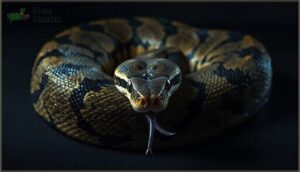
Once you’ve mastered safe handling techniques, reading your python’s body language becomes your next line of defense. Defensive postures aren’t random — they’re a clear conversation.
Watch for these warning signs before a situation escalates:
- An S-shaped neck coil with a raised, pulled-back head signals a primed threat response
- Locked eye contact combined with short, rapid tongue flicks means the snake’s temperament has shifted into defensive mode
- Hissing, body freezing, or bluff strikes are all reticulated python behavior cues telling you to back off now
Reducing Aggression and Building Trust

Once you know the warning signs, the real work begins — earning trust. Short, calm handling sessions several times a week are your foundation. Lift from the midbody, support the snake’s full weight, and let it move through your hands freely.
Positive reinforcement, stress reduction, and consistent socialization are what shift a reticulated python’s defensive behaviors into genuine calm over time.
Special Considerations for Children and Pets

Living with a reticulated python means setting non-negotiable rules around child supervision and pet safety tips. These aren’t suggestions — they’re constrictor precautions that protect everyone.
- Children never open the enclosure alone
- Small pets stay completely separated
- Handling always involves a second adult
- Emergency planning covers bite and constriction response
- Snake safety and handling sessions happen when kids are elsewhere
Top 8 Products for Reticulated Python Care
Getting the right gear makes a real difference when you’re keeping a snake this size. Your setup doesn’t have to be complicated, but it does need to cover the basics — space, heat, humidity, and safety.
Here are eight products worth having on your radar.
1. Reptizoo Large Reptile Terrarium Tank
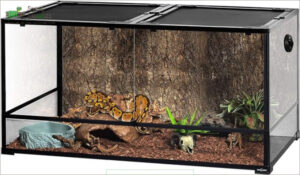
Space is non-negotiable with reticulated pythons, and the Reptizoo 120-gallon terrarium delivers exactly that. At 48 by 24 by 24 inches, it gives your retic room to move, stretch, and thermoregulate properly.
The tempered glass holds heat gradients well, and the front sliding door means you’re not reaching over your snake from above, which matters for calm, trust-building interactions.
The anti-escape lock and raised waterproof base round out a setup that’s built for serious keepers who don’t cut corners.
| Best For | Serious reptile keepers who need a large, secure enclosure for big snakes, bearded dragons, or tortoises and want easy access without stressing their animal. |
|---|---|
| Brand | REPTI ZOO |
| Primary Use | Reptile enclosure |
| Species Suitability | Snakes, lizards, tortoises |
| Ease of Use | Moderate |
| Maintenance Required | Regular cleaning |
| Product Format | Physical enclosure |
| Additional Features |
|
- Tempered glass keeps heat gradients stable and holds up over time
- Front sliding door makes feeding and cleaning way less stressful for both you and your pet
- Anti-escape buckle and front door lock give you real peace of mind
- At nearly 91 pounds, you’ll want a second set of hands to move it
- Some buyers have run into assembly headaches or shipping damage
- You’ll need to buy extra gear for humidity and temperature control — it doesn’t come ready to go
2. Zoo Med Forest Floor Bedding
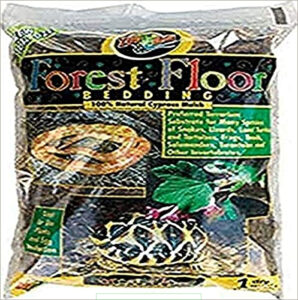
Substrate might seem like a small detail, but it shapes your retic’s entire environment. Zoo Med Forest Floor Bedding is made from 100 percent natural cypress mulch, and it does something most substrates can’t pull off cleanly: it holds moisture without turning into a swamp.
That steady humidity is exactly what tropical species like reticulated pythons need. It’s easy to spot clean, and you can mix it with coconut fiber to fine-tune your setup even further.
| Best For | Reticulated pythons, tropical snakes, amphibians, and other humidity-loving reptiles that need a natural, moisture-retaining substrate. |
|---|---|
| Brand | Zoo Med |
| Primary Use | Reptile substrate |
| Species Suitability | Snakes, amphibians, tortoises |
| Ease of Use | Easy |
| Maintenance Required | Spot cleaning |
| Product Format | Loose substrate |
| Additional Features |
|
- Made from 100% natural cypress mulch, so it looks great and mimics a real forest floor
- Holds moisture well, helping you maintain the steady humidity tropical species like retics need
- Easy to spot clean, especially when mixed with coconut fiber or other substrates
- Can get expensive fast if you’re filling a large enclosure
- May have bigger chunks mixed in that you’ll want to pick out before use
- Hard to spot waste on its own — you’ll likely want to mix it with something else
3. Vivosun Reptile Heating Pad Thermostat Combo

Temperature control isn’t optional when you’re keeping a reticulated python — it’s the foundation of everything. The Vivosun Reptile Heating Pad Thermostat Combo gives you real control over your snake’s belly heat, with an adjustable range of 40–108°F and far-infrared technology that warms evenly without creating hot spots.
The digital thermostat cycles power on and off based on a probe inside the enclosure, so you’re not guessing. It’s best suited for juvenile setups or quarantine tubs, not full adult enclosures.
| Best For | Reptile keepers with juvenile snakes, small lizards, or hatchlings who need reliable belly heat in tubs or quarantine setups. |
|---|---|
| Brand | VIVOSUN |
| Primary Use | Heat regulation |
| Species Suitability | Reptiles, amphibians |
| Ease of Use | Easy |
| Maintenance Required | Monitoring |
| Product Format | Electronic device |
| Additional Features |
|
- The digital thermostat actually reads the enclosure temp and cuts power when it hits your target — no more guessing or overheating.
- Far-infrared heat spreads evenly across the mat, so there are no hot spots that could burn your animal.
- Setup is straightforward — peel, stick, plug in, and you’re ready to go.
- It’s not built for large adult enclosures or aquariums, so don’t expect it to carry a big setup.
- Some users have had durability issues over time, so it may not be a forever product.
- Temperature accuracy isn’t always spot-on — a few degrees of drift is something to watch for.
4. Fluker’s Ceramic Heat Emitter
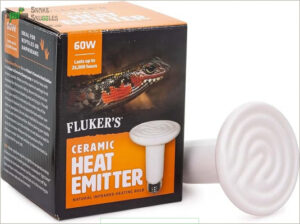
When overhead heat matters, Fluker’s Ceramic Heat Emitter delivers without the drama. Running at 60 watts, it pushes infrared warmth into surfaces and basking zones — not just the air — so your python actually absorbs it the way it would in nature. No light, no disruption to its day-night rhythm.
It’s rated for up to 25,000 hours, which means fewer replacements and more consistency. Just pair it with a ceramic socket fixture and mount it over a screen top, never glass.
| Best For | Reptile and amphibian owners who need a steady, 24-hour heat source without disturbing their pet’s natural light cycle. |
|---|---|
| Brand | Fluker’s |
| Primary Use | Heat source |
| Species Suitability | Reptiles, amphibians |
| Ease of Use | Easy |
| Maintenance Required | Monitoring |
| Product Format | Hardware emitter |
| Additional Features |
|
- Emits infrared heat without any light, so your reptile’s day-night rhythm stays intact
- Works around the clock as a reliable heat source for tropical and desert species
- Large emitter surface means a bigger basking zone, not just a hot spot
- 60 watts may not cut it for larger enclosures or species that need serious heat
- Requires a separate compatible fixture — it doesn’t work on its own
- Lifespan can vary depending on how hard you run it
5. Repti Zoo Reptile Mister Fogger System

Humidity isn’t optional for a reticulated python — it’s survival infrastructure. The Repti Zoo Reptile Mister Fogger System takes that pressure off you with a 10-liter tank, a near-silent pump, and a built-in timer that manages scheduled misting without any babysitting.
Fine droplets raise humidity without killing airflow, and the auto shutoff protects the pump when it runs dry. Pair it with distilled water to cut down on mineral buildup, and you’ve got a reliable system that keeps your enclosure dialed in.
| Best For | Reptile owners who want hands-off humidity control without constantly spraying down their enclosure. |
|---|---|
| Brand | REPTI ZOO |
| Primary Use | Humidity control |
| Species Suitability | Reptiles, amphibians |
| Ease of Use | Moderate |
| Maintenance Required | Regular cleaning |
| Product Format | Electronic device |
| Additional Features |
|
- The 10L tank means fewer refills, so you’re not constantly babysitting it
- The silent pump and built-in timer keep humidity levels steady on a schedule
- Connects up to 20 nozzles, so it can grow with your setup
- Needs regular cleaning or you’ll run into clogs and bacteria buildup
- A few users have had trouble with the timer acting up or nozzles getting blocked
- Setup has to be done carefully, or you risk flooding your enclosure
6. Stainless Steel Snake Hook Tool

Every serious retic keeper needs a good snake hook — full stop. The CL33 Stainless Steel Snake Hook gives you 33 inches of reach with a copper ferrule that keeps it light and balanced in your hand.
The rubber grip won’t slip, even when your python decides to shift its weight unexpectedly.
Use it for tap training, repositioning, or just moving your snake away from the enclosure door before you reach in. It’s a simple tool that makes a real difference in how safely you handle your retic.
| Best For | Snake keepers who work with small to large snakes like ball pythons and want a reliable, well-balanced hook for tap training, repositioning, and safe daily handling. |
|---|---|
| Brand | Unnamed |
| Primary Use | Snake handling |
| Species Suitability | Snakes, lizards |
| Ease of Use | Easy |
| Maintenance Required | Minimal |
| Product Format | Physical tool |
| Additional Features |
|
- The copper ferrule keeps it light and nicely balanced, so your hand doesn’t fatigue during longer sessions.
- The rubber grip holds firm even when a snake shifts its weight, which makes a real difference in confident handling.
- At 33 inches, it’s long enough to give you safe reach while still being manageable inside tighter enclosures.
- It’s a fixed length, so if you need something adjustable or longer for different setups, this won’t cut it.
- Not the right tool for very large or aggressive snakes that need more reach and control.
- Single-purpose design — though it can grab items in tight spaces, it’s really built for reptile handling and not much else.
7. Galapagos Terrarium Sphagnum Moss
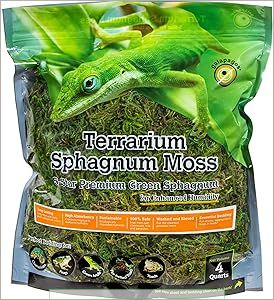
Humidity is one of those things that can make or break a clean shed for your retic. Galapagos Terrarium Sphagnum Moss gives you a practical way to manage it without constant misting.
This natural, long-fiber moss holds up to 20 times its dry weight in water, releasing moisture slowly into the enclosure air. Pack it into a hide box, and you’ve built a reliable humid retreat your python can use right before a shed.
It’s non-toxic, safe, and straightforward to use.
| Best For | Reptile and amphibian owners who need a reliable way to boost humidity in tropical or wetland terrariums, especially during shedding. |
|---|---|
| Brand | Galapagos |
| Primary Use | Humidity substrate |
| Species Suitability | Reptiles, amphibians |
| Ease of Use | Easy |
| Maintenance Required | Regular maintenance |
| Product Format | Loose substrate |
| Additional Features |
|
- Holds moisture well and releases it slowly, making it great for humidity-sensitive species like geckos, frogs, and snakes
- Non-toxic and safe, so you’re not putting your animals at risk
- Works beyond the tank too—handy for houseplants or garden decoration
- Some users noticed heavy green dye, which might be a turn-off if you want a more natural look
- Can develop mold over time if you’re not staying on top of maintenance
- Packaging tends to include a lot of air and crumbs, so you may get less usable moss than expected
8. Reticulated Pythons Care Handbook

Once your enclosure setup is dialed in, the next step is knowing why you’re doing what you’re doing. That’s where the Reticulated Pythons Care Handbook earns its place.
At 211 pages, it walks you through everything from daily husbandry routines to genetics, locality types, and long-term health planning — all written for keepers who take this seriously.
For $11.49, it’s a practical reference you’ll return to regularly, not just skim once and shelve.
| Best For | Reptile enthusiasts, experienced keepers, breeders, and herpetologists who want a serious, practical guide to reticulated python care. |
|---|---|
| Brand | Unnamed |
| Primary Use | Reptile care guide |
| Species Suitability | Reticulated pythons |
| Ease of Use | Moderate |
| Maintenance Required | N/A |
| Product Format | Printed book |
| Additional Features |
|
- Covers everything in one place — biology, behavior, housing, feeding, and long-term health care
- Includes safety protocols and ethical breeding guidance, so you’re not just winging it
- At $11.49 for 211 pages, it’s genuinely good value for a reference you’ll actually use
- Not the best starting point if you’re brand new to snakes — it assumes some baseline knowledge
- Touches on legal and conservation issues that can vary a lot depending on where you live
- Reticulated pythons are a big commitment, and the book makes that clear — it’s not light reading
Frequently Asked Questions (FAQs)
What is the temperament of a reticulated python?
What do you get when you combine raw power with sharp instincts? Reticulated pythons are bold, curious, and highly alert — captive-bred individuals tend toward calm, but every snake carries its own distinct personality.
Are reticulated pythons friendly?
Reticulated pythons aren’t friendly in the way a dog is, but captive-bred individuals can become calm and tolerant with consistent handling.
They respond to routine, not affection — respect that difference and you’ll be fine.
What is the calmest python species?
Ball pythons take the crown here. They’re calm, slow-moving, and rarely bite — making them the go-to choice for beginners who want a manageable, docile snake without the intimidation factor of larger species.
Can reticulated pythons recognize their owners over time?
Yes, they can — but not the way a dog does. Over time, your retic learns your scent, movement, and routine, responding with noticeably calmer behavior around you than around strangers.
How do feeding responses affect daily temperament?
It’s funny — the moment you walk up to the enclosure right before feeding day, your retic is already watching.
A hungry snake stays restless, reactive, and primed to strike at almost anything that moves.
Do retics show territorial behavior in captivity?
Most of what looks like territorial behavior in captivity is actually cage defensiveness or a food response.
Once you get a retic out of its enclosure, it usually calms down fast.
What triggers sudden temperament changes in adults?
Feeding scents, environmental stress, inconsistent handling, hormonal shifts, and hidden health issues are the main culprits. Even a hungry retic that smells prey on your hands can flip fast.
Are certain morphs calmer than others genetically?
Tiger morphs have a calmer reputation, but genetics don’t guarantee temperament.
Breeder practices, early handling, and individual personality matter far more than any morph label when predicting how your retic will behave.
How long do reticulated pythons typically live?
In captivity, reticulated pythons generally live 20 to 25 years, with well-cared-for individuals sometimes reaching close to Wild specimens usually live shorter lives, averaging around 12 to 20 years.
What do reticulated pythons eat in captivity?
In captivity, reticulated pythons live on whole prey — mice, rats, rabbits, and poultry. As they grow, prey size scales up to match their girth, keeping digestion smooth and nutrition balanced.
Conclusion
The snake that most people fear isn’t the one you’ll actually own—that version lives in headlines, not enclosures. The real reticulated python temperament profile reveals an animal shaped by environment, handling, and trust.
Get those variables right, and what you’re working with isn’t a liability—it’s a genuinely fascinating creature that rewards patience and knowledge. Respect its size, read its signals, and you won’t just manage this snake. You’ll understand it.
- https://www.petmd.com/reptile/species/reticulated-python
- https://bobclark.com/blogs/articles/reticulated-pythons
- https://www.behavioreducation.org/post/choice-based-and-context-based-snake-handling-respecting-boundaries-and-building-trust
- https://reptifiles.com/reticulated-python-care-sheet/
- https://www.bbc.com/news/world-asia-39427462