This site is supported by our readers. We may earn a commission, at no cost to you, if you purchase through links.
Most snake bites happen not because a snake is aggressive, but because it felt cornered. Snakes don’t chase people — they react to threats, and often, we create those threats without realizing it. A sudden reach into a woodpile, a shadow falling across a basking rattlesnake, or the scent of a mouse on your hand can shift a calm snake into full defensive mode within milliseconds.
Understanding snake strike triggers isn’t about fear — it’s about awareness. The difference between a close call and a bite often comes down to knowing what sets a snake off and adjusting your behavior before it matters.
Table Of Contents
- Key Takeaways
- Common Triggers for Snake Strikes
- Recognizing Snake Warning Signs
- Human Behaviors to Avoid Near Snakes
- Environmental Factors That Increase Strike Risk
- Safe Handling and Prevention Tips
- Frequently Asked Questions (FAQs)
- What repels snakes immediately?
- How to stop a snake from striking?
- Can snakes strike after being decapitated?
- Do snakes target specific body parts when striking?
- How far can a snake strike from resting position?
- Are certain snake species more strike-prone than others?
- Can snakes sense fear through human body chemistry?
- Conclusion
Key Takeaways
- Most snake strikes are defensive strikes, not aggressive — snakes bite when they feel cornered, startled, or mistaken for prey, so your behavior matters more than the snake’s mood.
- Watch for warning signs like S-shaped coiling, hissing, or rapid tongue flicking, because snakes almost always signal before they strike.
- Simple habits — washing hands before handling, wearing boots in snake country, and probing hidden spots before reaching in — cut your bite risk dramatically.
- Environmental factors like low light, temperature extremes, and disturbing a snake’s regular shelter all quietly raise strike risk, so staying aware of your surroundings is just as important as watching the snake itself.
Common Triggers for Snake Strikes
Most snake strikes aren’t random — they happen for specific reasons. Understanding what sets a snake off is the first step to staying safe around them.
Knowing the most common triggers — like sudden movement or accidental step-ons — can seriously cut your risk, and this guide on avoiding snake bites breaks it down in plain, practical terms.
Here are the most common triggers you’ll want to know.
Sudden Movements and Vibrations
Snakes don’t need to see you coming — they feel you. Through vibration detection in their jawbones, even your footsteps send ground alerts that trigger defensive postures. Sudden strikes often happen in milliseconds, faster than you can react.
Watch for these motion triggers that cause snake bites:
- Jerky hand movements near the body
- Stomping or running in snake habitat
- Dropping objects close to a resting snake
- Quick reaching motions over hidden areas
- Flinching during reptile behavior observation sessions
Approaching a Snake’s Head
Movement matters more than most people realize. A direct frontal approach activates snake strike behavior fast — their snake vision limits mean anything coming straight at the head looks threatening.
Use safe handling tools like hooks to reposition the body first. Keeping yourself slightly to the side reduces defensive posture signs and lowers strike distance factors dramatically. Never reach from above.
Handling During Shedding
Beyond approach angle, timing matters just as much. Reduced handling during a shed cycle is one of the easiest ways to avoid a defensive snake strike.
Vision impairment from cloudy eyes makes your snake startle easily. Shedding irritability is real — even calm snakes may bluff-strike. If stuck shed becomes an issue, use a lukewarm soak rather than direct handling techniques that risk snakebite prevention going sideways.
Mistaking Hands for Prey
Timing and scent matter more than most people realize. A hungry snake doesn’t pause to think — it reacts. Scent Cues like raw meat or rodent odors on your hands can trigger a feeding strike fast.
If you want to get better at catching those subtle hunger cues before feeding time, reading pet snake body language and behavior can help you spot the signs early.
Feeding Routines and Visual Mimicry also play roles:
- Wash hands thoroughly before handling
- Use tongs, never fingers, to offer food
- Avoid fast, prey-like finger movements near the enclosure
Recognizing Snake Warning Signs
Snakes don’t strike without reason — they usually give you a heads-up first.
Learning to read their body language can buy you just enough time to back off safely.
Watch for these three warning signs that a snake is about to reach its limit.
S-Shaped Coiling and Posture

That tight S-curve isn’t just posture — it’s a loaded spring. When a snake pulls its head back into a coiled neck and raises the front third of its body, it’s locked into defensive posture and running full threat assessment on you.
| Body Language Cue | What It Means | What You Should Do |
|---|---|---|
| Raised S-shaped neck | Strike mechanics ready | Stop moving immediately |
| Tight coiling behavior | Defensive behavior active | Back away slowly |
| Head aimed at you | Snake behavior — target locked | Increase distance now.” |
Venomous snakes commonly hold this position during tense snake encounters.
Hissing, Rattling, and Bluff Strikes
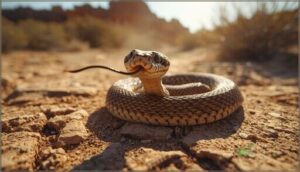
A hissing snake isn’t being dramatic — it’s running threat assessment and warning you to back off. These snake warning signs are layered, escalating signals you shouldn’t ignore.
- Hissing signals fear or stress — a defensive behavior asking for space.
- Rattling means a rattlesnake already knows you’re there.
- Bluff strike tactics — lunges without contact — mean the next one might connect.
Back away calmly.
Changes in Breathing or Tongue Flicking
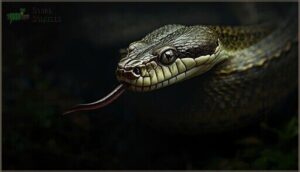
Subtle shifts in tongue flick rates and respiratory patterns can tell you a lot before a snake strike happens. A relaxed snake flicks slowly; a stressed one ramps up fast, using scent tracking to assess the threat. Stress breathing — visible body pumping near the ribs — signals the same thing. These defensive behaviors mean the snake’s already decided you’re a problem. Give it space.
Human Behaviors to Avoid Near Snakes
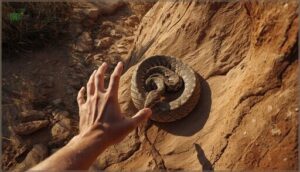
Most snake bites don’t happen out of nowhere — they happen because of something a person did first.
Your behavior around snakes matters more than you might think.
Here are the key habits to drop if you want to stay safe.
Reaching Blindly Into Concealed Areas
Your hand goes in first — your eyes never catch up. That’s the real danger of concealed space risks around snakes.
Woodpiles, rock gaps, and debris piles are prime hidden snake dangers, and blind reach consequences can be severe.
Before reaching in, use a rake or stick to probe first. Protective gear essentials — thick gloves and long sleeves — add a critical layer of defense.
Attempting to Catch or Handle Wild Snakes
Trying to catch a wild snake is one of the fastest ways to get bitten. Most venomous bites happen during snake handling, not random snake encounters.
Wildlife Safety experts consistently warn that snake behavior turns sharply defensive the moment you reach for one. Handling Risks are real — even a “dead” snake can strike by reflex. Just back away.
Ignoring Proper Protective Clothing Outdoors
What you wear in snake country can mean the difference between a close call and a serious bite. Around 60 to 80 percent of bites hit the lower legs and feet — bare skin right in the strike zone.
In snake country, your clothing is your first defense — and bare legs are an open invitation
- Lower leg bites happen most when you skip boots or gaiters
- Footwear risks increase dramatically with sandals or thin sneakers
- Venom absorption drops substantially when sturdy denim or snake-proof boots are worn
Gaiter protection and protective clothing aren’t overkill — they’re just smart outdoor safety.
Environmental Factors That Increase Strike Risk

Where you’re matters just as much as what you do around snakes. Certain environments and conditions quietly stack the odds against you, making a defensive strike far more likely.
Here are the key environmental factors worth knowing before you head out.
Disturbing a Snake’s Territory
Every snake claims a home range — and territorial invasion of that space can trigger a fast defensive response. Whether it’s a rocky crevice, a snake shelter under old timber, or a sun-warmed ledge, snakes return to the same spots repeatedly.
Habitat disruption from digging, clearing brush, or careless border encroachment near these zones narrows their escape routes. Good spatial awareness keeps you out of trouble.
Nighttime and Low-Visibility Encounters
Spatial awareness matters just as much after dark. Nocturnal snake behavior peaks at dusk, when thermal detection makes your warm feet an easy target — even before you spot anything.
Studies show nearly half of rural bites happen in evening hours. For nighttime safety tips, carry a flashlight and sweep it side to side. Low light encounters rarely end well without one.
Snake Behavior During Temperature Extremes
Temperature shapes snake behavior more than most people realize. Cold weather slows muscles, making strikes sluggish — but a disturbed snake still bites. Heat stress above the low 90s makes them irritable and quicker to snap.
Watch for these risk windows:
- Brumation patterns: sluggish spring emergence near den sites
- Thermal regulation: midday heat drives snakes into hiding
- Temperature tolerance limits: extreme cold or heat disrupts defensive mechanisms
Safe Handling and Prevention Tips

Knowing what triggers a snake strike is only half the battle — the other half is knowing how to act around snakes safely.
Whether you keep a pet snake or just want to stay smart outdoors, a few practical habits go a long way. Here’s what you should know about handling, housing, and spreading the word on snake safety.
Approaching and Lifting Pet Snakes
Picking up your pet snake isn’t complicated, but how you do it matters. Always approach from the side — never from above, which mimics a predator and can trigger a snake strike.
Touch the mid-body first, support the full length, and move with calm hands. Good lifting techniques and calm approach habits make a real difference in snake behavior and pet safety.
Setting Up Secure Enclosures
A well-designed snake enclosure does more than just house your pet — it protects everyone. Focus on escape prevention by sealing gaps under 3mm and adding secure locks to sliding doors.
Use metal mesh ventilation systems that balance airflow with solid barrier materials. Two hides, stable décor, and proper enclosure design support snake health and reduce defensive striking during routine reptile care.
Educating Others on Snake Safety
Spreading snake safety knowledge protects both people and wildlife. Teaching others about snake strike triggers, venomous species, and defensive mechanisms turns a fearful encounter into a manageable one. Share these core snake bite prevention habits:
- Never reach blindly into brush, logs, or rock piles
- Always leave snakes a clear escape path
- Wear boots and long pants in snake country
- Recognize warning postures before getting too close
- Call wildlife control instead of handling snakes yourself
Good hiking safety starts with what you teach before the trail.
Frequently Asked Questions (FAQs)
What repels snakes immediately?
Physical blockades and ground barriers are your best bet. Vibration devices pulse through soil, sending snakes elsewhere. Loud noises and stomping work similarly. Skip chemical snake deterrents — research shows they rarely hold up.
How to stop a snake from striking?
To stop a snake from striking, move slowly, stay calm, and give it space.
Understanding snake behavior and defensive postures helps you recognize threat assessment signals before a defensive strike occurs.
Can snakes strike after being decapitated?
Yes — a decapitated snake can still strike. Reflex bites from a severed head remain a real danger for up to an hour.
Post-mortem movements and venom injection can still occur, so never handle one.
Do snakes target specific body parts when striking?
Snakes don’t aim. They strike whatever is closest — usually your hands or feet. About 47 percent of bites hit arms and hands, mostly because people reach toward them.
Distance is your best defense.
How far can a snake strike from resting position?
From a resting coil, most snakes can strike roughly one-third to one-half their snake length. A 3-foot snake’s maximum reach spans 12–18 inches, so never assume you’re safely out of range.
Are certain snake species more strike-prone than others?
Oddly enough, species temperament matters as much as venom. Copperheads and cottonmouths show more aggressive behaviors than corn snakes. Strike patterns and defensive postures vary widely — even among venomous species.
Can snakes sense fear through human body chemistry?
Not quite. Despite popular belief, there’s no evidence snakes detect human fear through body chemistry.
Their chemosensory systems read prey scent and predator odors — not the subtle chemical shifts in your stress sweat.
Conclusion
Snakes are like locked doors — they don’t swing open unless something pushes them. Knowing which snake strike triggers to avoid puts you in control of every outdoor moment.
Respect their space, read their warnings, and move with intention rather than impulse. Whether you’re hiking remote trails or keeping a pet snake at home, awareness is your best protection.
Stay calm, stay observant, and most encounters will end the same way they began — peacefully.
- https://www.nhm.ac.uk/discover/snakes-senses-stretchy-jaws-deadly-venom.html
- https://www.forbes.com/sites/scotttravers/2026/02/09/meet-the-snakes-that-strike-faster-than-humans-can-react---a-herpetologist-explains/
- https://www.sciencedaily.com/releases/2008/02/080221105350.htm
- https://www.smithsonianmag.com/smart-news/slow-motion-videos-reveal-what-really-happens-when-snakes-bite-180987571/
- https://www.mtcounties.org/news/association-news/safety-corner/rattlesnake-safety-tips-to-prevent-snake-bites/