This site is supported by our readers. We may earn a commission, at no cost to you, if you purchase through links.

Your snake won’t tell you when the temperature drops to dangerous levels—by the time you notice lethargy or refused meals, thermal stress has already begun damaging its immune system.
A $15 thermometer error can trigger respiratory infections that cost hundreds in veterinary bills, yet most beginners rely on inaccurate stick-on gauges or guesswork.
Snake thermometers for beginners aren’t just accessories; they’re diagnostic tools that reveal whether your heating equipment actually maintains the gradient your species needs.
The difference between a thriving snake and one struggling through recurring health issues often comes down to knowing the real temperature at substrate level, not what the pet store employee promised your heat lamp would deliver.
Table Of Contents
- Key Takeaways
- Why Accurate Temperature Matters for Snakes
- Types of Snake Thermometers Explained
- Key Features to Look for in Thermometers
- Setting Up and Placing Your Thermometer
- Top 10 Snake Thermometers for Beginners
- 1. Fluker’s Digital Thermometer Hygrometer
- 2. Zoo Med Dual Thermometer Humidity Gauge
- 3. Repti Zoo Digital Thermometer Hygrometer
- 4. ThermoPro Digital Hygrometer Thermometer
- 5. Inkbird Digital Thermometer Hygrometer Monitor
- 6. Reptile Thermometer Humidity Gauge
- 7. Mini Digital Hygrometer Thermometer
- 8. Paizoo Reptile Thermometer Hygrometer
- 9. Oasirep Reptile Thermometer Hygrometer
- 10. Digital Reptile Thermometer Hygrometer
- Budget and Brand Considerations for Beginners
- Maintenance and Troubleshooting Tips
- Maximizing Thermometer Use for Snake Health
- Frequently Asked Questions (FAQs)
- Conclusion
Key Takeaways
- Accurate temperature monitoring prevents costly health crises like respiratory infections and metabolic disorders that develop silently when enclosures drift just 2-3 degrees from species requirements, making a reliable thermometer the difference between proactive care and reactive veterinary bills.
- Position digital thermometers at substrate level in both warm and cool zones rather than at human eye level or against glass surfaces, since your snake experiences temperatures 8+ inches lower where gradient variations of 15-20°F can occur within the same enclosure.
- Budget-friendly options ($12-18) from established brands like Zoo Med, Fluker’s, and ThermoPro deliver the ±1°F accuracy needed for proper husbandry, while devices under $10 typically drift 3-5°F within months and compromise long-term reliability.
- Monthly calibration checks using ice water (32°F standard) catch sensor drift before it endangers your snake, and replacing thermometers when readings diverge more than 2°F from calibration standards protects against the gradual accuracy loss that occurs over 2-3 years of use.
Why Accurate Temperature Matters for Snakes
Your snake’s body doesn’t generate its own heat source—it borrows every degree from its environment.
That’s why tracking ambient and surface temps with a reliable reptile thermometer is the only way to know your setup is actually working.
A snake’s warmth comes entirely from its environment, not its own body
When temperatures drift even a few degrees off target, you’re looking at suppressed immune function, incomplete sheds, and meals that sit undigested for days.
If your snake’s entering a cooler period, adjusting feeding schedules during brumation can prevent dangerous digestive slowdowns.
Let’s break down exactly what’s at stake when your thermometer lies to you.
That’s why choosing the right type and placement matters—reptile thermometers for tropical snakes aren’t one-size-fits-all, and even a few degrees off can throw everything out of balance.
Preventing Health Issues in Snakes
Temperature errors don’t announce themselves with warning signs—they accumulate silently until your snake stops eating, develops a respiratory infection, or fails to mount an immune response to routine pathogens.
That’s why verifying your enclosure stays within the right range should be part of your weekly routine, not something you check only when symptoms appear.
Even minor thermal stress compromises reptile health through:
- Respiratory diseases from cool-side temperatures below species requirements
- Impaired snake nutrition and digestion when heat gradients collapse
- Suppressed immune function allowing routine reptile diseases to proliferate
- Metabolic disorders from inconsistent environmental control
Accurate reptile thermometers with proper thermometer calibration prevent these cascading failures.
For setups monitoring multiple enclosures, reptile thermometers designed for multi-tank systems simplify temperature tracking without draining batteries quickly.
Impact on Shedding and Hydration
Your thermometer’s accuracy shapes shedding cycles more directly than you might expect—incomplete ecdysis quality often traces back to temperature control failures, not just humidity control. When basking zones drop below 85°F or gradients collapse, snakes struggle with retained skin and eye caps regardless of hydration status.
Proper thermoregulation through calibrated reptile thermometers facilitates complete sheds; without it, you’re troubleshooting symptoms while the real problem persists. Understanding retained eye caps is vital for maintaining healthy snakes.
Supporting Proper Digestion and Behavior
The same thermal precision that drives successful ecdysis controls your snake’s ability to digest prey—without a basking zone holding steady at 88–92°F, stomach enzymes can’t break down food efficiently.
This temperature sensitivity is closely related to the thermogenic response in snakes, which affects their digestive performance.
Temperature control through proper reptile thermometer calibration determines metabolic rates; cool enclosures stall digestion health and trigger regurgitation, while accurate temperature gradients support nutrition balance.
Behavioral cues like post-feeding thermoregulation depend on reliable monitoring—your reptile care outcomes hinge on this fundamental connection.
Types of Snake Thermometers Explained
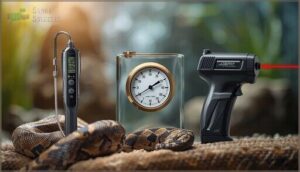
You can’t maintain proper snake husbandry without the right temperature monitoring equipment—but walking into a reptile supply store reveals dozens of options that all claim to do the same job.
Digital displays promise precision; analog gauges offer simplicity; infrared guns provide spot readings without contact. Understanding the distinct advantages and limitations of each thermometer type helps you select tools that match your enclosure setup, your monitoring needs, and your experience level.
Digital Vs. Analog Thermometers
You’ve got two paths here—one runs on batteries and precision, the other on a coiled metal strip and zero fuss. Digital thermometers deliver thermometer accuracy within 0.5°F—critical when your ball python needs exactly 88°F for digestion.
Analog reliability means no dead batteries at 2 a.m., but expect ±2°F variance. Digital displays eliminate squinting; analog gauges demand good lighting and interpretation skills.
Infrared and Probe Options
Spot-checking basking rocks demands infrared sensors—they deliver surface readings in under half a second without disturbing your snake, usually accurate within ±1.5%.
Probe placement matters more for continuous monitoring; position one probe in the warm hide and another on the cool side to track temperature gradients your animal actually experiences.
Contact probes beat infrared sensors for precision, but handheld guns reveal hotspots fast—pair both for complete thermometer selection and calibration in reptile care.
Combo Units for Temperature and Humidity
Dual-function devices simplify temperature control and humidity monitoring without cluttering your vivarium walls. Digital displays on combo units track both metrics simultaneously—most measure 23°F to 122°F and 30–90% relative humidity, covering tropical to desert setups.
Remote probes enable precise probe placement at snake height while keeping electronics outside humid zones. Calibration tips: cross-check readings with standalone devices since budget hygrometers drift ±5% in reptile thermometer comparisons.
Key Features to Look for in Thermometers
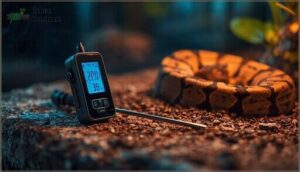
Not all thermometers deliver the reliability your snake needs—some fail at humidity, others drift out of calibration within months.
The right device combines precision with practical design features that make daily monitoring straightforward rather than frustrating. Here are the five essential specifications that separate dependable thermometers from cheap gauges that put your snake at risk.
Accuracy and Precision
A thermometer that’s off by even three degrees can mean the difference between a healthy shed and a trip to the vet with a dehydrated snake. You need sensor accuracy within ±1°F—not the ±3-5°F you’ll find in cheap stick-on models.
Look for:
- Digital thermometers with stated precision ranges
- Thermometer calibration features or ice-bath compatibility
- Real-time temperature and humidity control readouts
Measurement errors compound fast in small enclosures.
Durability and Water Resistance
Snake enclosures don’t run on gentle conditions—they’re humid, splashed with water during misting, and subjected to temperature swings that stress every component inside.
Your digital thermometer needs waterproof materials and corrosion resistance—not just humidity tolerance. Look for IP44-rated housings minimum; sealed probe connections prevent moisture infiltration that throws off temperature and humidity control.
Durable designs with moisture protection survive the wet reality of proper reptile care and management without requiring constant thermometer calibration or replacement.
Display Readability and Backlighting
You can’t manage what you can’t read—especially when you’re checking temperatures at dawn or after lights-out.
Prioritize these display clarity features in your digital thermometer:
- Backlight options that light up without waking your snake during nighttime temperature checks
- High-contrast color schemes with font sizes above 10mm for instant readability across the room
- Screen visibility from multiple angles—critical when reptile thermometers sit behind branches or hides
Clear displays prevent thermometer calibration mistakes that compromise safety.
Mounting and Placement Options
Where your thermometer lives determines whether it tells you the truth about your snake’s environment—or feeds you comforting lies.
Choose adaptable mounting systems—your reptile thermometer should track thermal regulation at substrate level, not ceiling temperature that means nothing for your snake’s actual thermal experience.
| Mount Type | Best Use |
|---|---|
| Adhesive Mounts | Permanent placement on enclosure frames |
| Suction Cups | Glass terrariums requiring repositioning |
| Magnetic Clips | Metal-backed enclosures and quick adjustments |
Power Source and Battery Life
Digital thermometers die at the worst possible moments—right when your heat lamp fails during a winter cold snap or your snake enters a critical shed cycle.
Battery types and power consumption determine your reptile thermometer’s reliability; AAA batteries offer universal availability while lithium cells extend lifespan to 12-18 months.
Energy efficiency varies wildly—backlit displays drain power three times faster than basic digital thermometers, compromising your reptile care when temperature monitoring matters most.
Setting Up and Placing Your Thermometer
You can own the best thermometer on the market, but if it’s in the wrong spot, you’re getting worthless data.
Snake enclosures need deliberate sensor placement to capture the full temperature range your animal experiences—not just the numbers that look good from across the room.
Let’s walk through where your thermometers belong and what mistakes send beginners down the wrong path.
Ideal Thermometer Placement in Snake Enclosures
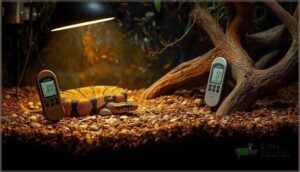
Placing your thermometer at the wrong height—even by a few inches—can give you falsely reassuring numbers while your snake bakes or freezes at floor level. Position your reptile thermometer directly at substrate height in both the warm and cool temperature zones; that’s where your snake actually lives.
Mount a second device mid-enclosure if you’re monitoring arboreal species—snake behavior dictates thermometer angle, not convenience.
Tracking Temperature Gradients

A single thermometer tells you one number—a thermal gradient reveals whether your enclosure actually functions as the thermal landscape your snake needs to survive.
Install one digital thermometer at each end of your tank—warm basking zone and cool retreat—to track the thermal gradient between heat sources. You’re not measuring ambient air; you’re mapping temperature zones that drive thermal cycles, digestion, and thermoregulation across your snake’s entire habitat.
Avoiding Common Placement Mistakes

Even with two thermometers installed, most beginners sabotage their gradient by sticking sensors directly onto glass, mounting them at eye level instead of substrate height, or placing probes so close to heat lamps that readings spike 15–20°F above what the snake actually experiences.
Avoid these thermometer placement errors:
- Attaching sensors to glass walls — surface temperature doesn’t reflect air temperature at substrate level
- Mounting probes within six inches of any heat source — direct radiation skews sensor calibration
- Ignoring humidity control placement — combo units need airflow; corners trap moisture and distort readings
- Installing at human eye level — your snake lives eight inches lower in the reptile enclosure where temperature gradients shift dramatically
Top 10 Snake Thermometers for Beginners
You need a thermometer that won’t fail when your snake’s health depends on it.
The following devices balance accuracy, durability, and ease of use—qualities that matter when you’re learning to maintain proper thermal gradients. Each option caters to specific beginner needs, from budget constraints to feature requirements.
1. Fluker’s Digital Thermometer Hygrometer
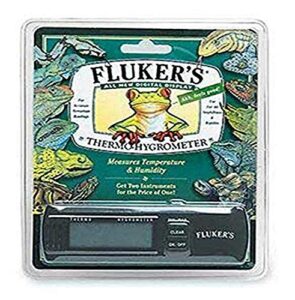
Fluker’s Digital Thermometer Hygrometer delivers dual-function monitoring at a price point that won’t make beginners regret their first equipment purchase—though you’ll need to verify its hygrometer accuracy against a known standard.
This plastic unit weighs just 1.44 ounces and provides clear digital readings for your reptile enclosure. Sensor placement matters—position it at snake level, not against the glass where adhesive issues plague some users.
Thermometer calibration ensures your readings reflect true conditions; inaccurate hygrometer readings won’t compromise the temperature data you need for proper husbandry.
| Best For | Budget-conscious reptile keepers who need reliable temperature readings and don’t mind double-checking humidity levels with a backup hygrometer. |
|---|---|
| Display Type | Digital |
| Material | Plastic |
| Measures Humidity | Yes |
| Measures Temperature | Yes |
| Power Source | Battery |
| Mounting Method | Adhesive |
| Additional Features |
|
- Lightweight digital display that’s easy to read at a glance
- Affordable dual-function monitor perfect for beginners setting up their first terrarium
- Compact 4-inch design fits discreetly in most enclosures without taking up valuable space
- Hygrometer accuracy is questionable—several users report readings that don’t match other devices
- Weak adhesive backing often fails to keep the unit in place or creates a sticky hazard for pets
- Shorter lifespan than expected, with some units failing after just a few months of use
2. Zoo Med Dual Thermometer Humidity Gauge
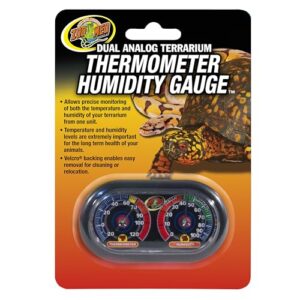
Zoo Med’s analog dual gauge trades batteries for Velcro—a straightforward swap that beginners appreciate until they discover the temperature readings drift two to three degrees from calibrated standards.
The humidity control function provides workable estimates rather than sensor accuracy you’d stake reptile health on. At 6 x 1 x 4 inches, this plastic unit monitors temperature gradients adequately if you cross-reference against a calibrated digital thermometer. The analog display requires no power—your hygrometer won’t fail mid-shed when monitoring matters most.
| Best For | Reptile owners on a budget who want a simple, battery-free monitoring option and don’t mind verifying readings with a second thermometer. |
|---|---|
| Display Type | Analog |
| Material | Plastic |
| Measures Humidity | Yes |
| Measures Temperature | Yes |
| Power Source | Battery |
| Mounting Method | Velcro |
| Additional Features |
|
- No batteries needed—the analog display keeps working indefinitely without power source worries
- Velcro backing makes it easy to move between different spots in the terrarium or remove for cleaning
- Affordable way to get both temperature and humidity readings from a single compact unit
- Temperature readings can be off by 2-3 degrees, so you’ll need a backup thermometer for accuracy
- Humidity measurements aren’t precise enough if your pet needs exact levels maintained
- Analog dial is harder to read quickly compared to digital displays, especially in dim lighting
3. Repti Zoo Digital Thermometer Hygrometer
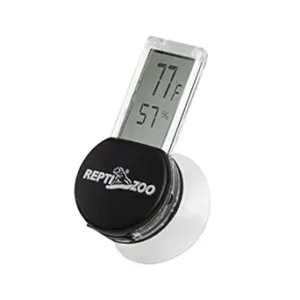
Repti Zoo’s SH125B delivers LCD precision at a price point that won’t drain your setup budget—though its suction cup attachment demands patience you mightn’t possess during initial installation.
The digital display tracks both temperature and humidity—dual monitoring that eliminates guesswork in humidity management and temperature control. You’ll appreciate the included standby battery; reptile care shouldn’t pause when your primary power source fails.
Water exposure terminates function permanently, so mount this hygrometer above substrate level where condensation won’t compromise your digital thermometer’s circuitry.
| Best For | Reptile owners who need budget-friendly dual monitoring of temperature and humidity but can keep the device away from water sources. |
|---|---|
| Display Type | Digital LCD |
| Material | Glass, Plastic |
| Measures Humidity | Yes |
| Measures Temperature | Yes |
| Power Source | Battery |
| Mounting Method | Suction Cup |
| Additional Features |
|
- Clear LCD screen shows both temperature and humidity readings in one compact unit
- Comes with a backup battery so you won’t lose monitoring if the main power dies
- Affordable option compared to pricier alternatives on the market
- Not waterproof—stops working completely if it gets wet, so placement matters
- Suction cup can be tricky to install and doesn’t always stay put where you want it
- Display can be tough to read depending on lighting, and some units develop errors after a few months
4. ThermoPro Digital Hygrometer Thermometer
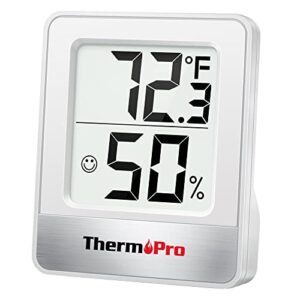
ThermoPro’s TP49 proves that sub-$10 instruments can deliver lab-grade accuracy—±1°F precision that rivals devices costing three times as much. The 10-second refresh rate tracks fluctuations faster than most digital thermometers in this price bracket, and the comfort indicator eliminates manual humidity control calculations.
You’ll find sensor placement straightforward with three mounting options—tabletop, magnetic, or hanging configurations that adapt to your enclosure design. ThermoPro features include 2%-3% humidity accuracy, though the absence of backlighting complicates nighttime thermometer calibration and reptile care maintenance checks.
| Best For | Budget-conscious hobbyists and homeowners who need reliable temperature and humidity monitoring for greenhouses, baby rooms, or small living spaces without spending more than $10. |
|---|---|
| Display Type | Digital LCD |
| Material | Plastic |
| Measures Humidity | Yes |
| Measures Temperature | Yes |
| Power Source | Battery |
| Mounting Method | Multiple Options |
| Additional Features |
|
- Lab-grade accuracy (±1°F and ±2-3% humidity) that matches devices costing three times more
- Fast 10-second refresh rate catches environmental changes quickly
- Three versatile mounting options (tabletop, magnetic, hanging) work in any setup
- No backlight makes nighttime readings nearly impossible
- Lightweight build (1.23 oz) feels less durable than heavier models
- Indoor-only design won’t survive harsh outdoor conditions
5. Inkbird Digital Thermometer Hygrometer Monitor
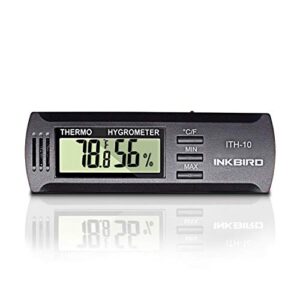
Inkbird’s ITH-12 stores 20 days of max/min data—a feature that transforms random temperature checks into evidence-based habitat management. You’ll track heating system failures and seasonal fluctuations that single readings miss entirely, with ±1.8°F temperature sensors delivering digital accuracy comparable to veterinary-grade instruments.
The compact 3.9″ design mounts via magnet or tabletop stand, though humidity control specs of ±3% lag behind premium hygrometer options. Battery-powered CR2032 cells eliminate wire clutter—practical for multi-enclosure setups where thermometer calibration consistency matters more than backlit displays.
| Best For | Reptile keepers and instrument owners who need reliable 20-day temperature tracking across multiple enclosures without dealing with complicated setup or wiring. |
|---|---|
| Display Type | Digital |
| Material | Plastic |
| Measures Humidity | Yes |
| Measures Temperature | Yes |
| Power Source | CR2032 Battery |
| Mounting Method | Adhesive |
| Additional Features |
|
- Stores 20 days of max/min data so you can catch heating failures and seasonal shifts instead of relying on single snapshots
- Compact 3.9″ design with magnetic mount makes it easy to monitor multiple tanks or cases without cluttering your space
- Battery-powered setup means no cords to manage, which is perfect when you’re juggling several habitats
- Humidity accuracy at ±3% falls short compared to higher-end hygrometers, so it might not cut it for precision-sensitive environments
- Some users report accuracy and durability issues over time, meaning you may need to replace units sooner than expected
- Non-adjustable calibration forces you to manually track any measurement discrepancies instead of fixing them in the device
6. Reptile Thermometer Humidity Gauge
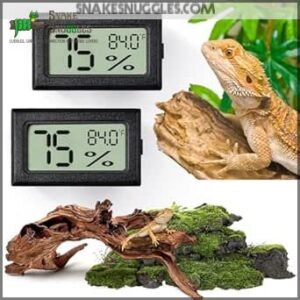
Vodolo’s dual-pack thermometer hygrometer hits the sweet spot between redundancy and budget—two units for thorough gradient monitoring at a price point that won’t eclipse your heating equipment costs.
The 0.9°F accuracy chip manages environmental tracking across basking zones and hides simultaneously, though adhesive mounting fails in high-humidity enclosures where suction alternatives would serve better.
You’re getting functional reptile monitoring without backlit displays—adequate for diurnal species checks, problematic for nocturnal temperature calibration when ambient lighting drops below practical reading thresholds.
| Best For | Reptile owners who need affordable dual-zone monitoring for temperature gradients in dry to moderately humid enclosures with daytime viewing access. |
|---|---|
| Display Type | Digital LED |
| Material | Plastic |
| Measures Humidity | Yes |
| Measures Temperature | Yes |
| Power Source | Battery |
| Mounting Method | Adhesive |
| Additional Features |
|
- Two-unit pack allows simultaneous monitoring of basking and cool zones without buying separate devices
- High-precision 0.9°F accuracy chip provides reliable environmental data for temperature-sensitive species
- Simple adhesive installation and battery power eliminate cord clutter in multi-tank setups
- Adhesive backing fails in high-humidity environments, causing units to detach from enclosure walls
- No backlit display makes temperature checks difficult during nighttime or in dim lighting conditions
- Water-resistant only—not waterproof—so direct spray or heavy misting can damage the unit
7. Mini Digital Hygrometer Thermometer
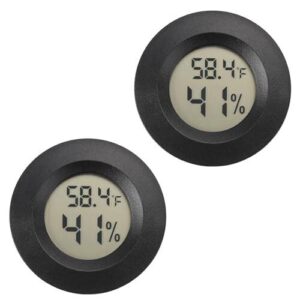
This compact unit strips thermometer design to its functional minimum—0.47-inch thickness and 1.44-ounce weight that disappears against enclosure glass while delivering ±1°F accuracy every ten seconds. You’re getting dual digital displays for simultaneous temperature sensors and humidity control monitoring, though the 9-month battery lifespan demands replacement planning.
The Fahrenheit/Celsius toggle accommodates international protocols, but thermometer calibration requires external standards—built-in verification doesn’t exist. Mini hygrometers sacrifice backlit readability for portability; you’ll struggle during nocturnal maintenance when ambient lighting fails.
| Best For | People managing pet habitats, greenhouses, or storage spaces who need a budget-friendly way to track basic temperature and humidity without bells and whistles. |
|---|---|
| Display Type | Digital |
| Material | Plastic |
| Measures Humidity | Yes |
| Measures Temperature | Yes |
| Power Source | LR44 Battery |
| Mounting Method | Adhesive |
| Additional Features |
|
- Updates every 10 seconds so you catch changes quickly instead of waiting around
- Crazy portable at under 1.5 ounces—stick it anywhere with the included pads and forget it’s there
- Switches between Fahrenheit and Celsius, which is handy if you’re following care guides from different countries
- The screen’s pretty small and not backlit, so checking it at night or if your eyesight isn’t great becomes a real pain
- Battery only lasts about 9 months, meaning you’re swapping cells more often than you’d probably like
- Accuracy is decent for the price but won’t match pricier models if you need lab-level precision
8. Paizoo Reptile Thermometer Hygrometer
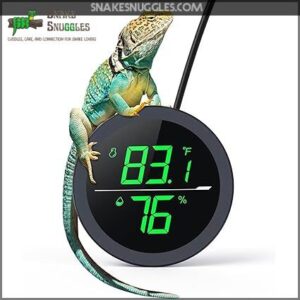
Paizoo’s USB-powered design eliminates battery anxiety entirely—you’re plugging into constant power that powers the HD LED display’s backlight through years of continuous operation. The 2.56-inch acrylic housing mounts via 3M adhesive that degrades in high-humidity environments; you’ll need supplemental fasteners for long-term stability.
Electronic sensor accuracy measures reliably for temperature control, but humidity management readings show drift—users report discrepancies requiring external hygrometer verification. Some units fail within months despite the compact footprint and affordable entry point that appeals to budget-conscious reptile care.
| Best For | Budget-conscious reptile owners who have easy access to a USB outlet and want a simple, always-on temperature monitor with a backlit display. |
|---|---|
| Display Type | Digital LED |
| Material | Acrylic |
| Measures Humidity | Yes |
| Measures Temperature | Yes |
| Power Source | USB |
| Mounting Method | 3M Tape |
| Additional Features |
|
- No battery replacements needed thanks to USB power that keeps the HD LED display running 24/7
- Clear backlit screen makes it easy to check readings day or night
- Compact 2.56-inch design installs easily without taking up much tank space
- Humidity readings often drift and need verification with a separate hygrometer
- 3M adhesive weakens in humid environments, requiring extra mounting support
- Some units fail within months despite the low price point
9. Oasirep Reptile Thermometer Hygrometer
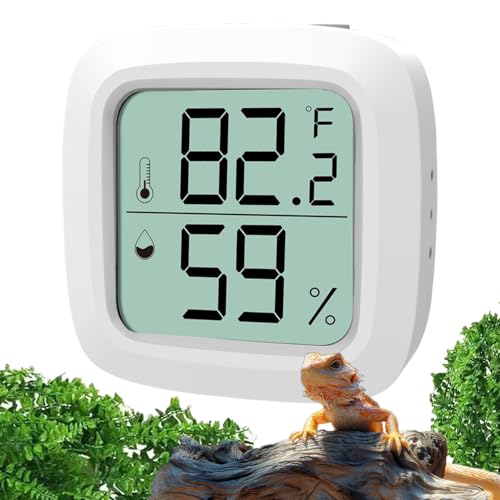
Battery-powered convenience meets practical limitations in Oasirep’s twelve-month CR2032 design—you’ll appreciate the included cell and minimal replacement frequency for basic reptile health monitoring. The ±1.8°F sensor accuracy enables adequate digital thermometer function, but humidity control readings at ±5%RH demand verification against calibrated reference instruments.
ABS housing with adhesive mounting works until moisture compromises bond strength; water exposure ruins electronics despite marketing for humid terrariums. The single-button Fahrenheit-Celsius toggle and simultaneous digital displays simplify beginner operation, though some users report early failure that undermines the budget appeal.
| Best For | Reptile owners who need a simple, affordable way to monitor basic temperature and humidity levels in small terrariums without investing in complex equipment. |
|---|---|
| Display Type | Digital LCD |
| Material | ABS |
| Measures Humidity | Yes |
| Measures Temperature | Yes |
| Power Source | CR2032 Battery |
| Mounting Method | Adhesive |
| Additional Features |
|
- Includes a CR2032 battery that lasts up to 12 months, so you won’t need to worry about frequent replacements
- Easy one-button toggle between Fahrenheit and Celsius with both temperature and humidity displayed at the same time
- Quick adhesive installation means you can stick it inside your tank without drilling or buying extra mounting hardware
- Not waterproof, so direct contact with mist or water can damage the unit despite being designed for humid reptile enclosures
- Humidity accuracy of ±5%RH may require you to double-check readings with a more precise instrument for sensitive species
- Some users experience early device failure, which can be frustrating given the adhesive-only mounting method
10. Digital Reptile Thermometer Hygrometer
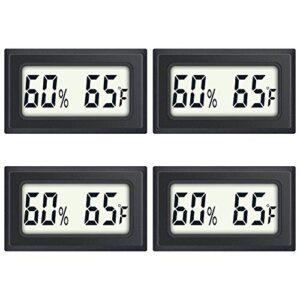
AikTryee’s four-pack offers redundancy that matters more than individual unit precision—you’ll position multiple ±2°F sensors across your gradient zones for under twenty dollars, accepting occasional calibration quirks as the cost of thorough monitoring.
The 2-in-1 digital displays track humidity control alongside temperature sensors, though ±2%RH accuracy demands periodic thermometer calibration against known references. Embedded mounting and eight-month battery life simplify reptile care and maintenance, but expect variability between units and potential cold-weather lockups that compromise reliability during winter temperature fluctuations.
| Best For | Reptile owners who need affordable, multi-zone monitoring across terrariums and enclosures without requiring lab-grade precision. |
|---|---|
| Display Type | Digital |
| Material | Plastic |
| Measures Humidity | Yes |
| Measures Temperature | Yes |
| Power Source | Battery |
| Mounting Method | Embedded/Tape |
| Additional Features |
|
- Four-pack setup lets you monitor different temperature zones across your enclosure for under $20
- Tracks both temperature and humidity on one display, saving space and simplifying your setup
- Eight-month battery life and easy mounting options mean less frequent maintenance
- Temperature readings can vary between units, so you’ll need to check them against a reference thermometer
- Some units may freeze up or malfunction in cold conditions
- ±2°F accuracy isn’t tight enough for sensitive species that need exact temperature control
Budget and Brand Considerations for Beginners
You don’t need to spend a fortune to keep your snake safe—reliable thermometers start around $10, though premium models with sophisticated features may justify their higher price tags.
Brand reputation matters more than flashy marketing; companies with proven track records in reptile equipment deliver the consistency your snake’s health depends on.
Understanding when basic gear no longer meets your needs prevents both wasted money on unnecessary upgrades and dangerous delays in replacing failing equipment.
Price Ranges and Value Picks
You don’t need to spend a fortune on accurate temperature monitoring—most beginner-friendly thermometers fall between $8 and $25, with the sweet spot for reliability hovering around $12 to $18. Budget options under $10 often sacrifice precision; cheap alternatives may drift by 3–5°F within months.
Here’s a cost analysis of value deals:
| Price Range | Expected Accuracy |
|---|---|
| $8–$12 | ±2–3°F variance |
| $13–$18 | ±1–2°F precision |
| $19–$25 | ±0.5–1°F accuracy |
| $26+ | Laboratory-grade |
Discount thermometers work initially—but reptile care tips emphasize long-term reliability. Thermometer reviews consistently show mid-range digital thermometers outperform ultra-budget models in temperature stability, making that $15 investment worthwhile for your snake’s health.
Reputable Brands for Snake Thermometers
Zoo Med and Fluker’s dominate the reptile thermometer market for good reason—they’ve been field-tested in thousands of enclosures and consistently deliver the ±1°F accuracy your snake actually needs. Thermometer and hygrometer comparison data and reptile thermometer reviews reveal why these brands excel:
- Quality control: Manufacturing consistency prevents sensor drift
- Warranty options: 1-year guarantees protect your investment
- Customer support: Troubleshooting assistance when calibration questions arise
ThermoPro and Inkbird offer competitive digital thermometer alternatives with proven reliability.
When to Upgrade Your Equipment
Your thermometer deserves replacement when readings drift more than 2°F from a known standard or when condensation repeatedly fogs the display—both signal sensor degradation that compromises your snake’s thermal gradient.
Upgrade timing also depends on equipment lifespan and performance metrics: digital thermometers usually require replacement after 2-3 years, while device calibration failures indicate immediate need for new hardware regardless of age.
Maintenance and Troubleshooting Tips
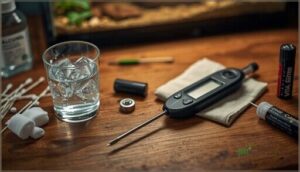
Your thermometer won’t stay accurate forever—drift happens, batteries die, and sensors degrade over time.
Regular maintenance catches problems before they compromise your snake’s environment.
The following sections walk you through calibration routines, cleaning protocols, and solutions to the most common thermometer failures you’ll encounter.
Regular Calibration and Accuracy Checks
Even the most expensive thermometer becomes a liability if it drifts by three degrees without you noticing—calibration isn’t optional maintenance, it’s the difference between precision husbandry and guesswork.
Test your digital thermometer monthly against a known standard (ice water reads 32°F exactly); if your device shows 29°F or 35°F, it’s time for drift correction or replacement to maintain precision standards your snake depends on.
Cleaning and Battery Replacement
Dust buildup and corroded battery contacts turn reliable instruments into sources of error—simple cleaning protocols protect your investment and your snake’s welfare. Follow these maintenance schedules to extend device longevity:
- Wipe your digital thermometer and hygrometer display weekly with a barely-damp microfiber cloth
- Remove battery compartment corrosion using cotton swabs dipped in white vinegar
- Replace batteries every 6-12 months regardless of function—weak cells compromise temperature accuracy
- Clean sensor probes monthly with isopropyl alcohol to prevent substrate residue interference
- Budget $3-8 annually for replacement costs in CR2032 or AAA batteries
Consistent battery care prevents the midnight discovery that your reptile thermometer died three days ago.
Identifying and Fixing Common Issues
When your thermometer displays 78°F in an enclosure that feels like a sauna, you’re facing one of three fixable problems—sensor drift, placement error, or environmental interference.
Test your digital thermometer against a mercury reference unit to confirm faulty readings; sensor issues usually manifest as persistent 2-3 degree discrepancies. Recalibrate using ice-water baths or replace units showing erratic swings—repair options for budget devices rarely justify the cost.
Maximizing Thermometer Use for Snake Health
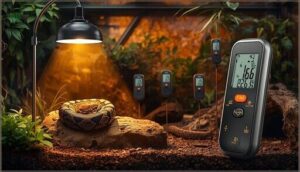
Owning a thermometer is only half the equation—you need to use it strategically to keep your snake thriving. That means checking temps daily, understanding what the numbers reveal about your enclosure’s environment, and making adjustments before small problems escalate.
Here’s how to turn raw temperature data into actionable care that promotes your snake’s long-term health.
Monitoring and Adjusting Enclosure Conditions
A thermometer without regular attention becomes just another piece of plastic in your snake’s enclosure—useful readings demand consistent monitoring and thoughtful adjustments based on what those numbers actually mean. Check your digital thermometer and hygrometer twice daily; morning and evening readings reveal patterns that single checks miss.
Your action plan:
- Adjust heating options when enclosure temperature drifts beyond your snake’s preferred range—don’t wait for problems to develop
- Monitor humidity levels alongside temperature control, since ventilation systems affect both simultaneously
- Document readings for two weeks to identify patterns before modifying enclosure design
Using Multiple Devices for Gradient Tracking
One thermometer tells you a single spot’s temperature—two or three reveal whether your snake can actually thermoregulate across the gradient you think you’ve created. Place a digital thermometer hygrometer at both the warm and cool ends, plus one mid-enclosure for multi-zone thermal monitoring. Device calibration matters; sensors reporting identical readings in different locations signal malfunction, not uniformity.
| Zone | Ideal Temperature | Sensor Placement | Device Type | Check Frequency |
|---|---|---|---|---|
| Basking | 88-92°F | 6″ from heat source | Digital thermometer | Twice daily |
| Warm side | 82-85°F | Snake height level | Thermometer hygrometer | Twice daily |
| Mid-enclosure | 78-80°F | Center, away from walls | Reptile thermometer | Daily |
| Cool side | 72-76°F | Opposite end from heat | Digital thermometer | Twice daily |
| Hide boxes | Match zone temps | Inside each hide | Probe thermometer | Weekly verification.” |
Gradient mapping prevents the common mistake of assuming heat distributes evenly—physics doesn’t work that way, and your snake’s metabolism depends on accurate thermal zones for proper digestion and humidity regulation.
Recording and Interpreting Temperature Data
Checking temperatures twice daily means nothing if you’re not writing down what you find—patterns emerge only when you track data over weeks, not guesswork from yesterday’s half-remembered reading. A simple notebook beats memory; data analysis tools like spreadsheets reveal thermal cycles your digital thermometer hygrometer detects but you might miss.
Heat mapping shows whether your reptile thermometer readings match seasonal adjustments—temperature logging transforms raw numbers into actionable insight through consistent data visualization and pattern recognition.
Frequently Asked Questions (FAQs)
How often should I replace my thermometer?
Quality digital units last three to five years with proper care; analog models drift after eighteen months.
Replace immediately when readings diverge more than two degrees from calibration standards—your snake’s metabolic health depends on precision monitoring.
Can I use human thermometers for snakes?
Human thermometers lack the range and durability reptile thermometers provide.
Temperature accuracy matters for snake health—ambient readings require sensors designed for enclosures, not oral or temporal devices meant for brief contact with skin.
Do different snake species need different thermometers?
Species specificity doesn’t demand different thermometers—temperature ranges do.
Tropical species require warmer gradients than temperate snakes, but any accurate reptile thermometer calibrated correctly tracks those habitat-specific needs regardless of species classification.
Whats the ideal temperature range for hatchlings?
Most hatchlings thrive between 78–82°F on the cool side and 85–90°F at the basking spot.
Growth Rates and Reptile Development depend on maintaining precise Temperature Control; your Thermometer Hygrometer prevents thermal stress during this vulnerable stage.
Should I monitor nighttime temperatures differently?
Nighttime temps drop like clockwork in nature—your digital thermometer hygrometer should track these diurnal shifts.
Monitor cold spot readings and maintain thermal cycles; nocturnal temperature drops aid digestion while nighttime gradients prevent stress.
Conclusion
The next time you reach for your snake’s enclosure and feel warmth that seems about right, remember that your palm can’t detect the three-degree difference between ideal digestion and chronic stress.
Snake thermometers for beginners transform guesswork into measurable data—the foundation of prevention rather than reaction.
Your investment isn’t in the device itself; it’s in the years of health issues you’ll never have to troubleshoot because you measured what mattered from day one.
- https://docs.google.com/document/d/1ETuvgkvixUFOeow1j3C8mJtOF9XYcObxvB5qnYdblvo/mobilebasic
- http://reptileapartment.com/reptile-thermometer-analog-vs-digital/
- https://zoomed.com/high-range-reptile-thermometer/
- https://hardypaw.com/collections/reptile-thermometers-gauges-timers
- https://talis-us.com/blogs/news/optimal-temperature-ranges-for-corn-snakes