This site is supported by our readers. We may earn a commission, at no cost to you, if you purchase through links.

A heat mat without a thermostat can hit 130°F. Your kid’s corn snake needs 88°F on the warm side. That gap is where burned bellies and heartbroken children come from.
The good news: today’s reptile heat mats for kids with pet snakes are safer than ever, with self-limiting designs, built-in thermostats, and waterproof surfaces that wipe clean after the inevitable cricket incident. The catch is knowing which features matter and which are marketing fluff.
I’ve compared eight of the best options, checked the specs, and sorted the safe from the sketchy. Here’s what deserves a spot under your kid’s tank.
Table Of Contents
- Key Takeaways
- Top 8 Reptile Heat Mats for Kids’ Pet Snakes
- How to Choose a Safe, Kid-Friendly Reptile Heat Mat
- Safe Heat Mat Installation for a Proper Thermal Gradient
- Snake Heat Mat Temperatures, Thermostats, and Daily Monitoring
- Heat Mat Maintenance, Electrical Safety, and Adult Supervision
- Frequently Asked Questions (FAQs)
- Are heat mats okay for snakes?
- What is the best heating mat for snakes?
- Are heat pads good for ball pythons?
- Where to put a heat mat for a snake?
- Are heat mats safe for snakes?
- What temperature should a heat mat be for a snake?
- How to keep a snake enclosure warm in winter?
- Can you leave the heating pad on all night for a snake?
- Can heat mats work for lizards and turtles?
- How often should heat mats be replaced?
- Conclusion
Key Takeaways
- An unregulated heat mat can reach 130°F within 30 minutes, while a snake’s warm side should be only 88°F, so a thermostat is the single most important safety purchase for any setup.
- The mat should cover just one-third to one-half of the enclosure floor under one side, creating a thermal gradient (warm 88–92°F, cool 75–80°F) so the snake can regulate its own body temperature. If you’re setting up multiple enclosures, this guide to heating pads for breeding setups explains how to keep each tub’s warm side and cool retreat consistent.
- Built-in-thermostat combos like the Vivosun models suit beginners, while simpler mats (Fluker’s, iPower, Aiicioo, Zilla) require a separate thermostat and careful monitoring—especially for known flaws like inaccurate readings, weak adhesives, or short lifespans.
- Daily temperature checks with an independent thermometer, weekly inspections for wear or peeling, GFCI outlets, child-locked controls, and replacing mats every one to two years keep both the snake and curious kids safe.
Top 8 Reptile Heat Mats for Kids’ Pet Snakes
Each mat below was chosen with kid-supervised setups in mind, balancing safety features, reliable heat output, and ease of use. You’ll find options across different sizes and price points, so there’s something here whether you’re starting with a small corn snake or a larger ball python.
Pairing your new heat mat with one of the calm, kid-friendly species covered in our guide to the best pet snakes for children—like corn snakes and ball pythons—makes setup day even easier.
Safety ratings, thermostat compatibility, and wattage vary by model, so read each pick before deciding.
1. Vivosun Reptile Heating Pad Thermostat Combo
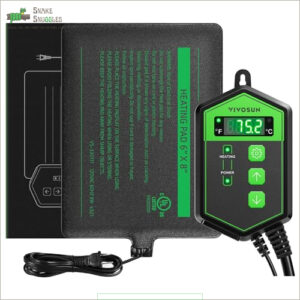
If you’re just starting out with snake keeping, the Vivosun Reptile Heating Pad Thermostat Combo makes the whole learning curve noticeably shorter. The 6×8 inch pad fits comfortably under 20-30 gallon tanks, and the built-in digital thermostat covers a wide 40-108°F range, so you’re not constantly guessing every time you check the enclosure temperature.
Far-infrared technology spreads heat evenly across the surface, which cuts down on hot spots that can stress or burn a young snake. The IP67 water-tight surface wipes clean in seconds, which any parent will appreciate on a busy weekend morning.
Worth knowing: some users report the pad struggles to climb above 72°F in real-world conditions, and thermostat readings can run up to 20°F off actual pad temperature. Keep an independent thermometer inside the enclosure at all times.
| Best For | Families new to reptile keeping who want simple, reliable warmth without constant temperature monitoring |
| Dimensions | 6 x 8 inches |
| Power | Not specified |
| Adhesive Mounting | 3M adhesive |
| Tank Compatibility | Small terrariums |
| Thermostat Included | Yes, digital (40-108°F) |
| Reptile Compatible | Yes |
| Additional Features | IP67 water-tight surface, far-infrared heating, UL certified safety |
Best For: Beginner snake keepers and families who want a simple, affordable heating pad with a built-in thermostat for small terrariums.
| Reptile Safe | Yes |
|---|---|
| Mounting | 3M adhesive |
| Even Heating | Far-infrared |
| Thermostat Included | Yes, digital |
| Under-Tank Placement | Yes |
| Tank Compatibility | Small terrariums |
| Additional Features |
|
- Built-in digital thermostat with a wide 40–108°F range reduces guesswork for beginners
- Far-infrared heating provides even heat distribution, minimizing hot spots that could harm reptiles
- IP67 water-tight surface wipes clean easily and allows safe scrubbing
- Some users report the pad doesn’t exceed 72°F in practice, regardless of settings
- Thermostat accuracy issues, with readings differing up to 20°F from actual pad temperature
- Mixed feedback on adhesive quality, with reports that it loses stickiness over time
2. Zilla Terrarium Heat Mat
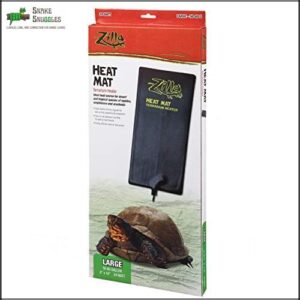
Prefer to skip the thermostat learning curve entirely? The Zilla Terrarium Heat Mat keeps things refreshingly simple. Carbon fiber construction radiates heat evenly across the surface, so there are no internal wires to pinch or break and no hot spots that could harm a curious young snake.
The adhesive backing mounts underneath the tank or along the side, covering roughly a third of the floor. That’s how you build a proper gradient: warm side for digesting, cool side for retreating. It’s self-limiting to 113°F, so it won’t cook an enclosure even without a thermal switch.
Still, pair it with a thermostat and a second thermometer for peace of mind. Snakes do best with a warm side around 82-89°F.
| Best For | Families wanting a low-maintenance, energy-efficient heat source for desert and tropical reptiles |
| Dimensions | 8 x 18 inches |
| Power | Not specified |
| Adhesive Mounting | Yes, under-tank or side mounting |
| Tank Compatibility | Various enclosures |
| Thermostat Included | No |
| Reptile Compatible | Yes |
| Additional Features | Carbon fiber heating, self-limiting to 113°F, no hot spots, 8.16 oz weight |
Best For: Families and beginner reptile keepers who want a simple, low-maintenance under-tank heat mat for desert or tropical reptiles without needing a thermostat.
| Reptile Safe | Yes |
|---|---|
| Mounting | Adhesive backing |
| Even Heating | Carbon fiber |
| Thermostat Included | No |
| Under-Tank Placement | Yes |
| Tank Compatibility | Various enclosures |
| Additional Features |
|
- Carbon fiber construction delivers even heat with no hot spots or internal wires that can pinch or break
- Self-limiting to 113°F, so it’s safe to use without a thermal switch
- Adhesive backing allows easy mounting underneath the tank or on the side to create a warm/cool temperature gradient
- Capped at 113°F, which may not provide enough heat for larger enclosures or very cold rooms
- No thermostat included, so an external one is still recommended for precise control
- Indoor use only, with a fixed 8" x 18" size that may not suit all tank dimensions
3. Fluker’s Reptile Heat Mat
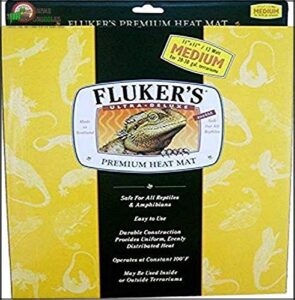
Fluker’s takes a no-frills approach, and honestly, that’s a feature. This mat runs at a steady 90–112°F surface temperature with zero settings to fiddle with. No dials, no guesswork. Just plug it in and it does its job.
If you’d rather compare this simplicity against mats with built-in thermostats, our guide to the best under-tank heaters for hatchlings breaks down all eight options side by side.
The chloroprene construction is thin, flexible, and heat-resistant, and it’s made in the U.S. It mounts under the tank or along the side, and the 11 x 11-inch medium size suits most starter enclosures. Snakes, lizards, and even hermit crabs all do fine with it.
One catch, and it matters: no thermostat included. Running it bare can push surface temps past 100°F, which is too hot for direct belly contact. Add a thermostat with a probe before your snake ever touches this mat. Also note there’s no adhesive backing, so plan how you’ll position it.
| Best For | Families wanting a simple, flexible heat mat for snakes, lizards, or hermit crabs who’ll pair it with a separate thermostat |
| Dimensions | 11 x 11 inches |
| Power | Not specified |
| Adhesive Mounting | No adhesive |
| Tank Compatibility | Various enclosures |
| Thermostat Included | No |
| Reptile Compatible | Yes |
| Additional Features | Chloroprene material, side or bottom mount, reusable placement, U.S. made |
Best For: Keepers of snakes, lizards, or hermit crabs who want a simple, plug-in heat mat and are willing to pair it with a separate thermostat.
| Reptile Safe | Yes |
|---|---|
| Mounting | No adhesive |
| Even Heating | Chloroprene element |
| Thermostat Included | No |
| Under-Tank Placement | Yes |
| Tank Compatibility | Various enclosures |
| Additional Features |
|
- Maintains a steady 90–112°F with no settings to adjust
- Flexible, heat-resistant chloroprene construction made in the U.S.
- 11 x 11-inch medium size fits most starter enclosures, with side or bottom mounting
- No thermostat included, so bare running can push surface temps past 100°F
- No adhesive backing, making positioning trickier
- Mixed reviews on durability and value for money
4. iPower Reptile Heat Mat
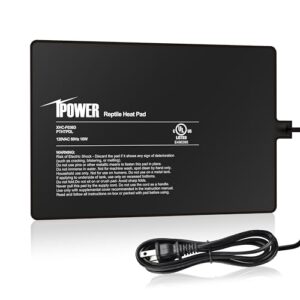
Budget-friendly and flexible, the iPower Reptile Heat Mat earns its spot. Four sizes run from a tiny 4×7 inch pad up to 8×18 inches, so matching your kid’s tank takes no guesswork.
The 8×12 inch, 16-watt model suits 30 to 40 gallon setups. Its PTC heating film spreads warmth evenly without wild temperature spikes, and the 3M adhesive sticks firmly to glass. The moisture-proof design means damp-cloth cleaning is safe.
Two caveats: no thermostat included, so add one before your snake moves in. And some owners report adhesive peeling after 1–2 months, so check it monthly. A one-year warranty backs it up.
| Best For | Budget-conscious families with 30–40 gallon tanks who’ll pair it with a separate thermostat |
| Dimensions | 8 x 12 inches |
| Power | 16 watts |
| Adhesive Mounting | 3M adhesive |
| Tank Compatibility | 30-40 gallon |
| Thermostat Included | No |
| Reptile Compatible | Yes |
| Additional Features | PTC heating film, moisture-proof design, 1-year warranty |
Best For: Budget-conscious families with 30–40 gallon tanks who want a reliable under-tank heater and are willing to pair it with a separate thermostat.
| Reptile Safe | Yes |
|---|---|
| Mounting | 3M adhesive |
| Even Heating | PTC heating film |
| Thermostat Included | No |
| Under-Tank Placement | Yes |
| Tank Compatibility | 30-40 gallon |
| Additional Features |
|
- PTC heating film delivers even heat without dangerous temperature spikes
- 3M adhesive backing mounts firmly to glass, and the moisture-proof design allows safe damp-cloth cleaning
- Available in multiple sizes, with the 8×12 inch, 16-watt model fitting 30–40 gallon tanks and backed by a one-year warranty
- No thermostat included, so one must be purchased separately to prevent overheating and fire risk
- Adhesive may peel after 1–2 months of use, requiring monthly checks
- Terrarium must be elevated with rubber feet to avoid heat entrapment and potential fire hazard
5. iPower Reptile Heating Pad Mat
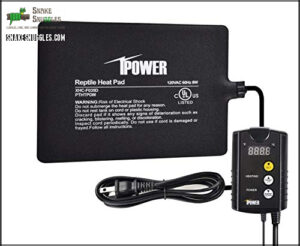
One thing that sets this mat apart is the built-in digital thermostat. No separate controller to buy, no extra cords to manage. Temperature control runs from 40 to 108°F right out of the box, which means your kid’s setup is fully ready from day one.
The PTC heating film distributes warmth evenly across the mat’s surface, eliminating the kind of hotspots that can burn a snake sitting still in one spot. At just 8W on a standard 120V outlet, it’s energy-efficient and runs quietly in the background.
Setup is genuinely simple. The 3M adhesive backing sticks directly to the terrarium bottom and it’s sized for 10–20 gallon tanks. For a beginner, that combination of built-in control and easy mounting removes a lot of the guesswork that trips up first-time reptile families.
| Best For | Beginners setting up a reptile or small animal tank who want simple, built-in temperature control without buying separate gear. |
|---|---|
| Dimensions | 6.1 x 11.4 inches |
| Power | 8W |
| Adhesive Mounting | 3M adhesive |
| Tank Compatibility | 10–20 gallon |
| Thermostat Included | Yes, digital (40–108°F) |
| Reptile Compatible | Yes |
| Additional Features | Energy-efficient PTC heating, 1000W max load, fermentation compatible |
| Best For | Beginners setting up a reptile, amphibian, or small animal terrarium who want reliable, built-in temperature control without purchasing separate equipment. |
|---|---|
| Reptile Safe | Yes |
| Mounting | 3M adhesive |
| Even Heating | PTC heating film |
| Thermostat Included | Yes, digital |
| Under-Tank Placement | Yes |
| Tank Compatibility | 10-20 gallon |
| Additional Features |
|
- Built-in digital thermostat with a 40–108°F control range means no extra controller to buy or set up
- PTC heating film distributes warmth evenly across the mat, reducing the risk of hotspots that could harm your pet
- Simple 3M adhesive mounting and a size designed for 10–20 gallon tanks make installation straightforward for first-time owners
- The adhesive backing can weaken over time and may need to be reattached or replaced
- Performance drops in cooler ambient environments (below 68°F), which could limit effectiveness in unheated rooms
- The controller and probe must stay dry, so it’s not suitable for humid setups where water contact is likely
6. Zacro Reptile Heating Pad
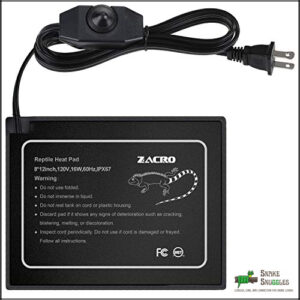
A few honest caveats come with the Zacro Reptile Heating Pad, and knowing them upfront makes you a smarter buyer. It’s a lightweight 10.5-ounce pad built with quality heating wire, designed for reptiles, amphibians, and even enclosure plants. The thin, flexible body sits flat under glass or lining, and it works with standard reptile thermostats.
Here’s the catch: pair it with a thermostat, always. The knob has no temperature markings, so precise adjustment is pure guesswork without one. Adhesion is hit-or-miss, so check it regularly rather than trusting the tape long-term. And durability is the weak spot; many units last under three months, so inspect for bubbling or fraying weekly and unplug at the first sign of wear.
Treat it as an affordable starter option, not a set-and-forget solution. Budget for a replacement. Your kid’s snake stays warm, and you stay ahead of the failure curve.
| Best For | Budget-conscious reptile or amphibian keepers who want an affordable starter heating pad and are willing to pair it with a thermostat and monitor it closely. |
|---|---|
| Reptile Safe | Yes |
| Mounting | Adhesive tape |
| Even Heating | Heating wire |
| Thermostat Included | No |
| Under-Tank Placement | Yes |
| Tank Compatibility | Standard glass tanks |
| Additional Features |
|
- Lightweight, flexible design that sits flat under glass or terrarium lining
- Built with quality heating wire for stable performance
- Versatile enough for reptiles, amphibians, and enclosure plants
- No temperature markings on the control knob, making precise adjustment guesswork
- Inconsistent adhesion; the pad may fall off over time
- Poor durability, with many units lasting under three months
7. Vivosun Reptile Heat Pad
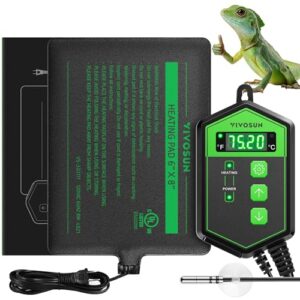
A solid pick for first-time snake keepers, the Vivosun Reptile Heat Pad earns its keep through simple, dependable design. The 6 x 8 inch mat fits 20 to 30-gallon glass tanks, and its far-infrared heating film spreads warmth evenly across the surface. No sneaky hot spots. No mystery burns.
Safety credentials check out: UL certified, with an IP67 waterproof surface you can scrub clean without worry. It ships with a digital thermostat kids can actually read, which matters more than you’d think when a curious ten-year-old wants to "help."
Setup takes minutes. Stick it under the glass, plug in the thermostat, done. Just remember: glass tanks only, and never insulate over the mat. It’s a straightforward tool that does one job well — keeping your kid’s scaly friend warm without drama.
| Best For | First-time snake keepers and families with kids who need a simple, safe heat mat for a 20 to 30-gallon glass terrarium. |
|---|---|
| Reptile Safe | Yes |
| Mounting | 3M adhesive |
| Even Heating | Far-infrared film |
| Thermostat Included | Yes, digital |
| Under-Tank Placement | Yes |
| Tank Compatibility | 20-30 gallon |
| Additional Features |
|
- UL certified with an IP67 waterproof surface that wipes clean easily
- Far-infrared heating film distributes warmth evenly without hot spots
- Quick, simple setup with a readable digital thermostat included
- Temperature consistency drops off above 72°F according to some users
- Adhesive performance is hit or miss
- Not suitable for placing objects on the pad, limiting flexibility
8. Aiicioo Reptile Terrarium Heating Pad
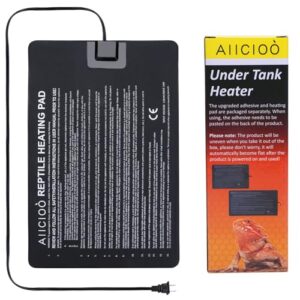
Sixteen watts might not sound like much, but for a 30–40 gallon tank, it’s exactly right. The Aiicioo Reptile Terrarium Heating Pad delivers steady heat between 104°F and 122°F using solid-state nichrome wire under a waterproof PVC surface. That’s dependable warmth without the drama.
Mounting is simple. The adhesive backing sticks to the outside bottom of your glass terrarium, and the included rubber feet lift the tank slightly so air circulates underneath. Never place it inside the enclosure, and skip plastic or acrylic tanks entirely — glass only.
Two honest caveats. There’s no built-in thermostat, so budget for one separately; it’s non-negotiable for your snake’s safety. And some owners report the adhesive peeling over time, so check it during routine cleaning.
For beginners with corn snakes or ball pythons in medium tanks, it’s an affordable, no-fuss workhorse. Just add the thermostat.
| Best For | Beginners keeping corn snakes, ball pythons, or other reptiles in 30–40 gallon glass terrariums who need affordable, steady 24-hour heat. |
|---|---|
| Reptile Safe | Yes |
| Mounting | Upgraded adhesive |
| Even Heating | Nichrome wire |
| Thermostat Included | No |
| Under-Tank Placement | Yes |
| Tank Compatibility | 30-40 gallon |
| Additional Features |
|
- Maintains steady heat between 104°F and 122°F with solid-state nichrome wire and a waterproof PVC surface
- Easy mounting on the bottom or side of glass terrariums, with included rubber feet for airflow
- Affordable and suitable for reptiles, amphibians, small animals, and plant terrariums alike
- No built-in thermostat, so one must be purchased separately for safe use
- Adhesion can be inconsistent, with reports of peeling or residue over time
- Not suitable for plastic, acrylic, or water tanks, and requires ventilation to avoid overheating
How to Choose a Safe, Kid-Friendly Reptile Heat Mat
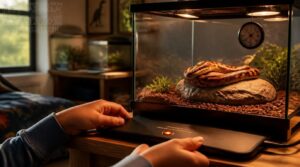
You’ve seen the top picks, but how do you actually decide which one belongs in your child’s terrarium? The right heat mat comes down to a few non-negotiable safety features and some simple sizing rules. Here’s what to check before you buy.
Verified Safety Ratings
Safety certifications aren’t glamorous, but they’re the difference between a warm snake and a fire report. Look for UL certified mats or CE marks, then cross-check with third-party lab results, since manufacturer claims don’t always match consumer standards. Reputable mats meet IEC 60335-1 household appliance safety. Skip anything without documentation.
Your kid’s pet deserves verified protection, not marketing promises.
Thermostat And Waterproofing
Here’s the truth: a heat mat without a thermostat is a small furnace with no manners. It won’t stop itself. An adjustable thermostat with an inline probe, set 1–2°C above your target basking temperature, does the stopping for you.
A heat mat without a thermostat is a small furnace with no manners—it takes an inline probe to make it stop itself
For damp terrariums, look for:
- IP67 waterresistant rating minimum
- Silicone-sealed cord entry points
- Sealed junction box with watertight fittings
- GFCI-protected outlet nearby
- Moisture resistant design throughout
That’s genuine childsafe reptile care.
Proper Sizing And Placement
Proper Sizing And Placement starts with one rule: the mat fits the basking zone, never the whole floor. Cover only one-third to one-half of the enclosure, always under one side. That’s thermal gradient management made simple.
| Snake Size | Mat Wattage | Coverage Area |
|---|---|---|
| Juvenile | 4–8 W | 4"×6" |
| Sub-adult | 8–16 W | 8"×8" |
| Adult | 16–24 W | 10"×11" |
Match mat width to your snake’s body length. Oversized mats invite tight coils and poor snake temperature regulation. Keep substrate above the mat under 1–2 cm. Deeper burial insulates heat and ruins your reptile enclosure setup’s gradient. Position the probe dead-center on the warm zone. Your kid’s snake needs a cool retreat under 26°C, always reachable.
Temperature Monitoring
Placement sets the gradient; temperature monitoring keeps it honest. Check mat and ambient readings every 4–6 hours, hourly during acclimation. Follow a written temperature monitoring schedule and log daily max/min values to catch drift. Correct temperature probe placement means the basking edge, never mat center. Run a monthly temperature calibration procedure against a trusted thermometer. Catch temperature spikes early. Your snake stays warm, safe, and thriving.
A digital terrarium thermometer with min/max memory does the logging for you, so overnight drift and sneaky spikes never slip past unnoticed.
Kid-Safe Maintenance Habits
Monitoring tells you what’s happening. Maintenance keeps it that way.
Wipe the mat with a damp, soap-free cloth weekly. Never soak it. Inspect cords and insulation for cracks or discoloration.
A child lock thermostat stops curious fingers from cranking heat. Make kid burn prevention part of your routine: unplug before adjusting, dry hands always.
Child supervision around enclosures turns maintenance into a shared, teachable moment. That’s child safe pet care done right.
Safe Heat Mat Installation for a Proper Thermal Gradient
Once you’ve picked the right mat, installation is where reptile heat mat safety gets real. Attach the mat to the underside of one side of the enclosure, never the inside. The mat should cover 25–50% of the floor. The opposite side stays unheated so your snake can cool off on purpose. That’s your proper thermal gradient: warm zone 28–32 °C, cool side 22–26 °C.
Keep the mat away from hides and water bowls. Trapped heat under decor creates hot pockets, and that’s a burn risk for a curious snake.
For child burn prevention, use a heat-safe barrier between the mat and any surface, and route cords where small hands can’t tug them. Good installation makes temperature gradient maintenance almost automatic. Five minutes of care now saves a vet visit later.
Snake Heat Mat Temperatures, Thermostats, and Daily Monitoring

Every pet snake deserves a temperature gradient that mimics nature, and your heat mat makes that possible. Aim for 28–32°C on the warm side, with a basking zone of 30–34°C for healthy digestion. Let the cool side drop to 20–24°C at night. That’s comfort, not stress.
Your thermostat matters as much as the mat. Check thermostat compatibility before buying. Proportional models hold steady temps; cheap on/off units swing wildly. Set yours near 30°C and confirm the mat’s actual surface temperature, since mats often run hotter than displayed.
Daily monitoring is where your kid becomes a real keeper. Here’s the routine:
- Record warm and cool side temps twice daily
- Check mid-day peaks and pre-dawn troughs
- Note the room’s ambient temperature
- Adjust if warm side tops 34°C three days running
- Raise heat if cool side dips below 24°C
Snake heat mat temperatures, thermostats, and daily monitoring work together. Master all three.
Heat Mat Maintenance, Electrical Safety, and Adult Supervision
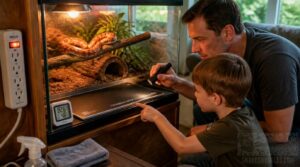
Even the best heat mat becomes a hazard if nobody checks it. Heat mat maintenance takes five minutes a week: look for nicks, cracks, or exposed wiring, and replace the mat immediately if you spot any. Wipe surfaces with a damp cloth only. Never submerge it or use harsh chemicals. Rotate the mat monthly so hot spots don’t develop.
For electrical safety for heat mats, plug into a GFCI outlet. Damp substrates happen, and ground-fault protection means a spill becomes a cleanup, not an emergency. Keep the emergency cut-off reachable and practice disconnecting it with your kids quarterly. Yes, really. Make it a game.
Adult supervision seals the deal. A designated caregiver should verify temperatures daily before snake access and log the readings. Reptile enclosure monitoring isn’t busywork. It’s how your family’s reptile heating safety record stays perfect.
Frequently Asked Questions (FAQs)
Are heat mats okay for snakes?
Yes, if used correctly. Snakes need belly heat, so undertank heating suits them well. But reptile heating safety demands a thermostat, controlled temperatures, and adult supervision. Heat mat safety means never direct contact.
What is the best heating mat for snakes?
The best heating mat for snakes? Think of it as a medieval hearth for your scaled friend. Choose the Vivosun thermostat combo for reliable, safe snake habitat heating. Always pair any reptile heat mat with a thermostat.
Are heat pads good for ball pythons?
Heat pads work well for a ball python when paired with a reptile thermostat. Use a heat mat under one side, keep surface temps below 90°F, and monitor daily for safe, stable temperature control.
Where to put a heat mat for a snake?
Wondering where to put a heat mat for a snake? Under the warm side, covering 60–70% of floor width, creating a proper thermal gradient. Keep shallow substrate, align with the warm-side hide, and use a thermostat.
Are heat mats safe for snakes?
Are heat mats safe for snakes? Yes, when paired with a thermostat. Unregulated mats can overheat within minutes and cause burns. Add overheat protection, a proper temperature gradient, and daily checks for true snake burn prevention.
What temperature should a heat mat be for a snake?
What temperature should a heat mat be for a snake? Picture a Victorian furnace—crude, unregulated. Today’s answer: 88–92°F warm side, 75–80°F cool side, always governed by a thermostat for snake burn prevention.
How to keep a snake enclosure warm in winter?
Winter can chill a snake’s enclosure fast. Seal drafts, add a small room heater nearby, and pair your reptile heat mat with a thermostat for steady, safe thermal gradient control. Consistent temperature control keeps your snake healthy.
Can you leave the heating pad on all night for a snake?
So your kid’s snake needs warmth after bedtime, right? Yes, leave the heat mat on overnight — but only with a thermostat. Without temperature control, burn risk rises fast.
Can heat mats work for lizards and turtles?
Lizards benefit from belly warmth via a reptile heating pad, but turtles need overhead basking alternatives instead. Always pair any heat mat with a thermostat for proper reptile thermoregulation.
How often should heat mats be replaced?
Replace your heat mat every one to two years. If you spot cold spots, cracking, or peeling before then, don’t wait — swap it immediately.
Conclusion
Unregulated heat mats can hit 130°F within 30 minutes of being plugged in. That single fact is why choosing the right reptile heat mats for kids with pet snakes matters more than most new reptile parents expect.
A thermostat-controlled mat doesn’t just protect your snake. It protects your kid from the heartbreak of a sick or injured pet. Buy smart, set it up correctly, and check the temperature every single day. That’s the whole job.