This site is supported by our readers. We may earn a commission, at no cost to you, if you purchase through links.

Most captive snakes die slowly—not from venom or predators, but from habitats that look perfect to humans yet fail their occupants at the cellular level. An underheated enclosure drops a ball python’s metabolism by 40%, turning digestion into a three-week ordeal instead of five days; excess humidity rots a corn snake’s scales before you notice the damage.
When you’re setting up a snake habitat, you’re not decorating—you’re engineering a life-support system that replicates the precise thermal zones, moisture levels, and spatial structure your snake evolved to depend on. Get the enclosure material wrong and you’ll fight humidity swings daily; misjudge substrate depth and your fossorial species will pace endlessly at the surface, stressed and exposed.
The margin between thriving and surviving hinges on decisions you make before your snake ever enters its new home.
Table Of Contents
Key Takeaways
- Enclosure material—glass, plastic, or wood—determines heat retention and humidity control at the cellular level, making it the foundation of thermoregulation success or respiratory disease.
- Thermal gradients spanning 10–20 cm with warm zones at 28–32°C and cool zones at 22–26°C are non-negotiable for proper digestion, immune function, and metabolic health.
- Substrate depth of 3–5 inches paired with species-specific materials like coconut fiber or cypress mulch directly impacts burrowing behavior, humidity stability, and stress reduction.
- Daily waste removal, weekly disinfection, and continuous monitoring of temperature and humidity through calibrated instruments prevent ammonia buildup, scale rot, and parasitic infections that compromise survival.
Choosing The Right Snake Enclosure
Your enclosure choice isn’t just about budget—it’s about matching material properties to your snake’s physiological needs, and getting it wrong means chronic stress, respiratory infection, or worse. Glass, plastic, and wood each handle heat retention, humidity control, and ventilation differently, which directly impacts thermoregulation and immune function.
Your enclosure material directly determines whether your snake thrives or suffers from preventable respiratory disease and chronic stress
Here’s how each material performs and when to use it.
Glass Vs. Plastic Vs. Wooden Tanks
Glass, plastic, and wooden tanks each carry distinct trade-offs in enclosure selection—understanding these differences prevents costly mistakes in reptile enclosure design.
Glass offers excellent visibility and durability against gnawing, though it’s heavier; plastic vivarium options provide excellent thermal insulation and humidity control at lower weight; wooden tanks deliver aesthetic appeal but demand rigorous sealing to prevent moisture damage and maintain enclosure durability.
Matching Enclosure Size to Snake Species
Once you’ve settled on enclosure selection, match tank size to your snake’s adult length and activity patterns—research species-specific needs before you buy.
Terrestrial snakes need floor space at least 2-3 times their girth in length, arboreal species demand vertical vivarium height for climbing, and burrowing types require deeper enclosure depth for coiled rest.
Habitat scaling prevents stress, injury, and thermoregulation failures. Proper research techniques, including clear science writing, are essential for understanding species-specific habitat requirements.
Ventilation and Secure Latching Mechanisms
After you’ve sized your tank correctly, lock down air exchange and enclosure safety—snakes escape through gaps you’d swear were impossible.
Proper ventilation prevents respiratory infections, while humidity controls stop mold:
- Position vents opposite heat sources to minimize condensation buildup.
- Use two opposing openings for cross-ventilation in most layouts.
- Choose spring-loaded or magnetic latches with secondary safety locks.
- Inspect latch security weekly for alignment, tension, corrosion.
- Verify vent perforation size blocks snake contact without restricting airflow.
Temperature gradient stability depends on ventilation systems that don’t create drafts. Ensuring a stable environment is vital for the snakes’ health, and evaluating research methodology can help in creating ideal conditions.
Material Impact on Heat and Humidity Retention
Your choice of material determines how well your tank holds heat and moisture—poor decisions force heaters to run overtime, waste energy, and create temperature spikes. Material density, insulation types, and vapor barriers dictate thermal mass: glass moderates swings through higher thermal inertia, while sealed plastics excel at humidity control but limit airflow. Heat distribution suffers when you ignore surface emissivity—reflective interiors spread warmth evenly, supporting natural thermoregulation without hotspots.
Pair substrate depth with wall insulation—thicker bedding in wooden enclosures stabilizes humidity and lighting management better than thin layers over cold glass.
| Material | Thermal Mass & Heat Distribution | Humidity Control & Vapor Barriers |
|---|---|---|
| Glass | High thermal inertia moderates temperature gradients; reflective surfaces improve heat distribution | Low porosity retains moisture well; requires ventilation to prevent mold |
| Plastic (PVC) | Lower thermal mass causes faster temperature swings; requires constant heating | Excellent vapor barrier for tropical species; sealed construction holds humidity |
| Wood (Sealed) | Thick walls provide strong insulation; reduces energy input for basking spots | Moderate permeability; needs sealing and substrate pairing for humidity retention |
| Melamine | Moderate insulation types; balances heat retention with airflow needs | Non-porous surface aids cleaning; controls moisture when paired with proper substrate |
| Screen/Mesh | Minimal thermal retention; loses heat rapidly through convective transfer | Poor humidity retention; suitable only for arid-species thermoregulation needs |
Selecting Suitable Substrate and Decor
Your enclosure choice matters, but what you put inside it determines whether your snake thrives or merely survives.
Substrate selection affects everything from humidity retention to respiratory health, while hides and décor directly influence stress levels, thermoregulation success, and behavioral expression.
Let’s examine the specific substrate types and enrichment elements that support your snake’s physiological needs and natural behaviors.
Substrate Types for Burrowing and Humidity
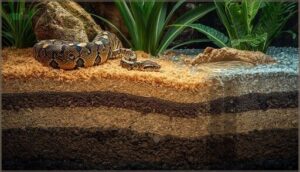
Your snake’s substrate isn’t just bedding—it’s the foundation of humidity control and thermoregulation. Fine-grain coconut fiber retains moisture without compaction, cypress mulch resists mold while supporting burrowing materials, and topsoil-sand blends improve drainage for fossorial species.
Substrate depth of 3-5 inches facilitates natural behaviors; moisture retention stabilizes temperature gradients across your naturalistic habitat, directly impacting your snake’s metabolic health and substrate safety.
Safe and Enriching Hides and Climbing Structures

Your snake’s security hinges on hides and climbing structures that mirror natural retreats—two to three body turns of interior space, side access for sightlines, and non-toxic materials like sealed cork or sanded branches prevent chemical leaching and injury. Thermal gradients around multiple hides support thermoregulation, enrichment flows from textured surfaces and vertical complexity, and habitat security demands anchored structures resistant to tipping during your snake’s exploration or enclosure maintenance.
- Cork bark or carved rounds offer lightweight, heat-conductive Snake Enrichment without sharp edges
- Multiple elevated hides for arboreal species replicate tree-hollow retreats within your naturalistic habitat
- Textured Climbing Materials like rough bark promote tactile exploration and exercise across temperature zones
- Anchored Hide Design prevents displacement, ensuring Habitat Security during active periods or cleaning routines
Incorporating Naturalistic Elements

Replicating your snake’s wild ecosystem through live or artificial greenery, branch structures, and substrate textures—leaf litter layered over organic soil—creates naturalistic environments that support thermoregulation, burrowing, and stress reduction through visual complexity. Position decor to generate microclimates: cooler zones under dense plant selection, warmer basking areas near natural lighting, and varied substrate depths that mimic the ecological gradients your snake navigates in its native range.
| Element | Function |
|---|---|
| Live or artificial plants | Provide cover, humidity stabilization, and visual barriers |
| Cork bark and branches | Create climbing opportunities and vertical ecosystem management |
| Leaf litter and organic soil | Support burrowing behavior and replicate natural substrate textures |
| Strategic decor placement | Generate thermal and humidity microclimates for ideal thermoregulation |
Water Features and Soaking Dishes
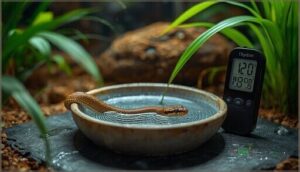
Your water dish isn’t just a container—it’s a multifunctional tool for snake hydration, shedding support, and humidity control. Choose shallow, non-slip dishes positioned away from heating elements to prevent bacterial buildup and substrate contamination, with soaking depths of 1–2 inches for smaller species and 2–4 inches for larger constrictors.
Position dishes in stable-temperature zones, offset from hiding spots to encourage exploratory behavior while supporting thermoregulation.
Critical water quality protocols:
- Change water daily using dechlorinated sources to minimize skin irritation and mucus membrane issues
- Sanitize dishes between refills with reptile-safe disinfectants, removing all substrate particles
- Monitor humidity spikes with probes, adjusting dish placement to maintain species-specific targets without condensation on heat sources
Managing Heating, Lighting, and Humidity
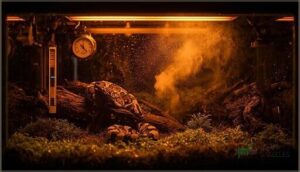
Your snake can’t generate its own body heat, so you’re responsible for creating the thermal environment it needs to survive—and getting this wrong means compromised digestion, weakened immunity, or worse.
Beyond temperature, humidity and lighting work together to support shedding, hydration, and natural behavior patterns that keep your snake thriving.
Here’s what you need to establish and maintain these critical environmental parameters.
Establishing Thermal Gradients
Your snake’s thermoregulation depends on a precise heat gradient spanning 10–20 cm, with the warm side at 28–32°C and the cool side at 22–26°C—most species won’t digest properly without this range.
Position heat sources at one end only, creating distinct climate zones rather than uniform warmth, then verify gradient stability with multiple calibrated thermometers placed strategically throughout the enclosure.
Choosing The Right Heating Equipment
Your selection of heating elements determines whether your snake thrives or suffers from chronic thermal stress—unreliable equipment can destabilize temperature gradients within hours. Consider these five options for safe thermoregulation:
- Under-tank heaters provide gentle ambient warmth without direct contact.
- Ceramic heat emitters deliver radiant heat without disrupting nocturnal behavior.
- Thermostatic controllers prevent overheating and maintain consistent temperature regulation.
- Infrared bulbs create effective basking zones for diurnal species.
- Heat cables enable custom heat gradient setup in large enclosures.
Inspect all heating equipment monthly—frayed cords and thermostat malfunctions cause burn injuries you won’t see coming.
Humidity Control Methods and Tools
Once your heating system stabilizes temperature gradients, moisture levels demand equal precision. Your digital hygrometer must deliver accurate readings within ±3% RH, not the ±10% tolerance of analog dials. Pair ultrasonic humidifiers with species-specific targets: 50–60% for corn snakes, 70–80% for rainbow boas, adjusting placement 2–3 inches above the substrate to prevent condensation. Calibrate sensors monthly using salt-test methods; evaporative cooling from mist systems risks thermal drops if you ignore ventilation balance.
| Method | Best For | Maintenance |
|---|---|---|
| Ultrasonic humidifier | Large enclosures, precise RH control | Weekly cleaning, monthly calibration |
| Manual misting | Tropical species, shedding cycles | Daily application, substrate monitoring |
| Humidity sensors (digital) | All setups requiring accuracy | Monthly salt-test recalibration |
| Mist systems (automated) | Multiple enclosures, consistent humidity | Biweekly nozzle checks, filter replacement |
| Evaporative cooling pads | Arid species needing slight moisture boost | Replace when dry, monitor airflow |
Proper Lighting for Health and Behavior
Beyond moisture, your photoperiod management shapes behavior as profoundly as thermal gradients. Mimicking natural lighting cycles—12 hours on, 12 off for most species—stabilizes circadian rhythms, supporting predictable feeding and shedding. UVB exposure isn’t universal; many snakes synthesize vitamin D through diet, not light. Still, observe your snake under varied intensity:
- Bright lights may suppress nocturnal activity
- Subdued illumination encourages natural exploration
- Coordinated heat gradient setup and lighting prevent thermal stress
Monitor responses; flickering or excessive glare disrupts feeding consistency.
Maintaining a Clean and Healthy Habitat

A spotless enclosure doesn’t just look better—it directly prevents respiratory infections, scale rot, and parasitic loads that compromise your snake’s immune function. Most keepers underestimate how quickly ammonia from waste accumulates in substrate, or how a single missed temperature spike can trigger regurgitation and metabolic collapse.
Here’s how to establish maintenance protocols that keep your snake thriving, not just surviving.
Daily and Weekly Cleaning Routines
Consistently, your snake habitat demands a structured cleaning schedule that prevents ammonia buildup and bacterial growth. This includes daily removal of waste and uneaten food, weekly sanitation of vivarium surfaces with reptile-safe disinfectants, and partial substrate refreshment in heavily soiled zones.
Proper hygiene practices are essential. Scrub water dishes daily to eliminate biofilm, and inspect substrate edges for mold. Follow strict sanitation protocols: wear gloves, rinse all cleaners thoroughly, and document every cleaning activity in your maintenance log.
Monitoring Temperature and Humidity
Beyond spotless surfaces, your snake’s survival hinges on precise climate control. Temperature gradients, humidity sensors, and calibrated temperature probes work together to prevent metabolic shutdown.
Install heat sources with digital thermostats, place hygrometers at multiple heights for accurate readings, and verify hygrometer calibration monthly. Without continuous monitoring of thermal gradients and humidity control, thermoregulation fails and your snake pays the price.
Observing and Adjusting for Snake Behavior
Vigilance reveals whether your habitat optimization matches your snake’s biology. Watch for behavioral stress signals—wall-bounding, refusal to eat, or persistent hiding spots abandonment—that expose environmental enrichment failures; these activity patterns demand immediate adjustment.
To decode animal behavior and fine-tune snake socialization needs:
- Log daily basking times, feeding responses, and shelter preferences.
- Correlate temperature readings with movement changes or lethargy.
- Test reversible tweaks to enrichment before major overhauls.
Observation drives precision.
Record-Keeping for Habitat Conditions
Documentation transforms guesswork into mastery—daily temperature logging at multiple gradient zones, humidity tracking with calibrated tools, and snake behavior notes linked to environmental events create a diagnostic roadmap.
Record basking times, misting schedules, thermoregulation patterns, and any climate control adjustments; this data exposes what’s working in your humidity and lighting management system and what silently undermines temperature regulation before your snake pays the price.
Addressing Species-Specific Habitat Needs
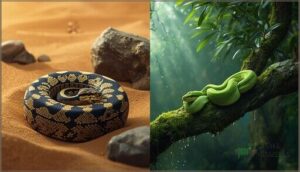
Not all snakes read the same care sheet—what works for a ball python won’t cut it for a green tree python, and your snake pays the price when you ignore that. Each species comes hardwired with specific behavioral needs shaped by millions of years in distinct habitats, from tropical rainforests to arid scrublands.
Here’s how to match your setup to your snake’s evolutionary blueprint.
Researching Natural History and Behavior
Your snake’s wild ancestors wrote the blueprint—ignore it and watch your setup fail. Species research reveals temperature ranges, photoperiod cues, and movement patterns that shape every habitat decision you’ll make, from substrate depth to perch height, driving ecological stability and behavioral adaptations that separate thriving animals from stressed captives.
- Temperature tolerances dictate basking sites and thermal gradient parameters
- Activity cycles determine lighting schedules aligned with natural photoperiods
- Foraging strategies inform prey presentation and feeding frequency
- Shelter preferences guide hide placement and substrate selection for habitat enrichment
- Sensory ecology shapes environmental complexity and species-specific needs
Customizing Habitats for Arboreal, Terrestrial, or Burrowing Snakes
Three habitat archetypes—arboreal, terrestrial, and fossorial—demand radically different layouts based on species research into snake behavior and locomotion physics. Arboreal species need vertical space (minimum 1.5× body length height) with secure branches 1–2.5× body girth. Terrestrial setups prioritize floor area (2–3× length) with multiple ground-level hides across temperature gradients. Burrowing snakes require substrate depth several times their girth, with muted surface features encouraging subterranean exploration. Match habitat layout to natural history—your snake’s morphology reveals its needs.
| Habitat Type | Key Design Priority |
|---|---|
| Arboreal | Vertical climbing structures, secure latching |
| Terrestrial | Wide floor space, ground hides at all thermal zones |
| Burrowing | Deep substrate (multiple body girths), minimal surface complexity |
Special Considerations During Shedding and Illness
When your snake enters shed—eyes clouded, skin dull—you must immediately boost humidity control by 10-15% above baseline, maintain stable temperature gradients (85-90°F basking, 75-80°F cool side), and guarantee constant access to fresh water for snake hydration.
Monitor daily for illness signs: prolonged lethargy, incomplete sheds, respiratory distress. Species-specific needs dictate exact parameters—your vigilance protects snake health. Persistent symptoms demand veterinary guidance without delay.
Quarantine and Veterinary Care Practices
Before introducing your new snake to an established collection, you need ironclad quarantine protocols—not optional recommendations.
- Isolate newcomers 30 days minimum with separate equipment, documented transfer records, and at least two consecutive negative disease screening tests
- Schedule routine veterinary checks every 6–12 months for proactive health surveillance and evidence-based parasite control
- Maintain detailed medical records tracking illness events, treatments, quarantine breaches
- Establish emergency planning with a licensed reptile veterinarian before purchase
Preventive reptile care protects your entire collection.
Frequently Asked Questions (FAQs)
How often should I replace my snakes substrate?
You’ll hear some keepers claim substrate lasts months—but spot-clean daily, replace every 1–2 weeks for loose bedding, and watch for odor, mold, or compaction that sabotages humidity control and threatens snake health.
Can multiple snakes share the same enclosure safely?
Generally, no—most species thrive alone. Multi-snake housing risks competition over temperature gradients, hiding spots, and stress-induced aggression.
Species interaction and compatibility testing are critical; even then, coexistence risks usually outweigh benefits in your vivarium.
What are signs of inadequate heating or humidity?
A ball python owner watched their snake refuse food for three weeks. A digital thermometer revealed the basking spot sat at 78°F, not the required 88-92°F, disrupting thermoregulation completely.
Do snakes need UVB lighting like other reptiles?
Most snakes don’t require UVB lighting for calcium metabolism like diurnal lizards—thermal regulation and photoperiod effects matter more.
However, emerging research suggests that certain species show improved thermoregulation, feeding responses, and overall vigor under low-level UVB exposure in reptile habitat setups.
How do I transition my snake to a larger enclosure?
Move your snake after several consistent feeding cycles; replicate thermal gradients, substrate, and hide placements in the new vivarium to reduce stress during enclosure upgrade and support smooth acclimation.
Conclusion
Your snake’s enclosure is its entire universe—a glass-walled ecosystem where every decision you make ripples through its physiology. What to think about when setting up a snake habitat isn’t theoretical; it’s the difference between a reptile that feeds reliably, sheds cleanly, and explores confidently versus one that refuses meals and hides compulsively.
You’ve engineered the temperature gradients, calibrated the humidity, and selected substrate with intention. Now your snake decides if you got it right. Watch closely—it’ll tell you.