This site is supported by our readers. We may earn a commission, at no cost to you, if you purchase through links.

You just watched your ball python refuse a perfectly good mouse for the third week straight. Your corn snake regurgitated its last meal within hours. Your juvenile boa constrictor hasn’t grown in two months despite eating regularly. The problem isn’t stubbornness or pickiness—it’s prey size.
Most feeding failures trace back to a single miscalculation: matching prey diameter to snake girth. Hatchlings suffocate on prey that’s too thick. Adults waste energy on undersized meals that don’t meet caloric needs. Juveniles develop metabolic issues when you guess instead of measure.
The girth-to-prey ratio controls everything from digestion speed to long-term health, yet most keepers eyeball it or follow outdated “rules of thumb” that apply to different species entirely.
Getting age-appropriate snake prey right means understanding the biomechanics of how your snake’s jaw, throat, and digestive tract handle different-sized meals at each growth stage—and adjusting with surgical precision as they develop.
Table Of Contents
- Key Takeaways
- What is Age Appropriate Snake Prey?
- Determining Proper Prey Size by Age
- Feeding Frequency by Snake Age
- Prey Types Suitable for Each Life Stage
- Monitoring Health and Growth During Feeding
- Common Feeding Issues and Solutions
- Top 3 Products for Safe Snake Feeding
- Frequently Asked Questions (FAQs)
- Conclusion
Key Takeaways
- Prey size must match your snake’s girth at the thickest body point—not age or weight—with prey diameter never exceeding 1.5 times the snake’s width to prevent regurgitation and ensure proper digestion.
- Feeding frequency shifts dramatically across life stages: hatchlings need meals every 5-7 days, juveniles every 7-14 days, and adults every 7-21 days depending on species and metabolism.
- Measure your snake’s girth every 1-2 weeks during growth phases using a flexible tape, then adjust prey size gradually to maintain the 8-15% body weight ratio that supports healthy development.
- Oversized prey triggers regurgitation in up to 80% of hatchlings while undersized meals cause malnutrition that delays maturity by months, making precise prey sizing the difference between thriving snakes and medical emergencies.
What is Age Appropriate Snake Prey?
Age-appropriate prey isn’t some abstract concept—it’s the difference between a healthy snake and a medical emergency. You need to match your snake’s size and age to the right prey dimensions, or you’re risking regurgitation, injury, or worse.
If you see signs like incomplete digestion or stress after feeding, check out this guide on how prey size affects snake regurgitation to troubleshoot the issue.
Let’s break down what “appropriate” actually means and why getting it wrong carries serious consequences.
Defining Age Appropriate Prey
Age appropriate prey means matching food width to your snake’s current girth—not its age in months. Measure the thickest body part, then select prey no wider than that diameter. This alignment prevents regurgitation and ensures proper snake nutrition.
A well-fed ball python thrives when you follow proven feeding schedules based on size and life stage, adjusting portions as your snake grows.
- Hatchlings consume prey 1/3 to 1/2 their girth
- Juveniles handle prey at 70–80% girth capacity
- Adults safely swallow prey matching full girth
- Verification requires supervised trial feeding
Why Prey Size Matters for Snakes
Proper prey size directly controls digestive health and growth rates in snakes. When prey matches 80–100% of your snake’s girth, digestion proceeds smoothly without strain. Oversized meals trigger regurgitation within 24–72 hours, while undersized prey fails to meet energy needs.
Matching prey to your snake’s body width prevents both regurgitation from oversized meals and malnutrition from portions that are too small, as detailed in this guide to proper prey sizing.
You’ll see stable weight gain and regular molting when prey selection aligns with body width. This predator-prey size ratio governs every feeding decision you make.
Choosing the right prey size for your ball python ensures they digest properly and maintain steady growth without regurgitation risks.
Risks of Incorrect Prey Sizing
Feeding complications escalate fast when you ignore the predator-prey size ratio. Prey exceeding 15–20% of body weight triggers regurgitation in 40–80% of hatchlings. Oversized meals cause mouth injuries and swallowing difficulties, while undersized prey creates snake malnutrition that delays maturity by months.
Oversized prey triggers regurgitation in up to 80% of hatchlings, while undersized meals stunt growth for months
Growth impacts compound with every feeding error—stress hormones spike, feeding efficiency drops, and body condition deteriorates rapidly.
Determining Proper Prey Size by Age
Getting the prey size right isn’t guesswork—it’s a measurable science that keeps your snake healthy and safe. You’ll need to understand how to measure your snake’s body, match prey to each life stage, and adjust portions as your snake grows.
Here’s how to nail down the right prey size every single time.
Measuring Snake Girth for Prey Selection

Measure your snake’s girth at the thickest body part—just behind the head—using a flexible tape. Prey diameter mustn’t exceed 1.5 times your snake’s girth, or regurgitation risk climbs sharply.
This measurement determines safe prey width. Accurate girth measurement protects feeding safety and aids steady growth monitoring throughout every life stage.
Record girth every 1–2 weeks during growth phases to track changes.
Prey Size Guidelines for Hatchlings, Juveniles, Adults

Hatchlings require pinky mice at 10–20% of body weight every 4–5 days. Juveniles accept larger prey—15–40% body weight—weekly. Adults need substantial meals totaling 50–100% body weight every 3–6 weeks, depending on species and health.
Your snake feeding size chart must match prey width to girth, never exceeding the snake’s thickest point. Precision protects against regurgitation and supports ideal snake nutrition throughout every growth stage.
Adjusting Prey Size as Snakes Grow

Growth monitoring drives prey scaling. Check your snake’s girth every 1–2 feedings to match prey size perfectly:
- Measure at the widest rib-cage point—this guides your snake feeding size chart.
- Target prey mass at 8–15% of girth to maintain a safe predator-prey size ratio.
- Increase prey dimensions gradually as body expansion occurs.
- Consistent size adjustment prevents regurgitation and promotes ideal snake nutrition.
Feeding Frequency by Snake Age

Your snake’s age directly determines how often you need to feed. Young snakes burn through energy fast and need frequent meals, while adults can go weeks between feedings without any issues.
Here’s the breakdown by life stage so you can set the right schedule for your snake.
Hatchling Feeding Schedules
Your hatchling needs food every 5–7 days. Most corn, king, and ball pythons thrive on this weekly interval. Some breeders push feeding every 2 days for accelerated growth rates, but this demands perfect temperatures and increases the risk of regurgitation. Pause feeding during shedding—your snake won’t eat anyway. Stick to a consistent feeding schedule to support steady development and proper hatchling nutrition. For ideal snake care, understanding bioactive terrarium maintenance is vital.
| Age | Feeding Schedule | Prey Size |
|---|---|---|
| 0–4 months | Every 5–7 days | Pinkie mice |
| 1–6 months (rapid growth) | Every 2 days | Fuzzy mice |
| Shedding period | Skip feeding | Resume after |
Juvenile and Sub-Adult Feeding Intervals
Juveniles need feeding every 7–14 days, depending on growth rates and body condition. Sub-adults stretch that interval to 10–21 days as their metabolism slows. Your snake’s feeding schedule hinges on three factors:
- Weight gain: track weekly weigh-ins to adjust prey size and feeding frequency
- Digestion times: allow complete stomach emptying before the next meal
- Species variation: large-bodied snakes tolerate longer intervals than smaller species
Monitor closely—snake nutrition demands precision.
Adult Snake Feeding Frequency
Adult snakes shift to extended feeding cycles—every 7 to 14 days for most species. Snake metabolism slows with maturity, demanding longer digestion time between meals.
Your feeding schedule hinges on body condition scoring, not rigid calendars. Monitor feeding response and weight trends to maintain nutrient balance. Warmer months may increase feeding frequency to every 5 days if your snake shows consistent appetite and proper snake nutrition.
| Life Stage | Feeding Frequency |
|---|---|
| Young Adult | 7–10 days |
| Mature Adult | 10–14 days |
| Large-Bodied Species | 14–21 days |
| Post-Shed Period | 5–7 days |
| Winter Months | 14–28 days |
Prey Types Suitable for Each Life Stage

You can’t feed a hatchling corn snake the same prey as an adult boa—your snake’s species and age dictate what belongs on the menu. Different prey animals offer varying nutritional profiles, sizes, and availability that match specific life stages.
Here’s what you need to know about matching prey type to your snake’s current needs.
Common Prey Options (Mice, Rats, Etc.)
Mice and rats form the backbone of carnivorous diets for most pet snakes. You’ll find pinky mice work best for hatchlings, while adults handle full-sized feeder rats with ease. Your feeding response improves when you match prey type to life stage:
- Pinky mice — newborns for tiny hatchlings
- Fuzzy mice — slightly larger for growing juveniles
- Adult mice — standard prey item variety for mid-sized snakes
- Weaner rats — transitional prey size between mice and rats
- Adult rats — large feeder rats for mature specimens
Monitor snake nutrition closely during transitions.
Species-Specific Prey Preferences
Prey selection depends heavily on snake species and natural feeding strategies. Ball pythons thrive on rodents, while garter snakes prefer fish or amphibians when prey availability allows. Your king snake might accept lizards, but corn snakes show a stronger rodent preference.
Match prey size to species-specific gape width—dietary adaptation occurs over weeks, not days. Monitor feeding techniques closely during species-appropriate introductions for ideal snake nutrition and reptile feeding success.
Transitioning Between Prey Types
Synchronize prey size adjustment with snake growth monitoring across 5–10 consecutive meals—documented feeding shift data reveals acceptance patterns you can’t ignore.
Shift gradually from smaller to larger prey type variety using adaptive feeding strategies that prevent digestive stress. Watch for handling difficulty during presentation; that’s your measurable signal for readiness.
Prey size impacts feeding frequency and snake nutrition outcomes directly.
Monitoring Health and Growth During Feeding
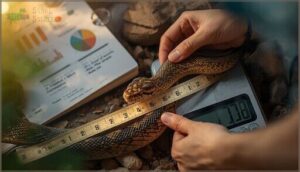
You can’t just toss prey into the enclosure and hope for the best. Tracking your snake’s physical metrics tells you whether your feeding approach is working or causing silent harm.
Here’s what you need to monitor to keep your snake healthy and growing at the right pace.
Tracking Snake Weight and Length
Track your snake’s progress with ruthless consistency. Weigh your snake to the nearest 0.1 g using a calibrated digital scale—never immediately after feeding. Measure length from snout to tail base with flexible measuring tape. Record both metrics weekly under identical conditions.
These numbers reveal growth tracking patterns that dictate prey size adjustments. Your data drives feeding frequency decisions and ensures proper snake nutrition through weight management and body condition assessment.
Signs of Overfeeding or Underfeeding
Your data reveals feeding imbalance faster than visual assessment alone. Weight monitoring that shows gains exceeding 10% monthly for several consecutive months signals overfeeding—your snake’s packing on excess fat. Conversely, stagnant or declining weight alongside dull, incomplete sheds screams nutrient deficits.
Rapid girth expansion means you’re pushing too much food. Persistent weight loss with wrinkled skin? You’re starving your animal.
Adjusting Diet Based on Body Condition
Body condition scoring guides your dietary adjustments with precision—muscle tone and fat deposits reveal what weight monitoring alone can’t. Underweight snakes need gradual meal increases to avoid regurgitation. Overweight animals demand reduced prey size or longer feeding frequency intervals.
Track these changes methodically. Consult a reptile veterinarian to fine-tune nutrition balance and maintain digestive health as your snake’s needs shift with growth.
Common Feeding Issues and Solutions

Even experienced keepers hit feeding roadblocks—your snake refuses meals, regurgitates prey, or packs on weight too fast. These problems usually trace back to prey size, timing, or environmental stress.
Let’s tackle the three most common feeding issues you’ll face and the fixes that actually work.
Dealing With Refusal to Eat
Refusal to eat happens—don’t panic. Your snake’s appetite often drops during shedding, temperature swings, or recent handling changes. Environmental stress, like inconsistent feeding schedules or wrong temps, triggers feeding refusal patterns.
Document every feeding attempt and note any stress cues. This reveals refusal patterns tied to specific conditions. Once you stabilize the environment and apply proper stress management, most snakes resume eating. Track feeding cues carefully—they’re your roadmap to better snake nutrition.
Preventing Regurgitation From Oversized Prey
Oversized prey triggers regurgitation. Match prey width to your snake’s midbody girth—no larger. Excess size strains swallowing mechanics and slows gut transit, forcing your snake to expel meals.
Proper prey size management prevents this stress. Warm prey to room temperature before feeding; cold items disrupt snake digestion. Avoid handling for 48 hours post-feeding.
Smaller prey reduces regurgitation causes while maintaining healthy snake nutrition and safe predator-prey size ratios.
Recognizing and Avoiding Overfeeding
Overfeeding creates silent health risks that compound over time. Track weekly weight against species-specific feeding charts to catch abnormal gains early—hatchlings adding more than 4 grams weekly signal trouble.
Monitor these overfeeding signs:
- Persistent weight gain beyond growth monitoring benchmarks
- Abdominal girth exceeding normal body proportions
- Reduced activity following standard feeding frequency
- Fat deposits visible along spine or ribs
- Regurgitation from overstuffed digestive systems
Adjust prey size and feeding intervals immediately when weight management data shows excess. Proper snake nutrition depends on calibrated portions, not guesswork.
Top 3 Products for Safe Snake Feeding
The right equipment makes feeding safer for both you and your snake. You need tools that minimize handling risks, maintain proper prey temperature, and create a controlled feeding environment.
Here are three products that address the most common feeding challenges snake keepers face.
1. Deepsoon Electric Heating Pad

Your snake won’t eat if it’s freezing—plain and simple. The Deepsoon Electric Heating Pad creates a proper thermal gradient in your reptile habitat with 6 adjustable temperature settings and essential overheat protection.
This electric heat control system maintains consistent warmth for digestion after feeding, which directly impacts snake nutrition and feeding techniques. The 2-hour auto shutoff provides heating pad safety during critical post-meal periods.
Position it under one side of the enclosure to establish proper heat regulation—your snake needs that warm zone for effective prey size processing and overall reptile care.
| Best For | Snake owners who need reliable temperature control to support proper digestion and feeding schedules in reptile enclosures. |
|---|---|
| Brand | Deepsoon |
| Weight | 0.9 Pounds |
| Primary Material | Polyester |
| Color/Flavor | Light Gray |
| Dimensions | 9.6 x 3.5 x 3.5 inches |
| Special Features | Auto shut-off |
| Additional Features |
|
- 6 adjustable temperature settings let you create the exact thermal gradient your snake needs for different activities like digestion and basking
- Overheat protection and 2-hour auto shutoff prevent dangerous temperature spikes that could harm your reptile
- Easy to position under enclosure substrate to create a warm zone without direct contact exposure
- The 2-hour timer might shut off too soon during extended digestion periods after larger meals
- Some users report the pad doesn’t get warm enough even on highest settings for certain snake species
- The control module placement can be awkward when trying to maintain it outside the enclosure
2. Ahab Live Prey Vinyl Album

This isn’t a snake feeding product. The Ahab Live Prey Vinyl Album is a doom metal music format from Napalm Records—a live performances recording that belongs in vinyl collecting, not reptile care.
Don’t confuse album reviews with feeding techniques. You need actual prey items matched to proper prey size for your snake, not a 12.3-inch record weighing 1.25 pounds.
This product offers zero nutritional value for prey type selection or snake feeding schedules. Skip this entirely for your reptile’s diet.
| Best For | Fans of Ahab and funeral doom metal who want to experience the band’s intense live performance from Death Row Fest 2017 and add a quality vinyl to their collection. |
|---|---|
| Brand | NAPALM RECORDS |
| Weight | 1.25 pounds |
| Primary Material | Vinyl |
| Color/Flavor | Black Vinyl |
| Dimensions | 12.2 x 12.3 x 0.4 inches |
| Special Features | Side D etching |
| Additional Features |
|
- Captures the raw energy of Ahab’s live sound with five tracks from their acclaimed 2006 album “The Call of the Wretched Sea”
- High-quality vinyl mastering by Role Wiegener at Tonmeisterei ensures excellent sound reproduction
- Special etching on Side D adds unique collector value to the release
- Limited setlist only features tracks from one album, missing other parts of Ahab’s discography
- Some notable tracks from the original album like “The Sermon” aren’t included
- Minimal audience noise may disappoint those looking for a full live concert atmosphere
3. The Prepared Pantry White Bread Mix
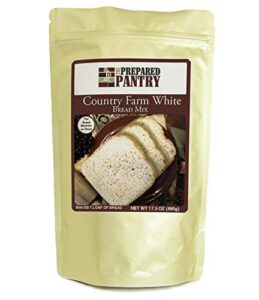
This isn’t snake food. The Prepared Pantry White Bread Mix is a 17.5-ounce baking product designed for homemade loaves, not reptile nutrition. Bread Mix Reviews praise its simplicity for high altitude baking and bread machine tips, but it offers zero prey size guidance or feeding frequency value for your snake.
Don’t waste time on White Bread Recipes when you need proper feeding techniques. Your snake requires whole prey matched to its girth—not enriched flour and yeast. Skip this product entirely for snake nutrition purposes.
| Best For | Home bakers who want an easy, no-fuss way to make white bread in the oven or bread machine without measuring out individual ingredients. |
|---|---|
| Brand | The Prepared Pantry |
| Weight | 1.08 Pounds |
| Primary Material | Bread Mix |
| Color/Flavor | Country Farm White |
| Dimensions | 17.5 Ounce unit |
| Special Features | Includes yeast |
| Additional Features |
|
- Simple prep with just butter and water—great for beginners or quick baking sessions
- Works in both bread machines and conventional ovens, giving you flexibility
- Includes yeast and herb mix already measured out, so less room for error
- Some users find the flavor pretty bland and suggest adding extra herbs or spices to liven it up
- The included yeast might be dead on arrival, meaning you’ll need to buy fresh yeast separately
- Recipe tweaks are sometimes needed (less butter, different water temps) to get the best results
Frequently Asked Questions (FAQs)
How does shedding affect feeding schedules?
Timing is everything” rings true here: shedding suppresses appetite, so delay feeding windows until post-shed care confirms a complete cycle.
Monitor snake vigor closely—digestion patterns and feeding frequency improve dramatically once sensory perception normalizes.
Should I feed multiple small prey items?
You can offer two smaller prey items in one session instead of a single larger piece—just verify the combined mass stays around 10 percent of your snake’s body weight.
Understanding proper prey size guidelines is vital for safe feeding practices.
What temperature should thawed prey be?
Warm thawed prey to room temperature—68 to 77°F. This temperature range mimics natural body heat, encouraging your snake’s feeding response.
Don’t offer cold or hot prey; temperature extremes cause stress and digestive problems.
Do different snake species have unique nutritional needs?
Yes. Species nutrition varies markedly across snake types. Constrictors and colubrids show different metabolic rates and nutrient profiles.
Dietary needs shift based on natural prey—rodents, birds, or reptiles—affecting calcium absorption and feeding variations substantially.
Conclusion
Precision prevents problems—permanently. Your snake’s survival hinges on matching prey diameter to girth at every growth phase, not guessing based on what “looks right” or worked for someone else’s python.
Measure before each feeding cycle. Track body condition weekly. Adjust as growth dictates.
Age-appropriate snake prey isn’t a suggestion you follow when convenient—it’s the baseline standard that separates healthy snakes from chronic feeders destined for metabolic collapse and early death.