This site is supported by our readers. We may earn a commission, at no cost to you, if you purchase through links.
Arboreal snakes drink differently than ground-dwellers—they don’t stumble across puddles on a forest floor. In the wild, species like green tree pythons and Amazon tree boas lap droplets from leaves or dip their heads into shallow pools wedged between branches.
Replicate that in a terrarium, and you’re not just adding décor; you’re meeting a real physiological need. A bowl that’s too deep, too unstable, or positioned at ground level often goes ignored entirely, quietly contributing to dehydration you might not notice for weeks.
Choosing the right reptile water bowls for arboreal snakes comes down to a few specific criteria—and the products that check every box are fewer than you’d expect.
Table Of Contents
- Key Takeaways
- Top 5 Arboreal Snake Water Bowls
- Key Bowl Features for Tree Snakes
- Choosing The Right Bowl Size
- Cleaning and Placement Tips
- Frequently Asked Questions (FAQs)
- What can I use as a water bowl for a snake?
- Do snakes need a large water bowl?
- How deep should my snakes water bowl be?
- Do snakes drink from water bowls?
- Can arboreal snakes drink from misting systems alone?
- Should bowls be elevated or ground-level for arboreal species?
- Are magnetic bowls safe for all arboreal snake species?
- How often should arboreal snakes drink water?
- Can arboreal snakes soak in water bowls?
- What water temperature suits arboreal snake bowls?
- Conclusion
Key Takeaways
- Arboreal snakes drink from elevated surfaces in the wild, so a bowl placed at ground level often goes ignored, quietly leading to dehydration over time.
- The best water bowls for tree snakes share four traits: a weighted base that won’t tip, shallow depth (1–1.5 inches), non-porous, food-grade material, and a smooth interior for easy cleaning.
- Bowl size should match your snake’s current body length, with depth kept between 1–2 inches for drinking and up to 4 inches for larger species that occasionally soak.
- Daily water changes, regular disinfecting, and keeping the bowl away from substrate contact are habits that protect your snake’s health long-term.
Top 5 Arboreal Snake Water Bowls
Finding the right water bowl for an arboreal snake comes down to a handful of options that actually hold up in real enclosures. Each pick below balances stability, hygiene, and size in ways that matter for tree-dwelling species.
If you’re still getting your bearings, this guide to water bowls for beginner snake owners covers the material and sizing basics before you commit to a pick.
Here’s what’s worth your attention.
1. Exo Terra Reptile Water Dish
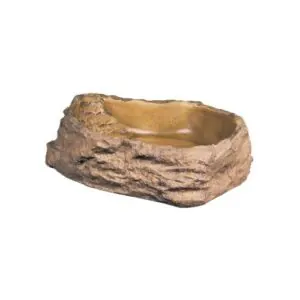
The Exo Terra Reptile Water Dish is a solid starting point for most arboreal setups. At roughly 8.7 × 6.7 × 2 inches and 2.39 lb, its heavy enough to stay put when your snake moves around — preventing no tipping, no spills.
The food-grade resin interior is smooth and non-porous, ensuring bacterial buildup stays manageable with regular cleaning. Built-in safety steps are a thoughtful touch if you keep small frogs or insects in the same enclosure.
At $13.85, it’s practical without being expensive.
| Best For | Reptile and amphibian keepers who want a stable, easy-to-clean water dish that looks natural in their terrarium setup. |
|---|---|
| Material | Food-grade resin |
| Interior Surface | Smooth, non-porous |
| Exterior Finish | Natural rock texture |
| Tip Resistance | Heavy, low-center design |
| Dual Purpose | Water and soaking |
| Weight | 2.39 lb |
| Additional Features |
|
- Heavy and low to the ground, so it won’t tip over even with bigger, more active animals like ball pythons or turtles.
- Smooth, non-porous interior resists bacterial buildup and makes cleaning quick and straightforward.
- Built-in safety steps give small frogs and insects a way out, which is a genuinely useful detail.
- Actual dimensions may not match what’s listed, so double-check before buying if space is tight.
- At 2.39 lb, it’s not the easiest thing to move around or reposition inside an enclosure.
- The 2-inch depth might be too much for very small or shallow-water species, making it harder for them to access safely.
2. Exo Terra Extra Large Reptile Water Dish
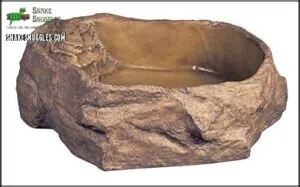
If your snake needs more room to stretch out or soak properly, the Extra Large version steps up in every way that matters.
It measures roughly 10 × 9.7 × 2.5 inches with a 16 oz capacity — enough for ball pythons, large tree boas, or any arboreal species that appreciates a real soak.
The same food-grade resin construction keeps the interior smooth and bacteria-resistant, while the weighted base holds firm during active feeding nights or misting cycles.
The Natural rock finish blends cleanly into most terrarium setups.
| Best For | Reptile owners with larger snakes, tortoises, or medium-sized amphibians who need a roomy, stable water dish that holds up to an active enclosure. |
|---|---|
| Material | Food-grade resin |
| Interior Surface | Smooth, non-porous |
| Exterior Finish | Natural rock texture |
| Tip Resistance | Heavy, low-center design |
| Dual Purpose | Water and soaking |
| Weight | ~1 lb |
| Additional Features |
|
- Smooth, food-grade interior wipes clean easily and won’t harbor bacteria over time.
- Heavy base stays put even when your reptile is splashing around or the mister kicks on.
- Built-in ramp entrance lowers the risk of smaller critters getting stuck or drowning.
- Actual dimensions may not match the listing, so double-check before buying for a tight enclosure.
- At about a pound, it’s not the easiest thing to move around when you’re doing a deep clean.
- The depth might be overkill for very small or strictly terrestrial species that just want a shallow sip.
3. Reptizoo Reptile Water and Food Bowl
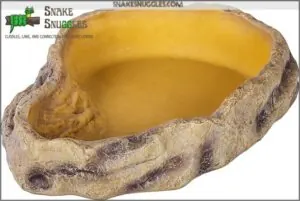
Not every setup calls for a floor-level bowl. If your arboreal snake spends most of its time off the ground, the Reptizoo Reptile Water and Food Bowl is worth a look. It mounts directly to the glass with six suction cups, keeping hydration where your snake actually lives.
The acrylic construction is food-safe, non-porous, and easy to wipe clean between sessions. At roughly 5.9 × 3.1 inches with a shallow 0.6-inch depth, it fits neatly without blocking climbing paths.
| Best For | Medium-to-large reptile owners who want a sturdy, naturalistic water dish that won’t tip over in an active enclosure. |
|---|---|
| Material | Premium resin |
| Interior Surface | Smooth, non-pitted |
| Exterior Finish | Rock/soil-tone finish |
| Tip Resistance | Weighted, low-profile |
| Dual Purpose | Water and soaking |
| Weight | 3.35 lb |
| Additional Features |
|
- Heavy, low-profile build keeps it firmly in place even with energetic snakes or lizards moving around
- Smooth interior makes cleaning quick and easy, cutting down on bacterial buildup
- Rock-like finish blends naturally into bio-active setups without looking out of place
- Only comes in one color, so it won’t match every terrarium aesthetic
- Too bulky for small enclosures or young reptiles that don’t need much water volume
- The weight is great for stability but can be a real hazard if you drop it on your foot
4. RunXF Large Simulation Rock Reptile Bowl
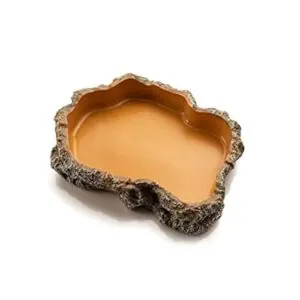
The RunXF Large Simulation Rock Reptile Bowl suits ground-foraging snakes, offering a spacious design at 9 × 6.7 × 2 inches. This size accommodates medium to large arboreal species, allowing natural drinking without awkward head angles.
For snakes that prefer to soak or drink at ground level, understanding what makes a water bowl safe for snakes can help you get the most out of this bowl’s low-profile, spacious design.
Its resin exterior mimics natural rock, seamlessly blending into desert or tropical terrarium layouts. The high-density base ensures stability during active movement, preventing shifts or spills.
The smooth interior wipes clean in seconds—no scrubbing required—making maintenance effortless.
| Best For | Reptile owners with medium to large species—like bearded dragons, ball pythons, or leopard geckos—who want a feeding or water dish that actually looks good in the tank. |
|---|---|
| Material | Food-safe resin |
| Interior Surface | Smooth |
| Exterior Finish | Rock-simulated texture |
| Tip Resistance | High-density base |
| Dual Purpose | Food and water |
| Weight | 13.4 oz |
| Additional Features |
|
- The extra-large bowl (9 × 6.7 × 2 inches) gives most mid-to-large reptiles plenty of room to eat, drink, or take a quick soak.
- The realistic rock texture blends naturally into desert or tropical setups without looking out of place.
- Smooth interior means cleanup is quick—just rinse and wipe, no scrubbing needed.
- Very large reptiles may find it a bit cramped, and it’s not deep enough for extended soaking sessions.
- The color can look different in person than it does in product photos—yellow versus brown is a real toss-up.
- Resin can scratch or crack if you’re rough with it, so skip the abrasive cleaners and heavy drops.
5. Penn Plax Fossil Rock Dish
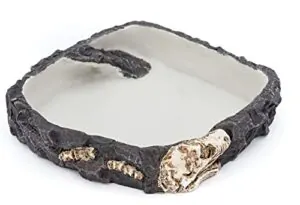
The Penn Plax Fossil Rock Dish rounds out this list with a compact, dual-purpose design that works for both water and food.
At 7 × 7 × 1.5 inches and 1.32 lb, it stays planted during feeding time without anchoring hardware.
The non-porous resin surface resists biofilm and wipes clean easily, which matters during daily water changes.
Its shallow 1.5-inch depth suits most arboreal drinkers, though larger constrictors will need something roomier as they grow.
| Best For | Reptile, amphibian, and crustacean owners who want a naturalistic-looking dish that pulls double duty as both a food and water bowl in a themed terrarium. |
|---|---|
| Material | Durable resin |
| Interior Surface | Easy-rinse resin |
| Exterior Finish | Fossil/rock texture |
| Tip Resistance | Stable, heavy base |
| Dual Purpose | Food and water |
| Weight | 1.32 lb |
| Additional Features |
|
- The fossil-stone look blends right into naturalistic setups without sticking out like a plastic eyesore.
- Heavy enough (1.32 lb) to stay put when animals are actively eating or drinking—no tipping, no mess.
- Super easy to clean; a quick rinse with warm water and a rag is all it takes between feedings.
- At only 1.5 inches deep, it won’t cut it for species that need a proper soaking dish.
- Larger reptiles will outgrow it fast, so you may end up replacing it sooner than expected.
- Resin can chip if dropped, so handle it carefully and check it regularly for damage.
Key Bowl Features for Tree Snakes
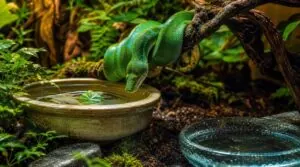
Not every bowl works for a tree snake — the shape, weight, and material all matter more than you’d think.
Before picking one, knowing what features actually make a difference in day-to-day care is essential.
Here’s what to look for.
Anti-tip Weighted Bases
Tipping is one of those problems that seems minor until your arboreal enclosure is soaked at 2 a.m. Quality reptile water bowls address this with a solid stable base, non-slip feet, and corner flange anchors that grip terrarium walls without permanent modification.
Base weight range generally runs 2–4 lbs for smaller snake water dishes. Adjustable ballast modules and weighted base materials let you reconfigure as your snake grows, ensuring long-term stability.
Shallow Drinking Access
Arboreal snakes drink differently than ground dwellers — they need a low-profile water bowl that meets them at branch level without demanding an awkward stretch. Rim Height and Water Depth matter more than most keepers realize.
Arboreal snakes need a low-profile bowl at branch level, where rim height and water depth matter more than most keepers realize
- Edge Roundedness prevents scale snagging mid-drink
- Branch Proximity keeps the stable hydration source within natural reach
- Wide rim enables easy lapping without full submersion
- Visibility Contrast helps snakes locate water dishes quickly
- 1.0–1.5 cm depth in reptile water bowls reduces soaking risk
Non-porous Safe Materials
Material choice quietly determines how safe and hygienic your snake’s water stays between cleanings. Food-grade, nonporous resin won’t absorb bacteria or leach chemicals — a baseline worth holding to. Ceramic durability, stainless steel hygiene, acrylic clarity, polypropylene resilience, and porcelain rock realism each brings reliable material and hygiene benefits for arboreal setups. These materials achieve resistance through dense molecular packing.
| Material | Key Benefit | Best For |
|---|---|---|
| Foodgrade resin | Nonporous, no bacterial absorption | All-purpose daily use |
| Stainless steel | Corrosion-resistant, easy cleaning | Larger, active snakes |
| Ceramic/Porcelain | High durability, glazed interior | Naturalistic enclosures |
Smooth Easy-clean Interiors
A continuous construction makes all the difference when scrub time comes around. The Exo Terra Snake Water Bowl’s design ensures easier maintenance through its smooth interior surfaces, crafted from nonporous, food-grade resin, which prevent algae and mineral buildup.
Filleted edges, rounded baffles, and integrated drainage eliminate hidden crevices, ensuring no residue is trapped.
A hydrophobic coating repels water and soap scum, allowing a quick microfiber wipe to handle most daily cleaning effortlessly.
Naturalistic Terrarium Styling
A water bowl that looks like it belongs in the enclosure is worth deliberately choosing. Natural rock texture and rock-inspired design, like The Bio Dude Rock Water Bowl, blend into Microhabitat Zoning without disrupting Layered Ground Cover or Vertical Planting arrangements.
Pair it with Rock Cluster Placement and Live Moss Integration for naturalistic terrarium aesthetics that feel cohesive rather than assembled.
Choosing The Right Bowl Size
Getting the size right is not complicated, but it matters more than most people expect. A bowl that’s too small leaves your snake without a proper soak, while one that’s too large can throw off the whole enclosure layout.
Here are five key things to think through before you pick.
Match Snake Body Size
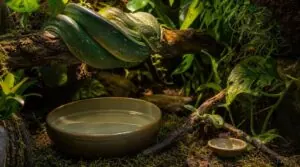
Your snake’s SVL tells you more than just length — it shapes every purchase decision, including which snake water dish actually fits. A juvenile arboreal species topping out at 40 cm needs a very different size and capacity than a large snake water bowl built for a 200 cm adult.
- SVL Monitoring guides bowl diameter selection
- Perch strength needs to scale with body mass
- Size-Based Feeding informs dish depth requirements
- Prey gape width correlates with head size and bowl opening
- Growth Milestones signal when to size up your stable base bowl
Track Growth Milestones regularly so your reptile hydration setup evolves with them.
Allow Safe Soaking
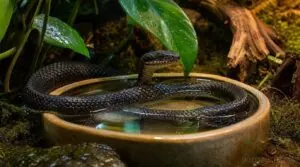
Safe soaking starts with water depth — aim for 1 to 2 inches so your arboreal snake can submerge its midsection without the head going under. Clear Level Markers help you maintain consistent reptile hydration without guesswork.
Anti-Spill Rims and Slip-Resistant Bases support water dish stability during soaking behavior.
Large capacity models with non-porous surfaces resist bacterial buildup and support Temperature Regulation.
Avoid Overcrowding Enclosure
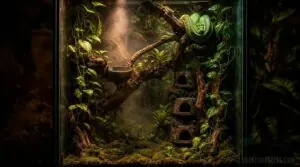
Vertical space utilization matters—stack hides and multiple bowl elevations to free up ground area. For multi-reptile tank sharing, microhabitat zoning keeps things orderly:
- Separate feeding and drinking zones by 12 inches.
- Maintain three distinct microhabitats.
- Use visual barrier integration to reduce crowding.
- Follow a bowl rotation schedule quarterly.
A bowl that’s too large steals real estate quickly. Large capacity doesn’t have to mean large footprint.
Consider Corner Placement
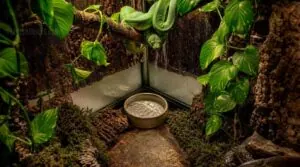
Corner placement takes space optimization a step further. Tucking a water bowl—like the Exo Terra Corner Water Dish or Corner Water Bowl LG Zoo Med—into a wall intersection frees central floor space for branch integration and natural movement paths.
| Corner Placement Benefit | Why It Matters | Practical Tip |
|---|---|---|
| Gravity Drain Management | Directs spills toward glass, not substrate | Angle bowl slightly inward |
| Microhabitat Simulation | Mimics tree-crevice hydration sites | Pair with rock hide nearby |
| Corner Lighting | Improves water visibility for monitoring | Align with ambient enclosure light |
These snake enclosure accessories work best flush against the backing wall, keeping your reptile’s environment uncluttered without sacrificing reliable water bowl access.
Balance Capacity and Stability
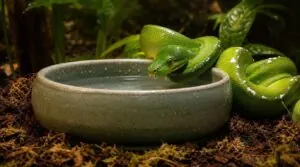
Capacity and stability go hand in hand—a water bowl that holds too much water for its base width will tip the moment your snake leans in. Keep these principles in mind when selecting:
- Base height ratio should be at least 2.5:1 to improve tilt resistance
- Low center of gravity aids even weight distribution across substrates
- Rim width design determines splash control and drinking access
- Larger options like the Exo Terra XLarge Water Dish balance volume with a stable, low-profile footprint
Mountable terrarium accessories with suction-cup anchors add extra security.
Cleaning and Placement Tips
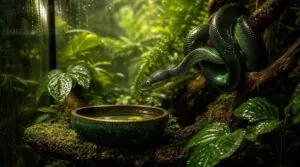
Even the best bowl won’t do much good if it’s sitting in the wrong spot or going days without a rinse. Placement and cleaning habits shape your snake’s health more than most keepers expect.
Here’s what to keep in mind.
Refresh Water Daily
Fresh water every 24 hours isn’t optional — it’s the foundation of waterborne bacteria control in any arboreal setup. A morning refill routine ensures hydration consistency and provides a daily visual check for water clarity.
Always use room temperature water; cold water can stress tree snakes into avoiding the bowl entirely. Sustainable bowl reuse begins with a quick rinse before each refill, maintaining hygiene without unnecessary waste.
Sanitize Bowls Regularly
Beyond daily water changes, routine cleaning and sanitation are crucial for maintaining waterborne bacteria control.
After each feeding, wash the water bowl with hot water and unscented soap, rinse completely, then apply a reptile-safe disinfectant following label dilution rates — sanitizer safety matters here.
Drying procedures are non-negotiable; reintroducing a damp bowl to the enclosure undoes everything.
Track cleaning frequency through simple record keeping to stay consistent.
Prevent Algae Buildup
Algae spreads fast when light and warmth meet standing water. Using Timer-Controlled Lights set to an 8–12 hour photoperiod cuts the photosynthesis window substantially. Position lights away from the water bowl’s surface, and consider opaque bowl lids during dark hours.
Consistent water temperature, Nutrient-Limited Water through daily refreshes, and Periodic Bowl Rotation all reduce buildup—core habits in sound reptile husbandry and long-term reptile health.
Keep Away From Substrate
Substrate contact is one of the sneakiest sources of contamination in any arboreal setup. Position your terrarium water dish on Raised Perch Platforms or use Suction‑Cup Mounts to keep it elevated and clean.
Moisture Barrier Liners and Dry Underlay Mats beneath a low‑profile water bowl or rock bowl prevent wicking. Corner Isolation Placement adds another layer of natural substrate integration protection.
Support Humidity Without Spills
A well-placed water dish quietly does double duty — drinking station and passive humidity source — but only if it doesn’t flood the enclosure floor. Look for bowls with Spill‑Containment Walls, a raised Elevated Lip Barrier, and a Vapor‑Resistant Coating to manage evaporation without soaking substrate.
- Wicking Base designs direct moisture upward, not outward
- Humidity‑Balancing Reservoir models regulate ambient moisture steadily
- Wet‑dry dish combos and low‑profile water bowls suit most reptile enclosure water dish setups
Frequently Asked Questions (FAQs)
What can I use as a water bowl for a snake?
Think of your snake’s water dish as its personal oasis. You can use a ceramic dish, glass water dish, silicone feeding cup, plastic aquarium bowl, or reusable silicone tray — all reliable hydration options.
Do snakes need a large water bowl?
Not necessarily. For arboreal snakes, bowl depth preference and space efficiency matter more than sheer size. A mid-sized dish enables hydration frequency without crowding the enclosure or disrupting climbing pathways.
How deep should my snakes water bowl be?
For most arboreal snakes, 1 to 2 inches works well for daily drinking. Larger species benefit from 2 to 4 inches to allow occasional soaking without disrupting branch proximity or moisture maintenance balance.
Do snakes drink from water bowls?
Yes, snakes drink from water bowls. Their hydration behavior depends on bowl accessibility — shallow edges, smooth interiors, and choice of clean water sources.
These factors all encourage consistent drinking in reptile enclosures or terrarium setups.
Can arboreal snakes drink from misting systems alone?
Misting helps, but it’s not the whole drip. Some species lick droplets off surfaces, making droplet size importance real—yet a water dish remains essential for reliable terrarium hydration.
Should bowls be elevated or ground-level for arboreal species?
Elevated water dishes reduce substrate contamination and support neck comfort during drinking.
For canopy enrichment, position bowls mid-height, matching your snake’s natural hydration efficiency while allowing adjustability for growth as your arboreal species matures.
Are magnetic bowls safe for all arboreal snake species?
Not always. Magnet corrosion risk, ingestion hazards, and weight distribution issues make magnetic reptile enclosure water dishes risky for certain species-specific behavior patterns. Always verify compatibility before mounting.
How often should arboreal snakes drink water?
Arboreal snakes drink opportunistically, usually every two to three days.
Watch for dehydration signs like sunken eyes. Supplement their water dish access with mist supplementation to mirror natural rainfall simulation.
Can arboreal snakes soak in water bowls?
Yes, tree snakes do occasionally take a dip. Short soaking sessions support hydration behavior.
But watch for over‑soaking risks—extended stays often signal humidity or temperature imbalance in the enclosure.
What water temperature suits arboreal snake bowls?
Keep water in your arboreal snake’s dish between 75 and 85°F. Use a thermometer and position the bowl away from direct heat sources for stable, stress-free temperature regulation.
Conclusion
Like a hidden crack in a branch, the wrong water bowl creates problems you won’t notice until real damage is done. Choosing the right reptile water bowls for arboreal snakes means thinking the way your snake does—elevated access, shallow depth, weighted stability, and surfaces that stay clean between refreshes.
Get those details right, and hydration stops being a guessing game. Your snake drinks consistently, your enclosure stays balanced, and care becomes something you can trust.