This site is supported by our readers. We may earn a commission, at no cost to you, if you purchase through links.
On a bright desert morning, a Uromastyx can move between punishing sun and a shaded crevice within minutes; inside a terrarium, that choice exists only if you build it. A lamp that looks bright to you may deliver negligible radiation in the 290–315 nm range.
Without sustained cutaneous D3 synthesis, serum calcium regulation falters long before fibrous osteodystrophy becomes visible, and a brief UVB shortfall can begin the same chain.
The best uvb lighting systems for desert species don’t chase wattage; they deliver UVI 3.0–5.0 at dorsal basking height. Compare output, coverage, mesh losses, and meter readings before you buy.
Table Of Contents
- Key Takeaways
- Why Desert Species Need UVB Lighting
- UVB Lamp Types and Performance Compared
- Top 10 UVB Lighting Systems for Desert Species
- 1. Zoo Med Desert UVB Lighting Kit
- 2. Reptile Systems T5 Desert UVB Lamp
- 3. Repti Zoo T5 UVB Lighting Kit
- 4. Zilla Reptile UVB Light Bulb
- 5. T5 Ho Uvb Reptile Light Fixture
- 6. Lucky Herp Reptile Uvb Light Bulb
- 7. Repti Zoo UVB Desert Reptile Lamp
- 8. Reptile UVB Light Fixture
- 9. Haceryc Reptile UVB Light Fixture
- 10. Reptile UVB Light Bulb
- Choosing The Right Desert UVB System
- UVB Installation, Monitoring, and Maintenance
- Frequently Asked Questions (FAQs)
- What is the best UVB light for reptiles?
- Is a basking light the same as an UVB light?
- Where can I buy UVB light?
- How far should UVB light be from tortoise?
- What is the difference between tropical and desert UVB bulbs?
- Is too much UVB bad for reptiles?
- Can I use UVB lighting through glass or mesh?
- How do I measure actual UVB output at home?
- Do nocturnal desert species need UVB lighting too?
- Whats the difference between UVB and UVA lighting?
- Conclusion
Key Takeaways
- Desert reptiles need species-appropriate UVB to produce vitamin D3, absorb calcium, and prevent metabolic bone disease, with high-sun species generally requiring UVI 3.0–5.0 at the basking surface.
- Choose lighting by verified UV Index, enclosure size, lamp coverage, and barriers rather than wattage or visible brightness; T5 HO systems with effective reflectors are usually the most reliable option for larger desert setups.
- Mount UVB so it overlaps the heat-basking area while providing lower-exposure shaded retreats, because glass blocks UVB and mesh can substantially reduce the level reaching your reptile.
- Measure output at your reptile’s actual basking height with a UV Index meter, clean fixtures regularly, and replace bulbs when readings fall below the target range rather than relying on how bright they appear.
Why Desert Species Need UVB Lighting
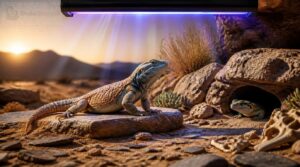
Desert reptiles don’t just tolerate UVB — they depend on it at a cellular level to make vitamin D3, regulate calcium, and avoid the slow deterioration that comes with metabolic bone disease. Getting this right means understanding your species’ Ferguson Zone, recognizing deficiency before it becomes irreversible, and knowing the difference between a high-sun basker like Uromastyx and a crepuscular species like a leopard gecko. Here’s what you need to know before choosing a system.
Use this desert reptile UVB lighting guide to match output and placement to your species’ natural sun exposure.
Vitamin D3 and Calcium Metabolism
Vitamin D3 production begins the moment UVB radiation contacts your reptile’s skin. Calcium metabolism follows five interdependent steps:
- UVB radiation (290–315 nm) converts 7-dehydrocholesterol to D3 in skin
- Liver hydroxylation then yields circulating 25(OH)D
- Kidneys then convert that to active 1,25(OH)₂D
- Active 1,25(OH)₂D upregulates intestinal calcium uptake
- PTH modulates serum calcium balance
Your UVB lighting systems must drive each step. This pathway is governed by CYP27B1 renal hydroxylase activity, which is tightly regulated by PTH, FGF23, and calcium levels.
Metabolic Bone Disease Prevention
When the five-step pathway above fails, the consequences arrive directly in bone. In Pogona vitticeps, metabolic bone disease manifests as fibrous osteodystrophy, where cortical bone is progressively replaced by poorly mineralized fibrous tissue.
Your UVB lighting systems must sustain vitamin D3 synthesis continuously, because even brief deficiencies suppress calcium metabolism enough to trigger irreversible skeletal resorption within just a few weeks.
Ferguson Zones and Target UVI
Skeletal damage like that forces you to think upstream, back to the UV source itself.
The Ferguson Zone system classifies desert species by their natural sun exposure, placing most in Zone 4, where average UVI reaches 2.4 and peak readings approach 6.0.
Your UVB lighting placement must replicate this, sustaining irradiance levels between UVI 3.0 and 5.0 at basking height.
High-sun Versus Crepuscular Species
Not all desert species demand the same UV budget. Crepuscular species like Uromastyx ornata, active at dawn and dusk, require you to target UVI 0.7 to 1.0 at basking height, where ambient irradiance rarely exceeds 1.5.
High-sun heliotherms like Pogona vitticeps, active under peak midday irradiance, need UVI 3.0 to 5.0 sustained at basking distance to drive effective D3 synthesis.
Deficiency and Overexposure Signs
When UVB output degrades below the Ferguson Zone threshold your species requires, calcium absorption collapses, triggering metabolic bone disease: jaw softening, hind limb tremors, and brittle dentition all confirm impaired vitamin D3 synthesis.
Overexposure from a miscalibrated UVB lighting setup drives eye irritation and behavioral withdrawal at excessive UVB exposure levels, which Solarmeter readings can catch before harm sets in.
UVB Lamp Types and Performance Compared
Not all UVB lamps are built the same, and the differences matter more than most keepers realize. From T5 HO fluorescents to mercury vapor bulbs and emerging LED systems, each technology has distinct trade-offs in output, coverage, and longevity. Here’s how the main types stack up.
T5 HO Fluorescent Tubes
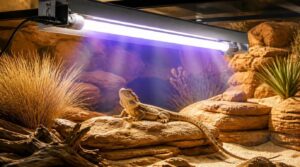
T5 HO Fluorescent Tubes produce 2-3x standard lumen output, replicating high-UVI heliozone conditions. Use the T5 High Output HO only with HO-rated ballasts; mismatches accelerate UVB output degradation.
- UVB 100 T5 HO targets Ferguson Zone 3-4
- UVB 50 T5 HO suits Zone 2-3 species
- 16 mm diameter, close fixture spacing
- G5 bi-pin, HO-rated ballast required
- 24-inch and 39-inch tube lengths
Compact Fluorescent UVB Bulbs
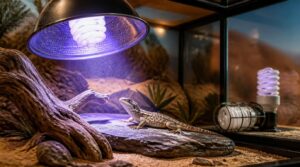
When you mount Compact Fluorescent UVB Bulbs in small enclosures for Ferguson Zone 1-2 species, target 8-12 inch basking distances within the 290-320 nm range.
UVB output degradation sets in near 6,000 hours, so consistently schedule UVB bulb replacement every 6 months.
Keeping fixtures within 20 cm sustains UVB lighting efficiency; observe UVB lighting safety protocols when discarding cracked units.
Mercury Vapor Combination Bulbs
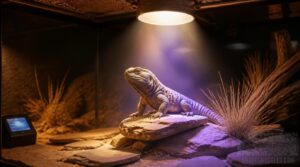
Mercury Vapor Combination Bulbs consolidate heat, visible light, and UVB into a single 100-160 watt source, generating UV Index readings of 4.0-8.0 at 30-45 cm, which suits Ferguson Zone 3-4 species like Uromastyx acanthinura far better than compact fluorescents.
Because warm-up demands several minutes before full 290-320 nm output, you must factor that startup lag directly into your photoperiod timing.
LED UVB System Performance
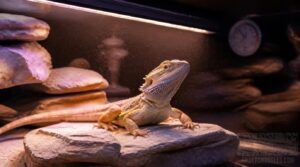
LED UVB technology has matured considerably, but output consistency remains the critical variable you need to control.
Most quality systems emit in the 290 to 315 nm range, delivering measurable UVI at basking height, though drive current and thermal management directly determine whether that output holds stable across a full 12-hour photoperiod or degrades quietly within the first year.
Reflector Efficiency and Coverage
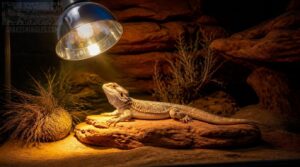
The geometry of your UVB lighting reflector determines whether irradiance reaches the basking zone at functional UVI or dissipates against walls.
Parabolic designs improve UVB reflector efficiency by up to 20 percent, tightening beam focus.
UVB lighting distance, UVB lighting angle, and UVB lighting coverage shift with curvature, so 5 degrees of lateral misalignment drops central irradiance by 15 percent.
Top 10 UVB Lighting Systems for Desert Species
With desert species demanding precision across Ferguson Zones 3 and 4, choosing the wrong UVB system isn’t just a minor inconvenience — it’s a physiological risk you can’t afford.
Each option below has been evaluated for spectral output, UVI range at basking distance, and real-world performance in arid-species enclosures. Here are the ten UVB lighting systems worth your serious consideration.
1. Zoo Med Desert UVB Lighting Kit
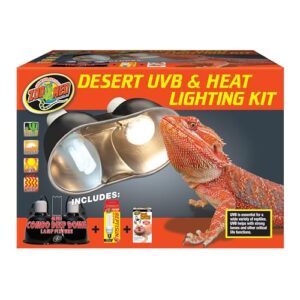
The Zoo Med Desert UVB Lighting Kit (LF-31) pairs a 13W ReptiSun 10.0 UVB compact fluorescent with a 75-watt Repti Basking Spot Lamp through dual ceramic sockets, each rated to 160 watts, in a fixture sized for smaller desert terrariums housing Pogona vitticeps or testudines.
The dual on/off switches let you control heat and UVB independently, which matters when calibrating photoperiods precisely.
One caution: CFL output degrades roughly 40% within six months, so monthly Solarmeter 6.5 verification at basking height is non-negotiable.
| Best For | Reptile owners housing bearded dragons, turtles, or similar desert species in smaller terrariums who need reliable basking heat and UVB light in a single, easy-to-control setup. |
|---|---|
| UVB Output | 10% (ReptiSun 10.0) |
| Wattage | 13W UVB + 75W basking |
| Lamp Type | CFL |
| Replacement Interval | 6 months |
| Target Species | Bearded dragons, turtles |
| Integrated Heat | Yes (75W basking lamp) |
| Additional Features |
|
- Dual independent switches let you control the heat and UVB lamps separately, making it easy to fine-tune your reptile’s light and heat schedule
- Comes with everything you need out of the box — a 75W basking bulb and 13W ReptiSun 10.0 UVB compact fluorescent included
- Ceramic sockets rated up to 160W give you room to upgrade to higher-wattage bulbs if needed
- The UVB bulb can fail early and CFL output degrades over time, so you’ll likely need a replacement sooner than expected
- Heat output may fall short in larger enclosures or rooms that run cool
- The fixture’s compact size may not accommodate certain bulb types or fit every tank configuration without some workarounds
2. Reptile Systems T5 Desert UVB Lamp
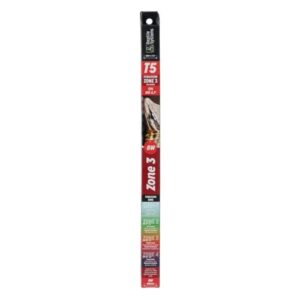
Where compact fluorescents fall short in deeper setups, the Reptile Systems T5 Desert UVB Lamp steps in. At 24 watts with 12% UVB output, this T5 HO tube sustains Ferguson Zone 3 UV Index readings between 4.0 and 6.0 at 12-18 inches, which covers exactly the photobiological window that Pogona vitticeps and Uromastyx spp. need for previtamin D3 synthesis across the 290-315 nm spectrum.
The curved reflector concentrates UVB into the basking zone rather than scattering it laterally, so you’re not losing output to enclosure walls. Because this lamp generates no heat, a separate heat source is required for proper thermoregulation. The included UVA spectrum helps with color distinction and natural feeding behavior throughout its full rated lifespan.
| Best For | Bearded dragons, uromastyx, and other desert baskers in enclosures over 24 inches |
|---|---|
| UVB Output | 12% (Ferguson Zone 3) |
| Wattage | 24W |
| Type | T5 HO fluorescent |
| Brand | Aquarium Systems |
| Best For | Bearded dragons, uromastyx, and other desert-dwelling reptiles that need strong, consistent UVB exposure in enclosures deeper than 24 inches. |
|---|---|
| UVB Output | 12% |
| Wattage | 24W |
| Lamp Type | T5 HO fluorescent |
| Replacement Interval | 6–12 months |
| Target Species | Bearded dragons, uromastyx |
| Integrated Heat | No |
| Additional Features |
|
- Delivers 12% UVB output tuned for Ferguson Zone 3, making it ideal for reptiles that need high UV levels to synthesize vitamin D3 and support healthy bone development.
- The T5 HO format produces more consistent illumination across larger enclosures compared to compact fluorescents, with stable output over its full lifespan.
- Full-spectrum UVA alongside UVB supports natural behavior, better color perception, and healthier feeding responses in desert species.
- Requires a compatible T5 fixture to operate — it won’t work as a standalone bulb without the right hardware.
- UVB output degrades over time, so you’ll need to replace it every 6–12 months even if it still appears to light up normally.
- Produces no heat, so a separate basking lamp or ceramic heat emitter is still needed for proper thermoregulation.
3. Repti Zoo T5 UVB Lighting Kit
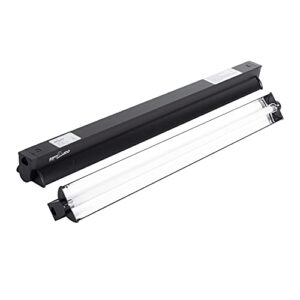
Where the Reptile Systems lamp prioritizes spectral purity, the Repti Zoo T5 UVB Lighting Kit competes directly on output while bringing the price point down considerably for keepers outfitting medium to large enclosures.
Available in 24W, 39W, and 54W configurations for setups spanning 24 to 48 inches, the kit pairs a Desert 10.0 T5 lamp with a polished curved reflector that concentrates UVB flux directly at the basking zone, rather than dispersing it laterally toward enclosure walls. That reflector geometry can boost effective UVB delivery by 30–70% compared to open fixtures, which matters when you’re targeting Ferguson Zone 3–4 UVI readings for Pogona vitticeps or Uromastyx spp. requiring previtamin D3 synthesis across the 290–315 nm range.
The low-profile, ETL-certified fixture includes a removable power cable with an on/off switch, making installation over mesh enclosures straightforward. Schedule annual bulb replacement to maintain biologically effective UVB output consistently.
| Best For | Bearded dragons, uromastyx, and other heliothermic desert species in 24–48 inch enclosures |
|---|---|
| UVB Output | 10.0 UVB |
| Wattage | 24W / 39W / 54W |
| Type | T5 HO fluorescent |
| Brand | REPTI ZOO |
| Replacement Interval | 12 months |
| Best For | Keepers of bearded dragons, uromastyx, and other desert reptiles who need a solid UVB solution for medium to large enclosures (24–48 inches) without breaking the bank. |
|---|---|
| UVB Output | 10% (Desert 10.0) |
| Wattage | 24W / 39W / 54W |
| Lamp Type | T5 HO fluorescent |
| Replacement Interval | 12 months |
| Target Species | Bearded dragons, uromastyx |
| Integrated Heat | No |
| Additional Features |
|
- The polished curved reflector focuses UVB output directly at the basking zone, making it noticeably more efficient than open fixtures
- Available in three wattages (24W, 39W, 54W), so you can match the kit to your exact enclosure size
- Easy to install with a low-profile design, removable power cable, and a handy on/off switch
- Multiple users have reported bulbs burning out within just a few weeks, raising reliability concerns
- UVB output can be inconsistent, which is a real problem when your reptile’s health depends on adequate exposure
- The actual input voltage (100–120V) doesn’t match the advertised 110–220V range, so international keepers will need a step-down transformer
4. Zilla Reptile UVB Light Bulb
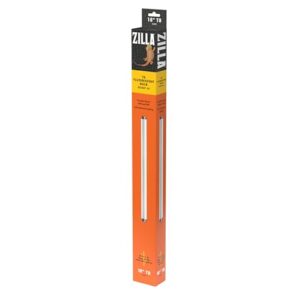
Where the Repti Zoo kit demands a dedicated strip housing, the Zilla UVB Light Bulb fits into fixtures you likely already own, making it a natural choice for keepers prioritizing accessibility over raw output.
At 15 watts in T8 format, it emits across the biologically active 280–315 nm range, supporting vitamin D3 synthesis in Pogona vitticeps, Uromastyx aegyptia, and comparably heliothermic desert taxa. The Desert 50 output aligns with Ferguson Zone 3 UVI parameters, suitable for moderate-exposure species rather than the high-sun demands of obligate baskers.
It integrates with standard dome housings and Zilla’s own strip fixtures, keeping installation uncomplicated. UVB output declines faster than visible light due to phosphor degradation, so schedule annual replacement at the 12-month mark regardless of apparent luminance.
| Best For | Desert reptiles requiring moderate UVB, including bearded dragons |
|---|---|
| UVB Output | Desert 50 (T8) |
| Wattage | 15W |
| Light Type | Fluorescent T8 |
| Brand | Zilla |
| Replacement Interval | 12 months |
| Best For | Reptile keepers with existing T8 fixtures who need a straightforward UVB bulb for desert species like bearded dragons without investing in new housing. |
|---|---|
| UVB Output | Desert 50 (T8) |
| Wattage | 15W |
| Lamp Type | T8 fluorescent |
| Replacement Interval | 12 months |
| Target Species | Bearded dragons, leopard geckos |
| Integrated Heat | No |
| Additional Features |
|
- Works with fixtures you likely already own, including standard dome housings and Zilla strip lights
- Available in Tropical 25 and Desert 50 outputs so you can match the bulb to your species’ actual needs
- Supports vitamin D3 synthesis and calcium metabolism, which are essential for long-term reptile health
- UVB output degrades over time, requiring replacement every 12 months even if the bulb still visibly lights up
- Some users have reported early burnout or flickering within just a few weeks of use
- May fall short for larger enclosures, potentially requiring additional lighting to ensure full UVB coverage
5. T5 Ho Uvb Reptile Light Fixture
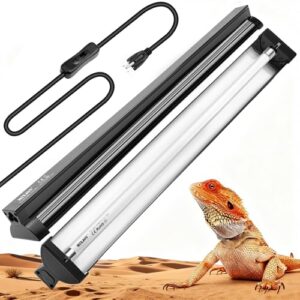
The MIXJOY T5 HO fixture pairs a 24-watt linear tube emitting ten percent UVB with a 95%-reflective aluminum reflector that concentrates photon flux directly onto your basking zone, establishing UV Index values consistent with Ferguson Zone 3 demands at twelve to eighteen inches.
That geometry matters for species like Pogona vitticeps and Uromastyx aegyptia, where previtamin D3 photoisomerization depends on UVB reaching the 280–315 nm range without attenuation. Don’t place this lamp above glass or acrylic, since barriers of that kind block up to sixty percent of biologically active wavelengths.
Three mounting configurations accommodate wooden enclosures, open-top setups, and mesh-lidded terrariums. The flame-retardant aluminum housing controls sustained thermal cycling, and smart plug compatibility lets you automate photoperiod cycling with precision.
Durability reports from the field are mixed, so verify your UVB output monthly with a Solarmeter 6.5 at basking height rather than assuming stable emission.
| Best For | Desert reptiles, including bearded dragons, tortoises, iguanas, and uromastyx |
|---|---|
| UVB Output | 10% UVB, 30% UVA (Desert 10.0) |
| Wattage | 24 watts |
| Light Type | Fluorescent T5 HO |
| Brand | MIXJOY |
| Replacement Interval | 12 months (T5 standard) |
| Additional Features | 95%+ reflective aluminum reflector, flame-retardant housing, three mounting options |
| Best For | Desert reptile owners keeping bearded dragons, tortoises, iguanas, uromastyx, or chameleons who need reliable UVB lighting to support healthy bone development and natural behaviors. |
|---|---|
| UVB Output | 10% |
| Wattage | 24W |
| Lamp Type | T5 HO fluorescent |
| Replacement Interval | 12 months |
| Target Species | Bearded dragons, tortoises, iguanas |
| Integrated Heat | No |
| Additional Features |
|
- The 95% reflective aluminum reflector focuses UVB output directly onto the basking zone, making the most of the 10% UVB and 30% UVA spectrum at 12–18 inches.
- Three mounting options give you flexibility whether you’re working with a wooden enclosure, open-top setup, or mesh-lidded terrarium.
- Smart plug compatibility makes it easy to automate day/night photoperiod cycles without any extra hassle.
- Durability is a real concern — some units fail within a day of use, and there are reports of no light output even with brand-new bulbs.
- Customer service responsiveness has been flagged as lacking, which is frustrating if you do end up with a defective unit.
- UVB can’t pass through glass or acrylic, so placement options are limited to open or mesh-top enclosures only.
6. Lucky Herp Reptile Uvb Light Bulb
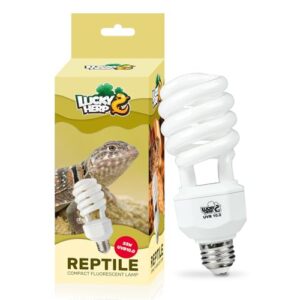
For keepers working with smaller enclosures, the Lucky Herp 23-watt CFL occupies a practical niche at a fraction of the cost of linear T5 systems. Operating through a standard E26 screw base at 120V, it delivers ten percent UVB output spanning wavelengths between 290 and 320 nanometers, with a color rendering index of ninety that helps with accurate reptile health monitoring.
At eight to twelve inches, you’ll read UV Index values of 2.5 to 4.0 at basking height, adequate for Eublepharis macularius and juvenile Pogona vitticeps but insufficient for high-sun species like Uromastyx geyri, which require Ferguson Zone 4 exposure. Phosphor degradation is the critical limitation here. CFL designs lose roughly forty percent of their UVB output within six months, so replace every six to twelve months and verify output monthly with a Solarmeter 6.5.
| Best For | Small to medium desert enclosures housing bearded dragons, leopard geckos, and tortoises |
|---|---|
| UVB Output | 10% UVB, 30% UVA |
| Wattage | 23 watts |
| Light Type | CFL (E26) |
| Brand | Lucky Herp |
| Replacement Interval | 6-12 months |
| Additional Features | 90 CRI, standard E26 base, 120V compatibility |
| Best For | Keepers of small to medium desert enclosures housing bearded dragons, leopard geckos, and tortoises who want an affordable UVB solution without the cost of a full T5 linear system. |
|---|---|
| UVB Output | 10% |
| Wattage | 23W |
| Lamp Type | CFL (E26) |
| Replacement Interval | 6–12 months |
| Target Species | Bearded dragons, leopard geckos, tortoises |
| Integrated Heat | No |
| Additional Features |
|
- Delivers 10% UVB and 30% UVA output through a standard E26 screw base, making it easy to install in most fixtures without any special hardware
- High 90 CRI means you can accurately observe your reptile’s colors and spot health issues more easily
- Cost-effective alternative to T5 tube setups for smaller enclosures, with a lifespan of up to 12 months before significant UVB degradation
- Some users report premature bulb failure within just days or weeks of use, making reliability a concern
- UVB output drops significantly over time—roughly 40% within six months—requiring regular monitoring with a UV meter and replacement every 6–12 months
- Not compatible with 220V systems without a voltage converter, and performance can suffer in dual-light fixtures due to heat buildup from nearby bulbs
7. Repti Zoo UVB Desert Reptile Lamp
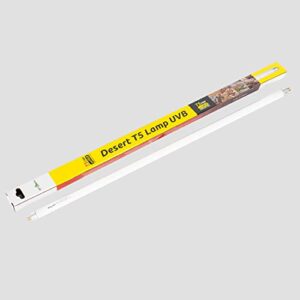
Budget-conscious desert keepers often assume that affordable means compromised spectral performance, but the Repti Zoo 24-watt T5 HO challenges that assumption directly.
Emitting UVB across the 295-310 nanometer range, this 22-inch tube generates UV Index values between 3.8 and 6.2 at basking distances of 10 to 14 inches when paired with the compatible REPTI ZOO AT28 reflector hood, placing it squarely within Ferguson Zone 3 to 4 requirements for Pogona vitticeps and Eublepharis macularius. That range actively helps with calcium homeostasis, reproductive stimulation, and sustained appetite, making it a competent solution for 24-inch desert enclosures housing juvenile to adult specimens.
One practical caveat: phosphor degradation strips UVB output below biologically effective thresholds considerably faster than visible light fades, so mark your calendar for scheduled replacement at the eight-month mark, not twelve.
| Best For | Desert reptile owners needing affordable UVB for 24-inch enclosures |
|---|---|
| UVB Output | 10.0 UVB |
| Wattage | 24 watts |
| Light Type | T5 HO Fluorescent |
| Brand | REPTI ZOO |
| Replacement Interval | 8 months |
| Additional Features | Prevents metabolic bone disease, stimulates reproduction, AT28 compatible |
| Best For | Desert reptile owners who want reliable UVB coverage for 24-inch enclosures without overspending, especially those keeping leopard geckos or bearded dragons. |
|---|---|
| UVB Output | 10% (10.0 UVB) |
| Wattage | 24W |
| Lamp Type | T5 HO fluorescent |
| Replacement Interval | 8 months |
| Target Species | Bearded dragons, leopard geckos |
| Integrated Heat | No |
| Additional Features |
|
- Delivers UVB output in the Ferguson Zone 3–4 range, supporting calcium absorption, appetite, and reproductive health in desert species
- Pairs seamlessly with the REPTI ZOO AT28 reflector hood for optimized light distribution
- Available in multiple wattages (24W, 39W, 54W) to fit different enclosure sizes
- UVB output degrades significantly by the 8-month mark, requiring more frequent replacement than some competing bulbs
- Some users report bulbs failing before the one-year mark, raising durability concerns
- Warranty claims can be denied if purchased through certain retailers like Amazon due to fragile-item return policy restrictions
8. Reptile UVB Light Fixture
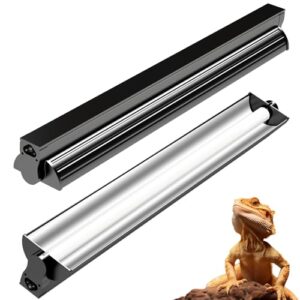
The REPTIDLDB fixture scales from an 8-watt, 12-inch configuration to a 54-watt, 46-inch tube, letting you match lamp length precisely to enclosure dimensions for species ranging from juvenile Eublepharis macularius to adult Uromastyx ornata. Emitting 10% UVB, its alloy reflective layer directs spectral output downward with high efficiency, partially offsetting the 30-45% mesh attenuation typical of screen-topped enclosures. The T5 HO electronic ballast maintains stable, flicker-free operation, and the replaceable bulb design means you won’t need to swap the entire fixture when output eventually degrades.
| Best For | Desert reptile owners needing adjustable UVB coverage across multiple enclosure sizes |
|---|---|
| UVB Output | 10.0 UVB (10% UVB, 30% UVA) |
| Wattage | 8W (12"), 24W (22"), 39W (34"), 54W (46") |
| Light Type | T5 HO Fluorescent |
| Target Species | Multiple desert reptiles |
| Brand | REPTIDLDB |
| Replacement Interval | Not specified |
| Additional Features | Alloy reflective layer, multiple size options, space-saving design |
| Best For | Reptile owners who need flexible UVB lighting that can scale with different enclosure sizes, from small juvenile setups to large adult habitats. |
|---|---|
| UVB Output | 10% |
| Wattage | 8W–54W (4 sizes) |
| Lamp Type | T5 HO fluorescent |
| Replacement Interval | Not specified |
| Target Species | Multiple desert reptiles |
| Integrated Heat | No |
| Additional Features |
|
- Comes in four sizes (12" to 46") so you can match the fixture to your specific enclosure without guessing
- The alloy reflective layer pushes more UVB downward, helping offset the natural loss that happens through wire mesh lids
- Replaceable bulb design saves money long-term — you swap just the bulb, not the whole fixture, when output starts to fade
- UVB output degrades over time even when the bulb still looks bright, so you’ll need to track replacement intervals carefully
- Won’t work through glass or plastic tank lids, which block UVB rays entirely
- The larger 34" and 46" options may simply be too big for smaller or compact enclosures
9. Haceryc Reptile UVB Light Fixture
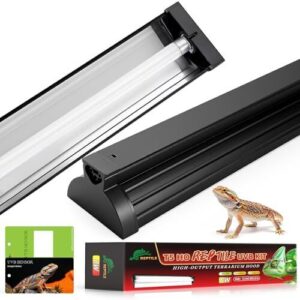
The Haceryc fixture brings together an 8-watt T5 HO tube emitting 10% UVB and 30% UVA alongside a thermally conductive aluminum alloy housing that dissipates heat more efficiently than plastic alternatives, and maintains stable operating temperatures throughout continuous daily use. Its polished curved reflector redirects up to 95% of emitted radiation downward, ensuring Pogona vitticeps or Uromastyx aegyptia basking 12 to 18 inches below the tube receive UV Index readings between 4.0 and 6.0, consistent with Ferguson Zone 3 requirements.
What distinguishes this unit is the included UVB test sensor card, reusable up to 500 times, confirming adequate output in under 10 seconds at basking height. That’s immediate verification without needing a Solarmeter. One honest caveat: multiple users report the housing is notoriously tricky to reassemble after bulb replacement, so approach each annual swap carefully.
| Best For | Reptile owners maintaining Pogona vitticeps or Uromastyx aegyptia in standard 12-inch enclosures requiring Ferguson Zone 3 UVB output |
|---|---|
| UVB Output | 10% UVB, 30% UVA |
| Wattage | 8W |
| Light Type | T5 HO Fluorescent |
| Target Species | Desert reptiles and amphibians |
| Brand | Haceryc |
| Replacement Interval | 12 months |
| Additional Features | UVB test sensor card (500 uses), polished curved reflector, 5.9-ft power cord with on/off switch |
| Best For | Reptile owners—especially those keeping bearded dragons or iguanas—who need reliable UVB lighting that supports healthy calcium metabolism and natural basking behavior in indoor enclosures. |
|---|---|
| UVB Output | 10% |
| Wattage | 8W |
| Lamp Type | T5 HO fluorescent |
| Replacement Interval | 12 months |
| Target Species | Bearded dragons, iguanas |
| Integrated Heat | No |
| Additional Features |
|
- Delivers proper UVB and UVA output to support vitamin D3 synthesis and bone health in desert reptiles
- Compatible with standard T5 UVB replacement bulbs, making future maintenance straightforward
- White finish housing is designed to blend well with front-opening reptile enclosures
- Housing is notoriously difficult to reassemble after bulb replacement, which can make annual swaps frustrating
- May need extra care or moisture protection if used in more humid reptile setups
- Reassembly may require tools or careful handling, adding hassle to routine upkeep
10. Reptile UVB Light Bulb
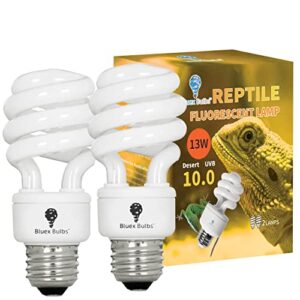
Screwing this 23-watt compact fluorescent into any standard E26 dome fixture gives Pogona vitticeps, Testudo hermanni, and related heliophilic taxa access to 280-315 nanometer UVB wavelengths required for endogenous cholecalciferol synthesis, with placement 12-18 inches above the basking zone generating UV Index readings within Ferguson Zone 3 parameters.
The manufacturer rates this bulb at 10,000 operational hours, and it ships in a two-pack, which is practical when you consider the reliability issues documented by keepers. Premature burnout within days or weeks, flickering under load, and reports of abnormal heat output point to significant unit-to-unit variance that can’t be ignored.
That inconsistency matters when calcium homeostasis depends on stable, consistent spectral output. If you select this bulb, monthly Solarmeter 6.5 verification at basking height isn’t optional. It’s the only reliable way to catch photobiological degradation before serious metabolic consequences emerge.
| Best For | Reptile owners managing Pogona vitticeps, tortoises, and desert lizards requiring consistent UVA and UVB support |
|---|---|
| UVB Output | 10% UVB |
| Wattage | 23W |
| Light Type | CFL E26 |
| Target Species | Desert reptiles |
| Brand | Bluex Bulbs |
| Replacement Interval | 6-12 months |
| Additional Features | 2-pack bundle, rated 10,000-hour lifespan, screened terrarium compatible |
| Best For | Reptile owners keeping bearded dragons, tortoises, and other desert-dwelling lizards that need reliable UVA and UVB exposure for healthy bone development and natural behavior. |
|---|---|
| UVB Output | 10% (10.0 rating) |
| Wattage | 23W |
| Lamp Type | CFL (E26) |
| Replacement Interval | Up to 10,000 hours |
| Target Species | Bearded dragons, tortoises, desert lizards |
| Integrated Heat | No |
| Additional Features |
|
- Delivers 10% UVB output, making it suitable for desert reptiles with high UV demands
- Fits any standard E26 dome fixture and comes in a convenient 2-pack
- Rated for up to 10,000 hours with no harmful UVC emissions
- Multiple users report premature burnout, with some bulbs failing within days or weeks of use
- Flickering and abnormal heat output have been documented across different units
- Significant unit-to-unit variance makes long-term reliability unpredictable
Choosing The Right Desert UVB System
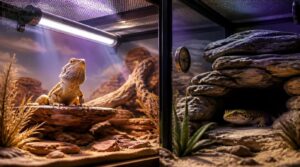
Picking the right UVB system isn’t just about wattage—it’s about matching your specific species, enclosure dimensions, and setup constraints to a light that actually delivers biologically effective UV at basking distance.
A bearded dragon (Pogona vitticeps) demanding a UVI of 4.0–6.0 has fundamentally different requirements than a leopard gecko thriving at 0.5–1.5, and your fixture choice needs to reflect that.
Here’s what to weigh before committing to a system.
Species-specific UV Index Needs
When Pogona vitticeps occupies Ferguson Zone 3-4, your lamp must deliver UVI 4-6 at the basking zone, which usually requires Solarmeter 6.5 readings between 30 and 50 at a UVB lighting height of 30 to 45 centimeters.
Uromastyx ornata, a relentless Zone 4 basker, demands the upper end. Miss that target either way, and you’re risking metabolic bone disease or acute photokeratitis.
Enclosure Size and Lamp Coverage
Once you’ve nailed target UVI for your species, enclosure geometry is next. A T5 HO tube covers roughly 12 by 24 inches at 12 inches; a 120-centimeter tank needs two.
- Match lamp length to 2.5x enclosure linear distance
- Keep UVB lighting height at 25-45 centimeters above the basking zone
- Angle fixtures to overlap basking and retreat zones
- Use reflectors to gain up to 30 percent more coverage
Mesh, Glass, and Plastic Barriers
Your barrier material cuts UVI more than most keepers expect.
Mesh screens reduce UVB transmission by 30 to 50 percent, meaning target UVI readings of 3 to 5 at basking height require a lower lamp position or reflector adjustment.
Glass and solid plastic panels block 290 to 320 nanometer UVB spectrum almost entirely, so open-top or mesh-screen enclosures are non-negotiable.
Heat Output and Fixture Compatibility
Once barriers are calibrated, heat output demands equal attention. High-output T5 UVB lighting systems raise basking zones by 2 to 6°F.
- Aluminum heat sinks dissipate thermal load better than plastic housings
- Ventilated hoods cut ambient enclosure heat buildup
- Ballast compatibility prevents T5 HO fixture hotspots
- UVB lighting wattage alignment avoids overheated corners
- Aging lamps shift heat output unpredictably without replacement
Energy Costs and Bulb Lifespan
Because operating expense accumulates quietly, you should compare UVB lighting wattage with verified output at the basking surface, not bulb price alone. A 10-watt LED may cost roughly $1–$4 annually in continuous use, while 24–54-watt T5 HO systems cost more but offer broad coverage.
Track UVB bulb lifespan: replace T5 tubes near 12 months, clean reflectors monthly, and verify UVB lighting performance with a Solarmeter.
UVB Installation, Monitoring, and Maintenance
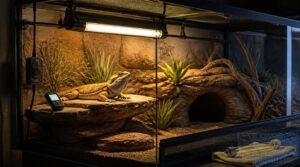
Even the best UVB system fails if mounting height, basking alignment, and access to shade are wrong.
You’ll need to verify UVI at the animal’s actual basking height, then maintain the fixture before output declines.
Use the following setup points to build a reliable, species-appropriate enclosure.
Basking Distance and Lamp Height
Set UVB lighting distance from the lamp face to the animal’s highest basking surface, beginning at 10 to 15 inches, or 25 to 38 cm, for most high-output T5 systems.
In an 18-inch terrarium, maintain UVB lighting height near 12 to 14 inches, then verify basking zone UVI levels and temperature with meters. As distance increases, UVB irradiance falls sharply, so adjust in small increments.
UV Gradients and Shaded Retreats
Because desert reptiles regulate exposure behaviorally, build a UVB gradient rather than flooding every square centimeter with uniform irradiance. Position UVB lighting fixtures so basking zone UVI levels taper predictably toward shaded zones, allowing Pogona vitticeps or Uromastyx spp. to select lower UV Index microhabitats.
Use dense, opaque-roofed hides beside accessible daylight corridors, and check reflective walls for secondary pockets.
Aligning UVB With Basking Heat
Heat and UVB must overlap where your lizard chooses to bask; otherwise, thermoregulation and vitamin-D3 synthesis become separate behaviors. Align linear UVB lighting systems parallel to the basking branch, with a 20–30° UVB lighting angle and heat lamp offset slightly.
Align heat and UVB at the basking site so reptiles can thermoregulate while producing vitamin D3
- Keep both beams accessible.
- Prevent lamp shadowing.
- Preserve escape routes.
- Target UV Index readings between 3.0–5.0.
- Maintain natural basking behavior.
Solarmeter Testing at Basking Height
At the animal’s dorsal plane, UVB testing at basking height tells you what a basking Pogona vitticeps actually receives, rather than what the fixture advertises. Hold a Solarmeter 5R perpendicular to lamp output at the perch, and record UV Index readings between 3.0–5.0 across the basking zone.
Repeat UVB metering after fixture repositioning; distance changes reshape basking behavior.
Cleaning and Replacement Schedules
With UVB, invisible decline begins long before a lamp fails. Perform weekly UVB lighting maintenance: remove dust from fixtures, wipe lenses with damp microfiber cloth, inspect reflectors, and log sessions. Use a lint-free microfiber cloth to lift dust without scratching lenses or leaving residue that could reduce UVB output.
For UVB lighting testing, use UVB metering monthly at basking height. Your UVB replacement schedule follows measured output, while bulb replacement schedules should occur when readings fall below UVI.
Frequently Asked Questions (FAQs)
What is the best UVB light for reptiles?
Like a solar runway, T5 high-output fluorescent systems are best for most reptiles: for bearded dragons, select UVB lighting systems delivering UV Index readings between 0–0 at basking height, then adjust for species-specific UVB requirements.
Is a basking light the same as an UVB light?
No. A basking light generates heat at the basking zone for thermoregulation, while a UVB lamp emits ultraviolet wavelengths that drive vitamin D3 synthesis, so you’ll need both to cover your desert reptile’s physiological requirements.
Where can I buy UVB light?
Chewy, Amazon, and manufacturer-direct sites carry the Zoo Med Desert UVB Lighting Kit, Reptile Systems T5 Desert UVB Lamp, and Repti Zoo T5 UVB Lighting Kit, with official datasheets and basking distance specifications included.
How far should UVB light be from tortoise?
For most desert tortoises, position your UVB lamp 10 to 20 inches (25 to 50 cm) above the basking surface, targeting a UVI of 5 to 5 measured directly at shell height.
What is the difference between tropical and desert UVB bulbs?
Think of it as Saharan midday sun versus filtered rainforest canopy light. Desert UVB bulbs push 10 to 12 percent output, penetrating beyond 20 inches, while tropical bulbs cap near 5 percent for shade-adapted species.
Is too much UVB bad for reptiles?
Yes, excessive UVB exposure can trigger photokeratoconjunctivitis, dermal burns, and disrupted calcium metabolism in captive reptiles, particularly when UVB intensity surpasses the species’ natural tolerance threshold or when inadequate shaded retreats prevent effective behavioral modulation.
Can I use UVB lighting through glass or mesh?
UVB through glass is effectively zero, since glass absorbs radiation below 320 nm. UVB mesh screening cuts transmission by up to 50%, so position your UVB lamp placement to maintain target UVI at basking height.
How do I measure actual UVB output at home?
A Solarmeter 5 held perpendicular at the exact basking height functions as your UV Index meter, verifying actual UVI against Ferguson Zone targets for your species rather than accepting manufacturer distance claims at face value.
Do nocturnal desert species need UVB lighting too?
Even creatures of the night still carry the sun’s chemistry deep in their bones. Nocturnal desert species require low-level UVB exposure during twilight windows to sustain vitamin D3 synthesis and guard against metabolic bone disease.
Whats the difference between UVB and UVA lighting?
The two UV bands serve entirely different biological functions. UVA spans 315 to 400 nanometers, governing color perception and behavior, while UVB at 280 to 315 nanometers drives vitamin D3 synthesis and calcium absorption.
Conclusion
A craftsman never blames his tools, but a keeper who can’t read a Solarmeter accurately at dorsal basking height has already lost the argument before it even starts.
The right uvb lighting systems for desert species deliver confirmed UVI 3.0–5.0, not raw wattage or visible brightness. Replace bulbs on a strict six-month schedule. Account for mesh attenuation.
Your animal’s calcium metabolism won’t wait for convenience, and this shortlist leaves you with absolutely no valid excuse.