This site is supported by our readers. We may earn a commission, at no cost to you, if you purchase through links.

Captive reptiles denied proper hiding spots exhibit stress-induced immunosuppression within 72 hours—yet most keepers still underestimate the biological non-negotiability of concealment. Your ball python coiled in the open corner isn’t “getting comfortable with you”; it’s experiencing chronic cortisol elevation that compounds into respiratory infections, feeding refusals, and shortened lifespans.
What makes a good reptile hiding spot isn’t aesthetic or optional—it’s a physiological requirement rooted in millions of years of predator-avoidance evolution. The difference between a decorative cave and a functional refuge lies in precise dimensional ratios (body length to entrance diameter), material thermal conductivity, and placement relative to your enclosure’s microclimatic zones.
Get these variables wrong and you’re not just missing enrichment points—you’re actively undermining cardiovascular regulation, immune function, and behavioral stability in an animal hardwired to associate visibility with mortality.
Table Of Contents
Key Takeaways
- Reptiles denied proper hiding spots develop stress-induced immunosuppression within 72 hours, leading to respiratory infections, feeding refusals, and shortened lifespans—hiding isn’t optional enrichment but a biological necessity rooted in predator-avoidance evolution.
- Effective hides require precise dimensional ratios (entrance openings 1.5-2 times body width, internal space allowing full coiling with wall contact, ceiling height 1.5-2 times body thickness) and must be positioned strategically across thermal gradients to enable self-directed thermoregulation without exposure.
- Materials matter critically—non-porous, formaldehyde-free options like food-grade HDPE, glazed ceramic, or CARB Phase 2-compliant wood prevent toxin leaching and bacterial colonization while maintaining structural integrity under basking-zone heat (90-100°F).
- Proper hide placement reduces measurable stress indicators by 20-35%, stabilizing cortisol levels that directly impact immune function, cardiovascular regulation, feeding response, and shedding cycles—making hide design a cornerstone of preventative reptile health care.
What Makes a Good Reptile Hiding Spot?
Your reptile’s hide isn’t just décor—it’s a functional tool that determines whether your animal thrives or merely survives in captivity. A well-designed hiding spot reduces stress by 20-35%, helps immune function, and triggers natural behaviors that captive reptiles would otherwise suppress.
Choosing the right type, size, and placement of reptile hiding places can mean the difference between a reptile that eats consistently and one that refuses food for weeks.
A well-designed hide isn’t decorative—it’s the difference between a reptile that thrives and one that merely survives
Understanding what separates an effective hide from a decorative rock requires examining three core elements: structural features, health impacts, and behavioral encouragement.
Key Features of Effective Hides
A well-designed reptile hide balances snugness with comfort—entrance openings sized just wide enough for voluntary retreat without sacrificing security, while internal chambers allow full coiling or curling without contact.
You’ll need non-toxic, easy-to-clean materials (BPA-free plastics, formaldehyde-free wood) that support thermal gradients and humidity control, resist tipping during exploration, and integrate seamlessly into hide boxes or DIY reptile hides across your enclosure’s warm and cool zones.
Importance for Stress Reduction and Health
Properly designed hides reduce stress indicators by 20-35%, which promotes reptile wellness in measurable ways—lower cortisol stabilizes feeding response, immune function, and shedding cycles. Stress management through therapeutic hides delivers these health benefits:
- Enhanced cardiovascular regulation (reduced heart rate, blood pressure)
- Improved sleep-wake cycles and metabolic balance
- Stronger immune resilience against pathogens
- Better mood stability and reduced anxiety-like behaviors
Environmental enrichment with strategically placed hiding spots becomes a cornerstone of long-term reptile health.
Role in Encouraging Natural Behaviors
When you provide hides that mimic naturalistic reptile environments, you trigger authentic behaviors—active foraging, exploratory activity, and climbing encouragement emerge as reptiles shuttle between cover and open zones. Thermoregulation support becomes instinctive, and social interaction flourishes in multi-hide setups.
That’s environmental enrichment for reptiles: you’re not just meeting reptile behavioral needs, you’re fostering species-specific reptile care at every turn. Providing hides is just one part of promoting overall reptile well-being through.
Essential Size and Fit Requirements
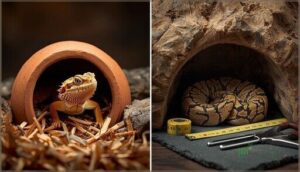
Getting the hide size right isn’t just about eyeballing it—precise measurements determine whether your reptile feels secure or stressed. The opening needs to be narrow enough to trigger that instinctive safety response, while the interior must allow natural positioning without forcing the animal into awkward contortions.
Most keepers find that understanding how many hides your snake actually needs helps them choose sizes that work across multiple locations in the enclosure.
Here’s how to dial in dimensions that balance snugness with functional comfort, accounting for species-specific needs and inevitable growth.
Snugness Vs. Comfort Balance
Finding the sweet spot between wall contact and movement space defines effective hide design for stress reduction. Your reptile should feel secure pressure on its sides—snakes especially seek this—but still shift position inside the hiding spot without scraping scales.
Hide boxes that are too roomy fail to deliver thermal comfort, while overly tight humidity hides can trap a growing animal and compromise its security balance.
Entrance and Internal Space Guidelines
You’ll want entrance openings that allow your reptile to brush both sides lightly while passing—usually 1.5-2 times body width—creating that cave-like security commercial hide boxes aim to replicate.
Internal layout must accommodate full-body coiling with walls close enough to touch, while ceiling height sits around 1.5-2 times your animal’s thickness to prevent exposed feelings.
Ventilation options through side entrances balance airflow with darkness, essential for stress-free reptile hiding places and DIY reptile hides alike. For certain species, maintaining proper humidity levels in captivity is important for overall health and well-being.
Adjusting Hide Size for Growth
Growth stage assessment drives hide box timing—plan upgrades at 3, 6, and 12 months when your animal reaches 50%, 75%, and adult dimensions respectively. Modular hide designs simplify reptile measurement tracking by allowing 20% internal space expansion over year one without full enclosure setup disruption.
Track body measurements monthly, adding 4-8 square inches per growth phase while maintaining entrance diameter at 25-40% of shoulder width.
| Growth Milestone | Hide Size Adjustment |
|---|---|
| 3 months (50% size) | Add 4 sq. in. floor area |
| 6 months (75% size) | Add 6 sq. in. floor area |
| 12 months (adult) | Add 8 sq. in. floor area |
Safe and Suitable Hide Materials
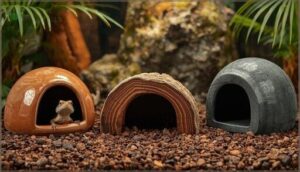
The materials you choose for reptile hides directly affect your animal’s long-term health. Non-toxic substrates prevent skin irritation, while surfaces that resist bacterial colonization reduce pathogen exposure by 10-18% compared to porous alternatives.
Formaldehyde-free wood, food-grade high-density polyethylene (HDPE), and ceramic options meet safety standards without leaching volatile organic compounds into enclosed microclimates.
Durability matters just as much as initial safety, since cracked edges or degraded coatings create injury risks that compromise both physical integrity and your reptile’s sense of security.
Non-Toxic and Easy-to-Clean Options
You want reptile hides made from chemically stable, non-porous materials—plastic, resin, or glazed ceramic—that don’t leach toxins under heat and resist bacterial colonization during hide sanitization.
Smooth surfaces on hide boxes and humidity hides allow rapid cleaning methods (warm soapy water, diluted chlorhexidine) without absorbing residues, while surface durability ensures DIY reptile hides won’t crack or splinter, keeping reptile enclosure maintenance straightforward and material safety consistent over years of use.
Formaldehyde-Free and Food-Grade Choices
Toxic material risks vanish when you select hides labeled with GREENGUARD Gold or CARB Phase 2 compliance—formaldehyde emissions drop to negligible levels, preventing respiratory irritation in enclosed terrariums.
Food-grade certifications (FDA 21 CFR equivalents) guarantee safe hide options for reptile hides, hide boxes, and humidity hides, while non-toxic finishes—water-based acrylics with zero VOCs—and eco-friendly alternatives like untreated bamboo guarantee DIY reptile hides remain chemically inert at hiding spots.
Material Durability and Safety Considerations
Edge smoothness prevents ventral-scale abrasions—sand molded seams on commercial hide boxes until no point snags skin, or apply aquarium-safe silicone over sharp ridges.
Heat resistance matters: ABS and rigid PVC reptile hides withstand basking-zone warmth (90–100°F) without warping, while low-grade plastics melt near ceramic heaters.
Structural integrity guards against cracks that trap bacteria and create jagged edges in humidity hides, so high-density materials outlast thin-walled resin in demanding reptile enclosure setups.
Strategic Placement in The Enclosure
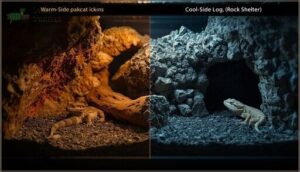
Where you position hides matters just as much as the hides themselves—improper placement can undermine thermoregulation, trigger territorial conflicts in multi-animal setups, and leave your reptile exposed when it needs refuge most.
Strategic hide distribution across temperature zones (warm side, cool side, basking gradient) allows self-directed thermal management while reducing stress indicators by 20-35% compared to single-hide configurations. The following placement strategies address thermal needs, privacy requirements, and multi-reptile dynamics to create a functional, low-stress environment.
Creating Thermal Gradients With Hides
A thermal gradient transforms your reptile habitat from a one-temperature box into an active thermoregulation arena. Place hides at both warm and cool ends so your animal can self-regulate without full exposure. Position thermal hideouts along a 10–15°F differential, with one near heat sources (85–95°F basking zone) and another in the cooler microclimate (usually 10–15°F lower at night), ensuring temperature control across the enclosure’s gradient design.
- Use infrared thermometers or probes to verify stable gradients inside and just outside hides
- Insulate hide interiors to prevent unwanted heat loss and maintain consistent microclimates
- Design entrance tunnels that allow quick transitions between warm and cool zones
- Monitor gradient stability weekly, adjusting heat sources as ambient room temperatures shift seasonally
Positioning for Security and Privacy
Beyond temperature control, your hide’s location determines whether your reptile actually uses it. Blocking the line of sight from three sides—especially by placing hide boxes against a wall—cuts visual exposure and measurably drops stress indicators like freezing and rapid tongue flicking. Traffic reduction matters: position hides away from doors, speakers, and the front glass so your animal can retreat without constant disruption. Elevated placement on mid-level ledges suits semi-arboreal species that prefer monitoring from above. Orient each hiding spot away from bright windows and hallway sightlines, using plants or backdrop panels as visual barriers that mimic natural cover.
| Placement Factor | Security Benefit |
|---|---|
| Against solid wall | Reduces rear exposure by blocking one visual angle |
| Away from front glass | Lowers alert responses to external movement |
| Under ledge or plant cover | Filters harsh overhead light and creates shade |
| Facing calmer room area | Minimizes disturbances from foot traffic and noise |
| Mid-level shelf for climbers | Matches arboreal instinct for elevated secure spots |
Adjusting hide orientation based on reptile behavior—such as watching whether your snake coils inside or only uses the entrance—helps you fine-tune each secure place for maximum stress reduction.
Placement for Multiple Reptiles
When you house multiple animals in one reptile enclosure, allocate 10–20% of floor space to individual hiding spots so territorial management reduces stress by 25–35%.
Distribute hide boxes evenly across warm and cool zones—staggered placement prevents sight-line overlap, cuts confrontation, and aids thermoregulation without crowding.
Use varied hide sizes and maintain clear escape routes between retreats to minimize territorial conflict and encourage natural reptile behavior.
Types of Hides and Their Benefits
You’ll find hides in every conceivable form—from mass-produced commercial units engineered for ease of use to handmade shelters you can customize down to the millimeter.
Each design fulfills specific physiological needs, whether that’s maintaining 85-95% relative humidity for a blue-tree monitor’s shed cycle or mimicking the crevice architecture a spiny-tailed iguana would seek in Sonoran scrubland.
Understanding the functional differences between commercial, DIY, humidity-focused, and naturalistic options lets you match your reptile’s behavioral and thermoregulatory requirements with surgical precision.
Commercial Vs. DIY Hides
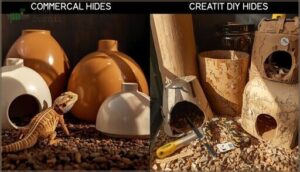
Your cost comparison between commercial hides—usually $10–40 each—and DIY hides built from storage boxes or cardboard under $10 determines budget allocation across multiple reptile enclosure setups.
DIY customization lets you sculpt entrance dimensions, tunnel length, and internal width to match species-specific body shapes more precisely than standardized small-medium-large commercial options.
However, material safety, durability tests, and aesthetic options favor branded resin or ceramic designs that resist scratching, warping, and bacterial absorption over porous DIY alternatives requiring frequent replacement.
Humidity and Naturalistic Hides
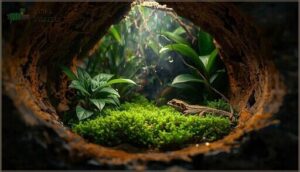
Humidity hides—usually filled with sphagnum moss or coconut fiber—trap moisture near the entrance and create humid microclimates several percentage points higher than ambient air, supporting shedding and hydration in species requiring consistent moisture retention. Naturalistic environments built from live plants, branches, and rock caves replicate wild refuges while providing vertical crevices and partial concealment that boost thermoregulation and humidity control, improving reptile comfort through authentic habitat design.
- Humid microclimates inside enclosed hides prevent rapid moisture loss, giving your reptile a stable refuge during vulnerable shedding periods
- Naturalistic reptile environments with plant cover and rocky terrain trigger innate exploration behaviors while maintaining secure retreat options
- Strategic hide placement near misting points or on the cool side reinforces moisture gradients without sacrificing thermal choice
- DIY reptile hides using food-grade containers and moss offer customizable humidity pockets at a fraction of commercial costs
Rotating and Enriching Hide Options
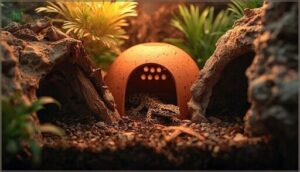
Swapping hides weekly unlocks reptile habitat enrichment by introducing fresh concealment angles, textures, and entry orientations, boosting exploration by 12–25% within 24 hours while reducing habituation stress. Rotating hides should feature adjustable vents for humidity balance, non-slip bases to prevent tipping, and smooth edges free of sharp protrusions. Combined with DIY reptile hides or commercial units, these enrichment strategies sustain behavioral flexibility and mimic seasonal shelter variability observed in wild populations.
| Feature | Function | Benefit |
|---|---|---|
| Rotating Hides | Multiple concealment profiles | Reduces boring routine stress |
| Adjustable Vents | Airflow and humidity control | Prevents stagnation, aids shedding |
| Safety Features | Smooth edges, secure locks | Eliminates injury risk during movement |
Frequently Asked Questions (FAQs)
How often should reptile hides be cleaned?
Spot cleaning your reptile hides daily removes waste and prevents pathogen buildup, while deeper sanitization every 4 to 12 weeks—depending on species and substrate moisture—keeps enclosure maintenance on track and promotes long-term reptile health.
Can you use household items as hides?
Before the age of plastic, keepers improvised clever hiding spots. You can still repurpose household items as DIY reptile hides, provided they’re sturdy, non-toxic, sanitized thoroughly, and offer secure entry points without sharp edges or chemical residues.
Do baby reptiles need smaller hide openings?
Yes—baby reptiles need smaller hide openings to minimize stress and create a snug fit that mimics natural burrow entries, usually 5–5 inches wide for hatchling hide design and small species needs.
What hide colors work best for reptiles?
Natural earth tones—browns, grays, olive greens—offer excellent color camouflage by blending with substrate and bark textures.
This reduces stress through species matching while maintaining thermal balance across your reptile habitat’s hiding spot design.
Should hides be replaced after shedding cycles?
Inspect hides after each shed cycle for cracks, warping, or moisture buildup—damaged structures harbor bacteria and irritate skin.
Replace worn options promptly to maintain security, prevent post-shed stress, and support ongoing reptile health.
Conclusion
Your gecko doesn’t care whether its hide matches your aesthetic—but its hypothalamic-pituitary-adrenal axis absolutely registers whether that cave meets dimensional, thermal, and textural specifications.
What makes a good reptile hiding spot isn’t subjective decoration; it’s quantifiable architecture that either bolsters or sabotages endocrine stability.
Measure entrance diameters, verify material conductivity, position strategically across gradients—or accept that chronic visibility stress will manifest as suppressed immunity, metabolic dysfunction, and premature mortality you could’ve prevented with a tape measure.