This site is supported by our readers. We may earn a commission, at no cost to you, if you purchase through links.
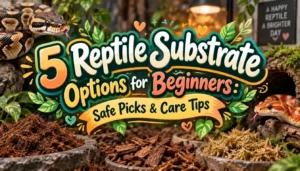
Cedar shavings look natural, smell pleasant, and sit on pet store shelves everywhere. They can also leave your snake gasping. The phenol oils inside cedar and pine irritate delicate lungs, and respiratory distress can start within days.
Your first snake’s bedding shapes its health more than most new keepers expect. Choosing reptile substrate options for beginners means matching humidity, depth, and dust levels to a ball python, corn snake, or boa, then sidestepping materials that cause impaction.
Start with the five safe picks below, and you’ll build an enclosure your snake can thrive in from day one.
Table Of Contents
- Key Takeaways
- How to Choose Reptile Substrate for Your First Snake
- 5 Beginner-Friendly Reptile Substrate Options Compared
- Matching Substrate to Corn Snake, Ball Python, and Boa Needs
- Reptile Substrate Safety: Toxic Woods, Dust, and Ingestion Risks
- Reptile Substrate Maintenance: Depth, Spot Cleaning, and Replacement Timing
- Frequently Asked Questions (FAQs)
- Where should you not touch a bearded dragon?
- What is a low maintenance reptile for beginners?
- What to use instead of substrate?
- How can I make homemade reptile substrate?
- What is the best substrate for reptiles?
- What is the easiest reptile to take care of for beginners?
- Do bearded dragons prefer sand or dirt?
- Can I mix different substrate types together?
- How does substrate choice affect feeding behavior?
- What substrate works best for baby reptiles?
- Conclusion
Key Takeaways
- Skip cedar and pine bedding entirely, because their phenol oils irritate your snake’s lungs and can cause respiratory distress within days.
- Match your substrate to your snake’s species and humidity needs, such as dry aspen for corn snakes and coconut coir or cypress mulch for ball pythons and boas.
- Start with paper towels if you’re a beginner or have a baby snake, since they’re cheap, low-dust, and carry almost no impaction risk.
- Spot clean daily and fully replace your substrate every few weeks, and change it right away if you notice mold, dampness, or a sour smell.
How to Choose Reptile Substrate for Your First Snake
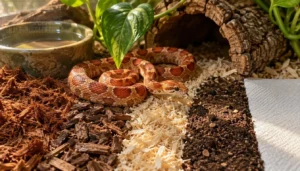
Your first snake’s bedding isn’t a minor detail, because the wrong substrate choice can cause impaction, respiratory trouble, and chronic infections. You’ll want to match it to your snake’s habitat, moisture needs, and cleaning routine before you buy anything.
If you’re weighing your options, this guide to the best substrate for a snake terrarium compares popular bedding types so you can match one to your species.
Here are the five points that will keep your setup safe and easy to manage.
Match Your Snake’s Habitat
Why does your snake’s origin matter so much? Because the wrong setup can wreck its health fast.
A ball python comes from African grasslands, so you need a dry surface with humid zones below. Your corn snake wants loose, diggable soil. Corn snakes thrive on a mix of topsoil, peat moss, sand, and clay, which mimics Southeastern U.S. soil and helps healthy shedding. Desert habitat and tropical environments demand opposite conditions, so choose species-specific substrate before anything else. Don’t guess. Research first.
Compare Beginner Substrate Options
Once you know your snake’s origin, you can run a quick reptile substrate comparison. Paper towels and newspaper cost under $5, install in minutes, and carry almost no impaction risk.
Aspen shavings and coconut coir run $10-20 per bag, but you’ll replace them every 2-3 months.
Reptile carpet costs more upfront, yet it lasts 6-12 months with rinsing.
Manage Moisture And Depth
Cheap bedding still fails if you ignore moisture, so set it up carefully.
- Pour 3 to 4 inches of substrate depth for corn snakes.
- Keep the top dry and the lower layer slightly damp.
- Track humidity control with a digital gauge daily.
- Remove wet clumps fast to lower impaction risk and mold.
Good moisture control matters most with bioactive substrates.
Keeping humidity within the right range helps the microfauna and plants thrive, so it’s worth reading up on ideal snake tank humidity levels before you set up your enclosure.
Avoid Unsafe Bedding
Wet clumps and mold are only part of the danger, because the wrong bedding can hurt your snake before moisture ever becomes a problem. Skip cedar and pine. Their toxic phenol oils can cause respiratory distress.
Avoid crushed walnut shells, calcium sand, and gravel too. Sharp or loose bits raise your impaction risk, and fine dust harms dust and respiratory health.
Plan Cleaning And Replacement
Waste builds fast, so commit to daily spotcleaning and scoop soiled substrate, uneaten food, and shed skin immediately. Don’t wait.
Substrate replacement depends on your bedding. Paper needs daily changes, aspen needs full replacement every three to four weeks, and bark needs it every few weeks.
Build full replacement schedules around your snake’s waste, then adjust cleaning frequency for odors.
5 Beginner-Friendly Reptile Substrate Options Compared
Your snake’s bedding decides whether it thrives or struggles with shedding, breathing, and stress from day one. Here are five beginner-friendly substrate options you can trust, and I’ll show you how they compare. Pick the one that fits your setup, and you’ll avoid the costly mistakes most first-time keepers make.
Paper Towels and Unprinted Newspaper
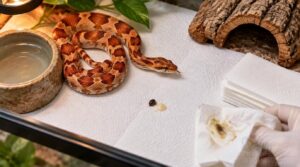
Your snake’s health problems start showing in the substrate first. Paper towels make beginner reptile care simple, because you’ll spot trouble fast:
- Feces and urates stand out on white.
- Mites show up clearly.
- Soiled sheets come out in seconds.
- Prey stays visible, supporting impaction prevention.
Skip printed newspaper. Unprinted paperbased bedding works, too. Replace soaked sheets completely, never just partially.
Aspen Shavings for Dry, Burrowing Setups
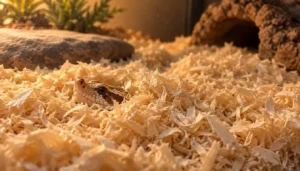
Picture your hognose vanishing under the substrate, leaving only a small mound behind. That’s what aspen shavings make possible.
They suit desert habitat species like corn snakes and hognoses, and they’re forgiving for beginners. Pack in 3 to 5 inches so burrowing holds its shape. Don’t let them get damp, or mold will follow. Watch for impaction risk during feeding.
Coconut Coir for Humidity Retention
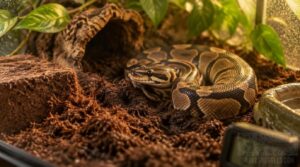
Think of coconut coir as a sponge tucked under your snake: it soaks up water and lets it go slowly. That makes coconut coir a solid pick for humidity control, especially for beginners keeping ball pythons.
Soak a brick, then drain the excess. Keep it damp, never soggy. Check lower layers, since the surface can fool you. Pair your reptile substrate with a hygrometer for real humidity management.
Cypress Mulch for Humid Enclosures
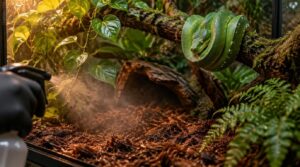
Dry air can wreck a tropical snake, so don’t gamble on humidity. Among reptile substrate types, cypress mulch holds moisture well, which makes it a smart pick for beginners with humid setups.
Expect a humidity spike, then mist as it dries. It can compact, so fluff it. For substrate safety, wash and sieve mulch to remove dust and sharp bits.
Reptile-Safe Bark for Moisture Control
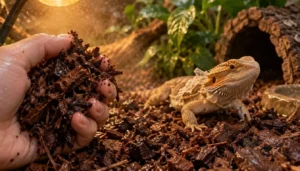
Think of bark as a slow-release humidity battery. Reptile-safe bark, usually heat-treated Douglas fir, soaks up water when you mist and lets it go gradually, which helps with shedding and keeps scale rot at bay.
Reptile-safe bark works like a slow-release humidity battery, soaking up mist and releasing it gradually to aid shedding and prevent scale rot
Beginners, keep it moist but never soggy. A squeezed handful should pack without dripping. Skip pine and cedar, and choose this over aspen shavings for humid setups.
Matching Substrate to Corn Snake, Ball Python, and Boa Needs
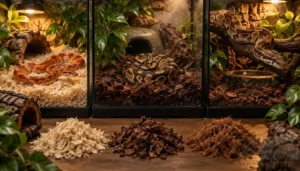
Now match that bedding to the snake you actually own.
Corn snakes do best on dry, dust-free aspen at 2-3 inches deep. That depth gives them room for burrowing, and it keeps impaction risk low. Keep humidity around 40-60%.
Ball pythons need 60-80% humidity, so choose coconut husk or cypress mulch and pile it 3-4 inches deep. Skip fine, dusty particles, since they irritate lungs. If your enclosure still feels dry or swampy, this ball python humidity guide explains how to adjust misting, ventilation, and a humidity hide.
Boas want 50-70% humidity, rising to 70-80% during shedding. Cypress mulch, coconut fiber, or an aspen-cypress mix holds moisture without molding. Avoid anything that compacts or stays soaked, because scale rot follows fast.
Beginners, don’t copy another keeper’s setup. Check your species first, because substrate safety starts with the right match. Get it right today.
Reptile Substrate Safety: Toxic Woods, Dust, and Ingestion Risks
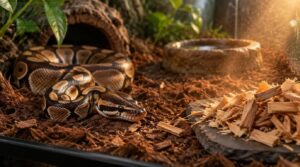
The wrong bedding can hurt your snake faster than you’d expect. Three hazards matter most: toxic woods, dust, and ingestion risks. Here’s what to watch for, so you can keep your enclosure safe.
Toxic Woods To Avoid
You can’t gamble with toxic wood substrates, so skip cedar shavings and pine shavings entirely. Both release phenolic oils that inflame your snake’s airways, and enclosed spaces trap those fumes.
Kiln-drying doesn’t erase toxic phenols, and pressure-treated or painted lumber adds arsenic and chemicals. Fir, spruce, and eucalyptus carry similar risks. If a wood smells of resin, leave it out.
Dust And Respiratory Risks
Toxic woods aren’t the only airborne threat. Dust quietly hurts your snake too, because its single functional lung clears debris slowly.
Fine particles trigger respiratory distress and respiratory infections, so watch for:
- Dry aspen shavings kicking up dust clouds
- Dry coir or cypress shedding fine fibers
- Damp, unchanged bedding that grows mold fast
- Poor humidity control leaving substrate bone dry
Ingestion And Impaction Risks
Dust isn’t the only hazard in your enclosure. Loose substrates stick to prey, and one strike sends bedding down your snake’s throat. That’s how impaction starts.
Babies face the highest impaction risks, so use paper towels. Feed with tongs or in a separate container. No digestible substrate exists for snakes, and substrate depth only gives particles more chances to cling.
Reptile Substrate Maintenance: Depth, Spot Cleaning, and Replacement Timing
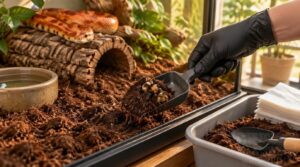
Every day you skip spot cleaning, bacteria gets a head start. Check the enclosure each morning, when waste is still fresh and contained. Remove droppings, shed skin, uneaten food, and a generous scoop of the surrounding material, since odor and bacteria spread beyond what you can see.
Keep substrate depth at 3 to 6 inches for a corn snake, and top up with fresh material of the same type after each cleaning.
Stir loose bedding like coconut coir weekly for mold prevention, and swap out damp clumps right away.
Plan a full replacement every 2 to 4 weeks. Don’t wait if you notice a sour smell, visible mold, or dampness. Those are the clearest signs it’s time to change substrate.
Frequently Asked Questions (FAQs)
Where should you not touch a bearded dragon?
Don’t touch the top of your head, tail, throat, belly, or feet. Looming over the pineal eye triggers panic, and squeezing ribs or toes causes injury.
Support a bearded dragon’s body from the side instead.
What is a low maintenance reptile for beginners?
Think of the leopard gecko as the easiest reptile: a sturdy, quiet roommate. Choose reptile carpet or aspen shavings for a budgetfriendly setup.
Bearded dragons demand more, so start here and you’ll gain confidence fast.
What to use instead of substrate?
You don’t need loose substrate to keep your snake safe. Paper towels cost little and make monitoring waste easy. Reptile carpet is washable and reusable. Ceramic tile cleans fast and holds heat, though textile options need frequent washing.
How can I make homemade reptile substrate?
Don’t gamble with your snake’s health. Mix 2 parts sifted topsoil, 2 parts washed coir, and 1 part sand. These loose substrates hold humidity, but sift sand well, because debris causes impaction. Check temperature daily.
What is the best substrate for reptiles?
Which substrate actually protects your reptile? Match it to your animal’s home range. Desert species need dry aspen, while tropical ones need coconut coir for steady humidity. Skip pine and cedar, and watch temperature and impaction risks.
What is the easiest reptile to take care of for beginners?
Leopard geckos can live 15 to 20 years. They’re the easiest reptile for beginners: calm, hardy, happy in a 20-gallon tank. Use plain paper towels as substrate, avoiding impaction, and keep temperature steady, humidity low.
Do bearded dragons prefer sand or dirt?
Desert ground isn’t a blank page; it’s a living map. Your bearded dragons want both.
Pack 70% organic topsoil with 30% sand, never pure sand or dirt, keep juveniles on solid substrate to dodge impaction.
Can I mix different substrate types together?
Say you’re mixing aspen with coconut coir for a ball python. Yes, you can, but start 50/50, watch humidity control closely, and prioritize substrate safety.
Mold threatens reptile health, so adjust if damp spots appear.
How does substrate choice affect feeding behavior?
Your snake’s dinner can turn into a gritty nightmare. Loose substrate sticks to prey, risking ingestion and refusal.
Smart substrate selection protects reptile feeding, reptile diet consistency, and reptile health. Feed on a bare surface.
What substrate works best for baby reptiles?
Start your juveniles on plain paper towels. This substrate is clean, low-dust, and easy to replace, so impaction and respiratory distress risks stay low while you watch feeding.
Substrate safety comes first: skip loose sand.
Conclusion
Picture a keeper who swaps cedar shavings for plain paper towels the day her ball python arrives. Two weeks later, the snake is eating, shedding cleanly, and breathing easy.
Whichever of the reptile substrate options for beginners you pick, match it to your snake’s humidity needs, keep spot cleaning routine, and skip anything dusty or aromatic. Your snake can’t tell you what’s wrong, so your setup has to speak first. Get bedding right from day one.