This site is supported by our readers. We may earn a commission, at no cost to you, if you purchase through links.

A snake won’t eat properly if its basking spot is off by even five degrees. That’s not an exaggeration — it’s how ectotherms work. These animals can’t generate their own body heat, so they depend entirely on their environment to power digestion, fight infection, and stay alive.
Get the temperature wrong, and you’re not just making your snake uncomfortable. You’re quietly breaking down its immune system and stalling its gut. The good news? Nailing your snake basking spot temperature guide comes down to knowing your species, picking the right gear, and reading your snake’s behavior. All of that starts here.
Table Of Contents
- Key Takeaways
- Why Basking Spot Temperature Matters
- Basking Temperatures by Snake Species
- Choosing The Right Heating Solution
- Top 3 Heat Bulbs for Snake Basking Spots
- Monitoring and Maintaining Basking Spot Accuracy
- Frequently Asked Questions (FAQs)
- What temperature should the basking spot be?
- Is 70 degrees too cold for a corn snake?
- What temperature should a heat lamp be for a snake?
- How often should I replace heat bulbs?
- Can snakes get sunburned from heat lamps?
- What causes sudden temperature drops in terrariums?
- Do pregnant snakes need higher basking temperatures?
- How long do snakes typically bask daily?
- Conclusion
Key Takeaways
- Set basking spot between 85–95°F depending on species (ball pythons need 88–92°F, corn snakes 85–90°F, boas 86–90°F) because snakes can’t generate body heat and rely entirely on external temperatures to digest food and fight infection.
- Create a thermal gradient with both warm and cool zones in the enclosure so your snake can move between temperatures and regulate its body naturally, which directly impacts digestion, immunity, and overall health.
- Use a digital thermometer with probes placed at basking surface level (not air temperature) and pair any heat source with a thermostat to prevent burns and maintain stable temperatures without dangerous fluctuations.
- Replace heat bulbs every 4–6 months and monitor your snake’s behavior daily—if it’s spending too long on the basking spot or showing stress signs like excessive tongue flicking, your temperature gradient likely needs adjustment.
Why Basking Spot Temperature Matters
Getting your snake’s basking spot temperature right isn’t something you can afford to guess at. It directly affects how well your snake digests food, fights off illness, and sheds its skin.
Understanding how temperature directly impacts your snake’s digestion can make it even clearer why nailing that basking spot matters.
Here’s what you need to know about why it matters so much.
How Ectotherms Regulate Body Temperature
Understanding ectotherm physiology is the foundation of proper snake temperature control. Unlike mammals, snakes can’t generate their own body heat. They depend entirely on their environment — a process called thermoregulation.
Your snake achieves this through three key thermal adaptation strategies:
- Basking — moving onto warm surfaces to raise body temperature
- Shading — retreating to cooler zones to prevent overheating
- Exploiting thermal gradients — positioning itself where temperatures match its needs
That’s why snake temperature regulation starts with you. As ectothermic animals, snakes have activity levels closely linked to ambient environmental conditions.
Impact of Temperature on Digestion and Immunity
Since snake temperature regulation depends on thermoregulation, getting your basking spot right directly shapes two systems: digestive health and immune response. Warmer basking temperatures accelerate enzyme activity, improving protein breakdown and nutrient absorption.
Meanwhile, temperature fluctuations can destabilize your snake’s gut microbiome, disrupting digestion and weakening immunity over time. Stable reptile temperature management within a proper temperature gradient keeps both systems running smoothly.
Think of temperature control as the foundation everything else depends on. Recent studies highlight the connection between temperature effects on immune function, emphasizing how heat exposure can alter immune responses in many animals.
The Role of Thermal Gradients in Snake Health
A stable digestive and immune system only tells part of the story.
Thermal regulation depends on your snake having both a warm and cool zone — that’s the thermal gradient.
Snake thermoregulation works by letting your snake move between these zones on its own.
Without proper gradient maintenance, ectotherm health suffers.
Temperature precision isn’t optional here.
Meeting your snake’s temperature requirements through a well-maintained temperature gradient keeps thermoregulation working as it should.
Basking Temperatures by Snake Species
Not every snake needs the same setup, and getting the temperature wrong can quietly cause problems you won’t notice right away.
Below, you’ll find the specific basking and cool zone temperatures for the most popular pet species. Match your enclosure to these numbers, and you’re already ahead of the game.
Ball Python Basking and Cool Zone Temperatures

Ball pythons are masters of snake thermoregulation — but only if you give them the right thermal gradient. Keep your basking spot between 88–92°F and your cool zone at 75–80°F. These temperature fluctuations matter more than most keepers realize.
A solid digital thermometer on both ends of the enclosure is really the easiest way to make sure your temperature gradient is dialed in.
Basking Tips for Ball Pythons:
- Place your heat source directly over one side to create a clear temperature gradient
- Keep the basking spot under 95°F to prevent burns
- Let nighttime temperatures drop safely to 70–75°F
Corn Snake Basking and Cool Zone Temperatures
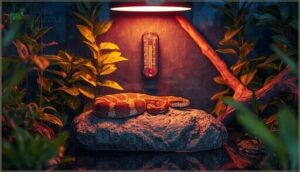
Corn snakes are surprisingly forgiving — but temperature matters. Aim for a basking spot of 85–90°F and a cool zone around 75–82°F. This thermal gradient facilitates snake thermoregulation and healthy digestion.
Your heat source options should include a thermostat to handle temperature fluctuations. At night, let snake habitat temperature drop to 65–72°F. That nighttime temperature shift mimics natural cycles and keeps your temperature control tight.
Boa Constrictor Temperature Requirements

Boa constrictors demand a wider thermal gradient than most beginner-friendly species. Set your basking spot between 86–90°F and your cool zone at 75–80°F.
That temperature range fosters healthy digestion and natural basking behavior. Your heat source should pair with a thermostat for tight environmental control — temperature fluctuation here can stall metabolism. Get the snake temperature requirements right, and your boa will thrive.
Special Considerations for Different Life Stages

Growth redefines everything a snake needs. Hatchling Care demands a tight basking zone of 88–92°F to fuel rapid thermoregulation.
Juvenile Development widens that temperature gradient slightly, dropping cool zones to 75–80°F. Subadult Health tolerates broader ranges, while Adult Maintenance prioritizes stability over intensity.
Senior Support calls for gentle warmth around 80–84°F. Mastering reptile temperature management across each life stage is the foundation of sound snake habitat temperature and snake temperature requirements.
Choosing The Right Heating Solution
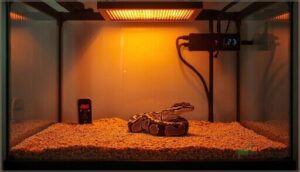
Now that you know what temperatures your snake needs, it’s time to figure out how to actually get there. Not all heating options work the same way, and the right choice depends on your species and setup.
Here’s what you need to know before you start shopping.
Heat Lamps Vs. Ceramic Heat Emitters
Your two main heat sources aren’t interchangeable — they do different jobs. Heat lamps hit the basking spot fast with radiant warmth, but they emit visible light that can disrupt nocturnal rest. Ceramic heat emitters provide steady, dark ambient warmth — better for nighttime thermal control and emitter safety.
Heat lamps ignite the basking spot instantly, but ceramic heat emitters own the night with steady, invisible warmth
Here’s how they stack up:
- Lamp Efficiency — Heat lamps reach target basking spot temperatures quickly but create uneven hotspots without proper positioning.
- Heating Costs — Ceramic heat emitters last longer and waste less energy, lowering long-term heating costs compared to halogen or incandescent bulbs.
- Light Interference — Heat lamps alter your snake’s day-night cycle; ceramic heat emitters emit zero visible light.
- Temperature Regulation — Ceramic emitters warm air evenly, making temperature control across the enclosure more stable.
- Emitter Safety — Both require proper mounting, a cage guard, and a quality thermostat — no exceptions.
What Wattage of Heat Bulb Will You Need?
Wattage isn’t one-size-fits-all — it depends on your enclosure size. Start your heat bulb selection at 60 watts and measure the basking spot at snake-head height.
If it reads 5°F or more below target, bump up wattage or close the distance. Proper wattage calculation keeps your thermal gradient intact, giving you reliable temperature control and temperature regulation across the whole setup.
What About Night Heat?
Once the lights go off, your snake still needs stable warmth. Nocturnal heating prevents dangerous temperature fluctuation overnight and aids snake temperature regulation around the clock.
Here’s how to handle night heat properly:
- Keep nighttime temps above 70°F using a low-wattage heat source
- Maintain your thermal gradient even after dark
- Use a thermostat for precise nocturnal heating and temperature control
- Choose heat source options like ceramic emitters or heat mats
- Monitor heating equipment nightly to catch any drift
Choosing The Right Setup
Now that night heat is sorted, it’s time to bring it all together. Your ideal setup depends on your snake’s species and enclosure design.
A daytime heat lamp paired with a ceramic heat emitter at night gives you reliable temperature control and smooth gradient creation. This combination facilitates consistent snake temperature regulation without overheating.
| Setup Component | Role |
|---|---|
| Daytime Heat Lamp | Provides basking spot warmth and light |
| Ceramic Heat Emitter | Maintains nighttime thermal gradient |
| Digital Thermostat Options | Ensures precise, stable temperature control |
| Dual-Probe Thermometer | Monitors both warm and cool zones of heating equipment |
Top 3 Heat Bulbs for Snake Basking Spots
You’ve already narrowed down your heating options — now it’s time to pick a specific bulb. Not every heat lamp is built the same, so your choice matters more than you might think.
Here are three solid options that work well for snake basking spots.
1. Vinaco Halogen Flood Light Bulb
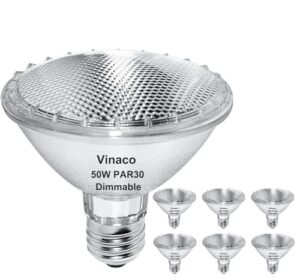
Versatility is the first thing you’ll notice here. The Vinaco halogen flood bulb runs at 50W and puts out 650 lumens of warm 3000K light — plenty bright for a solid basking spot.
It’s dimmable from 10% to 100%, so you can fine-tune heat output without swapping bulbs. The E26 base fits most standard fixtures. Just keep in mind: some users report shorter-than-expected lifespans.
| Best For | Reptile owners or anyone needing a warm, dimmable basking light that fits standard fixtures and works both indoors and out. |
|---|---|
| Wattage | 50W |
| Base Type | E26 |
| Voltage | 120V |
| Lifespan | 3000 hours |
| Dimmable | Yes |
| Color Temperature | 3000K |
| Additional Features |
|
- Smooth dimming from 10% to 100% lets you dial in exactly the heat and brightness you need
- Hits a solid 650 lumens at a cozy 3000K, great for creating a warm, natural-feeling glow
- Standard E26 base means it drops into most common fixtures with zero fuss
- Some users have seen these burn out way sooner than the rated 3,000-hour lifespan
- Halogen runs hotter and eats more energy than an LED alternative would
- Can cost a bit more upfront compared to other bulb types on the market
2. Repti Zoo Heat Lamp Bulb
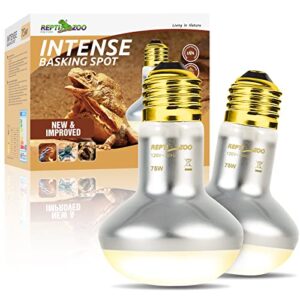
If you want something purpose-built for reptiles, the Repti Zoo Heat Lamp Bulb is worth a look. It runs at 75W and delivers focused infrared heat — solid for a defined basking spot.
The R25 shape and E26 base make it easy to install in most fixtures. Rated up to 3,000 hours, though some users report inconsistent lifespans. It is a good budget-friendly option overall.
| Best For | Reptile owners looking for an affordable, easy-to-install heat lamp that delivers a solid basking spot for bearded dragons, turtles, and similar pets. |
|---|---|
| Wattage | 75W |
| Base Type | E26 |
| Voltage | 120V |
| Lifespan | 3000 hours |
| Dimmable | No |
| Color Temperature | N/A |
| Additional Features |
|
- Puts out focused heat right where you need it, making it great for creating a proper basking spot
- The standard E26 base fits most common fixtures, so no hunting for specialty parts
- At 75W, it heats up a terrarium nicely without using a ton of energy
- Some owners have reported bulbs burning out or losing heat well before the 3,000-hour mark
- The adhesive holding the glass to the base can crack over time, which is a durability concern
- Not ideal for larger enclosures — you may need something more powerful to get even coverage
3. Par30 Halogen Flood Light Bulbs
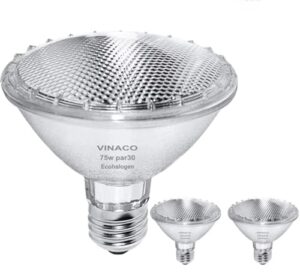
For a more adaptable option, PAR30 halogen flood bulbs are hard to beat. They use a standard E26 base, so they fit most clamp lamps and dome fixtures without adapters.
At 75W, they throw serious heat and reach full brightness instantly. Lifespans usually land between 1,000 and 2,500 hours. They’re not purpose-built for reptiles, but their broad availability and reliable output make them a practical, no-fuss choice.
| Best For | Anyone who needs a reliable, versatile flood light for terrariums, accent lighting, or general-purpose fixtures and wants something that just works out of the box. |
|---|---|
| Wattage | 75W |
| Base Type | E26 |
| Voltage | 120V |
| Lifespan | 2000+ hours |
| Dimmable | Yes |
| Color Temperature | 3000K |
| Additional Features |
|
- Hits full brightness instantly with no warm-up time, so you get consistent 1000-lumen output right away
- Fits standard E26 bases, meaning it works in most common fixtures without any adapters or guesswork
- Plays nice with dimmers, so you can dial the brightness up or down to match whatever vibe you’re going for
- Burns pretty hot at 75W, which can be a factor if your fixture or setup isn’t designed to handle that kind of heat
- Lifespan tops out around 2,000 hours, and some users have reported needing replacements even sooner than that
- Not nearly as energy-efficient as an LED swap would be, so it’ll cost a bit more to run over time
Monitoring and Maintaining Basking Spot Accuracy
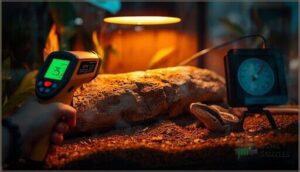
Once your heating setup is in place, the next step is making sure it’s actually doing what you think it’s doing. Accurate temperature monitoring is what separates a good basking spot from a dangerous one.
Here’s how to check, read, and fine-tune your temperatures with confidence.
Where to Place Temperature Probes
Probe placement can make or break your thermal monitoring setup. Position your primary temperature probe at the snake’s basking surface level — directly above the heat source, about 0.5 to 1 inch up. This ensures sensor accuracy across your thermal gradient.
Place a second digital probe at the cool end for proper temperature control. Weekly heat source calibration with an infrared thermometer keeps your thermoregulation data trustworthy.
Using Digital Thermometers for Precision
For reliable heat monitoring, digital thermometers are your best tool. They use thermistor sensors that read temperatures in under five seconds, giving you precision control across your thermal gradient. Keep your digital probes calibrated regularly — an ice water test at 0°C is the simplest method.
- Place temperature probes directly at basking level for accurate thermoregulation data.
- Verify digital accuracy monthly using the manufacturer’s calibration guidelines.
- Use a secondary probe at the cool end for full temperature management.
Adjusting Temperatures Based on Snake Behavior
Occasionally, your snake will tell you exactly what it needs — just watch. If it lingers on the basking spot too long, that’s a behavioral cue: your temperature gradient may run too cool.
Sudden tongue flicking signals stress from temperature fluctuations. Adjust your thermal gradient in small increments to support proper snake thermoregulation. Environmental enrichment starts with reading these cues and tuning your basking spot for precise temperature control.
Frequently Asked Questions (FAQs)
What temperature should the basking spot be?
Your snake’s basking spot needs precision—without it, digestion fails. Ball pythons thrive at 88–92°F, corn snakes prefer 90–95°F, while boa constrictors demand 95–100°F for proper thermoregulation and metabolic function.
Is 70 degrees too cold for a corn snake?
Yes, 70°F is too cold as a daytime ambient for Corn Snakes.
You’ll need a thermal gradient with a basking spot around 85–90°F to support proper digestion rates and prevent cold stress effects.
What temperature should a heat lamp be for a snake?
Your heat lamp should create a basking spot between 85 and 92°F, depending on species. Ball pythons need 88–92°F, corn snakes prefer 85–90°F, and boas thrive around 85–90°F for proper thermoregulation.
How often should I replace heat bulbs?
Replace heat bulbs every 4 to 6 months, or sooner if you notice flickering, blackening, or temperature drops. Keep spares on hand so your reptile heating never fails unexpectedly.
Can snakes get sunburned from heat lamps?
Believe it or not, your snake won’t need sunscreen.
Heat lamps don’t emit UV that causes sunburn, but they can create burns from excessive surface heat if you skip using a thermostat.
What causes sudden temperature drops in terrariums?
Drafts, poor insulation failures, heating system issues, and external factors like cold walls trigger sudden temperature drops.
Equipment malfunctions—miscalibrated thermostats or faulty relays—disrupt temperature control, collapsing your carefully built temperature gradient within minutes.
Do pregnant snakes need higher basking temperatures?
Yes, but only slightly. Gravid snakes often seek warmer basking behavior to support reproductive health and digestion, yet excessive heat stresses both mother and embryos—thermal gradient flexibility matters most.
How long do snakes typically bask daily?
Most snakes bask one to three hours daily, depending on species and temperature gradient.
Ball pythons usually bask 30 minutes to two hours, while corn snakes prefer one to two hours for ideal thermoregulation.
Conclusion
Picture your snake stretched across its basking spot, muscles relaxed, digestion humming along at the exact temperature it needs. That’s what this snake basking spot temperature guide delivers—precision that keeps your animal healthy, not guessing.
You’ve got the species ranges, the right bulbs, and the monitoring tools. Now it’s about consistency. Check your temps daily, watch your snake’s behavior, and adjust when needed. Get it right once, and everything else falls into place.