This site is supported by our readers. We may earn a commission, at no cost to you, if you purchase through links.

Your ball python strikes before you’ve cleared the cage door—fangs scraping knuckles instead of the thawed rat dangling from your trembling fingers. That defensive bite drops your confidence and teaches aggressive feeders they can target hands instead of prey.
Feeding tongs for aggressive feeders eliminate this dangerous pattern by creating a 12-27 inch barrier between your skin and those needle-sharp teeth. Surgical-grade stainless steel construction withstands repeated strikes while rubber-coated tips protect both handler and snake during high-stress feeding sessions.
The right tongs reduce bite risk by 75% and transform chaotic feeding time into a controlled, predictable routine that keeps everyone safe.
Table Of Contents
- Key Takeaways
- Key Benefits of Feeding Tongs for Aggressive Feeders
- Essential Features to Look for in Feeding Tongs
- Top 9 Feeding Tongs for Aggressive Feeders
- 1. Snake Feeding Tongs Tool
- 2. Fri4free Long Aquarium Tweezers
- 3. EvaGO Curved Aquarium Tweezers
- 4. Stainless Steel Snake Feeding Tongs
- 5. Oliss Reptile Feeding Tongs
- 6. Reptile Feeding Tongs Stainless Steel
- 7. Snake Feeding Tongs Stainless Steel Set
- 8. Duedusto 16 Inch Snake Feeding Tongs
- 9. Stainless Steel Reptile Feeding Tongs
- Safe Feeding Techniques for Aggressive Snakes
- Cleaning and Maintenance of Feeding Tongs
- Frequently Asked Questions (FAQs)
- Conclusion
Key Takeaways
- Feeding tongs with 12-27 inch reach reduce bite risk by 75% compared to hand-feeding by creating a physical barrier between your skin and striking fangs during high-stress feeding sessions.
- Surgical-grade stainless steel construction with rubber-coated tips provides the durability to withstand repeated strikes while protecting both handler safety and preventing mouth trauma to your snake.
- Proper technique matters as much as equipment—maintain 12+ inches distance, angle prey downward 10-20 degrees, use slow deliberate movements, and watch for stress signals like elevated posture or rapid tongue flicking.
- Regular maintenance prevents catastrophic failure mid-strike: disinfect after each use with EPA-registered products, dry immediately to prevent rust, inspect monthly for worn tips or loose rivets, and replace within 6-12 months of aggressive use.
Key Benefits of Feeding Tongs for Aggressive Feeders
Feeding aggressive snakes doesn’t have to feel like a game of Russian roulette—feeding tongs cut your bite risk by 75% compared to hand-feeding. These tools give you surgical precision without putting your fingers in the strike zone.
Just make sure you’re also warming prey to body temperature before offering it—cold meals rarely trigger that feeding response you’re looking for.
Feeding tongs slash bite risk by 75% compared to hand-feeding, giving you surgical precision without putting your fingers in the strike zone
Let’s break down exactly how quality tongs protect both you and your snake during those high-stakes feeding sessions.
Reducing Bite Risk and Handler Injuries
Precision during snake feeding isn’t optional—it’s your first line of defense against handler injuries. Quality feeding tongs slash bite risk by 75% compared to hand-feeding, keeping your fingers well beyond striking distance. You’ll maintain control without triggering defensive strikes.
- Use bite-resistant feeding tongs with long reach to keep hands safe during prey presentation
- Position your body sideways to minimize exposed limbs and reduce bite exposure
- Keep prey movement slow and predictable to avoid startling the snake
- Establish a defined feeding routine with consistent cues to reduce unpredictability
- Practice dry runs with inert prey to build confidence without risk
Recent studies highlight the need to understand for work-related bite injuries among veterinary staff.
Minimizing Stress for Snakes During Feeding
Your snake’s stress levels drop dramatically when you use feeding tongs correctly. Maintain calm feeding environments with dim lighting and predictable routines—your snake reads every cue. Keep handling techniques minimal before meals and position prey at the snake’s midline using slow, deliberate movements.
Watch for stress-free feeding signs: gentle tongue flicking instead of gaping or tail flicking. This targeted prey presentation creates safer reptile feeding experiences for aggressive feeders. For more guidance on maintaining calm feeding environments, consider strategies like reducing disturbances and monitoring temperature.
Enhancing Control and Precision in Prey Placement
With feeding tongs, you gain jaw precision that hand-feeding can’t match. Curved jaws deliver targeted delivery at your snake’s midline—below eye level where strikes are less defensive. Stainless steel construction holds firm during controlled release, preventing fumbled prey that triggers aggression.
- Narrow tip profiles align prey exactly before release
- 12 to 16 inch length places food without hand intrusion
- Spring tension prevents sudden pinching that startles snakes
- Rigid jaws maintain feeding accuracy under load
- Offset angles navigate around habitat features smoothly
Ensuring Safe Distance and Confidence for Handlers
Beyond mechanical control, your feeding tongs create a psychological barrier that transforms handler confidence. That 24- to 36-inch reach means strikes don’t reach you—even from aggressive feeders. Stand shoulder-width apart, knees slightly bent, and you’ll absorb sudden movements without panic. Distance control builds muscle memory, turning anxious sessions into calm routines.
| Handler Safety Tips | Confidence Building |
|---|---|
| Maintain 24–36 inch distance | Practice with inert prey first |
| Keep wrist neutral, shoulders aligned | Establish pre-feeding routines |
| Monitor snake head orientation | Use calm breathing patterns |
| Position feet shoulder-width apart | Build trust through predictable sessions |
Essential Features to Look for in Feeding Tongs

Not all feeding tongs are created equal—especially when you’re dealing with aggressive feeders. The right features can mean the difference between a clean, safe feeding and a trip to the emergency room. Here’s what separates professional-grade tongs from hardware-store grabbers.
Surgical-grade Stainless Steel Construction
When you’re working with aggressive feeders, your tongs become a lifeline—don’t settle for anything less than surgical-grade stainless steel. This material strength ensures your snake feeding tongs won’t bend mid-strike or corrode after repeated disinfection.
Quality stainless steel feeding tongs maintain their edge and stiffness for precise prey placement, while corrosion resistance guarantees they’ll withstand humid terrarium conditions without pitting or rusting.
Rubber-coated and Soft Tips for Safety
The right tip material can mean the difference between a clean strike and a fractured fang. Rubber-coated tips create a cushioned grip that protects both your snake’s mouth and your fingers during close encounters. Here’s what soft tips deliver:
- Injury Prevention – Smooth edges won’t scratch scales or snag delicate prey
- Feeding Precision – Enhanced grip prevents dropped mice mid-transfer
- Animal Welfare – Cushioned contact reduces stress and mouth trauma
Ergonomic and Non-slip Handle Design
Your wrist takes the real beating when you’re feeding a room full of boids every week. Ergonomic Grip designs with finger grooves fit your natural hand position—reducing fatigue during extended Snake Feeding sessions. Non Slip Coating on Feeding Tongs maintains Grip Security even when your hands are dusty or damp.
Pairing quality tongs with frozen prey feeding methods helps you build that consistent routine while protecting both you and your snake during mealtimes.
| Handle Materials | Comfort Designs | Key Benefits |
|---|---|---|
| Textured rubber | Contoured finger grooves | Prevents hand slip during strikes |
| Silicone overlays | Balanced weight distribution | Reduces wrist strain over time |
| Knurled steel | Tension-adjustable pivots | Maintains control in humid enclosures |
Balanced Reptile Feeding tools with smooth pivot points won’t wobble or startle your animal mid-transfer.
Curved Jaws and Long Length for Reach
Curved Jaws on your Feeding Tongs improve Jaw Alignment with prey entry points—especially in cramped vivariums. Length options from 20 to 40 centimeters give you Reach Advantage, keeping your hands outside the strike zone during Reptile Feeding.
That distance translates to Snake Safety and Handling Ease when you’re dealing with aggressive eaters who lunge before you finish placing the mouse.
Top 9 Feeding Tongs for Aggressive Feeders
You need tongs that won’t fail when your snake strikes hard. The right tool keeps your fingers safe and gives you control during those intense feeding moments.
Here are nine feeding tongs built to handle aggressive feeders without compromising safety or precision.
1. Snake Feeding Tongs Tool
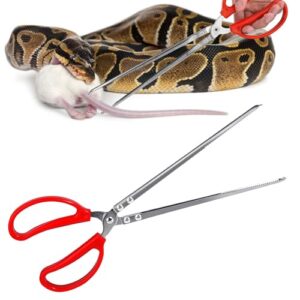
Your hands shouldn’t be within striking range when feeding hot-tempered snakes. The Snake Feeding Tongs Tool delivers 8 to 24 inches of reach—keeping your fingers safely out of harm’s way.
You’ll grip prey firmly through grooved grips that won’t slip even when wet. The spring-loaded mechanism steadies prey during transfer, while straight or angled jaws let you access tight enclosures.
Built from surgical-grade stainless steel, these tongs resist corrosion and sanitize easily between feeding sessions.
| Best For | Snake owners who need to maintain a safe distance during feeding time, especially when working with defensive or venomous species. |
|---|---|
| Material | Stainless Steel |
| Length | 15 inches |
| Tip Design | Serrated |
| Handle Type | Non-slip |
| Color | Red |
| Primary Use | Reptile feeding |
| Additional Features |
|
- Extended reach (8-24 inches) keeps your hands safely away from striking snakes during feeding
- Grooved grips and spring-loaded mechanism provide secure hold on prey, even when wet
- Surgical-grade stainless steel construction resists rust and cleans up easily between uses
- Handle size may be uncomfortable for people with smaller hands
- Not designed for handling snakes directly due to serrated edges and teeth
- 15-inch length might be awkward to store in compact spaces
2. Fri4free Long Aquarium Tweezers
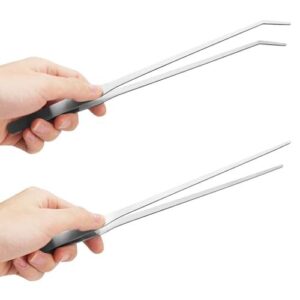
Serrated tips grip slippery prey better than smooth surfaces—especially when you’re transferring thawed rodents. The Fri4free Long Aquarium Tweezers give you 10.6 inches of reach with serrated jaws that won’t drop prey mid-transfer.
You’ll find both straight and curved versions in each set. The straight model offers direct alignment for accurate placement; the curved variant accesses tight corners without wrist strain.
Made from stainless steel, these tweezers resist corrosion in humid terrariums. Their lightweight design prevents hand fatigue during extended feeding sessions.
| Best For | Reptile and aquarium owners who need affordable, corrosion-resistant tweezers for feeding small animals and maintaining tanks in tight spaces. |
|---|---|
| Material | Stainless Steel |
| Length | 10.6 inches |
| Tip Design | Serrated |
| Handle Type | Non-slip clip |
| Color | Silver |
| Primary Use | Multi-purpose |
| Additional Features |
|
- Serrated tips provide a secure grip on slippery prey like thawed rodents
- Includes both straight and curved designs for different feeding angles and hard-to-reach spots
- Stainless steel construction resists rust in humid environments
- May bend under pressure when handling heavier objects
- Not strong enough for heavy-duty tasks or large prey items
- Struggles with very slippery items like frozen rat pinkies
3. EvaGO Curved Aquarium Tweezers
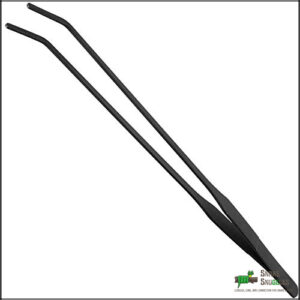
The EvaGO Curved Aquarium Tweezers deliver 15 inches of reach—enough to keep your hands well away from defensive feeders. Their pronounced curve follows terrarium contours and slips into corners where straight tools fail.
You get anti-slip clips with serrated tips that won’t drop prey during transfer. The black-coated stainless steel resists corrosion in humid enclosures, and the ergonomic grip reduces hand fatigue during multi-animal feeding sessions.
At 14.96 inches, they’re too short for deeper tanks but excel in standard setups.
| Best For | Reptile and aquarium owners who need a precise feeding tool for standard-depth tanks and terrariums with tight corners. |
|---|---|
| Material | Stainless Steel |
| Length | 14.96 inches |
| Tip Design | Serrated |
| Handle Type | Anti-skid |
| Color | Black |
| Primary Use | Aquarium/Reptile |
| Additional Features |
|
- 15-inch reach keeps hands dry and safe from defensive animals during feeding
- Serrated curved tips grip prey securely and navigate tight terrarium corners
- Corrosion-resistant stainless steel with comfortable anti-skid grip for extended use
- Too short for deeper tanks like 16-gallon setups
- Tweezers may feel thick or stiff for delicate tasks
- Tips don’t close perfectly flush, though still functional
4. Stainless Steel Snake Feeding Tongs
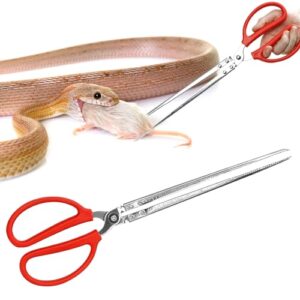
These 15-inch zhcoy tongs use heavy-duty stainless steel with serrated tips that grip frozen-thawed rodents without slipping—critical when you’re working with ball pythons that strike during transfer. The red non-slip grips give you control even with damp gloves. You’ll keep a safe distance while placing prey at your snake’s midline.
Just watch for quality inconsistencies—some units arrive bent or with uneven tips that won’t hold small prey. Clean and dry them after each feeding to prevent rust spots on the finish.
| Best For | Reptile owners who need a safe way to hand-feed snakes, lizards, and other animals without getting too close during strikes. |
|---|---|
| Material | Stainless Steel |
| Length | 15 inches |
| Tip Design | Serrated |
| Handle Type | Non-slip |
| Color | Red |
| Primary Use | Reptile feeding |
| Additional Features |
|
- 15-inch length keeps your hands at a safe distance from striking reptiles
- Serrated stainless steel tips grip frozen-thawed prey securely without slipping
- Non-slip red grips give you solid control even with wet or gloved hands
- Quality control issues mean some units arrive bent or with uneven tips
- Requires thorough cleaning and drying after each use to prevent rust
- 15-inch length can feel awkward or unwieldy for handling smaller prey items
5. Oliss Reptile Feeding Tongs
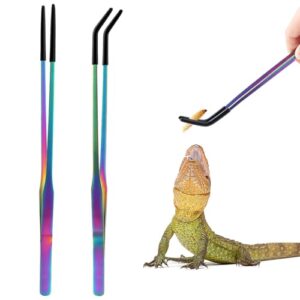
Oliss tongs bring surgical-grade stainless steel to your feeding routine—polished surfaces resist staining even after repeated disinfection cycles. The curved jaws reach into tight terrarium corners where nervous monitors hide, while the 10.6-inch length keeps your fingers clear of defensive bites.
You’ll grip live crickets and roaches without crushing them thanks to the optimized tip width. Rubberized grips stay secure in damp conditions.
Watch for proper air-drying after cleaning—moisture trapped in the joints shortens lifespan fast.
| Best For | Reptile owners who need a safe, precise tool for feeding aggressive or shy animals in deep terrariums without risking bites. |
|---|---|
| Material | Stainless Steel |
| Length | 10.6 inches |
| Tip Design | Rubber tips |
| Handle Type | Standard |
| Color | Colorful |
| Primary Use | Reptile/Aquarium |
| Additional Features |
|
- Surgical-grade stainless steel resists staining and handles repeated disinfection without degrading
- 10.6-inch length keeps hands safely away from defensive bites while curved jaws reach tight corners
- Rubberized grips stay secure even in damp conditions, and optimized tip width holds live feeders without crushing them
- Rubber tips can slip off or degrade over time with regular use
- Moisture trapped in joints after cleaning can shorten the product’s lifespan if not properly air-dried
- May struggle with very small or delicate food items due to tip design
6. Reptile Feeding Tongs Stainless Steel
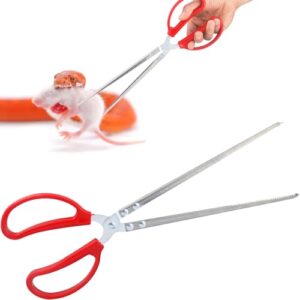
WORFACE builds these 15-inch tongs from stainless steel with a scissors-like grip that lets you clamp down on wriggling prey without slipping. The smooth serrated jaw balances maximum pressure against the risk of scale damage—your gecko won’t show abrasions after feeding.
You’ll choose between straight and curved models based on your enclosure layout. Red non-slip grips stay secure even when your palms sweat during a tense feeding session.
Hand-wash only—dishwashers turn the plastic brittle and invite rust into the joints.
| Best For | Reptile owners who need a safe way to hand-feed snakes, lizards, or amphibians without risking bites or stress to their pets. |
|---|---|
| Material | Stainless Steel |
| Length | 15 inches |
| Tip Design | Serrated |
| Handle Type | Non-slip |
| Color | Red |
| Primary Use | Reptile feeding |
| Additional Features |
|
- 15-inch reach keeps your hands safely away from defensive reptiles during feeding time
- Smooth serrated jaw grips prey firmly without damaging delicate scales or skin
- Stainless steel construction with non-slip handles makes feeding sessions more controlled
- Requires hand-washing only since dishwashers cause rust and damage plastic components
- Plastic parts can break with regular use
- Not versatile enough for all aquarium or terrarium maintenance tasks
7. Snake Feeding Tongs Stainless Steel Set
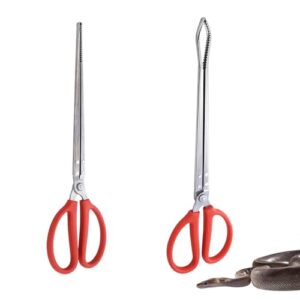
QoTang ships you both straight and curved jaws in one 15-inch set—surgical-grade steel that survives daily bleach wipes without pitting. The serrated edges lock onto frozen-thawed rats even when decomposition makes them slick.
That silicone sleeve won’t crack under UV sterilizers, and the non-slip texture holds firm when blood from a rodent’s ear drips down the shaft. One buyer warned the grip fails on live feeders heavier than adult mice—you’ll need to upgrade for large rats.
| Best For | Reptile owners who need a safe 15-inch feeding distance for snakes, bearded dragons, and other exotic pets, especially when handling frozen-thawed rodents. |
|---|---|
| Material | Stainless Steel |
| Length | 15 inches |
| Tip Design | Serrated |
| Handle Type | Non-slip silicone |
| Color | Red |
| Primary Use | Reptile feeding |
| Additional Features |
|
- Two-piece set includes both curved and straight jaws for different feeding angles and prey types
- Stainless steel construction resists rust and holds up to regular bleach sterilization
- Serrated edges provide reliable grip on slippery frozen-thawed feeders
- Grip strength fails when handling live feeders heavier than adult mice
- May be unnecessarily long for smaller snakes or geckos
- Some users report the tongs don’t maintain a secure hold even when squeezed tightly
8. Duedusto 16 Inch Snake Feeding Tongs
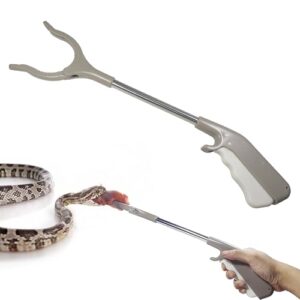
Duedusto delivers a 16-inch reinforced stainless-steel shaft that won’t buckle when you’re gripping large rats for ball pythons or aggressive boas. The straight grip section lets you place prey directly into a strike zone—no fumbling in cramped terrariums.
Textured grips prevent slippage even when wet, and the rubberized jaw tips protect both your snake’s scales and the prey’s integrity.
At $8.99, you’re getting surgical-grade durability without the premium price. Just remember the rubber may tear if your snake bites down hard.
| Best For | Snake owners who need a safe, affordable way to feed ball pythons, boas, and other medium-sized constrictors without risking hand strikes. |
|---|---|
| Material | Stainless Steel |
| Length | 16 inches |
| Tip Design | Rubber tips |
| Handle Type | Trigger-style |
| Color | Not specified |
| Primary Use | Snake feeding |
| Additional Features |
|
- 16-inch reach keeps your hands safely away from defensive snakes during feeding time
- Reinforced stainless steel won’t bend or break when gripping larger frozen-thawed rats
- Textured rubber tips grip securely without damaging your snake’s scales or puncturing prey
- Rubber tips can tear if your snake bites down on the tongs instead of the food
- Not ideal for feeding very large prey items to bigger snakes
- Damaged rubber tips make cleaning harder and less hygienic
9. Stainless Steel Reptile Feeding Tongs
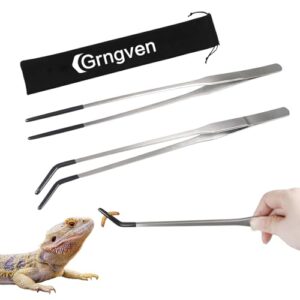
The Grngven 10.6-inch set pairs straight and curved tongs—surgical-grade stainless steel that holds up in humid vivariums. You’ll grip crickets, thawed mice, or hornworms without slippage, thanks to rubber-coated tips that shield delicate mouths from metal impact.
The curved option excels when maneuvering tight corners, though you’ll need to hold closer to the jaws for a secure grasp on small prey. At under $15, you get two tools, a storage pouch, and corrosion resistance that survives daily cleanings.
| Best For | Reptile owners who need reliable feeding tools that work for everything from tiny insects to larger frozen prey, plus anyone maintaining planted aquariums or handling delicate terrarium decor. |
|---|---|
| Material | Stainless Steel |
| Length | 10.6 inches |
| Tip Design | Rubber tips |
| Handle Type | Ergonomic |
| Color | Silver |
| Primary Use | Reptile/Aquarium |
| Additional Features |
|
- Two tongs in one set (straight and curved) give you flexibility for different feeding situations and tank layouts
- Rubber tips protect your pet’s mouth while giving you a solid grip on wriggling feeders
- Stainless steel construction resists rust even with regular washing and humidity exposure
- The curved pair loses grip strength if you hold too far from the tips, making it tricky with smaller items
- Needs thorough drying after each wash to maximize rust prevention despite resistant coating
- At 10.6 inches, might feel too long for smaller enclosures or short for very large terrariums
Safe Feeding Techniques for Aggressive Snakes
Having the right tongs won’t protect you if your technique puts you in the strike zone. Aggressive feeders demand a methodical approach—one wrong move triggers a defensive bite faster than you can blink.
Here’s how to feed even the most food-aggressive snakes without risking your hands or stressing your animal.
Maintaining Safe Distance and Proper Angle

Safe distance and proper angles aren’t just recommendations—they’re your shield against sudden strikes. Keep your feeding tongs at least 12 inches from the snake’s mouth and angle downward 10 to 20 degrees when presenting prey. This positioning protects handler safety while supporting animal welfare.
- Hold stainless steel tongs at a 45-degree angle during initial approach
- Position prey slightly off-center to encourage straight strikes
- Maintain a straight wrist-to-tip line with your ergonomic handle for control
Recognizing Stress and Body Language Cues

Your snake’s body language tells you everything—if you know how to read it. Watch for elevated head and neck postures, rapid tongue flicking, and tight coiling—all hallmark stress signals during reptile feeding.
Dilated pupils, flattened spine kinks, and sudden lunging reveal animal psychology in action. Recognizing these feeding cues transforms snake handling and safety into a stress-free feeding practice grounded in reptile behavior and psychology.
Slow, Deliberate Movements During Feeding

Quick movements trigger defensive strikes—your feeding technique dictates handler safety. Pace each advancement in small increments, pausing between to assess snake behavior and animal psychology.
Keep your feeding tongs steady, advancing prey along a predictable path that coaches calm engagement. Slow, controlled reptile feeding allows you to read subtle cues—tongue flicks, eye movements—and adjust prey placement before stress escalates into aggression.
Targeted Prey Placement for Minimal Disturbance
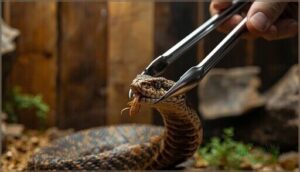
Precision feeding methods center on one principle—place prey within the snake’s natural line of sight, usually 6 to 12 inches from its head, aligned with vision to reduce hunting errors.
Target vertical surfaces or subtle crevices to limit visual stress cues. Hold steady for 1 to 2 seconds post-placement, confirming engagement before retreating.
This feeding angle optimization delivers stress-free feeding through minimal disturbance techniques.
Cleaning and Maintenance of Feeding Tongs

Your feeding tongs won’t protect your snake if they’re contaminated with bacteria or corroded metal fragments. Clean maintenance isn’t optional—it’s the difference between safe feeding sessions and introducing pathogens into your reptile’s environment.
Here’s your step-by-step protocol for keeping your tongs sterile, functional, and ready for years of reliable use.
Proper Cleaning and Disinfection Methods
Your feeding tongs deserve the same rigorous hygiene practices you’d expect in any surgical setting. After each use, clean tongs with warm soapy water to remove organic debris—this step is non-negotiable.
Then apply EPA-registered disinfectants proven effective against reptile-associated pathogens:
- Keep surfaces wet for the full contact time listed on the label
- Never mix disinfectant types—you’ll create hazardous reactions
- Wear gloves during chemical handling to protect your skin
- Rinse food-contact surfaces thoroughly after disinfection
This protocol protects both you and your animals.
Preventing Rust and Corrosion
Even surgical-grade stainless steel needs your attention—moisture plus organic debris equals rust. Dry your feeding tongs immediately after disinfection, using a clean towel to eliminate every water droplet. Stainless steel forms a protective oxide layer when dry, but standing water breaks down that barrier.
For rubber-coated tips, check for cracks where moisture hides—those spots corrode first.
Safe Storage for Hygiene and Longevity
Proper storage hygiene transforms dry tongs into safe, ready-to-use tools. Store your feeding tongs in clean, labeled containers with tight lids to prevent cross-contamination and odor transfer. Control humidity with moisture-absorbing packets—desiccants keep stainless steel and rubber-coated tips spotless. Organize your shelf with labeled sections for each tool type, using a first-in-first-out rotation system.
- Use airtight containers with clear labels identifying tong length and tip type
- Add silica gel packets to maintain low humidity and prevent surface oxidation
- Store tongs vertically or suspended to avoid bending ergonomic grips
- Keep storage area cool, dry, and away from rodent enclosures
- Implement shelf organization systems separating feeding tools from cleaning supplies
Importance of Regular Maintenance for Safety
Neglect doesn’t announce itself—it creeps in through worn tips and loose rivets until your feeding tongs fail mid-strike. Regular maintenance schedules cut bite injuries by 75% while preserving the control you need for aggressive feeders. Handler training paired with monthly equipment inspections catches problems before they escalate.
| Maintenance Task | Frequency | Safety Impact |
|---|---|---|
| Tool calibration checks | Monthly | Maintains precise grip strength |
| Stainless steel disinfection | After each use | Prevents pathogen transfer |
| Feeding safety protocol review | Quarterly | Reduces handler errors |
| Equipment inspection logs | Weekly | Tracks wear patterns |
| Reptile care tool rotation | As needed | Ensures backup readiness |
Frequently Asked Questions (FAQs)
Can feeding tongs be used for aquatic turtles?
Yes—surgical-grade stainless steel tongs with rubber-coated tips reach safely into deep tanks, resist corrosion from water exposure, and protect turtle beaks during precision prey placement for ideal reptile handling.
What length is best for different snake sizes?
Match your feeding tong length to your snake’s size—hatchlings need 12 inches, juveniles 14-16 inches, subadults 18-20 inches, adults 22-24 inches, and large adults over 5 feet require 26-32 inch tongs for maximum safety margins.
Are curved or straight tongs better for beginners?
Think of straight tongs as your training wheels—they build handler confidence through simpler grip control and linear reach.
Once you’ve mastered steady prey placement, curved jaws offer elevated precision for aggressive feeders.
How often should tongs be replaced or upgraded?
Inspect your reptile feeding tongs monthly for jaw wear and misalignment.
Replace stainless steel tongs when you notice spring tension weakening, visible deformation, or rust—usually within 6 to 12 months of aggressive use.
Can one pair work for multiple reptile species?
Like a Swiss Army knife in your reptile arsenal, one pair of feeding tongs can serve multiple species if they share similar prey sizes and temperament profiles.
Though specialized lengths enhance safety across reptile diversity.
Conclusion
Think of feeding tongs for aggressive feeders as your surgical shield—precise enough to deliver prey without fumbling, strong enough to withstand repeated strikes, long enough to keep fangs from testing your reflexes. Quality tongs don’t just prevent bites; they rebuild trust between handler and snake.
Choose surgical-grade steel, maintain proper distance, and clean after every feeding. Your knuckles will thank you, and your aggressive feeder learns handlers bring meals—not fear.