This site is supported by our readers. We may earn a commission, at no cost to you, if you purchase through links.
Your ball python’s skin looks dull and cloudy, and the shed that follows comes off in ragged patches, with a stubborn ring of old skin left around the tail tip. The culprit is usually humidity, and it often hides in plain sight.
Ball pythons need 50-60% ambient humidity, climbing to 70-80% during shedding. A damp hide filled with sphagnum moss delivers that boost without soaking the whole enclosure or inviting scale rot.
The right snake hides for humid environments hold moisture, breathe, and open easily for cleaning. Here’s how to pick one and build your own.
Table Of Contents
- Key Takeaways
- Match Humid Hides to Your Snake’s Species
- Choose Moisture-Resistant, Well-Ventilated Snake Hides
- Top 4 Snake Hides for Humid Environments
- Build and Position a DIY Humid Hide
- Monitor Humidity and Keep Snake Hides Clean
- Frequently Asked Questions (FAQs)
- What is a good humid hide for snakes?
- How do I keep my snakes enclosure humid?
- How to create a humid hide for snakes?
- Do snakes like humid environments?
- What is the best bedding for snakes in humidity?
- How to make a snake humid hide?
- How to make a snake enclosure less humid?
- How often should humid hides be replaced entirely?
- Can a humid hide double as a nesting spot?
- Do all snake species need a humid hide?
- Conclusion
Key Takeaways
- Ball pythons need 50-60% ambient humidity, rising to 70-80% during shed, and a damp sphagnum moss hide at the cool end gives you that boost without soaking the whole enclosure.
- You’ll want a smooth, non-porous hide with small vents and a removable lid, since it holds up to constant dampness, wipes clean easily, and lets you swap moss without disturbing your snake.
- If you’d rather build your own, a lidded plastic tub or capped PVC section with a sanded entrance, a few mesh-covered vent holes, and damp (never dripping) moss works just as well.
- Keep the hide moist but never saturated, check a calibrated hygrometer daily, and clean it weekly while replacing any moldy moss right away, because soggy substrate invites bacteria and scale rot.
Match Humid Hides to Your Snake’s Species

You’ll get better results when your humid hide matches your snake, because species specific care drives everything from humidity targets to placement.
Ball pythons and corn snakes, for example, need differently sized and positioned hides, so this guide to choosing a humid hide for your snake can help you pick the right one.
Ball pythons do well at 50-60% ambient humidity, rising to 70-80% during shedding, and they prefer a snug hide that touches them on all sides. Boas need 55-75%, climbing to 75-85% in shed, plus a sturdier hide for their heavier bodies.
Corn snakes are the easygoing option. They thrive at average room humidity, so their humid hides mainly help with shedding, and a longer hide suits their slim, active build.
Place ball python and boa hides at the cool end, and use sphagnum moss for substrate moisture retention. Mixing water directly into the substrate is the best way to build a reliable humidity gradient without standing water, which can lead to scale rot. Behavioral benefits follow quickly: easier sheds, less stress, calmer snakes.
Choose Moisture-Resistant, Well-Ventilated Snake Hides
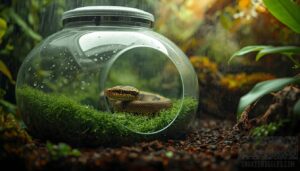
Once you’ve matched a hide to your snake, the next step is picking one that can handle constant dampness. A humid hide sits in the wettest part of the enclosure, so the material matters as much as the size.
Look for these three features:
- Non-porous material. Sealed PVC or smooth plastic won’t warp, absorb water, or grow mold.
- Adjustable ventilation design. Small vents let air circulation carry off stale, warm air, which lowers respiratory infection risk without draining moisture retention.
- Easy access. A removable lid lets you swap damp substrate without disturbing your snake.
Skip hides with crevices or rough textures. They’re hard to disinfect and tend to hold bacteria. Fill it with damp sphagnum so substrate moisture stays steady.
Smooth, non-porous hides wipe clean easily, so browsing these ball python hides for glass terrariums can make weekly disinfecting much simpler.
Top 4 Snake Hides for Humid Environments
You’ve got the basics down, so now it’s time to look at real options. Below are four hides that handle moisture well and give your snake a secure, humid retreat. Each one suits a slightly different setup, so you can pick what fits your enclosure.
1. Leoterra Large Snake Hide

Picture your ball python sliding into a dark, snug shelter while shed-time air hangs thick and damp. The Leoterra Large Snake Hide delivers that scene.
It’s solid black plastic, not natural wood, so it won’t soak up odors. Its size and accessibility suit adults, with a 2.75-inch entrance. Pack it with damp moss for moisture retention as a humid hide.
Since a snug fit matters most, check this guide to choosing the right hide box for a bioactive snake enclosure before sizing the entrance.
2. Reptile Humid Hideout Box
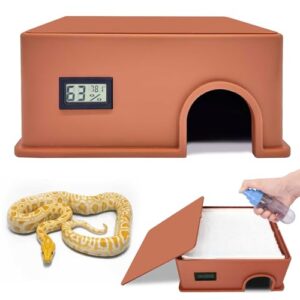
If you want something built for shedding, the Reptile Humid Hideout Box is made for exactly that. It’s a humid hide first and general shelter second. The high-density resin has smooth edges, so scales stay safe going in and out.
Pack it with moisture retaining substrate, mist lightly, and check your hygrometer calibration. Rotate substrate often so mold never settles in.
If your snake is approaching a shed, our guide to humidity and moisture requirements during shedding explains how to adjust levels so the skin comes off in one clean piece.
3. Repti Zoo Snake Hide Cave
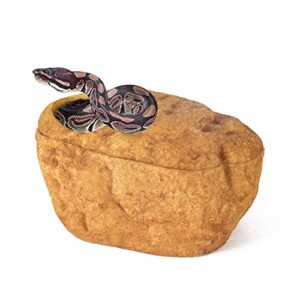
The Repti Zoo Snake Hide Cave gives your snake a natural-looking retreat made from high-grade resin. At 11 x 7 x 6 inches, it comfortably shelters snakes up to 4 feet long, and it works well for shedding and egg-laying.
A strong magnetic structure secures the top and bottom, though the lid can be tricky to lift one-handed. It’s heavy, so handle it with care. It may be too big for baby ball pythons, so save it for larger snakes.
- Made of high-grade resin with a natural look that suits reptile terrariums
- Roomy 11 x 7 x 6 inch size shelters snakes up to 4 feet long
- Strong magnetic structure secures the top and bottom, and the hide works well for shedding and egg-laying
- Magnetic lid may be difficult to lift one-handed
- May be too big for baby ball pythons
- Heavy weight may require careful handling in enclosures
4. Reptile Humid Hideout Cave
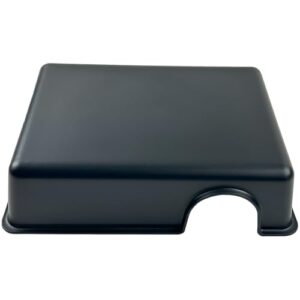
The Reptile Humid Hideout Cave suits small or juvenile corn snakes, plus geckos and frogs. Its plastic body measures 5.51 x 3.54 x 2.2 inches and includes a built-in monitor.
- Fill the groove with moisture retaining substrate.
- Check the monitor daily to keep humidity steady.
- Keep air circulation open for mold prevention.
It works as a compact, reassuring humid hide.
Build and Position a DIY Humid Hide
A damp patch of forest floor tells a snake it’s safe to shed, and you can recreate that little sanctuary yourself.
A little patch of damp forest floor tells a snake it’s safe to shed, and you can build that sanctuary yourself
Start with a DIY humid hide made from a plastic tub or a short section of wide PVC pipes with end caps. Cut a smooth entrance slightly wider than your snake’s body, then sand every edge until it’s burr-free. Drill a few small vent holes and cover them with fine mesh.
Fill the hide with moisture-retaining substrate, such as sphagnum moss dampened until it holds together without dripping.
Place it on the warm side, away from drafts, and wedge it so it can’t tip. Before trusting any readings nearby, run a quick hygrometer calibration so your numbers mean something.
Monitor Humidity and Keep Snake Hides Clean

Most snakes need humidity of 65-70% during shedding, so accurate humidity monitoring matters more than you might think.
Place a digital hygrometer at mid-level, away from misters and heat lamps, and check it daily. Cheap analog dials often mislead you.
Wet hides invite trouble, so keep this routine:
- Spot-clean humid hides weekly, removing waste and checking moisture.
- Replace moss immediately if you see mold growth.
- Deep clean monthly, disinfecting and rinsing thoroughly.
- Air dry hides completely before returning them.
- Compare your hygrometer against a second one monthly.
Keep the hide moist, never dripping. Saturated substrate encourages bacteria and scale rot.
Don’t seal every vent to raise humidity. Good air circulation and steady ventilation keep the enclosure healthy, even when it’s humid.
Frequently Asked Questions (FAQs)
What is a good humid hide for snakes?
A good humid hide is a lidded plastic container with an entrance hole, filled with damp sphagnum moss. It holds moisture, is easy to clean, and lets your snake shed comfortably.
How do I keep my snakes enclosure humid?
Think of humidity as breath inside your snake’s home. Mist the enclosure, use damp moisture-holding substrate, and cover part of the lid. Add a humid hide, then check relative humidity with a hygrometer, adjusting misters and substrate rotation.
How to create a humid hide for snakes?
Wondering how to build a DIY humid hide? Fill a snug lidded container with damp sphagnum moss, cut one entrance and a few ventilation holes, then place it mid-warm. Check your hygrometer and re-moisten daily.
Do snakes like humid environments?
Picture a ball python curled inside a damp, mossy hide, skin loosening in one clean sheet. Whether snakes like humidity depends on species: tropical ones thrive at 60-80%, corn snakes prefer 50-60%, and sand boas stay drier.
What is the best bedding for snakes in humidity?
For humidity, coconut fiber or cypress mulch is your best bet. Both are moisture-retaining substrate options that hold water well, and cypress resists mold. Skip aspen, and check your hygrometer often.
How to make a snake humid hide?
Grab a lidded plastic tub and cut a smooth, snug entrance hole. Fill it with damp sphagnum moss or coconut fiber, then squeeze test it. Place it on the warm side, and check your hygrometer.
How to make a snake enclosure less humid?
Start with ventilation. Add vents or prop the lid open so humid air escapes, and use a small fan for steady air circulation. Swap damp bedding for a dehumidifying substrate like aspen, then check your hygrometer.
How often should humid hides be replaced entirely?
Wondering when to start fresh? Replace substrate in your humid hides every four to six weeks.
Skip the schedule if you see mold growth. Use substrate sterilization, rehydrate with dechlorinated water, and offer shedding assistance.
Can a humid hide double as a nesting spot?
Yes, a humid hide can double as a nesting spot. Fill it with moisture-retaining substrate, place it on the warm end of the temperature gradient, and your gravid snake gets behavioral benefits from feeling secure.
Do all snake species need a humid hide?
Not every snake needs one, but most benefit from a humid hide. Good species-specific care matters here. Arid species like corn snakes can do fine without one, while tropical snakes need it for their shedding cycle.
Conclusion
Picture a ball python named Juniper, two days into shed, tucked inside a moss-filled hide that’s warm, damp, and dark. Tomorrow, she slides out of her skin in one clean piece, tail tip included.
That’s what the right snake hides for humid environments can do for your animal. Pick one that breathes, wipe it down weekly, and check your hygrometer daily. Small habits like these protect your snake’s health. Do that, and sheds go smoothly.