This site is supported by our readers. We may earn a commission, at no cost to you, if you purchase through links.

Ball pythons spend most of their lives out of sight—18 to 23 hours a day hidden away is completely normal for this species. So when yours disappears for days at a time, the instinct to worry makes sense, but the behavior itself often doesn’t.
The tricky part is knowing when a ball python hiding too much reflects healthy instinct versus something that needs your attention.
A new enclosure, an approaching shed, or a meal digesting in a warm hide can all look identical to early signs of stress or illness.
Getting that distinction right comes down to understanding what’s driving the behavior—and knowing exactly what to look for in your enclosure setup, temperatures, and your snake’s physical condition.
Table Of Contents
- Key Takeaways
- Is Your Ball Python Hiding Too Much?
- Common Reasons Your Ball Python Hides
- Enclosure Setup That Reduces Excessive Hiding
- Temperature and Humidity Are Key Factors
- When Hiding Signals a Health Problem
- How to Encourage Your Ball Python to Be More Active
- Frequently Asked Questions (FAQs)
- Conclusion
Key Takeaways
- Ball pythons hiding 18–23 hours daily are completely normal, but a sudden shift in that pattern — especially paired with skipped meals or low energy — is the real sign something’s wrong.
- Most excessive hiding traces back to fixable husbandry issues: warm side should hit 88–92°F, cool side 76–80°F, and humidity needs to stay between 60–80% consistently.
- Pre-shed, post-feeding digestion, and new enclosure stress all look identical to illness, so check physical condition — weight, scales, breathing — before assuming a health problem.
- Warning signs that actually need a vet include wheezing, nasal discharge, visible spine or weight loss, retained eye caps, or any hiding that comes with weeks of feeding refusal.
Is Your Ball Python Hiding Too Much?
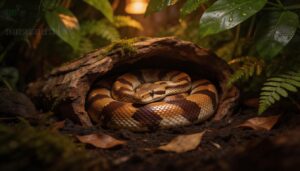
Ball pythons are naturally secretive animals, so some hiding is completely normal — but there’s a line between instinct and a sign that something’s off. Knowing where that line is will save you a lot of unnecessary worry.
Once you know how to read ball python stress signals, the difference between "just being a snake" and a real problem becomes much easier to spot.
Here’s what you need to understand about normal hide behavior, the instincts driving it, and how to spot when it becomes a problem.
How Much Hiding is Normal for Ball Pythons
Most ball pythons spend 18 to 23 hours hidden every single day — that’s not a problem, it’s their baseline.
Hide count variability and individual personality differences mean some snakes barely emerge, while others explore more. circadian rhythm influence drives activity after dark, not during daylight.
Ensuring they maintain proper temperature gradient helps reduce stress. A healthy behavioral baseline looks like this:
- Hidden most of the day
- Active 30 minutes to a few hours at night
- Consistent feeding response and stable body weight
Natural Instincts Behind Daily Hide Use
That daily hiding isn’t stubbornness — it’s millions of years of wiring.
Ball pythons rely on a strong nocturnal rhythm, burrow preference, and predator ambush strategy to survive in the wild. Their energy conservation instinct keeps them still and concealed most hours.
A secure ball python hide isn’t optional; it satisfies the camouflage instinct and natural hiding behavior built into every one of them.
Differences Between Normal and Excessive Hiding
The real tell isn’t hide frequency—it’s pattern consistency. A snake that retreats during daylight hours but comes out to eat, drink, and explore at night is showing normal hiding behavior in ball pythons.
Routine deviation is the red flag: sudden, prolonged concealment paired with skipped meals or low energy shifts hiding from instinct into a behavioral indicator worth investigating.
Common Reasons Your Ball Python Hides

Most of the time, a ball python hiding isn’t a crisis — it’s just doing what ball pythons do.
But the specific reason matters, because different causes call for different fixes.
Here are the most common ones worth knowing.
Adjusting to a New Environment
Moving into a new enclosure is a full sensory reset for your snake. New smells, new airflow, new Microclimate Zones — it all triggers instinct-driven concealment during the Acclimation Timeline, which usually runs one to two weeks.
Here’s what facilitates faster Territory Mapping and Scent Familiarization:
- Maintain steady temperature gradient (88–92 °F warm, 76–80 °F cool)
- Prioritize humidity control at 60–80%
- Apply stress reduction techniques — minimize handling, limit noise
Ventilation Optimization keeps the new environment breathable without disrupting settling.
Pre-Shed and Shedding Phase Behavior
When your snake hits the pre‑shed phase, expect a Pre‑Shed Hiding Surge. Opaque Eye Caps from Blue Phase Vision cut their sight, making them defensive and reclusive.
Skipping a feeding during this phase is completely normal—your snake’s appetite often drops off naturally, and you can find guidance on timing adjustments in this snake health and shedding prevention guide.
Poor humidity problems worsen abnormal shedding, so keep levels near 80%. Thermal gradient importance in reptile husbandry shows here — proper warmth drives normal ecdysis.
Post‑Shed Activity Spike and Nose Rubbing Behavior confirm the cycle’s end.
Post-Feeding Digestion and Rest
After a meal, your ball python isn’t being antisocial — it’s working. Postprandial thermophily kicks in immediately, driving your snake toward the warm side to spike its metabolic rate and speed up digestion. This digestive rest phase is completely normal.
After eating, a ball python retreats to warmth not out of antisocial behavior, but to fuel digestion
During the digestion period, watch for these postmeal hiding patterns:
- Coiling tightly in the warm hide for 3–7 days
- Minimal movement until the meal fully processes
- Postprandial hide preference near 88–92°F substrate temps
- Increased hydration impact — keep fresh water available
- Reduced tongue-flicking and surface exploration
Don’t handle during this window.
Seasonal Brumation and Pseudo-Brumation
Even indoors, your ball python’s internal clock reacts to daylight cues and shifting temperatures. When seasonal signals trigger hormonal changes, a metabolic slowdown follows — your snake hides more, eats less, and moves rarely. That’s brumation.
Pseudobrumation looks identical but stems from poor temperature gradient setup rather than true seasonal cycles. Correct the warm side to 88–92°F, and normal activity usually returns within days.
Stress From Handling, Light, or Noise
Your ball python isn’t being dramatic — it’s reacting to real stressors in its environment. Handling frequency, bright light levels, low-frequency noise, and enclosure placement all drive excessive hiding.
- Handle no more than 3–4 times weekly; sessions over 15 minutes raise stress noticeably
- Keep light below 50 lux during the day and avoid pre-shed handling
- Place enclosures away from speakers, appliances, and high-traffic areas
- Cover three sides to reduce noise stress and visible disturbances
Enclosure Setup That Reduces Excessive Hiding
If your ball python is hiding more than usual, the enclosure itself is often the first place to look.
Small adjustments to tank size, hide placement, substrate, and lighting can make a real difference in how comfortable and active your snake feels.
Here’s what to get right.
Choosing The Right Tank Size and Lid

Tank size matters more than most keepers realize. Hatchlings do well in 10-gallon setups, juveniles need a 20-gallon, and adults require at least a 40- to 60-gallon snake enclosure. Too much space without cover triggers hiding. Follow age-appropriate sizing as your snake grows.
For front-opening PVC or latched mesh both work — just make sure your lid lock mechanisms are tight. Mesh vs solid lids affect humidity directly, so balance ventilation carefully.
Placing Hides in Both Thermal Zones
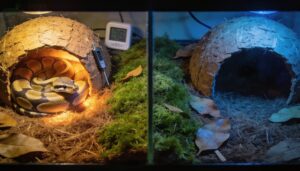
Every hide in your enclosure should serve a purpose. Place the warm hide directly over your heat source, targeting 86–90°F inside, and a matching cool hide on the opposite end, around 72–80°F.
Keep entrance size and shape consistent — hide size matching and entrance uniformity lets your snake choose by temperature, not comfort.
Put your thermostat probe inside the warm hide at snake level for accurate readings.
Best Substrate and Décor for Security
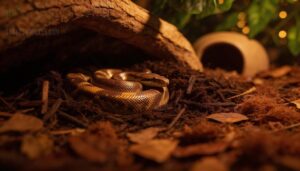
Substrate and décor choices matter more than most keepers realize. Here’s what actually works:
- Cypress mulch or coco coir holds humidity well and lets your snake partially burrow
- Deep substrate — 3 to 4 inches — gives real coverage options
- Cork bark and dense clutter create stable cover across the whole floor
- Snug hides with tight entrances reduce exposed, open-air resting spots
Lighting Cycles That Support Natural Behavior
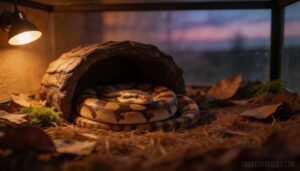
Lighting works the same way the substrate does — it either helps your snake feel secure or quietly stresses it out.
| Setting | Target | Effect |
|---|---|---|
| 12‑Hour Cycle | 12 hrs on / 12 hrs off | Promotes circadian rhythms |
| True Night Darkness | No bulbs after dark | Reduces nighttime stress |
| Low Light Levels | Ambient room light | Limits excess hiding |
Skip bright overhead lights. Seasonal day length shifts and UVB light balance matter less than keeping the cycle consistent.
Temperature and Humidity Are Key Factors

If your ball python is hiding more than usual, the climate inside the enclosure is often the first place to look. Temperature and humidity affect nearly every behavior, from how long they stay tucked away to how well they shed.
Getting these two factors right makes a real difference, so here’s what you need to know.
Setting The Correct Thermal Gradient
Get the thermal gradient right, and your ball python will move between zones naturally instead of staying locked in one hide.
The warm side should hit 88–92°F, with basking spot placement ideally reaching 90–95°F at substrate level. Cool side stays 76–80°F.
That gap is non‑negotiable — thermal zone balance drives temperature regulation. Check both sides daily using probe thermometers, and allow a controlled nighttime temperature drop to around 75–78°F.
Managing Humidity During and Between Sheds
Humidity matters just as much — and the same hiding patterns you saw during temperature issues can show up from humidity problems too.
Between sheds, enclosure humidity at 60–80%. During the pre-shed and shed phase, push it closer to 80%. A Moss Humid Hide with damp sphagnum moss gives your snake a microclimate to choose on its own terms.
- Substrate Moisture Balance prevents long dry spells between mistings
- Water Dish Size directly affects evaporation — bigger dish, more ambient moisture
- Ventilation Airflow Control keeps condensation from building up while holding steady humidity
- Humidity Stabilization Techniques like layered substrate do more than single misting spikes
Abnormal shedding — stuck eye caps, patchy breaks — almost always traces back to humidity that dropped too low and stayed there.
Using Thermostats and Hygrometers Correctly
Even the best thermostat fails if the probe is in the wrong spot. Place your thermostat probe at substrate level inside the warm hide — where your snake actually sits, not where the heat mat runs hottest. Your hygrometer belongs in the mid-enclosure, clear of buried substrate.
| Device | Correct Placement | Common Mistake |
|---|---|---|
| Thermostat | Inside warm hide, substrate level | Clipped to enclosure wall |
| Warm-side thermometer | On substrate surface | Above the snake’s body zone |
| Hygrometer | Mid-enclosure, ambient air | Buried in damp substrate |
Daily probe placement checks, a consistent calibration routine, and basic device maintenance keep your gradient monitoring reliable. Don’t assume a set number is accurate — verify it.
When Hiding Signals a Health Problem
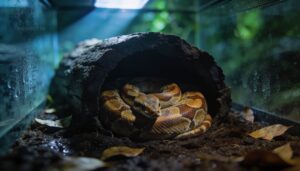
Most of the time, hiding is just your ball python doing what ball pythons do.
But when it comes with other changes — weight loss, odd breathing, dull scales — it’s worth paying closer attention. Here are the key warning signs that hiding might mean something is actually wrong.
Respiratory Infection Warning Signs
A ball python hiding around the clock isn’t always just "being a ball python." When abnormal hiding pairs with respiratory signs, something’s wrong. Respiratory and bacterial infections in snakes move fast, so catch them early.
Watch for these health problem signs:
- Mouth gaping while resting in a warm hide
- Wheezing sounds or audible clicking with each breath
- Nasal discharge — clear bubbles, foam, or yellow pus at the nostrils
- Lethargy signs paired with weight loss across consecutive weeks
Any one of these warrants a vet call.
Skin, Scale, and Shedding Abnormalities
Abnormal shedding is one of the clearest signs something’s off. A healthy ball python sheds in one piece every four to six weeks — patches left behind, scale discoloration as a health indicator, or crusty lesions on belly scales, point to improper humidity or infection.
Retained eye caps and scale rot management both require prompt action before tissue damage sets in.
Weight Loss, Lethargy, and Behavioral Red Flags
Weight loss in snakes doesn’t announce itself loudly. It creeps in — a slightly sharper spine, wrinkled skin along the sides, sunken eyes.
Combined with lethargy and abnormal hiding, these behavioral red flags form a pattern worth taking seriously:
- Visible vertebrae or tail thinning
- Limp, unresponsive body during handling
- Weeks of feeding refusal alongside digestive slowdown
Body condition scoring and consistent health monitoring catch these stress signs early.
When to Call a Reptile Veterinarian
Don’t wait when you spot blood in feces, impaction signs like a swollen belly with no stool output, visible fractures, severe dehydration, or abnormal posture like stargazing.
Signs of respiratory infection in snakes — wheezing, open-mouth breathing, nasal discharge — also need same-day attention.
Veterinary care guidelines for ball pythons recommend yearly exams minimum, but these illness symptoms in ball pythons mean you call now, not later.
How to Encourage Your Ball Python to Be More Active

Getting your ball python out of hiding more often comes down to a few consistent habits and the right setup. None of it requires major changes — just small adjustments that work with your snake’s instincts rather than against them.
Here’s what actually matters.
Safe Handling Techniques and Acclimation Steps
Give your new ball python at least one to two weeks before any contact — that acclimation period isn’t optional. Once it’s eating consistently, start with a stress-free introduction: wash your hands first (Hand Washing Protocol matters), then tap gently and scoop from the midsection using both hands.
Keep sessions to five to ten minutes. Gradual handling techniques build handling confidence without pressure.
Building Trust Without Causing Stress
Trust builds faster than you’d think — but only if you stay consistent. quiet environment and gentle touch do more than any forced interaction.
Approach slowly, never from above, and keep sessions short.
Positive reinforcement here means simply not pushing too hard. Gradual acclimation through minimal disturbance lets the snake learn you’re predictable, not a threat.
Feeding Schedule and Prey Size Best Practices
Feeding frequency matters more than most owners realize. Hatchlings need meals every 5–7 days; adults do fine every 1–2 weeks.
For prey size selection, match feeders to roughly 10–15% of your snake’s body weight, with a mid-body fit that isn’t noticeably wider than the snake itself.
Nighttime feeding aligns with their natural rhythm. Weight monitoring monthly keeps your regular feeding schedule on track.
Enrichment and Habitat Complexity Tips
Once feeding is dialed in, habitat complexity is the next lever. Dense cover — cork bark, artificial plants, branches — creates microhabitat zones that give your snake choices instead of one exposed floor.
Rotate décor occasionally for sensory stimulation without full overhauls.
A hide box packed with sphagnum moss doubles as a microclimate zone during sheds.
Live plant integration and varied decor rotation keep the environment from going stale.
Frequently Asked Questions (FAQs)
What are signs of overfeeding a ball python?
healthy ball python looks like a melted Hershey Kiss in cross-section.
Overfeeding shows through Body Shape Changes, Fat Rolls, Bulging Abdomen, Irregular Defecation, Regurgitation Episodes, increased body weight, and lethargy.
Can ball pythons cohabitate without increased stress?
Ball pythons are solitary by nature. Cohabitation almost always increases stress through resource competition, territorial aggression, and sexual dynamics.
Individual monitoring becomes nearly impossible, and feeding hierarchy issues make health tracking unreliable. Keep them separate.
How long do ball pythons typically live in captivity?
Think of a ball python as a long-term companion. With proper care, they generally live 20 to 30 years in captivity — and some reach 47 to
Do ball pythons recognize their owners over time?
Over time, yes — but not the way a dog or cat would. Your ball python builds Scent Familiarity through repeated contact, using chemical cues to distinguish you from strangers.
Are certain ball python morphs more prone to hiding?
Most morphs don’t hide more by nature. Albinos may stay covered longer due to light sensitivity, but genetic hiding variance is real — individual personality matters far more than morph name.
Conclusion
Finding the fine line between normal and excessive hiding habits helps you foster a healthy, happy ball python. By understanding your snake’s instinctual needs and recognizing potential health issues early, you can create a comfortable environment that encourages natural behavior.
If your ball python hiding too much concerns you, assess the enclosure, temperature, and humidity levels. With careful attention and adjustments, you can give your pet the best chance to thrive and interact with you confidently.