This site is supported by our readers. We may earn a commission, at no cost to you, if you purchase through links.

A snake that won’t eat, keeps rubbing its nose against the glass, or sheds in ragged, stuck patches isn’t being difficult—it’s telling you the air is wrong.
Humidity sits at the center of nearly every reptile health problem that stumps new keepers, yet most enclosures run on guesswork: a cheap dial hygrometer, some bark substrate, and a prayer. Your snake’s respiratory system, immune function, and skin integrity all depend on hitting a specific moisture window, and that window shifts by species, season, and even time of day.
Building a proper DIY humidity control setup removes the guesswork entirely—replacing it with sensors, smart substrate layering, and ventilation you can actually adjust.
Table Of Contents
Key Takeaways
- Your humidity target isn’t one-size-fits-all — species like rosy boas need as low as 20–40% RH while green tree pythons need up to 90%, so dial in the right range before building anything.
- Layering substrate with expanded shale at the base, vermiculite in the middle, and coconut fiber on top creates a passive moisture buffer that keeps humidity stable without constant manual correction.
- An Arduino-based controller with a DHT11 or DHT22 sensor lets you automate both your humidifier and exhaust fan with adjustable thresholds, removing the guesswork from daily humidity management.
- Too much humidity is just as dangerous as too little — watch for condensation, mold, and foggy glass, and pair good ventilation with regular sensor calibration to keep conditions consistently in range.
Pick The Right Humidity Range
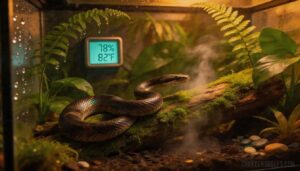
Getting the humidity right starts with knowing exactly what your snake needs — and that number isn’t the same for every species.
A quick look at how low humidity causes shedding problems makes it clear why getting that number dialed in for your specific species really matters.
Before you build anything, you need a clear target to aim for. Here’s what to nail down first.
Match Humidity to Your Snake Species
Every snake you keep carries its geographic origin in its biology — and that means species habitat moisture isn’t one-size-fits-all. Regular monitoring humidity levels helps prevent respiratory issues.
Match your target RH to where your snake evolved:
- Ball pythons: 60–70% RH
- Corn snakes: 40–60% RH
- Boa constrictors: 55–75% RH
- Green tree pythons: 70–90% RH
- Rosy boas: 20–40% RH
Desert vs tropical needs are worlds apart, so dial in microclimate zoning accordingly.
Set Separate Targets for Shedding Periods
Your baseline RH isn’t enough — bump your Variable Humidity Setpoint 8–12% above normal during the shedding window.
Shedding changes the game.
Think of it like a Shedding Target Schedule: you’re running Microclimate Calibration for a temporary phase.
In an Arduino-based humidity control system, adjustable thresholds and a user-defined setpoint via potentiometer let you dial in Automated Trigger Logic with a tight Hysteresis Band — no guesswork.
Check Warm Side and Cool Side Moisture Levels
Once your shedding targets are set, check both sides of the enclosure separately — the Humidity Differential between warm and cool zones tells the real story.
- Mount a humidity sensor DHT11 on the warm side near the basking spot.
- Place a second unit on the cool side for Reading Synchronization.
- Log both zones on your Arduino UNO board with LCD display for Trend Analysis.
- Adjust Vent Placement to control Condensation Spotting before it builds.
Spot Signs of Low Humidity in The Enclosure
Once you’ve mapped both zones, low relative humidity shows up fast if you know where to look.
Dry skin during molts, curling leaves on live plants, and sparse water droplets on enclosure glass are your first clues.
Mucous membrane dryness and shedding delays follow shortly after.
| Sign | What It Tells You |
|---|---|
| Dry skin during shed | RH dropped below target |
| Curling leaves | Rapid surface moisture loss |
| Sparse water droplets on glass | Poor humidity exchange |
| Shedding delays | Inadequate moisture for molt |
| Mucous membrane dryness | Sustained low ambient RH |
Your LCD realtime humidity measurement with LCD readout confirms what you’re seeing.
When the red LED status indication for humidity levels activates, don’t wait — act.
Spot Signs of Excess Humidity and Poor Airflow
Too much moisture is just as dangerous as too little. Watch for these red flags:
Knowing how to raise and stabilize your snake’s humidity levels means you’ll catch these warning signs early and actually know what to do about them.
A reptile humidity gauge for corn snake enclosures takes the guesswork out of monitoring before small imbalances turn into real problems.
- Condensation fogging on glass and water backsplash pooling in corners signal poor humidity regulation.
- Mold indicators like fuzzy patches warn of stale air and vent blockage.
- LED status indication for humidity levels turning red triggers the fan relay for environmental monitoring correction.
Assemble Your DIY Materials
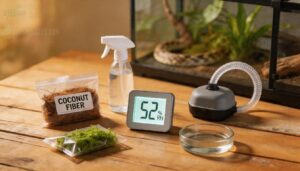
Getting the right materials together before you build makes the whole process a lot smoother. Each piece you choose — from your hygrometer to your substrate — directly affects how stable your snake’s environment stays day-to-day.
Here’s you’ll want to have on hand.
Digital Hygrometer and Thermometer Choices
Your meter is your eyes inside that enclosure. Entry-level digital units with DHT11 temperature humidity sensor technology normally hold ±5% RH accuracy — workable, but the DHT22 sensor tightens that to ±2–3%.
Look for wired probes, clear display types, and Bluetooth wireless connectivity for phone logging.
Check battery life on coin-cell models, and always run calibration methods using a salt test before trusting any reading.
Moisture-holding Substrate Options
Your substrate is the silent workhorse of humidity control. Peat moss benefits include holding up to 20 times its weight in water, while coconut fiber aeration keeps things from going swampy.
Add vermiculite water retention for long-lasting moisture pockets, and biochar porosity enhancement improves airflow underneath.
Think of it like layered insulation — each component pulling its weight for stable environmental monitoring.
Humid Hide and Sphagnum Moss Supplies
Your humid hide is only as good as what’s inside it. For sphagnum moss, Moss Quality Grading matters — fine-grade New Zealand moss holds up to 20 times its weight in water.
Apply Supplier Selection Criteria: choose reptile-specific vendors. Use breathable Storage Bag Types to extend shelf life.
Follow a 3–6‑month Replacement Schedule Guidelines to keep conditions stable and mold‑free.
Water Bowl Size and Placement Basics
Don’t underestimate the passive humidity engine — it’s a passive humidity engine running 24/7. Bowl Capacity Guidelines start at 200–500 ml for most setups, while Rim Width Considerations favor wide-lipped ceramic or stainless steel for Material Choice Benefits: nonporous, easy to sanitize.
- Place bowls on the cool side using Placement Height Tips at substrate level.
- Apply Stability Tips — sink the bowl slightly so your snake won’t tip it.
- Keep it away from heat sources to support consistent humidity measurement.
- Position near a wall to support environmental control without excess evaporation.
Manual Mister, Fogger, or Drip System Options
Each option hits differently. A manual mister with adjustable Mister Nozzle Types gives you direct control for quick humidity boosts. Foggers need the right Fogger Reservoir Size to run overnight without refilling. A drip setup lets you dial in Drip Flow Calibration precisely.
Consider System Noise Levels and Power Consumption Comparison before committing — quieter, low-draw units won’t stress your snake or your electricity bill.
Vent Covers and Airflow Control Materials
Airflow is the silent partner in humidity control — get it wrong, and your whole setup fights itself.
- Aluminum vent covers resist warping and corrosion in persistently humid enclosures.
- Adjustable duct dampers let you fine-tune air volume without disturbing your snake.
- Magnetic vent seals snap off for fast cleaning, then lock tight again.
- Acoustic louvers cut airflow noise that stresses sensitive animals.
Pair these with HEPA filter inserts to block debris. For automation, a 5V relay module — or a Grove 2Channel SPDT Relay — can drive both your humidifier relay and fan relay from a single controller, turning your automatic air humidifier into a responsive, hands‑free system.
Build The Enclosure Setup
Now it’s time to put everything together inside the enclosure. Each piece you place—from the hygrometer to the water bowl—has a job to do, and where you put it matters more than you’d think.
Here’s how to set it all up the right way.
Place The Hygrometer in The Right Location
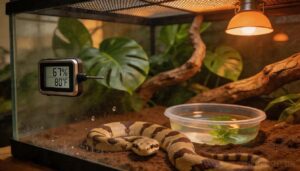
Mount your hygrometer at eye level on a side wall, roughly 4–5 feet up — that’s your sweet spot for accurate relative humidity readings inside the enclosure. Keep it away from heat lamps, drafts, and vents, since a DHT11 temperature‑humidity sensor sitting too close to airflow will skew your humidity range data quickly.
Distance from vents matters more than most keepers realize.
Layer Substrate for Better Moisture Retention
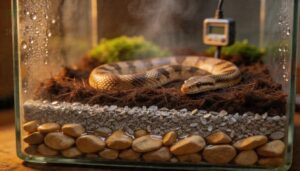
Once your hygrometer is placed, the substrate layering is what actually holds your humidity levels steady between readings.
Start with an Expanded Shale Base (2–3 cm) for drainage, then add a Vermiculite Mix mid‑layer for even moisture distribution. Top it with a Coconut Fiber Layer to retain surface humidity.
- Vermiculite prevents Layer Compaction Prevention issues by keeping air pockets open.
- Coconut fiber holds up to 40 % more moisture than plain bark.
- A proper Moisture Gradient Design lets your snake choose its comfort zone.
- This passive setup reduces how often your DHT11 Temperature Humidity sensor triggers the humidity threshold in your Arduino‑based humidity control system, giving you stable real‑time humidity measurement with LCD without constant environmental automation corrections.
Create a Humid Hide That Stays Damp
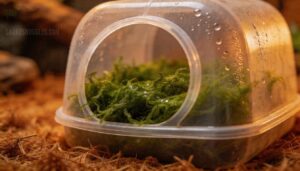
With your substrate layers sorted, the humid hide is where local moisture really concentrates. Use a sealed plastic container — Container Seal Integrity matters here — with a Drainage Slot Design cut along the base edge to prevent pooling. Pack damp sphagnum moss inside and monitor it with Moss Moisture Monitoring checks every 2–3 days.
| Feature | Spec | Why It Matters |
|---|---|---|
| Entry hole | Snake’s girth width | Reduces humidity escape |
| Substrate depth | 1–2 inches damp moss | Substrate Moisture Buffer |
| Placement | Warm side of enclosure | Temp Humidity Coupling drives evaporation |
Your DHT11 Temperature Humidity Sensor, paired with an Arduino-based humidity control system, tracks when the humidifier relay needs to fire — keeping your user‑adjustable humidity setpoint interface accurate and your automatic humidifier and fan control responsive without constant manual intervention.
Position The Water Bowl for Natural Evaporation

Set your shallow wide bowl on the warm side positioning of the enclosure — heat drives evaporation naturally.
Keep a stable non-slip base underneath so it won’t shift during feeding.
Your light avoidance strategy matters too; direct bulbs overheat the water quickly.
Gentle airflow exposure across the surface helps distribute moisture evenly.
Your humidity sensor Arduino and real-time humidity measurement with LCD will confirm when environmental regulation is holding steady.
Adjust Ventilation to Reduce Humidity Loss
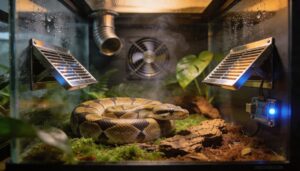
Ventilation is your humidity’s silent enemy — too much airflow and moisture bleeds out faster than your humidifier relay can compensate. Use Cross Vent Placement on opposite enclosure walls, and tune Exhaust Fan Speed low enough to exchange stale air without stripping moisture.
Louvers Positioning at a partial angle, combined with Pressure Balancing and your Arduino-based humidity control system’s User-adjustable humidity setpoint interface, keeps feedback control tight year‑round.
Add a Simple Misting or Fogging Routine
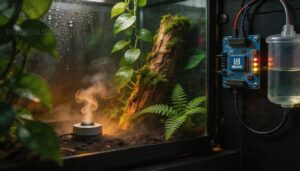
A consistent misting routine starts with Mist Frequency — twice daily works for most setups. Position your Fogger Position low in the enclosure so droplets rise naturally.
Pair a 5–10 liter Reservoir Capacity with Timer Scheduling to automate delivery.
Your Arduino based humidity control system manages Relay switching via the DHT11 Temperature Humidity sensor, while the LCD feedback display for humidity confirms results.
Clean Nozzle Cleaning weekly.
Dial in Moisture Levels
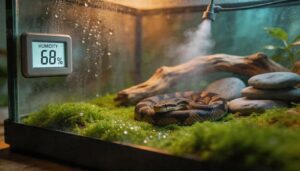
Getting the humidity right takes a bit of back-and-forth, but once you nail the balance, the enclosure basically runs itself. Before you introduce your snake, you’ll want to stress-test every part of the setup and know exactly how to nudge moisture up or down without throwing everything off.
Here’s how to dial it in the right way.
Test The Setup Before Adding Your Snake
Run a full system dry run before your snake ever touches that enclosure. Power it up, check power stability, and let the Arduino sketch collect 24 hours of real data.
Watch your LCD for real-time humidity measurement and confirm your DHT11 sensor calibration reads accurately. Check for leaks, verify your safety override responds correctly, and review your circuit design for humidity sensing consistency.
Raise Humidity Without Soaking The Enclosure
Soaking your substrate is the fastest way to create a mold farm. Instead, layer your moisture sources — passive evaporation from a wide water dish, a capillary mat beneath the humid hide, and humidity buffer materials like sphagnum moss all work together gradually.
Layer your moisture sources gradually — soaking substrate is the fastest way to build a mold farm
- Adjust misting frequency to two or three light sessions daily
- Position your fogger placement low, near the cool side
- Use your set humidity threshold using a potentiometer on the Arduino-based humidity control system to trigger the humidifier relay only when the DHT11 sensor reads below your target
- Watch LED status indication for humidity levels — green means you’re dialed in
Lower Humidity Without Drying It Too Fast
Dropping humidity too fast stresses your snake as much as keeping it too high. Gradual Humidity Reduction — no more than 5% RH per hour — is the target.
Open vents slightly, activate your fan relay, and let your Arduino-based humidity control system handle Dew Point Management automatically.
Your DHT11 Temperature Humidity sensor monitors each Sensor Reading Interval, adjusting the setpoint through Targeted Mist Scheduling while Microclimate Buffering and Humidity Drift Monitoring keep conditions stable.
Balance Humidity With Heat and Ventilation
Heat and humidity move together — warm air holds more moisture, so your Thermal Gradient Management directly shapes your RH readings.
Use your DHT11 Temperature Humidity sensor alongside these four steps for solid Heat Ventilation Balance:
- Run your fan relay when temps spike
- Activate your humidifier relay if RH drops after ventilation
- Apply a Cross Ventilation Strategy to prevent stagnant pockets
- Use Adaptive Setpoint Control with Latent Heat Recovery to stabilize terrarium temperature and humidity automation
Prevent Condensation, Mold, and Stagnant Air
Once you’ve balanced heat and ventilation, condensation becomes your next fight. Keep RH between 40–60%, wipe surfaces daily, and seal gaps where cold air sneaks in. Desiccant packs help absorb excess moisture near cool walls.
Your DHT11 Temperature Humidity sensor, paired with an Arduino‑based humidity control system, lets the fan relay and humidifier relay respond quickly — stopping mold before it starts.
| Problem | Cause | Fix |
|---|---|---|
| Wall condensation | Poor temperature gradient | Insulate cool side |
| Mold patches | Stagnant air | Improve sensor placement, run fan relay |
| Foggy glass | High RH + low airflow | Activate humidifier relay + ventilation |
Track Daily Readings for Stable Control
Once condensation is under control, consistent tracking keeps everything honest. Log readings three times daily — morning, afternoon, and evening — for reliable Time-of-Day Sampling.
Your Arduino-based humidity control system performs real-time humidity measurement with LCD display, so Daily Range Logging and Spike Detection stay automatic.
Review week-over-week Trend Charting, confirm your user-defined setpoint still matches the snake’s needs, and schedule a sensor calibration Calibration Reminder every three months.
Maintain and Upgrade The System
Getting your setup dialed in is only half the job — keeping it running well is where things really matter. A little routine care and a few smart upgrades can save you a lot of headaches down the road.
Here’s what to stay on top of.
Clean The Humid Hide and Water Bowl Regularly
Your humid hide and water bowl are bacterial hotspots — don’t underestimate them. Follow a Daily Scrubbing Routine with hot water and a dedicated brush, then run a Weekly Disinfection Protocol using diluted white vinegar.
Tool Color-Coding prevents cross-contamination between hide and bowl. Always complete the Drying Procedure fully before restoring moisture. Use Cleaning Log Tracking — like data output from a DHT11 Temperature Humidity Sensor — to catch patterns early.
Replace Moss and Wet Substrate as Needed
When moss starts showing Moss Browning Indicators — persistent patches, easy detachment, or sliminess — replace it within three to six weeks. Watch for Substrate Compaction Signs like soggy layers that won’t drain.
Follow Replacement Frequency Guidelines: rinse fresh moss using Sanitation Procedures, test with Moisture Retention Testing before reintroducing your snake.
Your Arduino-based humidity control system and DIY automatic humidifier project confirm stability through real-time humidity measurement with LCD and sensor data logging for solid environmental management.
Recheck Hygrometer Accuracy Over Time
Even a reliable DHT11 Temperature Humidity Sensor drifts quietly over time.
Schedule a Calibration Frequency of every six to twelve months, and run a Reference Hygrometer Check by placing a trusted second unit nearby.
Use sensor data logging and real-time data display to spot Drift Detection early.
Confirm Sensor Position Verification hasn’t shifted, then review your Log Trend Analysis to catch creeping inaccuracies before they mislead you.
Make Seasonal Humidity Adjustments at Home
Your snake’s needs shift with the seasons, and so should your setup.
In winter, apply a Winter Boost by raising your User-adjustable humidity setpoint interface by a few points to counter dry heated air.
Summer calls for Summer Dehumid — lower the setpoint and adjust Ventilation Timing accordingly.
Use Spring Shift and Fall Tuning for gradual setpoint adjustment, letting your DIY humidity monitoring with Arduino guide every change.
Add Timers or Controllers for Automation
Automation turns a hands-on routine into a system that works while you sleep. Mount your timer outside the enclosure — proper Timer Placement keeps it dry and readable.
Connect your relay module to the fogger or misting pump, then set Cyclic Scheduling for short daily bursts.
Your Arduino-based humidity control system manages Probe Positioning, Setpoint Hysteresis, and automatic humidifier control through a user-adjustable humidity setpoint interface using millis for precise timing.
Build a Backup Plan for Power or Equipment Failure
Your automation setup is only as reliable as the power behind it. Start with UPS Selection — a small UPS bridges short outages without interrupting your humidity cycle.
Follow safe Generator Placement rules, keeping units 20 feet from vents.
Add Battery Lighting near the enclosure, run System Monitoring on voltage levels, and document your Emergency Procedure so your MB102 3.3V/5V power module and DC 12V charger stay protected.
Frequently Asked Questions (FAQs)
Can tap water affect my snakes skin health?
Yes — tap water can quietly wreck your snake’s skin. Disinfectant irritation, mineral residue buildup, heavy metal exposure, and damp contact time all add up.
Use conditioned or distilled water every time.
How does enclosure size impact humidity stability?
Bigger enclosures buffer humidity swings through sheer volume, slowing moisture decay speed. Smaller setups spike and crash faster.
Your enclosure’s air exchange rate and microclimate zones directly shape how stable your target humidity range stays.
Should hatchlings have higher humidity than adults?
Hatchlings do need higher humidity than adults. Their surface area ratio means faster moisture loss, raising dehydration vulnerability.
Keep growth-stage humidity slightly elevated, and microclimate specialization in humid hides helps shedding acceleration without soaking the full enclosure.
Does room temperature change how fast moisture drops?
Room temperature directly drives temperature-driven evaporation. Warmer air shifts the saturation point, pulling moisture out faster. That’s the core of heat-humidity balance — higher heat means quicker drops.
Conclusion
Ironically, the most complex part of snake keeping isn’t the feeding schedule or the lighting—it’s the air.
Your DIY humidity control setup doesn’t need to be expensive or elaborate; it just needs to be intentional. Dial in your substrate, secure your humid hide, and trust your hygrometer readings.
When every layer of your enclosure works together, your snake stops sending distress signals and starts thriving quietly—which, for a reptile, is the loudest success you’ll ever hear.