This site is supported by our readers. We may earn a commission, at no cost to you, if you purchase through links.

A chameleon that can’t shed properly is a chameleon in trouble. Reptiles regulate far more than temperature—humidity controls their skin health, respiratory function, and even appetite. Get it wrong, and you’ll see retained shed, lethargy, and infections that a vet visit won’t fix cheaply.
An automatic misting system takes the guesswork out of humidity management, delivering precise moisture on a schedule your animals can count on.
Whether you keep a single ball python or a room full of tropical species, the right system makes the difference between surviving and thriving.
These eight models cover every setup, budget, and maintenance preference worth considering.
Table Of Contents
- Key Takeaways
- Top 8 Reptile Misting Systems
- 1. Coospider Reptile Fogger Humidifier
- 2. Moistenland Automatic Reptile Misting System
- 3. MistKing Starter Misting System
- 4. Smart Reptile Humidifier with Timer
- 5. Exo Terra Monsoon Solo II Misting System
- 6. REPTI ZOO Digital Touch Fogger Humidifier
- 7. MrReptile Automatic Reptile Mister
- 8. Runwusheng Reptile Misting System Timer
- Choosing The Right Misting System
- Reptile Humidity Needs
- Setup, Water, and Maintenance
- Value, Reliability, and Performance
- Frequently Asked Questions (FAQs)
- Are automatic reptile misters worth it?
- How much does a professional misting system cost?
- What reptiles need to be misted?
- Can misting systems work with bioactive vivariums?
- Are automatic misters safe for hatchlings?
- How does misting affect terrarium lighting schedules?
- Do reptile misters work with smart home systems?
- Can misters cause respiratory issues in reptiles?
- Conclusion
Key Takeaways
- Humidity isn’t just comfort—drives shedding, skin health, and appetite, so getting it wrong leads to real health problems that cost more to fix than a good misting system does.
- Match your system to your setup: tank size, reservoir capacity, timer flexibility, and nozzle count all determine whether your animals thrive or just survive.
- Always use distilled or RO water, clean nozzles every two to four weeks, and keep airflow moving—skip this, and mold, clogs, and pump failure follow quickly.
- Budget systems can work, but premium builds with ceramic pumps, corrosion-resistant fittings, and modular designs hold up longer and save money over time.
Top 8 Reptile Misting Systems
Not every misting system works the same way, and the wrong pick can leave your reptile too dry or soaking wet.
Getting the spray pattern and droplet size right matters more than most people realize, and choosing the right reptile habitat materials plays a big role in how evenly moisture actually spreads.
These eight options cover a range of budgets, tank sizes, and species needs. Here’s what made the cut.
1. Coospider Reptile Fogger Humidifier
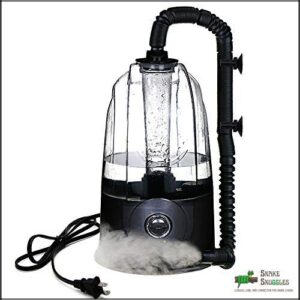
The Coospider Reptile Fogger Humidifier is a solid choice if you want hands-off humidity without constant babysitting. Its 3.8-liter tank runs up to 26 hours at medium output — enough for most tropical setups to stay in that 60–90% range overnight.
The ultrasonic atomizer keeps things whisper-quiet (under 35 dB), so your animals won’t be disturbed.
One thing to know: there’s no built-in timer, so pairing it with a smart power strip gives you real control.
| Best For | Reptile and amphibian keepers who want stable, hands-off humidity in 10–40 gallon enclosures without spraying by hand every few hours. |
|---|---|
| Water Source | Built-in 3.8L tank |
| Timer Included | No |
| Nozzle Count | 1 adjustable hose |
| Noise Level | <35 dB |
| Distilled Water Recommended | Yes |
| Clog Risk | Mineral buildup |
| Additional Features |
|
- Big 3.8L tank runs up to 26 hours at medium — plenty for overnight and then some
- Ultra-quiet ultrasonic mist (under 35 dB) won’t stress your animals during sleep hours
- Fine mist disperses evenly without soaking your substrate or pooling on enclosure walls
- No built-in timer, so you’ll need a smart plug if you want automated on/off cycles
- Low mist setting can be inconsistent and may need frequent tweaking to stay reliable
- The ridged hose traps condensation — most users swap it out for a smooth silicone tube fairly quickly
2. Moistenland Automatic Reptile Misting System
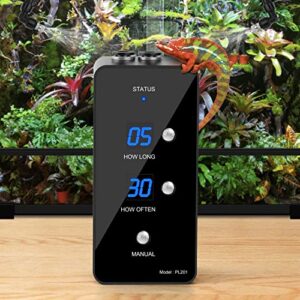
If you don’t want to deal with an internal tank, the Moistenland Automatic Reptile Misting System takes a different approach. It pulls water straight from an external reservoir — a gallon jug works fine — through a 16-foot hose to two 360°-adjustable nozzles.
You get full control over spray duration (up to five minutes) and intervals ranging from one hour to 30 days. Setup is straightforward, though the pump runs a bit loudly.
Best suited for small to mid-size enclosures.
| Best For | Reptile and amphibian keepers who want a tankless, low-maintenance misting setup they can leave running for days — or even weeks — at a time. |
|---|---|
| Water Source | External reservoir |
| Timer Included | Yes |
| Nozzle Count | 2 nozzles |
| Noise Level | Audible pump |
| Distilled Water Recommended | Yes |
| Clog Risk | Minor dripping |
| Additional Features |
|
- Pulls from any external reservoir, so you’re not stuck refilling a tiny built-in tank
- Flexible scheduling (1 hour to 30 days) means you can set it and forget it for extended trips
- Two 360°-adjustable nozzles give you solid coverage in small to mid-size enclosures
- The pump is audibly noisy, which can be annoying overnight
- Only works with its specific 5V/2A charger — use the wrong one and you’ll get errors
- Two nozzles may not cut it for larger or oddly shaped setups
3. MistKing Starter Misting System
If you’re ready to move up from basic setups, the MistKing Starter Misting System is worth the jump.
This 5th-gen kit runs on a 24V DC pump, operates near-silently, and accommodates up to 10 nozzles — all from one unit.
You get 15 feet of tubing, a programmable ST-24 timer, and a reservoir bulkhead included.
At $199.99, it’s a serious tool for tropical reptiles that need consistent humidity.
Fair warning: the timer takes some getting used to.
| Best For | Hobbyists, zoos, and botanical gardens keeping arboreal reptiles, amphibians, or tropical plants that need reliable, automated humidity. |
|---|---|
| Water Source | External reservoir |
| Timer Included | Yes |
| Nozzle Count | 1-10 nozzles |
| Noise Level | Ultra-quiet |
| Distilled Water Recommended | Yes |
| Clog Risk | Filter included |
| Additional Features |
|
- Near-silent 24V pump — easy to place in bedrooms or display cases without the noise bothering anyone
- Supports up to 10 nozzles and expands with higher-tier models as your setup grows
- ST-24 timer handles up to 10 cycles a day, so you’re not hand-misting every morning
- The timer isn’t the most intuitive — most users end up on forums figuring it out
- Tubing can be stubborn to route straight, especially for first-timers
- No reservoir included, and some users have had leaks or missing parts right out of the box
4. Smart Reptile Humidifier with Timer
 View On Amazon
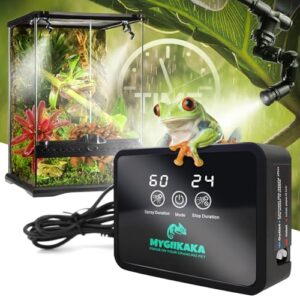
Not ready to spend $200? The Smart Reptile Humidifier with Timer covers the basics without the price tag.
It runs on USB power, so placement is flexible. Two 360° adjustable nozzles push fine mist evenly across your enclosure. You can set spray duration from 10 to 60 seconds and pause intervals from 2 to 24 hours — enough range for most tropical setups.
The built-in safety shutoff kicks in when the reservoir runs dry, which protects your pump automatically.
| Best For | Budget-conscious reptile owners who want automated misting without dropping big money on a premium system. |
|---|---|
| Water Source | External reservoir |
| Timer Included | Yes |
| Nozzle Count | 2 nozzles |
| Noise Level | Noisy pump |
| Distilled Water Recommended | Yes |
| Clog Risk | Clogs easily |
| Additional Features |
|
- USB-powered and compact, so you can tuck it almost anywhere without running new wiring
- Dual 360° nozzles give you solid mist coverage across different enclosure sizes
- Adjustable timer settings (spray duration and pause intervals) handle most tropical humidity schedules
- Hose connections have a tendency to loosen over time, which can mean surprise leaks outside the tank
- Nozzles clog pretty easily with tap water — you’ll want to use distilled water and clean them regularly
- Setup instructions are thin, and the timer controls can be finicky, so expect a bit of a learning curve
5. Exo Terra Monsoon Solo II Misting System
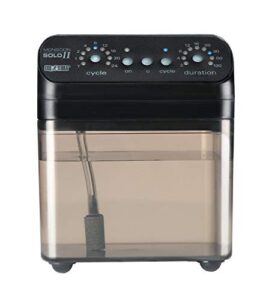
The Exo Terra Monsoon Solo II sits in a solid middle ground — capable enough for serious keepers, simple enough for beginners.
Its 36.25 psi pump delivers genuinely fine mist without pooling, and the 1.5 L reservoir accommodates several days of light use between refills.
You can dial spray duration from 2 seconds to 2 minutes, which covers everything from a quick chameleon spritz to a longer tropical soak.
Just budget for a separate power adapter — it’s not included.
| Best For | Reptile and amphibian keepers — from beginners to seasoned hobbyists — who want hands-off humidity control for tropical or bioactive setups. |
|---|---|
| Water Source | Built-in 1.5L tank |
| Timer Included | Yes |
| Nozzle Count | Up to 2 nozzles |
| Noise Level | Not specified |
| Distilled Water Recommended | Yes |
| Clog Risk | Nozzle clogging |
| Additional Features |
|
- Programmable misting cycles (2 seconds to 2 minutes) handle everything from quick chameleon sprays to long tropical soaks
- 36.25 psi pump delivers ultra-fine mist that won’t pool or oversaturate your enclosure
- Expandable to a second nozzle, so you can cover multiple tanks or a larger bioactive setup
- Power adapter isn’t included, so factor in an extra purchase right out of the box
- The 1.5 L reservoir runs out fast in high-humidity setups — expect frequent refills
- Some users report pump failures and programming glitches; distilled water is a must to avoid clogged nozzles
6. REPTI ZOO Digital Touch Fogger Humidifier
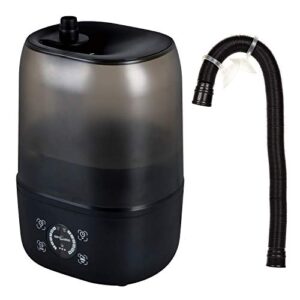
The REPTI ZOO Digital Touch Fogger punches above its weight for mid-range buyers.
Its 4-liter top-fill tank runs up to 12 hours continuously at max output — no bucket-swapping mid-week.
You get three mist rates (100, 200, or 300 ml/h), so dialing in humidity for a ball python versus a chameleon is straightforward.
The touch screen remembers your last settings, which saves time after power outages.
Just know the gaskets need monthly cleaning, or leaks will follow.
| Best For | Reptile keepers who want hands-off humidity management for mid-sized enclosures without jumping to a high-end system. |
|---|---|
| Water Source | Built-in 4L tank |
| Timer Included | Yes |
| Nozzle Count | 1 tube outlet |
| Noise Level | Quiet fan |
| Distilled Water Recommended | Yes |
| Clog Risk | Scale buildup |
| Additional Features |
|
- 4-liter top-fill tank runs up to 12 hours at full blast — no mid-week refills or awkward disassembly
- Three mist rate options make it easy to match humidity needs for different species and enclosure sizes
- Touch screen remembers your last settings, so power outages don’t mean reprogramming from scratch
- Gaskets wear down and collect grime fast — skip monthly cleaning and you’re dealing with leaks
- Fan motors have a habit of dying between 6–12 months, and replacement parts are hard to find
- The touch screen is overly sensitive, so accidental brushes can change your settings and trigger loud beeps
7. MrReptile Automatic Reptile Mister
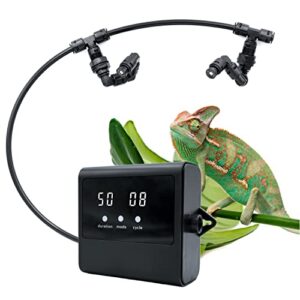
The MrReptile Automatic Reptile Mister keeps things simple without cutting corners. Its redesigned micro booster pump runs at around 55 dB — quiet enough for a bedroom setup.
You can set mist durations from a few seconds up to nine minutes, with intervals spanning one to 24 hours.
The ABS housing resists corrosion, and the built-in 2.8-liter tank skips the external bucket hassle.
One heads-up: nozzles aren’t disassemblable, so use distilled water from day one to avoid clogging.
| Best For | Reptile and amphibian keepers who want reliable, programmable misting without waking up the whole house. |
|---|---|
| Water Source | External reservoir |
| Timer Included | Yes |
| Nozzle Count | 1 nozzle |
| Noise Level | ~55 dB |
| Distilled Water Recommended | Yes |
| Clog Risk | Occasional clogging |
| Additional Features |
|
- Quiet at ~55 dB — easy to run in a bedroom or classroom without it being a nuisance
- Flexible scheduling from a few seconds to nine minutes of mist, every one to 24 hours
- Industrial-grade PCB and ABS housing make it more durable than the older version
- Nozzles can’t be taken apart, so clogging is a real headache if you skip distilled water
- Some users report pump failure within a couple months, which is frustrating at any price
- Assembly is fiddly — the zip ties are flimsy and the tubing needs a firm push or it’ll leak
8. Runwusheng Reptile Misting System Timer
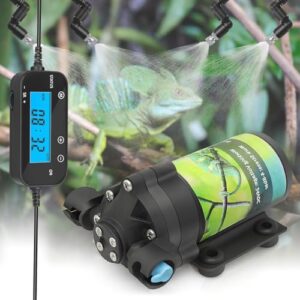
The Runwusheng gives you a lot of control for the price. At $69.55, you get 16.4 feet of tubing, six rotatable nozzles, and a self-priming pump that accommodates up to ten nozzles total.
Timer intervals range from 20 minutes to 130 days, with mist durations up to nine minutes.
There’s no built-in reservoir, so you’ll need an external container.
Fair warning — the instructions aren’t great, and hose connections can leak if you don’t cut the tubing cleanly.
| Best For | Reptile and amphibian owners who want solid automated misting without spending big on a premium system. |
|---|---|
| Water Source | External reservoir |
| Timer Included | Yes |
| Nozzle Count | 6 nozzles |
| Noise Level | Low-noise pump |
| Distilled Water Recommended | Yes |
| Clog Risk | Filter element included |
| Additional Features |
|
- Tons of timer flexibility — intervals from 20 minutes all the way out to 130 days, so you can set it and forget it
- Six 360° rotatable nozzles give you real freedom to aim the mist exactly where your animals need it
- Quiet pump means it runs in the background without bugging you or your pets
- The timer isn’t exactly intuitive — expect a few frustrating attempts before you nail your schedule
- No built-in reservoir, so you’re on your own for finding and maintaining an external water source
- Hose connections can drip if the tubing isn’t cut clean and pushed in all the way
Choosing The Right Misting System

Not every misting system works for every setup, and picking the wrong one can mean stressed animals and constant headaches.
A few key factors will point you in the right direction before you spend a dime.
Here’s what to look at.
Tank Size and Enclosure Coverage
Your tank’s size drives everything. A system with floor coverage ratio leaves dry corners where humidity drops fast. Aim for at least 60% substrate coverage to support even moisture spread.
Vertical space utilization matters too — taller enclosures need nozzles placed high to replicate rainforest habitat replication effectively.
Water runoff management keeps walls clean and substrate from getting waterlogged.
ball python humidity range should be kept between 40‑60% for healthy shedding.
Reservoir Capacity and Refill Frequency
Bigger isn’t always better, but running dry mid-cycle is. Capacity planning starts with your enclosure size and daily water consumption.
Small setups do fine with 1–2 liters. Larger enclosures demand 3+ liters for a 24-hour runtime without interruption.
Smart evaporation management — using distilled water and moisture-retaining substrate — stretches your reservoir capacity further and keeps your refill scheduling predictable instead of reactive.
Timer Flexibility and Spray Duration
Reservoir size gets you through the night — but timer control shapes the whole environment. A good programmable misting system lets you dial in adjustable misting frequency, burst synchronization across nozzles, and multi-zone programming for separate enclosures.
Three settings that actually matter:
- Interval Randomization — mimics natural rainfall patterns
- Four spray duration settings — from short bursts to longer soaks
- Battery backup — keeps your timer for spraying cycles running through outages
A clean user interface with four spray interval settings makes this simple, not stressful.
Noise Level and Pump Quality
Once your timer’s dialed in, pump noise becomes the next thing you’ll notice — especially at night.
Most quality systems land between 25 and 40 dB, with units like the MRREPTILE running under 35 dB.
Better impeller design, bearing materials like ceramic or nylon composites, and pump vibration isolation all keep things quiet.
Rubber feet and flexible tubing are simple noise dampening techniques that genuinely work.
Nozzle Count and Placement
Quiet pumps handle the "when" — nozzles handle the "where."
To select appropriate nozzle count and placement, think coverage zones first:
- Grid Spacing — Space misting nozzles 6–12 inches apart for even saturation.
- Corner Coverage — Hit enclosure edges where humidity drops fastest.
- Vertical Stacking — Layer nozzles for tall arboreal setups.
- Nozzle Angle Tuning — Adjust aim toward foliage, not hides.
Pressure Balance keeps every nozzle performing equally.
Reptile Humidity Needs

Every reptile has a humidity sweet spot, and hitting it consistently makes a real difference in their health. Your misting system is only as useful as your understanding of what your specific animal actually needs.
Here’s a breakdown of humidity requirements by species and situation.
Tropical Species and Target Humidity
same humidity level — and that gap matters. Most thrive between 70 and 90 percent during the day, with nighttime humidity settling around 60 to 85 percent.
programmable misting system helps you hit species-specific targets without guesswork. Build in microclimate zoning and a humidity gradient so your animals can self-regulate.
Keep peaks below 95 percent for mold prevention and long-term reptile health.
Ball Python Humidity Requirements
Ball pythons aren’t high-maintenance, but they do have a sweet spot.
Your Ideal Humidity Range sits between 55 and 65 percent under normal conditions — bump that to 70 to 80 percent during shedding.
Use a calibrated humidity gauge for reliable reptile enclosure humidity management, and lean on coconut fiber or cypress mulch for Substrate Moisture Retention.
A well-timed automatic misting system keeps reptile health steady without over soaking the enclosure.
Chameleons, Geckos, and Arboreal Reptiles
Chameleons, crested geckos, and other arboreal species are built for the canopy — zygodactylous feet, prehensile tails, setal adhesion on vertical glass. canopy microclimate matters too.
Target 60 to 80 percent reptile enclosure humidity control, with localized misting near foliage where they actually drink. An automatic misting system delivers those leaf droplets naturally.
Chameleons especially rely on nocturnal vision and surface moisture for arboreal species hydration.
Foggers Versus Misting Systems
Foggers and misters aren’t interchangeable. Foggers push droplets under 20 microns — nearly invisible vapor — for steady humidity stabilization without soaking your substrate.
Misters run larger droplets, 20 to 200 microns, requiring higher pump pressure requirements and delivering visible spray.
Evaporation rate differences matter too: mist dries faster, while fog lingers. For reptile enclosure humidity control, your species decides which wins.
Shedding Support and Skin Health
Shedding is where humidity control either earns its keep or fails your animal. Stable moisture balance keeps the shed layer flexible so it releases cleanly instead of tearing. Skin barrier hydration drops quickly in dry air, making retained shed prevention nearly impossible without consistent misting.
Consistent humidity at shedding time means clean releases; let it drop and your animal pays the price
- Automatic misting raises humidity in short bursts
- Prevents prolonged wetness that triggers bacterial issues
- Aids post-shed recovery with steady moisture
- Water quality impact affects nozzle consistency and skin contact
- Clean spray means even coverage when it matters most
Setup, Water, and Maintenance
Getting your mist ing system running smoothly is half the battle. The other half is keeping it clean, using the right water, and knowing how to expand when your collection grows.
Here’s what you need to know to stay ahead of the problems before they start.
Terrarium Installation Tips
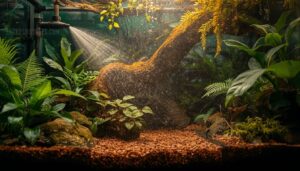
Good installation starts before the first drop of water hits the enclosure. Build your drainage layer design first — one to two inches of gravel keeps roots from sitting in standing water. Add a substrate barrier placement above it to stop soil migration.
Position nozzles toward the back for airflow optimization, and keep mounting hardware clear of lighting positioning zones to avoid heat interference.
Distilled or RO Water Use
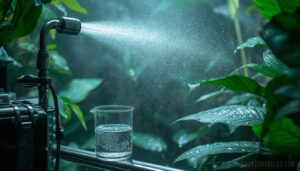
Tap water is the quiet enemy of your misting system. Minerals in it cause scale buildup that shortens component lifespan and throws off droplet size stability.
Distilled water eliminates that problem — its near-zero dissolved solids also reduce electrical conductivity impact on sensitive pumps.
Reverse osmosis water works too, though water source cost runs higher long-term.
Add ReptiSafe water conditioner for trace mineral supplementation that your animals still need.
Preventing Mold and Algae Buildup
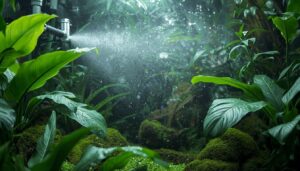
Mold and algae thrive wherever moisture lingers unchecked. Using distilled or reverse osmosis water — solid water quality management from the start — already cuts mineral deposits that feed buildup.
Beyond water quality considerations for misting systems, airflow optimization matters just as much. Aim for one to two air changes per hour.
Surface drying techniques like wiping down walls after each mist cycle stop spores before they spread.
Cleaning Nozzles, Tubing, and Reservoirs

Regular cleaning keeps your system running right. Every two to four weeks, pull the nozzles and do an acid soak — a citric acid solution dissolves mineral crust fast. Flush your silicone tubing with distilled water afterward.
- Reservoir decalcification routine: scrub walls monthly
- Anti-drip valve care: check for clogging after each cycle
- Leak inspection protocol: tighten joints after every refill
- Silicone tubing replacement: swap out every six to twelve months
Manifolds and Multi-enclosure Expansion

Once your cleaning routine is locked in, scaling up is the next move. A misting manifold splits one pump across multiple enclosures using quick-connect fittings and modular manifold design.
For expandable setups over 10 cages, valve isolation strategies let you shut off individual lines without disrupting the rest. Flow rate calculations keep pressure balancing consistent — so every nozzle hits its target, every time.
Value, Reliability, and Performance

Picking the right misting system isn’t just about features — it’s about whether it holds up six months down the road without becoming a headache. Price doesn’t always equal reliability, and the cheapest option can sometimes outlast a premium one with poor support.
Here’s how the top models compare with respect to real-world value, durability, and fit for your setup.
Budget Versus Premium Models
Spending less upfront sounds smart — until you’re replacing parts every few months. Here’s what separates budget from premium regarding reptile misting systems:
- Initial Investment — Economy versions cost under 60% of premium models upfront.
- Build Materials — Premium units use metal or high-grade polymer; budget models often use brittle plastic.
- Component Durability — Premium pumps and sealed electronics hold up far longer.
- Expansion Capability — Want to upgrade your current setup to multiple enclosures? Budget vs. premium reptile humidifiers differ sharply here — modular manifolds are a premium choice.
- Replacement Frequency — Lower-quality parts mean more frequent swaps, erasing early savings fast.
Best value depends on your collection size.
Warranty Coverage and Support
solid product warranty tells you a lot about how much a brand stands behind its work. Most reptile misters come with a 1-year warranty, though budget picks often cap at a 90-day warranty.
Register your unit right away — registration benefits include faster claims and fewer headaches.
Understand your coverage limits before trouble hits, and always know whether repair vs replacement is the offered resolution for defects.
When in doubt, premium choice brands usually offer extended warranty options worth the extra cost.
Long-term Durability and Parts Quality
When the materials inside your mister are built to last, everything else gets easier. The best systems use Ceramic Bearing Pumps, Corrosion Resistant Fittings, and Fluorocarbon O-Rings that hold tight for years in humid enclosures.
Look for these three quality markers:
- UV Stabilized Tubing that won’t crack after two years
- Modular Service Design for easy part swaps
- Nozzle orifices that resist wear beyond 5,000 cycles
Strong material durability and a solid 5-year warranty signal genuine long-term durability of reptile foggers you can trust.
Power Options and Energy Efficiency
Most automatic misting systems run on Low-Voltage Pump Design, drawing just 5 to 15 watts through an AC adapter. Battery Backup Systems and battery-powered misting options keep schedules running during outages. Solar Power Integration suits off-grid setups.
Smart Humidity Control paired with Energy Monitoring Sensors cuts unnecessary runtime. With an automatic misting timer managing cycles, energy-efficient misting stays consistent without driving up your electricity bill.
Best Fit for Small or Large Collections
Your collection size shapes everything. A compact system with a small pump footprint and economical misting options accommodates one to four enclosures without overcomplicating your setup.
Scale up, and modular nozzle arrays with expandable reservoir design keep multi-tier enclosure integration manageable. Adjustable humidity zones let you expand without starting over — truly modular misting system components grow with you.
Frequently Asked Questions (FAQs)
Are automatic reptile misters worth it?
Yes — programmable misting saves real time, cuts manual work, and maintains consistent humidity that directly improves shedding and skin health.
The health benefits alone make the cost vs performance tradeoffs worthwhile for most keepers.
How much does a professional misting system cost?
Professional Labor and Material Costs vary widely. DIY kits start around $100–$300, while professionally installed systems run $500–$5,
Factor in Ongoing Expenses, like water, power, and maintenance, when weighing budget vs premium reptile humidifiers.
What reptiles need to be misted?
Tropical species like veiled chameleons, crested geckos, and dart frogs depend on microhabitat moisture for skin shedding triggers, respiratory health, and egg incubation humidity.
Consistent humidity also helps with mite prevention across humidity-sensitive species.
Can misting systems work with bioactive vivariums?
Absolutely.
A programmable misting system pairs well with bioactive setups by supporting Plant Root Hydration, Beneficial Bacterial Growth, and Microfauna Habitat Support — keeping your substrate alive while handling reptile terrarium humidity control automatically.
Are automatic misters safe for hatchlings?
With the right settings, automatic misters are safe for hatchlings. Use gentle spray cycles, practice direct face avoidance, and control humidity spikes to protect delicate skin and support healthy shedding.
How does misting affect terrarium lighting schedules?
Misting right before lights on can trigger condensation glare and UVB diffusion loss.
Time your dawn mist sync at least 15 minutes before the full photoperiod to avoid heat loss and light intensity drop.
Do reptile misters work with smart home systems?
Some reptile misters do support smart home integration.
Wi‑Fi Compatibility varies by model — the Ycxydr Smart Misting System and others offer app scheduling, Voice Assistant Integration, and even IFTTT Automation for hands-free control.
Can misters cause respiratory issues in reptiles?
Yes, they can. Cold humid air, poor ventilation airflow, excess humidity, large droplet size, and mold biofilm buildup all raise respiratory risk. Proper maintenance and calibrated timers keep conditions safe.
Conclusion
An ounce of prevention is worth a pound of cure—and nowhere is that truer than in reptile husbandry. A reliable automatic misting system for reptiles removes the daily guesswork, keeps humidity dialed in, and gives your animals the stable environment they need to genuinely thrive.
Match the system to your species, your setup, and your schedule. Do that, and you’re not just maintaining reptiles—you’re keeping them healthy for the long haul.