This site is supported by our readers. We may earn a commission, at no cost to you, if you purchase through links.

Picture a hawk’s shadow sliding across a snake’s basking spot. In the wild, that overhead darkening means one thing: incoming predator. Lift a top-opening lid over your snake the same way, and you’re triggering that same ancient alarm bell, whether you meant to or not.
That’s why the front opening vs top opening snake enclosures debate matters more than most keepers realize. Your choice affects daily stress, escape risk, and how easily you handle feeding and cleaning.
Get this decision right, and you’ll spend less time wrestling defensive strikes and more time watching a calm, settled snake.
Table Of Contents
- Key Takeaways
- Front-Opening Vs Top-Opening Snake Enclosures
- How Each Style Affects Snake Stress
- Comparing Daily Care and Maintenance
- Enclosure Materials and Construction Compared
- Door Mechanics and Escape Prevention
- Ventilation, Heating, and Humidity Control
- Which Enclosure Style Fits Your Snake
- Frequently Asked Questions (FAQs)
- Do snakes prefer vertical or horizontal enclosures?
- What are the common reptile enclosure mistakes?
- What type of enclosure is best for a snake?
- How do I know if my snake enclosure is too hot?
- How much does a snake enclosure typically cost?
- Can beginners safely use front-opening enclosures?
- What size enclosure does a juvenile snake need?
- How often should snake enclosures be fully cleaned?
- Are DIY conversions from top to front opening safe?
- Conclusion
Key Takeaways
- Top-opening lids trigger snakes’ instinctive fear of overhead predators, causing more stress, defensive strikes, and hiding, while front-opening doors avoid that overhead threat and keep snakes calmer.
- Front-opening enclosures make daily care easier and safer, letting you spot-clean, rearrange decor, and manage bioactive setups without looming over or removing your snake.
- Material choice matters for climate control: PVC and HDPE hold heat and humidity far better than glass, which loses heat faster and needs extra ventilation management through screen tops.
- Reliable containment depends on solid door mechanics like tight locks, minimal gaps (under 2-3mm), and adequate lid weight, since even small design flaws can let snakes escape.
Front-Opening Vs Top-Opening Snake Enclosures
Picking a snake enclosure comes down to one big decision: front door or top lid. That choice affects everything from your snake’s stress levels to your Saturday cleaning routine. Here’s what actually separates the two, side by side.
Front-opening designs also make it easier to keep water bowls and hides near the entry point, a setup detail this ball python enclosure guide breaks down nicely.
Key Differences at a Glance
Five differences separate these two enclosure designs, and they shape everything from your snake’s stress levels to your Saturday cleaning routine. Choosing front opening tanks can really help reduce animal spooking during handling.
| Factor | Front-Opening | Top-Opening |
|---|---|---|
| Stress response | Lower | Higher |
| Cleaning ease | Spot-clean without disturbing decor | Requires lifting lid |
| Humidity control | Adjustable, retains moisture | Escapes fast through mesh |
| Escape risk | Locking doors | Relies on lid weight |
| Material fit | PVC, HDPE | Glass, screen tops |
Why This Choice Matters
That table isn’t just trivia, it’s a safety risk assessment in disguise. Enclosure design shapes your snake’s daily welfare and your own physical strain during cleaning.
| Outcome | Front-Opening | Top-Opening |
|---|---|---|
| Behavioral health | Calmer, less hiding | More defensive |
| Long-term habitability | Stable, adaptable | Prone to escapes |
| Keeper strain | Minimal reaching | Frequent lifting |
How Each Style Affects Snake Stress
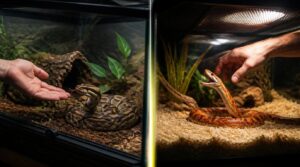
Your snake reads every enclosure opening as a survival cue, not just a door. The direction you reach in changes how safe your snake actually feels. Here’s what happens to their stress levels with each style.
Predatory Threat From Overhead Access
Ever watch a snake freeze the instant a shadow crosses its tank? That’s avian silhouette detection at work. Owls and hawks trigger real aerial threat perception, and top-opening enclosure lids leave that overhead shadow response unchecked.
A front-opening enclosure removes the predatory angle entirely, cutting escape routes for stress and keeping security considerations front and center instead of overhead.
Defensive Striking and Hiding
That overhead shadow doesn’t just spook a snake, it can trigger a full defensive strike, especially from a coiled position where they can reach half their body length. Threat felt from above means fewer visible escape routes, and blocked exits are exactly when strikes happen.
A shadow from above can trigger a snake’s full defensive strike when it feels every escape route is blocked
Visual barriers and solid-sided hiding zones lower this response fast, cutting cortisol and calming a rattled snake considerably.
Species That Prefer Front Access
Ball pythons and corn snakes both settle faster in a front-opening enclosure, and Morphmarket surveys back it up: 85% of keepers report calmer behavior. Leopard geckos show more exploratory habits with front access, too.
Since front-opening access alone won’t tell you everything, pairing it with hands-on temperament checks—like this guide to choosing snake morphs with specific care needs—helps you match enclosure style to each snake’s real personality.
Arboreal species benefits show up clearly with green tree pythons and emerald tree boas, since front access mirrors natural branch approaches. Juvenile growth transitions stay smooth this way, right through target feeding sessions later on.
Adding Visual Security Barriers
Glass walls give you a view, but your snake sees a wide-open threat zone unless you break it up. Natural habitat mimicry through high-res backgrounds blocks household distractions and cuts predator avoidance behavior fast.
Layered backgrounds create depth illusion benefits, encouraging exploration. Krawlo’s guide notes improved feeding responses when solid backdrops replace bare glass — a small fix with real security considerations built in, whether you’re running a front-opening enclosure or top-opening enclosure.
Comparing Daily Care and Maintenance
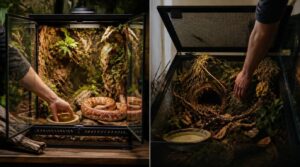
Stress isn’t the only thing your enclosure design affects, your daily routine takes a hit too. Some setups make cleaning and rearranging a breeze, while others turn a five-minute task into a wrestling match. Here’s where the real differences show up.
Spot Cleaning and Water Refills
Daily spot-cleaning gets way easier from the side. A front-opening enclosure lets you scoop waste without looming over your snake, cutting stress fast. Top-opening setups need a paper towel roll blocking the gap first.
Wipe water bowls with hydrogen peroxide, then refill—weekly changes, daily checks. Keep a spare bowl nearby during cleanouts, and use dedicated scrapers, never shared tools, for bioactive substrate.
Lifting Lids Vs Sliding Doors
Try lifting a water-logged glass lid one-handed while your snake’s coiled near the edge—it’s a recipe for a dropped lid and a stressed animal. Lid weight safety matters here.
Sliding glass doors give you incremental door opening control, though tracks collect sliding track debris over time.
Hinged doors on frontopening enclosures skip that mess but demand outward swing room and cause less maintenance physical strain overall.
Rearranging Decor and Branches
Redesigning your snake’s climbing setup shouldn’t feel like a wrestling match. Front-opening enclosures let you rearrange branches without pulling your snake out at all, cutting stress way down.
Build vertical zones—ground, mid-level perches, canopy—anchored with Gorilla glue or silicone for stability. Leave two-inch wall clearance, plan routes reachable within two minutes, and your snake will usually explore the new layout within 24 hours.
Managing Bioactive Setups
Think of a bioactive setup as a tiny world you’re the landlord of. Front-opening enclosures make that job easier, since you can adjust drainage layers, prune live plants, and manage your cleanup crew without disturbing the whole habitat.
3 things to check weekly:
- Substrate moisture balance
- Cleanup crew activity
- Plant health
Top-opening tanks make this fiddly, cramped work.
Enclosure Materials and Construction Compared
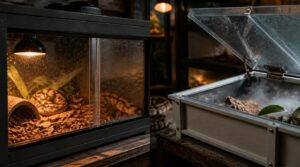
The door style matters, but what your enclosure’s made of matters just as much. Different materials handle heat, humidity, and daily wear in totally different ways. Here’s how the main options stack up.
PVC for Heat and Humidity
PVC punches above its weight at trapping heat. Those millions of tiny closed air bubbles inside the panels act like a thermal wall, cutting heat loss by up to 50% compared to glass.
That means your thermostat cycles less, and humidity-loving species stay comfortable without constant fiddling. Thicker panels (half-inch beats quarter-inch) boost insulation and cut your energy bill.
HDPE for High-Humidity Species
HDPE takes PVC’s temperature retention and adds serious moisture resistance—it won’t absorb water, so mold and bacteria can’t gain a foothold even at 90% humidity.
Three wins for tropical species:
- Biofilm resistance stops pathogen buildup
- One-piece construction resists cracking for 20+ years
- Smooth surfaces dry fast, blocking mold growth
Glass and Its Ventilation Needs
Glass looks great, but it fights you on humidity retention. Glass loses heat 2-3 times faster than PVC or HDPE, so moisture evaporates unevenly.
Screen tops make it worse—warm, humid air escapes through that mesh like an open window. Many keepers cover 75% of the screen with foil just to hold moisture steady.
Front-opening glass doors help by managing convective flow through small gaps instead.
Checking for Structural Integrity
Whatever material you choose, don’t skip the strength check. Solid frontopening reptile enclosures hold up to 200 pounds of compressive force, with corner joints resisting 25 foot-pounds of torque. Look for:
- No cracks after thermal cycling
- Load deformation under 0.5%
- Stable locking mechanisms
- Frame stress tested to 10-minute cycles
This confirms real reptile containment, not just good looks.
Door Mechanics and Escape Prevention
A snake can push through weak spots you’d never think to check. That’s why door mechanics matter just as much as the enclosure itself. Here’s what to look for before you trust any lid or latch with a determined escape artist.
Locking Sliding Vs Hinged Doors
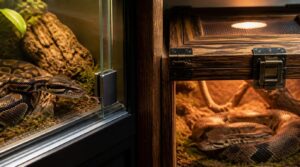
A locked door only works if the lock actually holds. Magnetic lock efficacy shines on sliding glass, while hinged doors rely on interlocking frame mechanisms for security.
| Lock Type | Best For | Access Style |
|---|---|---|
| Magnetic/combination | Sliding glass | Partial opening |
| Interlocking hinge | Swing-out doors | Full opening |
| Keyed external | Curious snakes | Two-handed |
Dual-locking security systems add serious peace of mind for stronger species.
Lid Weight as Containment
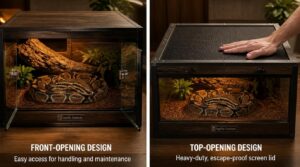
Sometimes the best lock is just gravity. Lid mass security works because a heavy screen top gives snakes nothing to control against.
- Zilla’s 48"x24" cover weighs 31 pounds
- Larger covers reach 56.5 pounds
- Lids over 40 pounds create natural locking effects
- Mass beats escape artistry for pythons under 5 feet
- Weight distribution removes control points entirely
That’s real escape force resistance, no hardware required.
Gaps, Tracks, and Jamming Risks
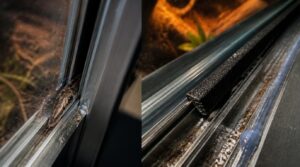
Ever measured your snake’s escape route in millimeters? A gap of just 2-3mm lets baby snakes squeeze free, so escape gap tolerances matter more than lock strength.
Substrate track buildup jams sliding doors within months. Fix it with weather stripping (1/8-1/2 inch) or silicone sealant along edges—cheap insurance against costly escapes.
Front-opening enclosures need precise door alignment; sloppy installs cause most incidents.
Stacking Enclosures Safely
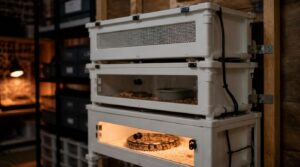
Stacking snake racks saves floor space, but skip the weight capacity limits and you risk a collapse. Standard PVC units handle three units high, max.
Use 1-inch spacers for airflow and cable routing, and always strengthen the bottom enclosure. Anchor tall stacks to studs.
Whether you run front-opening enclosures or a top-opening enclosure, habitat stability comes down to smart terrarium design.
Ventilation, Heating, and Humidity Control
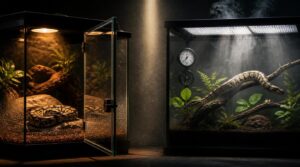
Air, heat, and moisture don’t behave the same way in every enclosure. Get the balance wrong, and you’re looking at a sluggish snake or a respiratory infection down the road. Here’s how each design controls the climate control basics.
Airflow Through Front Doors
Even a closed door isn’t sealed tight, and that’s the point. Door gap ventilation lets air trickle through 24/7, no fans required. Natural convection pulls cool air in low, pushes warm air out high.
Add a mesh door and you get 40% more exchange than solid glass. Front-opening enclosures turn that steady airflow into real microclimate management, no guesswork needed.
Mesh Lids and Moisture Loss
That mesh top look great, but it’s a moisture thief. Screen lids drop humidity from a lush 90-100% down to a bone-dry 39-42%, sometimes overnight.
Ball pythons need daily misting just to hold 50-60%, while solid-top setups barely need intervention. Tropical species can lose weight in 7-10 days without help.
Humidity retention hack: cover 50-75% of the mesh with foil, cutting moisture loss without smothering airflow.
Placing Heat Lamps Safely
Foil covers a mesh top’s moisture problem, but heat lamps need their own placement plan. Mounting lamp spots matter most: always outside the enclosure, never inside a mesh top or over flammable decor. Keep 6-12 inches of clearance for safe basking distances.
- Use thermostat control methods—proportional units beat basic on/off cycling
- Check daily for warping near bulbs (preventing heat burns)
- Guard bulbs to block direct contact, cutting fire hazard risk
Adjusting UVB and LED Fixtures
Heat lamps aren’t your only fixture to dial in—UVB matters just as much.
Front-opening enclosures make height adjustments easy; just slide the door and reposition.
Ball pythons need 6% bulbs at 11-13 inches; bearded dragons want 12% at similar range.
Grab a Solarmeter 6.5R to confirm actual UVI, then replace bulbs every 6-12 months regardless of appearance.
Which Enclosure Style Fits Your Snake
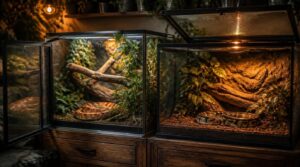
So how do you actually pick between the two? It comes down to your snake, your space, and how you like to work. Here’s what to weigh before you settle on a design.
Ball Pythons and Corn Snakes
Your ball python and corn snake both do best in front-opening enclosures, though for slightly different reasons. Ball pythons need secure hides on each thermal side; front access lets you refill water and adjust humidity without disturbing them. Corn snakes are escape artists, so locking doors matter most.
- Reduced stress during handling
- Fewer failed sheds
- No frantic midnight escape hunts
Space Efficiency and Layout
Square footage isn’t the only thing that matters—height counts too. Front-opening enclosures make use of vertical territory that top-opening tanks waste, since lids cap climbing height near 18 inches.
| Feature | Front-Opening |
|---|---|
| Climbing height | Up to 36 in |
| Space gained | 40% more territory |
| Floor savings | 25% less needed |
| Decor clearance | None near ceiling |
Multi-level platforms simply fit better without lid interference.
Matching Style to Your Routine
How does your daily routine actually look? That’s the real question here. If you’re feeding, handling, or adjusting heat lamps every day, frontopening enclosures win on feeding efficiency, handling speed, and adjustment agility. Maintenance workflow stays simple, and training consistency improves fast.
Prefer a hands-off setup with occasional peeks? Topopening enclosures still work, just expect slower accessibility and maintenance.
Frequently Asked Questions (FAQs)
Do snakes prefer vertical or horizontal enclosures?
Depends on the species. Species specific ratios matter: arboreal climbers crave vertical climbing space, while ground-dwellers want floor space requirements met first.
Understanding natural movement patterns—climbing vs crawling—helps you match habitat complexity benefits to what your snake actually does all day.
What are the common reptile enclosure mistakes?
One overlooked terrarium mistake can undo a perfect setup overnight: inadequate hiding spots, wrong substrate, exposed wiring, wild heat swings, and poor ventilation balance all silently stress your snake, especially in a mismatched top-opening enclosure lacking proper habitat husbandry.
What type of enclosure is best for a snake?
For most snakes, front-opening PVC enclosures win out. They cut stress, speed up cleaning, prevent escapes with double-latching doors, and hold steady heat and humidity—beating any topopening enclosure for security, accessibility, and long-term habitat husbandry.
How do I know if my snake enclosure is too hot?
Your tank turns into a furnace when the glass traps sunlight fast. Watch for glued-to-the-glass pacing, gaping, or soaking in water—classic overheating signs. Place a digital thermometer at snake level, and keep the cool zone under 80°F.
How much does a snake enclosure typically cost?
Prebuilt PVC reptile enclosures run $342 to over $1,000 depending on size, while DIY builds cost roughly half that. Budget-conscious owners save more building their own terrarium setup than buying an aquarium, especially once hidden accessory costs get added in.
Can beginners safely use front-opening enclosures?
Yes, absolutely. Beginner front-opening kits ($139-$169) include built-in escape prevention locks, tempered glass doors, and pre-drilled vents, making feeding, cleaning, and observation-without-handling simple, safe routines for new keepers building confidence.
What size enclosure does a juvenile snake need?
A juvenile corn snake needs roughly 7 × length by 5 × length floor space, plus climbing height and a proper temperature gradient layout—warm and cool zones, hides, water bowl, and 2 inches of substrate depth.
How often should snake enclosures be fully cleaned?
Monthly deep cleans are standard, but bioactive setups stretch that to once or twice yearly. Species, substrate, and daily spot cleaning all shift the schedule—front-access doors make routine substrate changes and accessibility far easier than wrestling with a top lid.
Are DIY conversions from top to front opening safe?
Picture a hacksaw, a glass panel wobbling in one hand, and a snake somewhere nearby thinking about freedom. Only if you nail structural frame integrity, use rated glass, and seal every seam—otherwise you’re just building a fancy escape hatch.
Conclusion
A door isn’t just an opening; it’s a promise your snake reads as either safety or threat. The front opening vs top opening snake enclosures debate isn’t really about your convenience. It’s about whether your snake trusts its world.
Front doors keep the sky clear of shadows, making feeding and cleaning calmer. Top lids can still work, paired with solid visual barriers. Pick whichever setup lowers daily stress first.
Your snake will answer back through its posture.