This site is supported by our readers. We may earn a commission, at no cost to you, if you purchase through links.
A tail tip left dangling in dead skin can lose blood flow within days, and the culprit is rarely disease—it’s a hygrometer reading you never checked. Snake dry skin humidity problems start quietly: a patchy shed here, a retained eye cap there, until you’re staring at cracked scales wondering what went wrong.
The truth is mechanical. Below 70% relative humidity, keratin loses flexibility and mucus thickens, setting off a chain reaction from stuck shed to labored breathing. Get the moisture right, and most of these problems fix themselves before they start.
Table Of Contents
- Key Takeaways
- Why Humidity Affects Your Snake’s Skin
- Signs of Dry Skin and Low Humidity
- Measuring and Monitoring Enclosure Humidity
- Fixing Low Humidity in Your Enclosure
- When Dry Skin Needs Vet Care
- Frequently Asked Questions (FAQs)
- How to rehydrate dried snake skin?
- Why does my snakes skin look dry?
- How much humidity is too much for a snake?
- How long does it take for snake skin to dry out?
- How often should snake enclosure humidity be checked?
- Can dry skin cause permanent damage to snakes?
- Does snake age affect ideal humidity needs?
- How quickly can low humidity harm a snake?
- Are misting systems better than manual spraying methods?
- Conclusion
Key Takeaways
- Below 70% relative humidity, keratin stiffens and mucus thickens, triggering stuck sheds, retained eye caps, and labored breathing.
- Verify your hygrometer’s accuracy with a salt test (75% RH benchmark) and place sensors mid-level, away from vents and heat lamps, since misplacement skews readings.
- Fix low humidity with moisture-retaining substrate, a dedicated humid hide, partial screen covering, and species-matched targets (60-80% for ball pythons, 30-50% for hognoses).
- Seek veterinary care for redness, swelling, pus, or wheezing and gaping, since these signal infection or respiratory distress that husbandry changes alone can’t resolve.
Why Humidity Affects Your Snake’s Skin
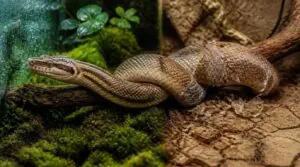
Humidity isn’t just background noise in your enclosure, it’s directly wired into how your snake sheds, heals, and breathes. When moisture levels swing too far in either direction, the effects show up fast, in the skin, the eyes, and the lungs. Here’s what’s actually happening beneath the surface, and why it matters more than most keepers realize.
Getting the balance right often starts with the enclosure itself, so it’s worth reviewing your complete pet snake habitat setup to catch any hidden humidity leaks or dead zones.
Humidity isn’t background noise—it’s directly wired into how a snake sheds, heals, and breathes
Role of Humidity in Shedding
Ecdysis is fundamentally moisture-driven: humidity in its enclosure softens the old skin, letting it separate cleanly from the new layer beneath. Adequate moisture triggers skin loosening and pre-shed mucus, easing release.
When humidity in the enclosure runs low, the skin dries and clings instead of lifting. That’s the mechanism behind incomplete shed and dysecdysis—not bad luck, but insufficient moisture during the shedding cycle. Using digital hygrometers can help make sure your enclosure maintains the precise moisture levels required.
Skin and Scale Health Link
Your snake’s outer scales aren’t just decoration—they’re a functional barrier layer that depends on moisture to stay flexible. Low humidity strips scale flexibility and dermal hydration, leaving epidermal health compromised.
Watch for:
- Dull, matte scales instead of natural sheen
- Rough edges catching on décor
- Stuck shed fragments
- Reduced skin elasticity when gently pinched
Poor skin integrity invites bacterial colonization, turning a cosmetic issue into something worse.
Hydration and Respiration Effects
Beyond the scales, dry conditions strain what’s happening inside. Low humidity thins airway surface liquid, raising mucus viscosity and respiratory resistance—your snake works harder to breathe.
| Hydration Status | Airway Moisture | Breathing Effort |
|---|---|---|
| Well-hydrated | Stable, thin mucus | Normal, quiet |
| Mild dehydration | Thickening mucus | Slightly labored |
| Severe dehydration | Dry, sticky airways | Wheezing, respiratory distress |
Osmotic balance affects lung compliance too—dehydration compromises gas exchange efficiency, turning a skin problem respiratory.
Signs of Dry Skin and Low Humidity
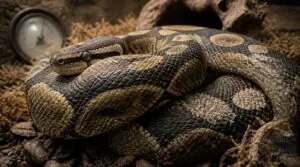
Once humidity drops out of range, your snake’s body starts showing it in fairly predictable ways. Some signs sit right on the surface, while others require a bit more attention to catch. Here’s what you should be watching for.
Stuck or Incomplete Shed
Patchy skin clinging near the tail tip or toes signals **dysecdysis— incomplete separation during shedding layer mechanics. Left unaddressed, retained shed can cause tail tip constriction, cutting circulation. A warm soak often loosens stubborn patches safely. Always check for retained eye caps, since trapped debris against the cornea poses real risk. Proper skin hydration prevents recurrence.
Dry, Flaky, Cracked Skin
Run your thumb along a snake’s flank and you’ll feel it before you see it: scale surface roughness replacing the usual smooth glide, a telltale sign of keratin layer dehydration.
If that roughness persists alongside a raised keel, it’s worth comparing what you’re feeling against this guide to identifying abnormal snake skin texture before assuming it’s just a normal shed cycle.
Left unchecked, low humidity drives:
- Flaking as the outer layer separates
- Microcrack formation at joints
- Progressive fissure development
- Higher infection risk
Cracked skin means broken skin barrier function—consistent moisture retention is non-negotiable.
Retained Eye Caps
Ever notice your snake’s eye looking permanently hazy days after a shed? That’s a retained eye cap—the spectacle didn’t release with the rest of the skin.
Check the shed for eye cap outlines; missing them means trouble. Left alone, the old cap traps debris, raises ocular pressure, and blurs vision. It won’t resolve itself. Low humidity caused the incomplete shed—fix that first, then address the cap directly.
Dehydration Warning Signs
How dehydrated is your snake, really? Gently pinch a fold of skin—slow return signals poor skin turgor.
Check for sunken eyeballs, dull scale sheen instead of natural gloss, and chalky or inconsistent urate output. These aren’t cosmetic quirks; they reflect systemic water loss affecting kidney function and gas exchange, and they demand humidity correction before shedding problems compound further.
Lethargy and Behavior Changes
A snake that stops acting like itself is telling you something. Watch for these five shifts:
- Feeding refusal patterns that persist across attempts
- Reduced exploratory movement, hiding more than usual
- Sluggish tactile response to gentle handling
- Defensive posture shifts—tighter coiling, quicker retreats
- Locomotion friction from dry, uncomfortable skin
These behaviors trace back to low humidity and dehydration. Correct the environment, and normal activity usually returns.
Measuring and Monitoring Enclosure Humidity
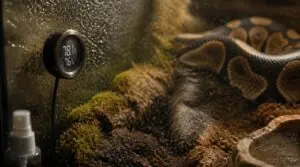
Guesswork won’t cut it when your snake’s health depends on accurate numbers. You need reliable tools and a consistent routine to know what’s actually happening inside that enclosure. Here’s how to measure humidity the right way, step by step.
Using Digital Hygrometers Correctly
Where you place your hygrometer matters as much as owning one. Mount it at mid-level, away from vents, lamps, or direct sun, and let it acclimate several hours before trusting the reading.
| Placement Mistake | Consequence | Fix |
|---|---|---|
| Near heat lamp | False high reading | Relocate mid-enclosure |
| Near vent | Skewed low reading | Shield from airflow |
| Multiple sensors | Conflicting data | Use one per zone |
Weak batteries cause drift, so check them often.
Calibrating With Salt Test
A pinch of salt tells you more about your hygrometer’s honesty than the manufacturer’s spec sheet ever will. Build a humidity box: saturated salt solution in a sealed jar, sensor suspended above (never touching) the liquid, resting several hours until it stabilizes near 75% RH.
- Dissolve table salt into distilled water until saturated
- Seal the container, sensor elevated, no contact
- Wait hours for equilibrium
- Compare reading against 75%
- Log hygrometer drift for future reference
Tracking Humidity Gradients
One calibrated sensor only tells you about one point in space. Real enclosures have microclimates—cooler substrate, warmer basking zones—so map hotspots with a sensor grid at multiple heights.
| Sensor Location | Typical RH Variance |
|---|---|
| Substrate level | Baseline |
| Mid-air | -5 to -10% |
| Near basking spot | -10 to -15% |
| Humid hide | +15 to +20% |
Track trends over days, not hours.
Checking Skin Pliability
Numbers on a hygrometer only tell half the story—your snake’s skin tells the rest. Gently pinch a fold near the mid-body and release; skin recovery timing under 2 seconds signals healthy turgor, while tenting past 3 seconds points to dehydration, not just low humidity.
Pair this tactile check with sunken eyes as a red flag before assuming your enclosure numbers are lying.
Logging Shedding Patterns
A single skin tent tells you today’s status. A written log tells you the trend—which matters more.
Track shed cycles by date, note completeness, and record any retained shed around eye caps or tail tips. Over several ecdysis events, patterns emerge: shortening intervals may flag growth spurts, while repeated incomplete sheds signal ecdysis issues. Cross-reference with feeding data and season to catch deviations before they become chronic problems.
Fixing Low Humidity in Your Enclosure
Once you’ve confirmed low humidity is the problem, the fix comes down to a handful of practical adjustments to the enclosure itself. None of these require expensive equipment, just the right combination of materials and placement. Here’s what actually moves the needle.
Moisture-Retaining Substrate Choices
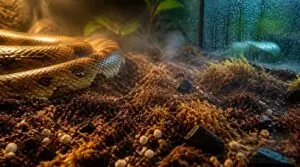
Your substrate is the foundation of humidity gradients, not an afterthought.
| Substrate | Key Benefit |
|---|---|
| Coco coir | Retains moisture, resists mold |
| Peat mix | Stable 60-70% RH |
| Vermiculite | Slow-release hydration |
| Coir-sphagnum mix | Boosts post-shed moisture |
| Activated carbon | Buffers dry spells, odor control |
Choose moisture-retaining substrate matched to your species’ needs—habitat management starts at ground level, literally.
Building a Humidity Hide
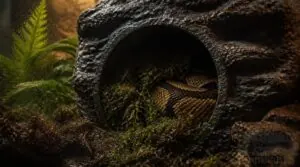
Carve out a dedicated microclimate rather than relying on ambient humidity alone.
- Size the entry hole just wider than your snake’s girth
- Fill several inches with damp sphagnum moss for moisture buffering
- Place the hide on the cooler side, away from heat sources
- Keep it shaded to prevent mold growth
- Re-dampen substrate regularly, checking during pre-shed cycles
Species-specific design matters—tropical species need it saturated; arid species, barely damp.
Covering Screen Lids Safely
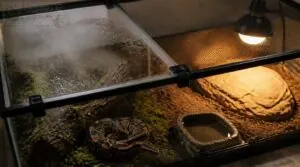
Wrap foil or acrylic over no more than half the screen, always on the side away from basking heat, to curb evaporation without smothering airflow. Secure it with escape-proof clips—loose coverings invite prying snouts and injury.
Choose heat-safe, non-porous materials only; wicking fabrics near warm zones worsen moisture problems instead of solving them. Check weekly for warping or buildup.
Adjusting Water Bowl Placement
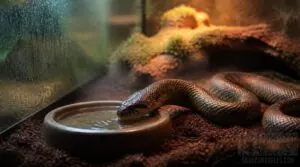
Where you put the water bowl matters as much as how often you fill it. Strategic bowl positioning helps maintain ambient humidity while minimizing drinking stress and preventing scent interference near feeding zones.
- A bowl tucked near moist substrate, gently steaming under warm light
- Water beaded on cool glass, far from the basking lamp’s glare
- A snake dipping its chin low, undisturbed by nearby traffic
- Damp coir darkening slightly where splashes land
- A stable dish, unshifting beneath a coiling body
Species-Specific Humidity Ranges
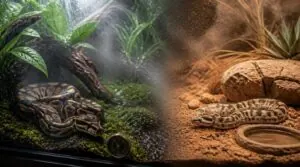
Not every snake wants the same air. Your ball python needs 60–80% ambient humidity, while a hognose thrives at 30–50%.
Match species-specific requirements: tropical setups need misting and gradients toward 80%, arid tanks stay dry with brief shedding bumps to 40–50%, and temperate species split the difference at 40–60% for smooth, crack-free sheds.
When Dry Skin Needs Vet Care
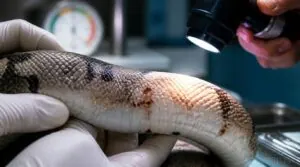
Most humidity problems resolve with husbandry fixes, but some signs mean you’re past the point of DIY correction. Skin that won’t rehydrate, discoloration along the belly, or breathing that sounds wrong all point toward a problem your enclosure adjustments can’t fix alone.
Here’s what tells you it’s time to call your vet instead of your hygrometer.
Rehydrating Dried Snake Skin
Found a brittle, papery patch of retained shed weeks later? A glycerin soak (40-60% concentration), 15-30 minutes at 20-25°C, restores pliability. Press between towels, flatten under glass with light weights, then seal with a thin conditioner coat. If the patch involves a stuck eye cap or a tight ring near the tail, hold off on home fixes and check this guide to safe retained shed removal and when to see a vet.
This grips cosmetic dryness only—true dehydration and low humidity require enclosure fixes, not skin treatments.
Signs of Skin Infection
Not all dry skin is cosmetic. If a lesion shows redness, warmth, or swelling that worsens, or you spot pus, crusting, or a foul odor, you’re likely dealing with bacterial or fungal colonization—possibly scale rot.
Systemic signs like fever, lethargy, or swollen lymph nodes mean the infection’s moved beyond the skin.
That warrants veterinary care, not home treatment.
Avoiding Excess Humidity Risks
Chasing higher humidity to fix dry skin can backfire fast. Above 80%, you invite scale rot and biofilm on damp surfaces—prime conditions for microbial pathogens.
- Watch for substrate saturation, not just air readings
- Improve ventilation airflow to prevent stagnant, humid pockets
- Remove waste promptly to curb ammonia buildup
- Replace substrate regularly to limit fungal growth
- Check for condensation signaling excess moisture
Recognizing Respiratory Distress
Respiratory distress rarely stays quiet. Listen for clicking, wheezing, or gurgling sounds, and watch for mouth gaping, neck stretching, or labored, effortful breathing instead of normal cycles.
Check the mouth lining—pale or bluish tissue signals poor oxygenation.
Combine this with lethargy or appetite loss, and you’re looking at a respiratory emergency, not a humidity tweak. Get veterinary care immediately.
Frequently Asked Questions (FAQs)
How to rehydrate dried snake skin?
A keeper once soaked a stiff shed in warm water for an hour—wrong move. Use gentle steam exposure, light glycerin dilution, or mineral oil instead; avoid stretching, then store flat in a cool, dry spot.
Why does my snakes skin look dry?
Most often, it signals low humidity disrupting scale oil balance and skin secretion levels, causing dehydration, micro-tears, and incomplete sheds.
Seasonal humidity shifts worsen this—your snake’s natural moisture retention can’t compensate without consistent snake humidity and hydration support.
How much humidity is too much for a snake?
A rainforest can drown as easily as a desert can parch. Above 90% humidity, you’re inviting mold growth, scale rot, and respiratory distress—watch for condensation, musty odor, and labored breathing as your cue to boost ventilation.
How long does it take for snake skin to dry out?
In warm, dry conditions shed skin reaches full dryness within 2 to 6 hours; cooler or humid enclosures stretch this to 12–24 hours. Pinning it flat and ensuring good airflow speeds evaporation while preventing mold growth on the discarded skin.
How often should snake enclosure humidity be checked?
Check digital hygrometers daily during shedding cycles and seasonal shifts; weekly suffices for stable, established enclosures.
Juveniles need closer monitoring, and calibrate gauges regularly using the salt test to keep ambient moisture readings across humidity gradients trustworthy.
Can dry skin cause permanent damage to snakes?
Yes. Repeated dry sheds cause chronic skin scarring, permanent ocular pressure from retained caps, and long-term renal impact through dehydration—each incomplete shed weakens epidermal integrity, creating microbial entry points that compromise skin hydration and metabolic health permanently.
Does snake age affect ideal humidity needs?
Absolutely—neonate moisture sensitivity demands 60-70% humidity for growth spurts, while adults tolerate 50-65%. Seasonal acclimation and species-specific lifecycle transitions matter too, so adjust gradually as your snake matures to support metabolic health and proper husbandry.
How quickly can low humidity harm a snake?
Faster than you’d think—no scales to it. Rapid dehydration onset starts within 6 to 12 hours, irritating mucosa, cracking skin, and dropping blood volume—setting up respiratory stress, compromised skin integrity, and retained shed before you’ve even noticed anything’s wrong.
Are misting systems better than manual spraying methods?
For precision humidity control, misting systems win—programmable cycles maintain ambient moisture within a few percentage points, reducing labor versus daily manual spraying.
Reliability matters most for species-specific setups requiring tight gradients, though manual methods still suit spot treatments during shedding or illness.
Conclusion
When a snake "doesn’t quite make it" through a shed cycle, the real story is written in percentages, not fate. Most snake dry skin humidity problems trace back to one missed number on a hygrometer, not bad luck or bad genetics.
Fix the moisture, and the cracked scales, stuck caps, and dull sheds resolve themselves. Watch the gradient, log the sheds, trust the numbers. Your snake’s skin will tell you everything, if you’re willing to listen.