This site is supported by our readers. We may earn a commission, at no cost to you, if you purchase through links.

Most people picture boas as large, powerful constrictors from tropical rainforests. The rosy boa breaks that image completely. Native to the rocky deserts of southern California and Arizona, this snake tops out at 36 inches and spends most of its life wedged quietly between sun-warmed granite slabs.
It’s one of only two boa species native to the United States. That distinction alone makes it worth a closer look.
Calm by nature, slow to stress, and manageable in size, rosy boas suit beginners without sacrificing the rewards of keeping a true boa. Knowing their origins, appearance, and care needs sets you up for a long, successful relationship with one.
Table Of Contents
- Key Takeaways
- What is a Rosy Boa?
- Rosy Boa Appearance and Behavior
- Rosy Boa Enclosure Setup
- Rosy Boa Care Requirements
- Top 8 Rosy Boa Care Products
- 1. Etekcity Infrared Laser Temperature Gun
- 2. Zoo Med Natural Red Reptile Sand
- 3. F10 All Purpose Veterinary Disinfectant Spray
- 4. Repti Zoo Glass Reptile Terrarium
- 5. Repti Zoo Reptile UVA Basking Lamp
- 6. Exo Terra Natural Yellow Desert Sand
- 7. Zoo Med Excavator Clay Burrowing Substrate
- 8. Rescue One Step Veterinary Disinfectant Cleaner
- Frequently Asked Questions (FAQs)
- How much does a rosy boa cost?
- Does a rosy boa bite hurt?
- Are rosy boas friendly?
- Are rosy boa venomous?
- Do rosy boa like to be held?
- What size tank does a rosy boa need?
- How long can rosy boas live in captivity?
- Are rosy boas good pets for beginners?
- When is the best time to handle rosy boas?
- Can rosy boas be housed together safely?
- Conclusion
Key Takeaways
- Rosy boas are small, nonvenomous desert boas from the American Southwest that usually reach 24–36 inches and can live 20–30 years with steady care.
- Their calm temperament, manageable size, and simple feeding routine make them a strong choice for beginners, but each snake needs its own secure enclosure.
- Set up a dry, escape-proof habitat with snug hides, a warm end of 90–95°F, a cool end of 65–75°F, and humidity around 40–60%.
- Feed juveniles frozen-thawed mice every 7 days and adults every 10–14 days, avoid handling for 48 hours after meals, and watch for shedding or breathing problems.
What is a Rosy Boa?
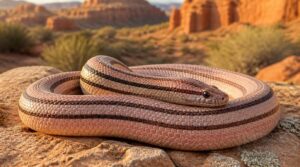
The rosy boa (Lichanura trivirgata) is a small, docile snake native to the deserts and rocky slopes of the American Southwest — and one of only two boa species found in the United States. They’re hardy, slow-moving, and genuinely low-maintenance, which makes them a smart first snake for beginners.
With lifespans stretching well past 25 years, it’s worth building good habits early — this rosy boa feeding and care schedule is a great place to start.
Here’s what you need to know about what they’re and why so many keepers love them.
Species Overview and Taxonomy
The rosy boa is one of only two boa species endemic to the United States. Scientists classify it as Charina trivirgata, though older resources sometimes list it as Lichanura trivirgata. Its full taxonomy places it here:
- Class: Reptilia
- Order: Squamata
- Family: Boidae
- Genus: Charina
This classification follows the Linnaean hierarchical ranking system, which organizes organisms from broad domains down to specific species. Regional subspecies variation shows up as differences in stripe color and body markings across its range.
Natural Range and Habitat
Knowing where rosy boas come from helps you understand what they need in captivity. Their native range covers southwestern United States and northwestern Mexico, stretching across southern California, Arizona, and parts of Baja California.
They thrive in arid rocky desert terrain, using granite outcroppings and crevices for shelter, thermoregulation, and hunting small burrowing rodents year-round.
Adult Size and Lifespan
Most adults reach 24 to 36 inches, with coastal snakes occasionally hitting 48 inches. Females run larger than males. Growth slows after two to three years, when sexual maturity sets in. An adult needs at least a 36 x 12 x 12 enclosure.
With good care, rosy boa longevity reaches 30 years. Weigh it monthly to catch health changes early.
A well-cared-for rosy boa can live 30 years — weigh yours monthly to stay ahead of health changes
Breeding and Live Birth
Unlike most snakes, rosy boas give live young rather than eggs. After spring mating, the gestation period lasts 4 to 6 months. Here’s what captive breeding often looks like:
- Minimum litter: 2 neonates
- Typical litter: 3 to 4
- Maximum litter: 6 neonates
- Neonate size: 6 to 8 inches
Neonates are fully independent within days and need no maternal care.
Beginner Pet Suitability
Few snakes are as forgiving for beginners as the rosy boa. Their docile temperament means most tolerate gentle handling right from the start.
They stay small, reaching just 2 to 3 feet, eat every 7 to 14 days, and need no complex lighting. A secure, tight-fitting lid is your biggest concern.
With basic care, they live 20 to 30 years.
Rosy Boa Appearance and Behavior
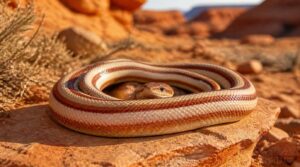
Rosy boas have a look that’s hard to mistake once you’ve seen one. From their bold, striped patterns to their calm, slow-moving temperament, there’s a lot to appreciate about this species. Here’s a closer look at what makes them stand out.
Colors, Stripes, and Morphs
Rosy boas wear their colors like a signature. The base coat runs from creamy white to warm cinnamon, crossed by three longitudinal stripes that can be brown, gray, orange, or red. Juveniles often show bolder striping that softens slightly with age.
Morphs like albino and anerythristic alter pigment entirely, removing red or melanin respectively, and these traits are genetically inherited.
Regional Appearance Differences
Where a rosy boa lives shapes how it looks. Color variation by region is real:
- Mojave snakes show dusty, muted browns
- Sonoran boas lean coppery and warm
- High-elevation snakes display cool gray bases
Band patterns and scale texture shift too. Northern boas have broader stripes; desert snakes show jagged bands. Ventral markings and tail tip coloration also vary by location.
Body Shape and Features
Their build tells you a lot. Rosy boas have a stout, cylindrical body that stays thick for most of its length, tapering near the short, blunt tail. Adults reach 2 to 3 feet.
The head is oval and compact, set just slightly wider than the neck. Eyes hold round pupils and sit toward the sides, while facial scales stay smooth and tight.
Temperament and Activity Patterns
Temperament is one of this snake’s biggest strengths. Rosy boas are calm and docile, even as beginners handle them. They’re primarily nocturnal, most active around dusk and dawn. Four patterns worth knowing:
- Short bursts of movement follow long rest periods
- Burrowing increases after feeding during digestion
- Juveniles start skittish but settle with routine
- Stress signals a quiet retreat into hides
Safe Handling and Bonding
Start slow. Pick up your snake with two hands and support its full body to prevent stress. New snakes may curl into a defensive ball or release foul-smelling musk.
That’s normal for a snake still adjusting to you. Keep sessions to 10 to 15 minutes, and wash your hands before and after. Consistency builds trust faster than any single technique.
Rosy Boa Enclosure Setup
Setting up the right enclosure is one of the most important steps you’ll take as a rosy boa owner. Get it right from the start, and your snake will have everything it needs to stay healthy and comfortable for decades. Here’s what you need to know about building the perfect home for your rosy boa.
Enclosure Size by Age
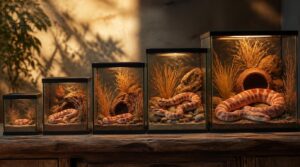
Getting enclosure size right matters from day one. Neonates do well in a 10-15 gallon tank to start.
As juvenile growth stages advance, move to 20 and 30 gallons for comfortable coiling and exploration. Subadults go to 40, and adults usually need 55 to 75 gallons. Track your feeding schedule and upgrade your rosy boa once it reaches 24 inches.
Substrate and Burrowing Options
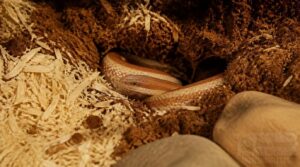
Once your enclosure size is set, substrate becomes the next call. Rosy boas burrow naturally, so the right material matters.
Aspen shavings stay dry and resist mold well. Coconut husk holds moisture and helps with burrowing. Avoid sand, since it risks impaction.
Three solid options:
- Aspen bedding, dry and very safe
- Coconut husk, soft for burrowing
- Clay mix, ideal for tunnels
Hides and Habitat Enrichment
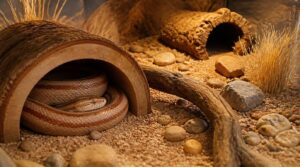
With substrate sorted, hides come next. Your rosy boa needs at least two hides — one on each end of the temperature gradient. This lets the snake thermoregulate without feeling exposed.
Keep hides snug. The whole snake should fit comfortably inside. Smooth, non-abrasive surfaces protect the skin during shedding. Rotate enrichment items every 1-2 weeks to maintain novelty and reduce stress.
Ventilation and Escape Prevention
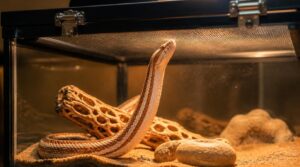
Good ventilation keeps the air fresh without creating drafts. Aim for 5 to 10 percent open vent space.
- Cross ventilation openings on opposite sides
- Clear vents of debris monthly
- Lightweight substrates improve floor airflow
- Tight-fitting lids with secure latches
- Avoid fans that blow directly on the snake
Rosy boas can push hard against loose lids, so don’t take any chances.
Cleaning and Sanitation Routine
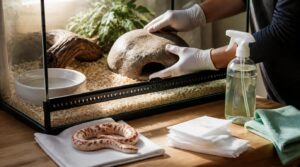
A clean enclosure keeps your rosy boa healthy. Spot clean daily, removing waste as soon as you see it. Replace substrate fully every 4 to 8 weeks.
Sanitize hides and decor weekly with warm soapy water, then rinse thoroughly. Clean your water dish daily. Use 70% isopropyl alcohol to wipe surfaces, and let everything dry before adding your snake back.
Rosy Boa Care Requirements
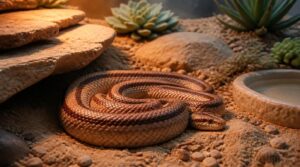
Getting the environment right is the most important part of rosy boa care. Temperature, humidity, lighting, and feeding all follow specific numbers that are easy to dial in once you know what to look for. Here’s what your rosy boa needs to stay healthy and thrive.
Temperature Gradient and Heating
Your rosy boa can’t regulate its own body heat, so the enclosure does all that work for it. Place a basking spot at 90-95°F using a 75-watt bulb or heat tape under one end. The cool side holds steady at 65-75°F. Use a digital thermometer at both ends to monitor the gradient. At night, allow temperatures to drop to 65-72°F.
Lighting and Day-Night Cycle
Rosy boas are nocturnal, so lighting is simpler than you might expect. Aim for a 12-hour light, 12-hour dark cycle using a timer. A basking bulb provides daytime heat while keeping one end bright. At night, turn lights off completely.
UVA/UVB bulbs are optional but can support immune function when placed over the basking zone.
Humidity, Water, and Shedding
Keep humidity between 40 and 60 percent. A shallow water dish aids hydration and aids the shedding cycle.
Eyes turn bluish before a shed begins.
- Set up a humidity hide with damp moss
- Monitor with a hygrometer
- Mist lightly near hides
- Clean the dish weekly
- Manage substrate moisture carefully
Skin health depends on steady humidity control.
Feeding Schedule and Prey Size
Your snake’s appetite follows a reliable rhythm. Juveniles need feeding every 7 days; adults do well on every 10 to 14 days. Feeding at consistent times helps build a strong response.
For additional context, compare male vs. female boa size differences, as larger adults may need more substantial prey.
Use this frozen rodent size chart for snakes to match prey thickness as your snake grows.
Prey size should match the widest part of your snake’s body. Start on pinky mice, then scale up to fuzzies and hoppers. Frozen-thawed prey is always the safest option.
Common Health Problems
Most health issues come down to one thing: poor conditions. Respiratory infections show up as wheezing, open-mouth breathing, or nasal discharge, usually from humidity above 50% or weak temperature gradients.
Mouth rot and mites follow unsanitary setups. Correct the environment first, then see a vet.
Watch for shedding problems and quarantine new snakes to prevent parasites and IBD.
Top 8 Rosy Boa Care Products
Getting your rosy boa’s setup right comes down to having the right gear from the start. These eight products cover the essentials — from accurate temperature readings to safe substrates and reliable cleaning solutions. Here’s what’s worth picking up before you bring your snake home.
1. Etekcity Infrared Laser Temperature Gun

Getting the temperature right in your rosy boa’s enclosure isn’t guesswork — it’s the foundation of good care. The Etekcity Infrared Laser Temperature Gun takes the uncertainty out of it completely.
Point it at any surface, squeeze the trigger, and you get a reading in 0.5 seconds. No contact, no waiting. It measures from -58°F to 842°F, so checking your basking spot’s 90–95°F target is well within range.
The 12:1 distance-to-spot ratio means at 12 inches away, you’re reading a 1-inch spot. That’s precise enough for any enclosure surface. Adjustable emissivity (0.1–1.0) improves accuracy across hides, glass, and substrate alike.
One thing to remember: it reads surface temperature only, not air temperature.
| Best For | Reptile keepers and hobbyists who want a fast, accurate way to monitor enclosure temperatures without disturbing their animals. |
|---|---|
| Primary Use | Temperature monitoring |
| Best For | All reptile keepers |
| Ease of Use | Point and shoot |
| Key Limitation | Surface temp only |
| Setup Required | None |
| Maintenance Level | Low |
| Additional Features |
|
- Instant 0.5-second readings let you check basking spots and cool zones quickly without opening the enclosure
- Wide temperature range (-58°F to 842°F) and adjustable emissivity make it versatile across different enclosure surfaces and materials
- The 12:1 distance-to-spot ratio gives you precise, targeted readings from a comfortable distance
- Only measures surface temperature, so you’ll still need a separate thermometer for accurate air temp readings
- Accuracy can drop on shiny or reflective surfaces, which may be an issue with glass tanks depending on angle
- Requires careful positioning — the wrong distance or angle can throw off your readings
2. Zoo Med Natural Red Reptile Sand
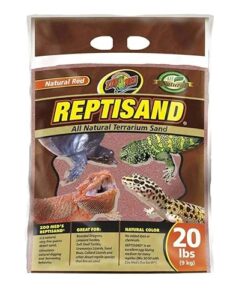
With your temperatures dialed in, it’s time to think about what lines the floor of your enclosure. Zoo Med Natural Red Reptile Sand (Model SR-20) is a 100% natural quartz substrate with no added dyes or chemicals. That matters because rosy boas do occasionally taste their surroundings.
The sand conducts heat well, which helps your basking zone stay effective right down to ground level. It also helps natural burrowing behavior, something rosy boas instinctively do in the wild.
A quick rinse before setup cuts the dust a lot. At 20 lbs, one bag covers a standard adult enclosure with room to spare.
| Category | Details |
|---|---|
| Primary Use | Burrowing substrate |
| Chemical Free | Yes |
| Key Limitation | Rinse before first use |
| Best For | Rosy boas, sand boas, bearded dragons |
| Best For | Rosy boas, sand boas, bearded dragons, and other desert reptiles that naturally burrow and dig. |
|---|---|
| Primary Use | Burrowing substrate |
| Best For | Desert reptiles |
| Ease of Use | Rinse and pour |
| Key Limitation | Dusty out of bag |
| Setup Required | Rinse before use |
| Maintenance Level | Moderate |
| Additional Features |
|
- 100% natural quartz with no dyes or chemicals, so it’s safe even if your reptile tastes the substrate
- Conducts heat effectively, keeping your basking zone warm all the way to ground level
- 20 lbs covers a standard adult enclosure generously, and it’s easy to clean and reuse long-term
- Can be dusty straight out of the bag, so a rinse before setup is usually necessary
- May contain small gravel or rock particles that can’t be sifted out
- Higher price point than some alternatives, and some buyers have reported torn or underweight bags
3. F10 All Purpose Veterinary Disinfectant Spray
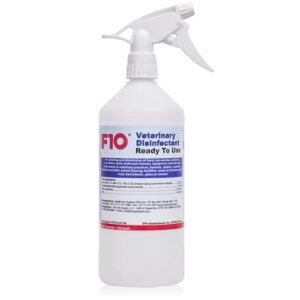
Clean sand is only half the job. Droppings, shed skin, and spilled water can leave bacteria on bowls, glass, and décor, so routine sanitation matters.
F10 All Purpose Veterinary Disinfectant Spray gives you a ready-to-use disinfectant for those jobs. This unscented, biodegradable spray is made for veterinary settings. It works on hard, nonporous surfaces: plastic hides, glass doors, water bowls, and feeding tools.
First remove dirt. Spray the surface, keep it wet for the label contact time, and allow it to air-dry fully before your rosy boa returns. You don’t need to rinse treated hard surfaces after drying.
Wear gloves, keep the bottle from children, and don’t mix it with other cleaners. It costs more, but its broad-spectrum action makes it a choice after illness, mites, or an enclosure cleanout.
| Best For | Reptile, bird, and exotic animal keepers who want a ready-to-use veterinary disinfectant for thorough enclosure sanitation. |
|---|---|
| Primary Use | Enclosure disinfection |
| Best For | All reptile enclosures |
| Ease of Use | Spray and dry |
| Key Limitation | Higher cost |
| Setup Required | None |
| Maintenance Level | Low |
| Additional Features |
|
- Broad-spectrum formula targets bacteria, viruses, fungi, and spores.
- Pre-diluted, unscented spray requires no mixing or measuring.
- Safe for hard surfaces in animal habitats when used according to label directions.
- Costs more per ounce than household disinfectants or concentrated options.
- May be restricted from direct consumer shipment in some states.
- More disinfecting power than most routine enclosure touch-ups require.
4. Repti Zoo Glass Reptile Terrarium
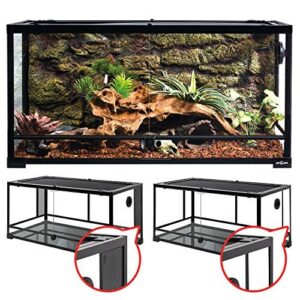
A clean enclosure means nothing if the structure itself is flimsy or awkward to use. The Repti Zoo 36 x 18 x 18-inch terrarium checks the right boxes for adult rosy boas. Its tempered glass panels resist warping and hold up to routine cleaning without losing clarity over time.
The dual front-opening doors let you reach in for feeding without lifting a lid or startling your snake from above. Rosy boas respond better when you approach from the front. The raised bottom frame fits a substrate heater underneath cleanly, which is exactly how you want to deliver belly heat for this species.
At roughly 53 pounds, have a second person nearby during setup. Assembly takes about 5 minutes with no tools required.
| Best For | Rosy boas, adult ball pythons, corn snakes, and other medium-sized reptiles that thrive with front-access feeding and reliable belly heat. |
|---|---|
| Primary Use | Snake housing |
| Best For | Medium-sized reptiles |
| Ease of Use | Tool-free assembly |
| Key Limitation | No built-in locks |
| Setup Required | 5-minute assembly |
| Maintenance Level | Low |
| Additional Features |
|
- Tempered glass panels stay clear and warp-free through regular cleaning, so the enclosure looks good long-term
- Dual front-opening doors let you feed and interact with your snake from the front, which is far less stressful than approaching from above
- The raised bottom frame fits a substrate heater neatly underneath, making belly heat setup clean and straightforward
- No built-in door locks, so escape-prone species may need an additional latch or clip
- Side vents can be nudged open by curious or determined snakes, which is worth monitoring
- At 53 pounds, moving or repositioning the tank solo is awkward and really needs two people
5. Repti Zoo Reptile UVA Basking Lamp
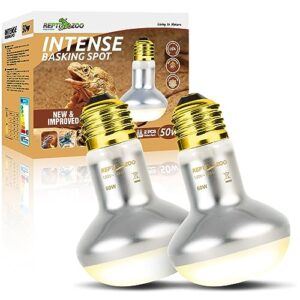
Lighting is easy to overlook when you’re focused on substrate and hides, but it shapes how your rosy boa behaves. The Repti Zoo UVA Basking Lamp runs at 50 watts and can push that basking spot into the 85–95°F range. Its aluminum-coated glass boosts thermal output by 35% compared to a standard bulb.
The frosted surface softens the light reaching your snake’s eyes without cutting heat delivery.
Keep in mind this bulb emits UVA only, not UVB, so it won’t support vitamin D3 synthesis on its own. Rosy boas don’t rely heavily on UVB since they’re naturally nocturnal, so that’s not a dealbreaker here. Pair it with a thermostat to hold temperatures steady throughout the day.
Some units have failed within weeks, so keep a spare bulb ready before you need one.
| Best For | Rosy boa owners who want a reliable heat source that mimics natural sunlight and supports healthy basking behavior without breaking the bank. |
|---|---|
| Primary Use | Basking heat source |
| Best For | Rosy boa owners |
| Ease of Use | Screw in and use |
| Key Limitation | No UVB output |
| Setup Required | Fixture required |
| Maintenance Level | Low |
| Additional Features |
|
- Aluminum-coated glass boosts thermal output by 35%, making it easier to hit that ideal 85–95°F basking spot
- Frosted surface softens glare so your snake’s eyes aren’t stressed by harsh direct light
- Compatible with dimmers and thermostats, giving you precise control over enclosure temperatures
- Emits UVA only — no UVB, so it won’t support vitamin D3 synthesis on its own
- Some users report bulbs failing within 4–6 weeks, well short of the 3,000-hour rating
- Requires a high-heat rated fixture, which adds to setup cost if you don’t already have one
6. Exo Terra Natural Yellow Desert Sand
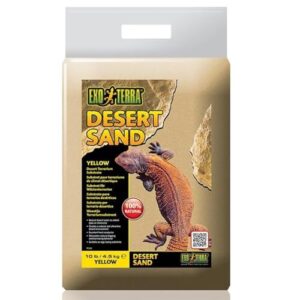
Sand substrate isn’t always the right call for every reptile, but rosy boas are a natural fit. Exo Terra Natural Yellow Desert Sand is free of dyes and chemicals, which means you’re not introducing anything harmful into your snake’s space. The sand is sifted to a uniform grain size, so it conducts heat evenly from your basking setup and reduces clumping during spot cleans.
It can get dusty when you first pour it out of the bag. Mix it lightly with water before adding it to the enclosure to reduce those airborne particles. Your snake can dig and burrow through it naturally, which helps the exploratory behavior rosy boas show in the wild. That’s a real benefit for a ground-dwelling species.
At 10 pounds per bag, you have enough to cover most adult enclosures at a 2-3 inch depth.
| Best For | Rosy boas and other desert-dwelling reptiles that benefit from a natural digging substrate in a chemical-free enclosure. |
|---|---|
| Primary Use | Burrowing substrate |
| Best For | Desert-dwelling reptiles |
| Ease of Use | Mix and pour |
| Key Limitation | Can be dusty |
| Setup Required | Mix with water |
| Maintenance Level | Moderate |
| Additional Features |
|
- No dyes or chemicals, so it’s safe for direct contact with your snake
- Sifted to a uniform grain size for even heat conduction from your basking setup
- Encourages natural digging and burrowing behavior
- Can be quite dusty straight out of the bag — mix with water before use
- Not suitable for all reptile species, so double-check compatibility before buying
- Mixed reviews on odor control, which may be a factor in smaller or enclosed spaces
7. Zoo Med Excavator Clay Burrowing Substrate
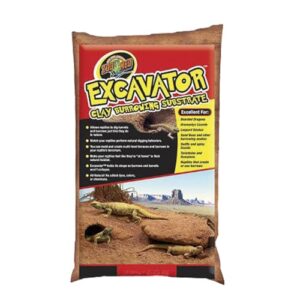
If your rosy boa could pick its own substrate, Zoo Med Excavator Clay would probably be near the top. These snakes are natural burrowers, and this moldable clay lets you build real tunnels and stable hides before your snake even moves in.
You mix it with water to a dough-like consistency, then sculpt it directly in the enclosure. It dries firm in 24 to 48 hours, holding its shape under your snake’s weight without collapsing. One 10-pound bag covers most adult enclosures at a solid depth.
The clay is 100 percent natural with no dyes or added chemicals, so it’s completely safe for your snake to rest against or move through every day.
If a section cracks after drying, re-wet that area and press it back into shape. The tunnels stay stable for several months, and repairing them takes almost no effort.
| Best For | Rosy boas, bearded dragons, leopard geckos, and other burrowing reptiles whose owners want a natural, moldable substrate that supports instinctive digging behavior. |
|---|---|
| Primary Use | Moldable substrate |
| Best For | Burrowing reptiles |
| Ease of Use | Mix and sculpt |
| Key Limitation | Can crack when dry |
| Setup Required | 24-48 hour cure |
| Maintenance Level | Low |
| Additional Features |
|
- Holds its shape after drying, so tunnels and hides stay stable for months without collapsing under your snake’s weight
- Made from 100% natural clay with no dyes or chemicals, making it safe for daily contact
- Easy to spot-clean since dry waste sits on the surface and can be removed without disturbing the whole setup
- Can crack or crumble if not packed and moistened properly during setup
- Some users report structural failure within 48 hours, especially under heavier animals or added moisture
- Tends to get dusty when dry, and adding too much water can turn it into an unworkable muddy mess
8. Rescue One Step Veterinary Disinfectant Cleaner
Keeping your rosy boa’s enclosure clean isn’t glamorous, but it matters more than most beginners expect. Rescue One Step makes that job fast and practical. It uses Accelerated Hydrogen Peroxide technology to clean, disinfect, and deodorize all at once, no mixing or measuring needed.
It kills tough pathogens like Canine Parvovirus in as little as 60 seconds and is safe on plastic, sealed surfaces, and cage materials common in reptile setups. It’s a staple in vet clinics and shelters for good reason.
One honest heads-up: the odor during application is strong. Ventilate the room thoroughly and let surfaces dry completely before putting your snake back. Once dry, it leaves no harsh residue.
| Best For | Reptile keepers, foster homes, and shelter volunteers who need a fast-acting, no-fuss disinfectant that’s tough on pathogens but safe for animals once dry. |
|---|---|
| Primary Use | Enclosure disinfection |
| Best For | All animal enclosures |
| Ease of Use | Apply and dry |
| Key Limitation | No spray nozzle included |
| Setup Required | Nozzle required |
| Maintenance Level | Low |
| Additional Features |
|
- Kills dangerous pathogens like Canine Parvovirus in as little as 60 seconds with no mixing or dilution required
- Safe around pets after drying and trusted by veterinary professionals and shelters
- Cost-effective for regular use compared to disposable wipes
- Does not include a spray nozzle, so you’ll need to buy one separately
- Can leave streaks or a film on clear surfaces like acrylic panels
- Strong chemical odor during application requires good ventilation before returning your snake to the enclosure
Frequently Asked Questions (FAQs)
How much does a rosy boa cost?
Prices, patterns, and provenance all shape what you’ll pay. A common hatchling runs $150 to $250, but rare color morphs can reach $350 to $400. Factor in setup costs of $200 to $500 before you buy.
Does a rosy boa bite hurt?
A bite feels like a quick pinprick — sharp for a second, then gone. There’s no venom, so no swelling or lasting pain. Most marks disappear within minutes.
Are rosy boas friendly?
Friendly is a fair word for them. Calm and slow-moving by nature, they rarely bite and tend to retreat rather than strike when startled. That steady temperament makes them a natural fit for first-time snake owners.
Are rosy boa venomous?
No, rosy boas are completely non-venomous. They subdue prey through constriction, not venom. A bite may cause minor swelling, but there’s no toxin involved. They’re one of the safest snakes you can own.
Do rosy boa like to be held?
Can any snake truly enjoy being held? Most calm, slow-moving species tolerate handling well when started young. With short, consistent sessions of 5 to 10 minutes, most individuals relax quickly in your hands.
What size tank does a rosy boa need?
Tank size depends on age. Start with a 10 gallon for hatchlings. Juveniles move up to 10 to 15 gallons, and adults need at least a 20 to 30 gallon setup with a secure, escape-proof lid.
How long can rosy boas live in captivity?
With good care, these snakes commonly live 20 to 30 years. Some reach 30 to 35 years when temperature gradients stay stable, humidity stays consistent, and routine vet checks catch problems early.
Are rosy boas good pets for beginners?
Surprisingly, the easiest pets to keep are often the ones most people overlook. Rosy boas are calm, rarely bite, and live 15 to 25 years, making them one of the best beginner snakes available.
When is the best time to handle rosy boas?
Handle your boa in the morning, when it is awake and exploring. Keep sessions to 5–10 minutes. Never handle for 48 hours after feeding, and skip handling while its eyes are cloudy or shed is underway.
Can rosy boas be housed together safely?
Like keeping two kings in one castle, cohabitation invites trouble. House each snake alone.
Shared space can cause feeding fights, stress, injuries, and possible cannibalism. Separate enclosures also make temperature control, health checks, and feeding safer.
Conclusion
While the desert’s little boa has somehow avoided a committee meeting, it still requires steady heat, clean water, secure hides, and correctly sized meals. A rosy boa won’t reward shortcuts, but it rarely asks for spectacle either.
Consistent care keeps this quiet snake healthy for decades. Set up its rocky refuge well, watch its routine closely, and you’ll find responsible husbandry is the whole trick, no rainforest drama required, just a well-kept life indoors.