This site is supported by our readers. We may earn a commission, at no cost to you, if you purchase through links.

Step onto sand at noon and you’ll feel it through your boots within seconds: ground temperatures pushing past 40°C, hot enough to injure bare skin in minutes. Yet somewhere beneath that scorching surface, a rattlesnake rests at a comfortable 25°C, tucked into a borrowed rodent burrow.
That contrast defines survival in the desert. A desert habitat for snakes isn’t just sand and heat, it’s a patchwork of microclimates, from cool rock crevices to shaded washes, that these reptiles exploit with impressive precision.
Understanding how snakes read this landscape, where they shelter, hunt, and cool down, reveals adaptations refined over millions of years, and offers practical insight for anyone sharing that terrain with them.
Table Of Contents
- Key Takeaways
- What Defines a Desert Snake Habitat?
- Desert Microhabitats Snakes Use for Shelter
- How Snakes Survive Desert Conditions
- Desert Snake Species Around The World
- Desert Snake Ecology and Human Coexistence
- Frequently Asked Questions (FAQs)
- How do snakes adapt to the desert biome?
- Where do snakes like to hide in the desert?
- What is the best habitat for a snake?
- Can you find a snake in the desert?
- How do snakes navigate desert storms safely?
- What role do snakes play in desert ecosystems?
- Can snakes hear in the desert environment?
- Do desert snakes have unique mating rituals?
- How do snakes protect themselves from sandstorms?
- How do desert snakes reproduce and care for young?
- Conclusion
Key Takeaways
- Desert snakes beat extreme heat by using microhabitats like burrows and rock crevices, which stay 8-12°C cooler than the scorching surface above.
- Since water is scarce, these snakes have evolved clever tricks like producing concentrated uric acid paste instead of liquid urine and pulling moisture straight from their prey.
- Snakes shift their entire routine with the seasons, basking at dawn, hunting at night when it’s cooler, and retreating underground during the harshest heat.
- Beyond just surviving, desert snakes play a real ecological role by controlling rodent populations by up to 40%, making them essential (not just tolerable) neighbors as human development pushes into their territory.
What Defines a Desert Snake Habitat?
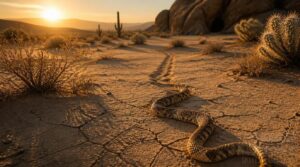
A desert isn’t just sand and sun; it’s a set of harsh conditions every snake has to answer with real adaptations. Understanding what makes this habitat so demanding will help you see why these reptiles look and behave the way they do. Here are the five defining traits that shape life for a desert snake.
If you’re planning to recreate these conditions at home, this guide to building a proper desert snake habitat walks through replicating each of these adaptations safely.
Extreme Heat and Temperature Swings
Picture sand hot enough to blister skin by noon, then air cold enough for a jacket by midnight. That’s desert life.
Desert sand can blister skin by noon and turn jacket-cold by midnight, all in a single day
Ground surfaces can swing over 40°C daily, forcing desert thermoregulation through basking, burrowing, and nocturnal hunting. Snakes dodge thermal stress by seeking rock crevices or burrows, avoiding ground heat while heat waves intensify nighttime warmth, straining their narrow survival window.
This challenge is intensifying as prolonged nighttime heat becomes more common, giving desert wildlife less time to cool down before the next day’s extremes begin.
Low Rainfall and Scarce Water
That heat problem gets worse without water. Desert regions see under 250mm of rain yearly, with evaporation outpacing it up to sixfold.
So snakes rely on metabolic water extraction from prey, produce concentrated uric acid paste instead of liquid urine, and shift to nocturnal hunting, conserving hydration while thermal refuges buffer them against relentless, drought-driven scarcity.
Sparse Vegetation and Ground Cover
Water scarcity shapes more than snake behavior. It shapes the ground itself. Canopy cover often stays below 15%, leaving bare soil exposed to albedo effects that intensify daytime heating.
- Sun-baked crusts cracking underfoot
- Shrub islands casting thin shadows
- Gravel mantles glinting under harsh light
Wind erosion control and seed bank protection depend on this sparse cover, creating microclimate patches you’ll use for camouflage and thermoregulation.
Prey Availability and Predator Pressure
That bare ground you just crossed hides a livelihood: rodent burrows mean prey density pockets, but also predators watching those same burrows.
| Factor | Benefit | Risk |
|---|---|---|
| Rodent burst | Fast energy | Predator ambush |
| Rock crevice | Concealment | Limited exit routes |
| Drought lull | Longer refuge | Starvation odds |
Every strike balances hunting efficiency against becoming someone else’s meal.
Seasonal Changes in Habitat Conditions
As seasons turn, a desert snake’s world reshuffles entirely. Temperature range expansion stretches highs past 45°C while winter nights drop near freezing, forcing sharper thermoregulation choices.
Monsoon moisture shifts briefly ease water conservation demands, triggering vegetation growth cycles that boost prey. But dry spells return fast, so burrowing behavior and nocturnal hunting behavior intensify as refuge availability changes and ground moisture variability sends snakes deeper underground.
Desert Microhabitats Snakes Use for Shelter
Once you understand why desert conditions are so brutal, the next question is where snakes actually go to escape them. Every desert has its own set of hiding spots, each offering a different kind of relief from heat, dryness, or predators. Here’s a closer look at the microhabitats you’re most likely to find them using.
Beyond simply picking the right hideout, many desert snakes rely on subtle physiological tricks for surviving heat and drought that work alongside their choice of shelter.
Sandy Dunes and Loose Soil
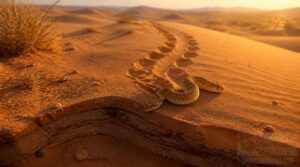
Loose sand isn’t empty space, it’s a snake’s toolkit. Wind-built dunes and fine grains (0.1–0.5mm) let sidewinders excavate refuges fast, cratering into cooler subsurface layers within minutes.
Porous soil drains rare rainfall quickly, so burrow stability depends on grain compaction, not moisture. These shifting dune fields also link basking sites to shelter, giving you a working thermal gradient just beneath the surface.
Rocky Outcrops and Crevices
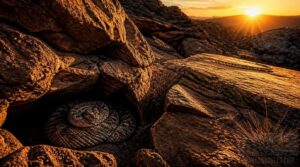
Boulders hold secrets sand can’t. Crevice thermoregulation lets you track temperature swings of 5–15°F, tucking into shaded pockets while boulder field basking warms you fast on south-facing slabs.
Deep cracks trap humidity, aiding refuge moisture retention during droughts. Ledges become ambush points, funneling lizards and rodents past narrow gaps, rewarding patient microhabitat selection with reliable, low-risk hunting.
Burrows and Underground Refuges

Go underground and the desert gets forgiving. Burrows buffer you from surface heat topping 40°C, holding steady between 23-28°C thanks to burrow temperature regulation.
You’ll often inherit abandoned rodent burrows rather than dig fresh tunnels. Nest chamber construction favors loose soil for insulation, while soil moisture retention keeps eggs viable.
Nighttime air exchange flushes humidity, and connected tunnels create habitat connectivity between denning sites and thermal refuges.
Shrubs, Cacti, and Desert Washes
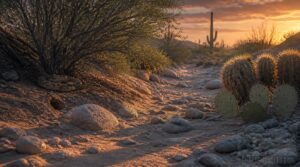
Vegetation isn’t just scenery in a desert habitat for snakes, it’s functional cover. Cactus and succulent plants offer shade pockets, while dense shrubs with shrub water retention hide ambush points.
Sandy washes create cooler microclimates after floods. These zones also draw pollinators and support seed dispersal, indirectly feeding the rodents you’ll find hunting nearby.
Oases and Human-Altered Areas
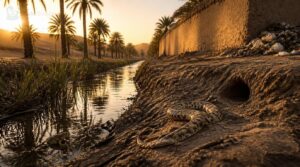
Water changes everything. Springs and oases draw snakes toward human settlements and agricultural lands, where prey concentrates but risks multiply.
- Irrigation ditches humming with rodents
- Date palm groves offering shade
- Canal banks lined with frogs
- Farm walls warm at dusk
- Trash piles hiding easy meals
Water extraction effects and habitat fragmentation push snakes closer to people, raising snakebite prevention concerns as habitat encroachment continues.
How Snakes Survive Desert Conditions
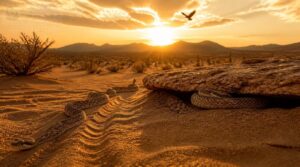
Finding shelter is only half the battle out here. The desert throws heat, drought, and hungry predators at every snake that calls it home, and survival takes more than a good hiding spot. Here’s how these reptiles turn brutal conditions into a livable routine.
Basking and Behavioral Thermoregulation
Watch a snake at sunrise and you’ll see pure strategy: it flattens its ribs, exposing dark scales for rapid heat absorption, gaining 5-10°C in twenty minutes.
| Time | Behavior |
|---|---|
| Dawn | Basking posture |
| Midday | Thermal refuge seeking |
| Afternoon | Duration adjustment |
| Dusk | Cooling reset |
| Night | Dormancy |
This morning radiant heating ritual fuels digestion and survival.
Burrowing During Peak Heat
Once surface temperatures climb past 40°C, basking stops paying off, and burrows become the better bet. Snakes select burrow depth based on need: shallow tunnels (20-40cm) cool quickly, while deeper systems (1-2m) hold temperatures 8-12°C lower.
Soil moisture matters too, damp clay stays cooler longer than sun-baked sand, giving these thermal refuges their staying power through the hottest hours.
Nocturnal and Seasonal Activity
Burrows buy time, but the real shift happens with the sun. Below 35°C, snakes emerge to hunt, favoring crepuscular foraging and post-midnight peaks when rodents move.
- Cooler nights extend hunting windows
- Moonlight adds 1-2 extra hours
- Winter drops 5-15°C, boosting activity
- Rain triggers surges in prey
- Seasons shift activity windows broadly
Water Conservation Adaptations
Timing your hunts is only half the battle out here. Your kidneys do the quiet work too, producing concentrated uric acid paste instead of liquid urine. Impermeable scales cut evaporation by 70%. Digested prey yields metabolic water, and humid nights let some species absorb moisture straight through skin.
| Adaptation | Function |
|---|---|
| Uric acid excretion | Minimizes fluid loss |
| Scale impermeability | Blocks evaporation |
| Cutaneous absorption | Draws humidity in |
Sidewinding, Camouflage, and Sensory Hunting
Picture a rattlesnake looping sideways across a dune, belly barely touching the scorching sand. That’s sidewinding mechanics at work, each loop covering 30 to 60 centimeters per second while minimizing heat gain.
Camouflage patterns match scales with pebbles and debris. Meanwhile, heat-sensing pits detect prey warmth to 0.003°C, vibration sensing catches footsteps, and combined sensory perception times each ambush predation strike with precision.
Desert Snake Species Around The World
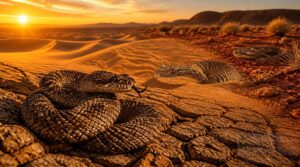
Every desert on Earth has produced its own cast of snakes, each shaped by the same brutal sun and thin water supply. You’ll find rattlesnakes in Arizona, horned vipers in the Sahara, and death adders in the Australian outback, all solving the same survival puzzle in different ways.
Here’s a look at who these snakes are and where you’ll actually find them.
North American Rattlesnakes and Kingsnakes
Two neighbors, opposite strategies: the Western Diamondback injects hemorrhagic venom, while the desert kingsnake shrugs off rattlesnake bites entirely thanks to evolved resistance.
- Mojave venom targets nerves
- Kingsnakes constrict, don’t envenomate
- Rattlers birth live young
- Kingsnakes lay 4-20 eggs
- Sonoran Desert hosts both
That habitat overlap creates a predator-prey relationship you won’t forget once you’ve watched it unfold.
African Vipers and Desert Cobras
Cross North Africa’s dunes and you’ll find two contrasting hunters. The Egyptian cobra relies on hood display and neurotoxic venom; the Saharan horned viper ambushes via horned scales and sandy terrain camouflage.
| Trait | Egyptian Cobra | Horned Viper |
|---|---|---|
| Length | 2.5m | 25-40cm |
| Venom | Neurotoxic | Cytotoxic |
| Hunting | Nocturnal foraging | Ambush |
Asian Sand Boas and Vipers
Ambush hunters don’t need speed, just patience. Asian Sand Boas stay buried in shallow burrow networks, striking upward at passing prey. Nocturnal feeding cycles pair with sand camouflage so effective you’ll rarely spot one before it moves.
- Stocky, 1-2 foot bodies
- Tan patterning
- Weeks between meals
- Sidewinding retreats
- Live births, 4-10 young
Asian Vipers hunt similarly, ambushing from concealed desert habitat spots.
Australian Death Adders and Elapids
Don’t let the stocky build fool you. Death adders ambush with a strike so fast most prey never see it coming, thanks to long, movable fangs delivering potent neurotoxic venom.
Found across the outback’s arid and semi-arid zones, these elapids stay motionless in leaf litter, camouflaged and nocturnal. Females give birth to live young, no eggs required for outback survival.
Venomous Versus Nonvenomous Habitat Use
Venomous snakes lean toward rocky refuges, while nonvenomous species favor open sand for ambush hunting.
- Rocky outcrops shelter venomous species by day
- Sandy patches suit nonvenomous ambush tactics
- Both use washes, but venomous snakes hug limestone shade
- Venomous species show stronger nocturnal shelter fidelity
Refuge preference reflects heat avoidance and predator avoidance built into each snake’s survival strategy.
Desert Snake Ecology and Human Coexistence
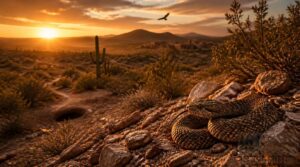
Desert snakes aren’t just surviving out there, they’re pulling weight in a whole natural community, and that matters more once people move into their range. Understanding that role changes how you think about coexisting with them, not just avoiding them. Here’s what you need to know about their place in the desert and how to stay safe when your paths cross.
Rodent and Lizard Population Control
A single gopher snake can knock pocket mice numbers down by 40 percent during peak breeding season. That’s real pest control, not folklore. Snakes track lizard ambush sites too, occupying crevices lizards need for escape and suppressing dominant species in patchy microhabitats.
| Prey Type | Snake Impact | Habitat Zone |
|---|---|---|
| Rodents | Up to 40% density drop | Burrow networks |
| Lizards | Localized suppression | Rocky crevices |
| Amphisbaenians | Seasonal chase spikes | Spring foraging |
Snakes Within Desert Food Webs
That pest control ripples outward. Snakes sit as mid-level predators, converting rodents and lizards into energy for hawks, foxes, and larger snakes.
- Rodents dominate diets in wet years
- Lizards fill gaps during dry spells
- Invertebrates sustain snakes in drought
- Prey specificity shifts seasonally
- Predator-prey relationships stabilize desert food chains
Dietary adaptations keep the desert food chain balanced, even when rainfall stays unpredictable.
Climate Change and Habitat Loss
That balance faces new pressure now. Deserts are projected to warm 1.5 to 2.5°C by 2050, pushing thermal stress adaptation past its limits and forcing range shifts.
Erratic rainfall disrupts prey and shelter, fragmenting habitat and straining the desert environment’s fragile equilibrium in ways behavioral adjustments alone can’t fully offset.
Preventing Encounters Around Desert Homes
Habitat loss pushes snakes toward yards, so snake barriers matter now. Install four-foot fencing with one-inch mesh, seal gate gaps, and fit door sweeps.
- Clear debris and woodpiles 30 feet out
- Control water sources and pet bowls
- Use amber lighting, not bright white
Cleanup, sealing, and smart lighting cut encounters without harming the natural world.
Safe Sightings and Bite Response
When you spot a snake on the trail, freeze first, react second. Stay calm, back away slowly, and give it a clear escape route. Avoid touching or handling it yourself; call wildlife management instead.
If bitten, immobilize the bite, keep it at heart level, and clean the wound promptly with soap and water. Skip tourniquets. Seek help immediately.
Frequently Asked Questions (FAQs)
How do snakes adapt to the desert biome?
Where searing sand meets nighttime chill, survival hinges on contrast. Snakes counter this through burrowing, thermoregulation, and camouflage, conserving water via uric acid paste, absorbing moisture through skin, and using sensory pits to hunt efficiently despite scarce prey.
Where do snakes like to hide in the desert?
You’ll find them tucked in rock crevice shelters, sand dune burrows, and abandoned rodent tunnels. Shrub shade zones and cactus base cover work too, hiding coils from both sun and hungry predators during nocturnal hunting patterns.
What is the best habitat for a snake?
Picture a rocky outcrop at dusk, crevices holding the day’s warmth. That’s ideal: thermal refuge selection meets water access and steady prey distribution patterns, letting a snake’s desert adaptation thrive without competing for scarce microclimate resources.
Can you find a snake in the desert?
Yes, absolutely. Snake spotting rewards patience: scan rock crevices at dawn or dusk, watch for sidewinder trails in loose sand, and look for subtle movement near shrubs. Their camouflage is excellent, so slow, careful observation from a safe distance works best.
How do snakes navigate desert storms safely?
When gusts kick up, you head for burrows or rock crevices, using wind blocking cover and humidity refuge underground. Low exposure zones under shrubs limit heat gain, while you stay still, conserving water until conditions calm.
What role do snakes play in desert ecosystems?
Think of snakes as the desert’s quiet balancing scale. Through rodent population control and serving as prey themselves, they anchor predator-prey relationships, prevent trophic cascades, and sustain biodiversity hotspots essential to overall desert environmental balance.
Can snakes hear in the desert environment?
Not through airborne sound. Snakes rely on vibration sensing through jaw-to-inner-ear contact, picking up low frequency ground vibrations.
Because of this, snakes tend to respond best to deep, bass-heavy sounds, and you can explore what kinds of music snakes seem to like best if you’re curious.
Sand and soil transmit prey footfalls and predator movement, giving desert snakes a survival strategy built on touch rather than traditional hearing.
Do desert snakes have unique mating rituals?
Love finds a way, even in sand traps. Desert snakes rely on pheromone tracking, tail signaling, and courtship displays, sometimes forming mating balls, to secure a partner before slithering off, leaving no post-mating care behind.
How do snakes protect themselves from sandstorms?
When wind kicks up sand, you’ll spot snakes retreating into burrows or rock crevices fast. Fused eye spectacles and tucked heads shield them from grit, while slowed breathing and sand-toned camouflage keep exposure and energy loss minimal.
How do desert snakes reproduce and care for young?
It’s a race against the clock: females time egg incubation or live birth to cooler seasons, then vanish. Parental care ends fast, so hatchlings rely on instinct, camouflage, and denning sites for survival odds.
Conclusion
Still waters run deep, and so does desert wisdom hidden beneath scorched sand.
Every burrow, crevice, and shaded wash tells you something about how a desert habitat for snakes actually functions, not as barren wasteland, but as a finely tuned survival system.
Rattlesnakes cooling in rodent tunnels, sidewinders gliding across dunes at dusk, these aren’t accidents.
They’re millions of years of adaptation.
Respect that system, watch your step, and the desert will show you its secrets without ever needing to bite.
- https://www.open.edu/openlearn/nature-environment/natural-history/animals-the-extremes-the-desert-environment/content-section-2.3?printable=1
- https://www.animalsaroundtheglobe.com/10-things-snakes-do-to-regulate-heat-and-3-that-leave-them-exposed-6-353802
- https://tpwd.texas.gov/education/resources/texas-junior-naturalists/snakes-alive