This site is supported by our readers. We may earn a commission, at no cost to you, if you purchase through links.
wrong substrate has killed more captive reptiles than most keepers realize. Not from toxicity—though that happens too—but from chronic stress, respiratory infections, and impaction caused by flooring that never matched the animal’s natural environment. Small mismatches with compounding consequences.
ball python burrowing through calcium sand. green tree frog pressed against paper towels with nowhere to hide.
Substrate shapes humidity, temperature, behavior, and health all at once. The reptile tank substrate options available today range from simple cypress mulch to layered bioactive ecosystems seeded with live microfauna—each built for a different animal and a different goal.
Table Of Contents
- Key Takeaways
- Best Reptile Tank Substrate Types
- Match Substrate to Reptile Needs
- Top 4 Reptile Substrate Products
- Bioactive and DIY Substrate Mixes
- Cleaning and Safety Best Practices
- Frequently Asked Questions (FAQs)
- What to put in the bottom of a reptile tank?
- What not to use for snake bedding?
- What not to put in a terrarium?
- Can I mix different substrates together safely?
- How much substrate depth do reptiles need?
- Do substrates expire or go bad over time?
- Are colored or dyed substrates safe for reptiles?
- Can I reuse substrate after deep cleaning it?
- Can I reuse substrate after deep cleaning?
- How does substrate affect shedding cycles?
- Conclusion
Key Takeaways
- Substrate isn’t just flooring — it directly controls humidity, temperature, burrowing behavior, and long-term health, so matching it to your specific species is one of the most important choices you’ll make.
- Dangerous materials like cedar, pine, calcium sand, and dyed substrates can cause respiratory damage, toxic reactions, or life‑threatening impaction, and should never go in any reptile enclosure.
- Bioactive setups using layered soil mixes, drainage materials, and cleanup crews like springtails and isopods create self‑sustaining environments that reduce maintenance while better mimicking natural habitats.
- Even the best substrate becomes a health risk without regular spot‑cleaning, proper depth maintenance, and timely full replacements — quarantine and hatchling tanks need swaps every two to four weeks.
Best Reptile Tank Substrate Types
Substrate is one of those choices that affects everything — humidity, behavior, health, and how natural your reptile’s home actually feels. so many options out there, knowing what each one does makes picking the right fit a lot easier.
A closer look at substrate options for snake health and habitat can help you match the right material to your specific species’ needs.
Here’s a look at the most common substrate types and what they’re best suited for.
Topsoil-based Substrate Mixes
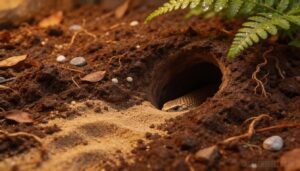
Topsoil makes a surprisingly adaptable base — cheap, widely available, and easy to customize. A 70/30 topsoil-to-play-sand mix ratio gives you solid moisture balance while keeping particle size manageable for burrowing substrate selection.
Before adding anything to your tank, safety screening matters: check for debris, perlite, or chemical additives.
Good soil composition facilitates substrate compaction just enough to hold burrows without turning into mud.
organic topsoil benefits by providing a natural medium for cleanup crews.
Coconut Fiber and Coconut Coir
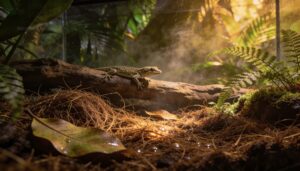
Coconut coir — also called coconut fiber or Eco Earth Coconut Fiber Substrate — comes from coconut husks, making it a smart example of renewable waste utilization.
high lignin durability keeps it from compacting quickly, while natural antimicrobial properties slow bacterial buildup.
pH neutrality makes it safe for most species.
substrate moisture retention stays consistent without turning soggy — ideal for tropical setups needing reliable moisture control using coconut coir.
Cypress Mulch and Bark Chips
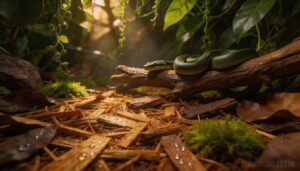
Cypress mulch and bark chips work differently than coir, but complement it well in tropical builds.
Cypress mulch offers strong Water Holding Capacity, Slow Decomposition, and Aromatic Insect Deterrence from its natural oils. Its Neutral pH keeps it safe for most species.
Follow substrate safety guidelines for exotic pets — watch humidity management in terrariums carefully, since excess moisture raises mold risk and impaction risk of loose bedding.
Avoid hatchlings.
Reptile Carpet and Terrarium Liners
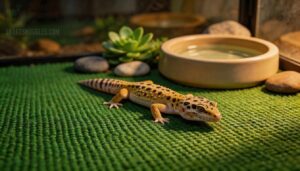
Unlike loose substrates, reptile carpet and cage liners give you a clean, fixed surface with near-zero impaction risk — a real advantage for floor feeders.
- Installation Tips: Cut liners to fit any enclosure with scissors
- Material Durability: 85% wool, 15% nylon carpet lasts for years
- Odor Control: Enzyme-treated options reduce smell naturally
- Temperature Conductivity: Lower than tile; pair with under-tank heaters
- Cost Comparison: Carpet runs $10–$94; liners just $0.30–$4.80
Follow substrate safety guidelines — inspect regularly for fraying.
Paper Towels and Newspaper
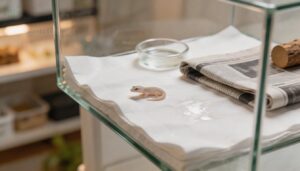
For quarantine setups and hatchlings, paper towels and newspaper are hard to beat. Both offer strong absorbency hygiene with easy daily swaps — true disposable bedding at minimal cost. Stick to black-and-white newsprint; colored ink safety is a real concern for sensitive animals.
| Feature | Paper Towels / Newspaper |
|---|---|
| Isolation Use | Ideal for quarantine and hatchlings |
| Environmental Footprint | Biodegradable; replace daily |
| Absorbency | High; newsprint softens with moisture |
| Ink Safety | Black-and-white only |
Sand and Play Sand Blends
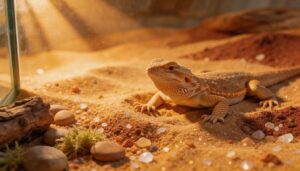
Sand works well for desert species like bearded dragons and leopard geckos — but not all sand is equal. Fine, washed play sand blended with topsoil reduces impaction risk and facilitates natural burrowing behavior.
- Dust reduction techniques matter: washed quartz minimizes airborne silica.
- Starch-based binder types improve moldable sand benefits without toxic additives.
- Avoid damp storage — storage guidelines prevent mold and humidity management issues.
Tile and Solid-surface Options
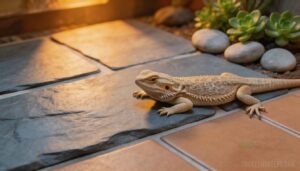
Tile might not be the first thing that comes to mind, but slate or ceramic tiles are genuinely practical heat retention substrates for reptiles.
Unglazed surfaces offer grip and absorb warmth from basking zones. Moisture resistance makes cleanup fast — just wipe with reptile-safe cleaners.
Keeping surfaces easy to clean also helps you spot early warning signs of dehydration or illness — a habit that pairs well with a solid snake hydration and electrolyte routine.
tile sealing or grout gaps means fewer bacterial hideouts. Edge finishing keeps debris contained. Simple, durable, zero impaction risk.
Match Substrate to Reptile Needs
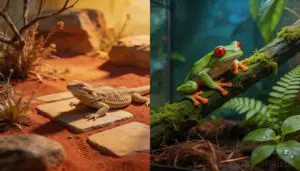
Not every reptile wants the same thing under its feet. A bearded dragon and a red-eyed tree frog have completely different needs — and the wrong substrate can stress or even harm your animal.
Here’s how to match your choice to what your specific reptile actually needs.
Desert and Arid Species
Desert-dwelling reptiles live with temperature extremes — scorching days, cold nights — so their substrate needs to work hard. Fine sand or a sand-topsoil blend helps burrow microclimate regulation and natural nocturnal behavior.
Their Camouflage Coloration also blends best against arid tones.
Heat retention substrates for reptiles like reptile carpet or tiles keep things stable, aiding temperature regulation and even passive water harvesting from surface condensation.
Tropical and Rainforest Species
Tropical and rainforest reptiles need humidity sitting between 60–90% — that’s not optional; it’s survival. Their natural world features Canopy Moisture Channels, Epiphyte Habitat Integration, and a rich Leaf Litter Food Web supporting prey.
Replicate that with:
- Coconut coir for steady humidity management in terrariums
- Cypress mulch to mimic forest-floor Microclimate Temperature Gradients
- Sphagnum moss layered for moisture control
- Bioactive substrate supporting Conservation Habitat Connectivity principles
- Mixed tropical blends for complete enclosure stability
Burrowing Reptiles
Burrowing reptiles are natural engineers — their Digging Morphology, including wedge-shaped heads and strong forelimbs, demands substrate that holds real Tunnel Architecture.
Choose a loose topsoil-sand blend at least 5–10 cm deep so your animal can disappear fully underground.
That depth provides Thermal Stability, Predator Avoidance, and a natural Moisture Gradient.
For burrowing behavior and substrate selection, prioritize safety: follow the Substrate safety guidelines for exotic pets and watch for the Impaction risk of loose bedding closely.
Arboreal Reptiles
Unlike burrowers, arboreal reptiles don’t need depth — they need grip. Species with zygodactylous feet, adhesive toe pads, and a prehensile tail rely on stable surfaces to climb safely.
- Reptile carpet prevents slips on flat surfaces
- Bark chips and cypress mulch add naturalistic texture below
- Coconut coir helps canopy thermoregulation by managing ambient humidity
Skip loose substrate — it works against vertical enclosure climbing.
Hatchlings and Quarantine Setups
Hatchlings need simplicity, not sophistication. Start quarantine setups with paper towels, butcher paper, or plain newspaper — they’re easy to swap and let you monitor droppings closely.
After 4–8 weeks of health monitoring, you can graduate to coconut fiber for better humidity management. Keep temperature regulation steady, maintain a consistent feeding schedule, and resist overcomplicating things early on.
Humidity Retention Needs
Once your hatchlings are settled, humidity management in terrariums becomes your next real challenge. Substrate is your first line of defense.
Coconut Fiber and cypress mulch act as moisture retentive layers, creating microclimate zones through slow water vapor exchange.
This moisture buffering keeps your humidity gradient steady without soaking the floor.
Moisture control using coconut coir and cypress mulch means less misting, more stability.
Heat Retention and Surface Comfort
Humidity sets the stage, but heat retention closes the deal. Substrate thickness, density, and moisture content all shape how warm your reptile’s floor feels hour to hour. Thermal mass layering — pairing insulating underlayers with moisture heat buffering materials like coconut coir — slows heat loss considerably.
- Reptile carpet offers a steady surface texture temperature and low thermal conductivity loss
- Dense, moist substrates act as natural heat retention materials, releasing warmth slowly overnight
- Bark chips create insulating pockets that function similarly to phase-change materials in stabilizing temps
- Tiles work as a direct heat conductor, ideal for basking zones needing quick surface warmth
Top 4 Reptile Substrate Products
Not every substrate works for every reptile, and the wrong pick can cause real problems. These four products cover a solid range of needs — from tropical setups, arid enclosures, to hatchling tanks.
Here’s what each one offers and who it’s best suited for.
1. Zoo Med ReptiSoil Terrarium Substrate
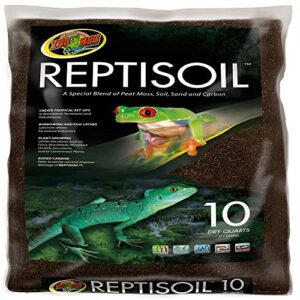
Zoo Med ReptiSoil is one of those substrates that genuinely does a lot of heavy lifting. It blends peat moss, organic topsoil, sand, and coconut carbon into a mix that holds humidity without getting waterlogged.
That makes it a solid pick for tropical lizards, amphibians, tarantulas, and box turtles. It’s also bioactive-ready — microfauna and live plants both thrive in it.
If you also keep snakes, this guide to corn snake body language shows how to read stress signals and fix habitat problems early.
At $10.98 a bag, larger enclosures will need multiple bags. Keep it damp, not soaked.
| Best For | Tropical lizards, amphibians, tarantulas, box turtles, and anyone setting up a bioactive or planted terrarium that needs steady humidity. |
|---|---|
| Brand | Zoo Med |
| Price | $10.98 |
| Odor Control | Microbial carbon activity |
| Moisture Handling | Retains humidity well |
| Intended Species | Tropical lizards, amphibians, invertebrates |
| Burrowing Support | Yes, soft and diggable |
| Additional Features |
|
- Holds moisture well without getting waterlogged, keeping humidity stable for tropical species
- Bioactive-friendly — supports live plants, microfauna, and natural burrowing behavior
- Coconut carbon helps cut down on odors over time through microbial activity
- Gets sticky and messy when too wet, which makes cleanup a hassle
- Larger enclosures over 30 gallons will need multiple bags, so costs add up
- Occasional wood chips or small stone fragments in the mix that some owners find annoying
2. Zilla Green Terrarium Liner
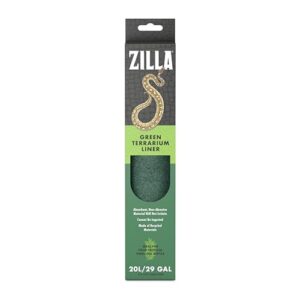
If you’re after something clean and fuss‑free, the Zilla Green Terrarium Liner is worth a look. It’s made from recycled polyethylene and polypropylene — soft on feet, non‑ingestible, and enzyme‑treated to keep odors down between cleanings.
Just rinse with cold water, let it dry, and it’s ready to go again.
Juveniles and beginner setups benefit most here. One caveat: snakes can snag on the fibers, and burrowers won’t get anything useful out of it.
Available in multiple sizes, trimmable to fit.
| Best For | Beginner reptile owners and juvenile pets like bearded dragons, leopard geckos, and ball pythons who need a clean, low-maintenance enclosure setup. |
|---|---|
| Brand | Zilla |
| Price | $9.38 |
| Odor Control | Enzyme-treated material |
| Moisture Handling | Absorbent, stays dry |
| Intended Species | Bearded dragons, ball pythons, leopard geckos |
| Burrowing Support | No, surface-only carpet |
| Additional Features |
|
- Rinse it off and reuse it — super easy to maintain
- Enzyme-treated to cut down on that reptile smell between deep cleans
- Safe for feeding time since reptiles can’t accidentally ingest it
- Snakes can get their teeth or claws caught in the fibers
- Zero burrowing support, so it’s a no-go for species that need to dig
- Stubborn, dried waste takes real effort to clean off and seams can trap bacteria
3. Zoo Med Forest Floor Substrate
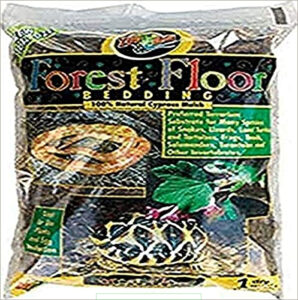
Forest floor in a bag — that’s basically what Zoo Med’s Forest Floor gives you. natural cypress mulch holds humidity well, making it a solid pick for snakes, tropical tortoises, frogs, and skinks.
It encourages light burrowing, looks great in display setups, and runs low on dust compared to most bark substrates.
Spot-clean as needed, and do a full swap every two to three months. One tip: rinse it before first use to settle any loose particles.
| Best For | Reptile and amphibian owners keeping tropical species like snakes, frogs, tortoises, or blue-tongued skinks who need a substrate that holds humidity and looks natural. |
|---|---|
| Brand | Zoo Med |
| Price | $29.98 |
| Odor Control | Natural mulch absorption |
| Moisture Handling | Mist for humidity control |
| Intended Species | Snakes, lizards, tortoises, frogs, tarantulas |
| Burrowing Support | Partial, stable walkable surface |
| Additional Features |
|
- Holds moisture really well, which makes it a go-to for humidity-loving species and helps with shedding
- Low-dust compared to most bark substrates, and it looks great in display enclosures
- Works for a wide range of animals and can be mixed with other substrates to stretch the bag further
- Pricier per volume than some alternatives, which adds up fast if you’re working with a large tank
- Waste can hide in the mulch pretty easily — you’ll need to do a smell check or dig around to find it
- Dries out over time and needs regular misting to stay effective, which means more maintenance
4. Zilla Alfalfa Meal Reptile Bedding
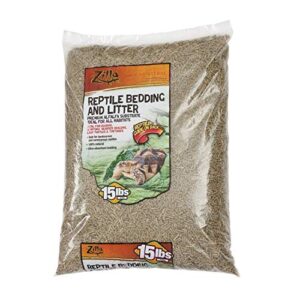
Alfalfa mightn’t be the first substrate that comes to mind, but Zilla’s pelleted bedding earns its spot. Made from 100% natural alfalfa meal, it’s digestible — so if your bearded dragon or juvenile lizard takes a bite, you won’t panic.
It pairs especially well with the guidance in this overview of substrate and bedding options for desert species, which walks you through what to weigh before committing to any enclosure floor.
It absorbs moisture, controls odor, and holds heat well with under-tank heaters.
Just keep water bowls elevated and watch for soggy spots, since wet pellets mold fast.
Best used alongside a drier substrate for balance.
| Best For | Bearded dragons, water dragons, and juvenile lizards that need a digestible, diggable substrate with good heat retention. |
|---|---|
| Brand | Zilla |
| Price | Not listed |
| Odor Control | Bacteriostatic agent included |
| Moisture Handling | Expands and clumps when wet |
| Intended Species | Bearded dragons, water dragons, tortoises |
| Burrowing Support | Yes, loose diggable pellets |
| Additional Features |
|
- Made from 100% natural alfalfa meal — safe if your reptile accidentally eats it
- Absorbs odors well and holds heat nicely with under-tank heaters
- Biodegradable and made in the USA, so it’s a cleaner choice for eco-conscious owners
- That alfalfa smell is real — expect a farm-like odor, especially in smaller rooms
- Wet pellets mold quickly, so water bowls need close monitoring
- Too loose for some reptiles like tortoises, and not great as a standalone substrate long-term
Bioactive and DIY Substrate Mixes
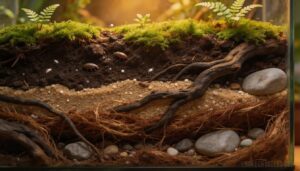
Bioactive and DIY substrate mixes take your enclosure setup to a whole new level. Instead of buying a bag off the shelf, you’re building something that actually works with your reptile’s natural environment.
Here’s a breakdown of what goes into these systems and how to put them together right.
What Bioactive Substrate Does
Bioactive substrate is like a tiny ecosystem living beneath your reptile’s feet. Microfauna — springtails and isopods — drive waste conversion and nutrient cycling by breaking down feces, shedding skin, and leftover food.
Springtails and isopods silently sustain your reptile’s world, turning waste into life beneath their feet
Beneficial bacteria in substrate continue that process at a microscopic level, creating a stable microbe habitat. The organic layers also support humidity stabilization and natural burrowing, making habitat replication genuinely functional.
Single-layer Vs Layered Systems
Think of it as a trade-off between ease and performance. A single-layer substrate keeps installation simplicity front and center — one material, one depth, done.
A multi-layer substrate adds a drainage layer beneath the main mix, improving moisture regulation and burrowing stability while providing better thermal buffering against temperature swings.
Layered bioactive substrate systems cost more upfront but lower long-term cost through reduced replacements.
Match the approach to your setup’s complexity.
Drainage Layer Materials
Once your layered system is in place, the drainage layer beneath does the heavy lifting.
expanded clay pellets work well — lightweight, porous, and fast-draining.
crushed lava rock adds aeration without compacting over time.
A perlite vermiculite mix suits tropical builds needing slight moisture retention.
gravel aggregate or coarse rocks create reliable void space.
Always separate layers using geotextile fabric to prevent substrate and sand or coconut fiber from clogging the drainage layer below.
Soil Mix for Tropical Enclosures
With your drainage layer sorted, the real magic happens in the mix above it. For tropical habitats, blend 40% organic topsoil, 30% coconut fiber, 20% orchid bark, for root aeration balance, and 10% charcoal inclusion to keep things fresh.
Top it with a leaf litter layer for microfauna integration. This bioactive substrate holds moisture retention beautifully — squeeze it, and it holds shape, never drips.
Soil Mix for Arid Enclosures
Arid setups need a completely different approach. Your goal here is Moisture Balance Ratio — just enough to hold structure, never enough to trap humidity. Aim for 60% topsoil mix and 40% coarse sand for Substrate Compaction Prevention.
- Particle Size Optimization: use 0.5–2mm sand
- Mineral Content Adjustment: skip fertilizers entirely
- Temperature Conductivity Testing: add heat retention substrates for reptiles
- Cypress mulch: keep under 15%
Mixing Topsoil, Sand, and Mulch
Once you’re past arid basics, Proportion Ratios become your best tool. A reliable topsoil mix blends roughly 60% pesticide-free topsoil, 20–30% coarse sand for Drainage Optimization, and the remainder cypress mulch for organic structure. This balance helps Compaction Prevention while maintaining Mix Consistency.
Nutrient Balance matters too — skip fertilizers entirely. Following substrate safety guidelines for exotic pets means choosing between sand, topsoil, and play sand mixes carefully.
Adding Moss for Humidity Control
Sphagnum moss is your go-to for Moss Species Choice — it holds water longer than sheet or cushion moss and releases it slowly as the air dries out. Tuck it into hides using smart Moss Placement Techniques for a humid microclimate during shedding.
Keep Moss Moisture Management simple: moist, never soggy.
Moss Health Monitoring and Moss Safety Guidelines both point the same direction — check weekly and pull anything slimy or smelly fast.
Cleaning and Safety Best Practices
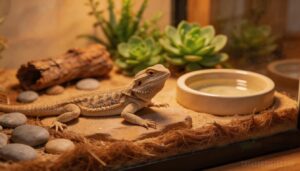
Choosing the right substrate is only half the job — keeping it clean and safe is what actually protects your reptile long-term. A few simple habits can prevent serious health issues like impaction, mold, and respiratory problems.
Here’s what you need to know to maintain a safe enclosure from the ground up.
Spot-cleaning Loose Substrate
Spot-cleaning is your first line of defense between full substrate swaps. Focus on the top 1–2 cm, where most debris collects.
Use a gentle Vacuum Technique with a terrarium-safe handheld unit, or rely on Brush Selection — a soft-bristle tool works best.
A light Moisture Mist settles dust before you start.
Always wear a Protective Mask and use Debris Containment trays to catch spills.
Full Replacement Frequency
Even with regular spot-cleaning, full substrate replacement can’t wait forever.
For desert species, swap everything out every 6–9 months — sooner if odor thresholds are crossed or waste layers hit 2 inches.
Tropical setups need turnover every 3–6 months, since higher humidity accelerates mold trigger points.
Hatchling and quarantine enclosures: Every 2–4 weeks.
Seasonal humidity shifts and drainage efficiency also affect your substrate replacement frequency.
Preventing Mold and Mites
Mold and mites don’t appear out of nowhere — they move in when conditions invite them. Airflow Management keeps damp air from stagnating over the substrate, while a proper Drainage Layer Design stops moisture from pooling below.
Practice consistent Moisture Monitoring, spot-clean waste promptly, and lean on a Biological Cleanup Crew — springtails and isopods — for microbial balance in bioactive setups.
Mold Resistant Materials help too.
Reducing Impaction Risk
Impaction is one of the sneakiest risks in reptile keeping — and substrate choice is usually where it starts. Prioritize particle size control: larger, non‑ingestible pieces dramatically lower the risks of impaction from ingestible substrates.
Pair that with moisture management, proper ventilation optimization, and a consistent feeding frequency. Smaller, regular meals reduce gut stress.
Keep up stool monitoring to catch problems before they become emergencies.
Avoiding Dusty or Toxic Materials
Some substrates are slow-acting hazards. Cedar and pine release aromatic oils that cause serious respiratory issues, and sawdust — one of the worst offenders — raises a real risk of dust inhalation that can cause silicosis over time.
Your substrate safety guidelines for exotic pets should include material toxicity screening before any substrate enters the enclosure.
Pre-wet handling cuts airborne particles fast. Prioritize dust-free selection, and never skip ventilation management.
Safe Substrate Depth Guidelines
Depth matters more than most keepers realize. Minimum Depth Standards start at 3–6 inches for most burrowing species — adults often need 6–12.
Layered Depth Planning builds moisture buffer depth below the surface, stabilizing humidity naturally. For substrate safety guidelines for exotic pets, monitor settling over time.
Burrowing substrate selection and impaction prevention both depend on keeping that depth consistent, not letting it compact down to nothing.
Substrates to Avoid Completely
Some materials can seriously hurt your reptile — no matter how cheap or convenient they seem.
Cedar shavings release toxic oils that damage skin and airways. Pine dust triggers respiratory issues fast.
Calcium sand encourages geophagy, making impaction risk from substrate ingestion almost guaranteed.
Reptile carpet traps waste and paper towel hazards include fiber ingestion.
These are the worst substrate options for exotic pets.
Frequently Asked Questions (FAQs)
What to put in the bottom of a reptile tank?
The right substrate does more than cover the floor — it shapes behavior, health, and habitat. Your choice affects temperature conductivity, moisture, and safety for your reptile every single day.
What not to use for snake bedding?
Skip Cedar Shavings, Pine Shavings, Kitty Litter, gravelly soil mixes, and moldy bark entirely.
These rank among the worst substrate options for exotic pets — causing respiratory issues, gut impaction, or toxic reactions.
What not to put in a terrarium?
Some choices are basically slow poison for your reptile. Never use flammable liquids, painted wood, resinous sawdust, citrus peels, or metal fragments.
These rank among the worst substrate options for exotic pets.
Can I mix different substrates together safely?
Yes, but grain size compatibility matters. Mixing fine and coarse particles can compact and reduce airflow.
Zone separation with barrier materials to keep substrate types apart and maintain moisture balance safely.
How much substrate depth do reptiles need?
Depth matters more than most keepers realize. Aim for 2–3 inches for surface dwellers, 4–6 for burrowing reptiles, and shallower quarantine layer thickness for hatchlings to support species-specific depth and impaction prevention.
Do substrates expire or go bad over time?
Most substrates do expire. Organic materials like coconut coir and cypress mulch degrade within months — especially with moisture impact.
Poor storage practices accelerate mold growth, odor, and pest risk, compromising substrate safety guidelines for exotic pets.
Are colored or dyed substrates safe for reptiles?
Skip dyed substrates entirely. Unnatural colors like pink, green, or blue signal chemical dyes that leach onto scales and into water.
Dye toxicity is a real health risk. Choose chemical-free, natural-color options instead.
Can I reuse substrate after deep cleaning it?
It depends on the substrate.
Inert materials like sand and tiles handle inert substrate reuse well after proper drying protocols.
Organic ones — soil, bark, mulch — carry organic material risks even post-clean.
Can I reuse substrate after deep cleaning?
Sometimes, yes — but not always. Washable and reusable options like reptile carpet hold up well.
Loose substrates often lose structural integrity, and full pathogen elimination isn’t guaranteed, so replacement is usually the safer call.
How does substrate affect shedding cycles?
Your choice of substrate directly shapes every shed.
Moisture balance, surface friction, and particle size all play a role — from humidity management in terrariums to impaction prevention and mold control during each cycle.
Conclusion
Don’t let your reptile’s home turn into a horror story. With the right reptile tank substrate options, you can create a thriving environment that matches their natural habitat.
From topsoil-based mixes to bioactive ecosystems, the choices are vast. Choose wisely, and your scaly friend will thank you.
A well-informed substrate selection is the first step to a happy, healthy pet. Make it count, and enjoy the rewarding experience of reptile keeping.
- https://www.petsuppliesplus.com/categories/reptile/basics/decoraccessories/cagecleanhandsanitizer/zoo-med-wipe-out-1/5228?gclid=Cj0KCQiAtICdBhCLARIsALUBFcGml_mWlCh0iitMpmbnOx2FfMz1pglalcBuVEXITQf6disMFtkpYWEaAsf6EALw_wcB
- https://www.wikihow.com/Clean-and-Reuse-Reptile-Substrate/Sand
- https://www.thebiodude.com/blogs/bio-activity-with-your-pets-how-does-it-work-with-mine/does-substrates-cause-impaction-in-reptiles