This site is supported by our readers. We may earn a commission, at no cost to you, if you purchase through links.

A stuck shed or a case of scale rot usually traces back to one decision: how you add moisture to the enclosure. The fogger vs misting system for snakes question matters because the two work differently. Foggers fill the air with ultrasonic vapor, raising humidity everywhere at once. Misters fire timed bursts of droplets at specific surfaces, then let everything dry out. Pick the wrong one for your species or setup, and you risk respiratory infections, fungal growth, or soaked substrate. This comparison breaks down the mechanics, the health stakes, and the best systems for your snake.
Table Of Contents
- Key Takeaways
- Fogger Vs Misting Systems for Snakes: Differences
- How Humidity Methods Affect Snake Health
- Fogger and Mister Pros and Cons
- Choosing by Species, Enclosure, and Climate
- Top 4 Snake Humidity Systems
- Safe Setup, Control, and Maintenance
- Frequently Asked Questions (FAQs)
- Are foggers or misters better?
- Do snakes need a misting system?
- Is a mister or fogger better for ball pythons?
- Should I use a mister or fogger for my chameleon?
- Can a fogger replace a snakes water bowl?
- Do misting nozzles create escape points for snakes?
- Why does reservoir water type affect fogger lifespan?
- How often should misting nozzles be descaled?
- What happens if a fogger reservoir runs dry?
- Conclusion
Key Takeaways
- Foggers raise ambient humidity broadly with ultrasonic vapor (best for tropical species like ball pythons), while misters deliver timed droplets to specific surfaces, letting them dry between cycles—so the right choice depends on your species, enclosure type, and climate.
- Most respiratory infections in captive snakes trace back to chronically wet substrate, not brief humidity spikes, so the real danger is sustained dampness from over-running either device without timers, ventilation, or a hygrometer.
- Safe operation hinges on setup and maintenance: use an external humidistat with proportional duty cycles, drip loops, distilled or filtered water, fail-safes like water-level shutoffs, and a regular schedule of descaling, nozzle cleaning, and sensor checks.
- Neither system is mandatory—a hand sprayer can suffice for some keepers—but for automation, options like the MistKing systems suit multi-enclosure or large setups, while budget foggers like the Coospider work for single tanks despite lacking built-in timers or hygrometers.
Fogger Vs Misting Systems for Snakes: Differences
Foggers and misting systems both manage humidity levels in a snake enclosure, but they work through different mechanisms. A fogger uses ultrasonic nebulization to convert water into a fine vapor that disperses through the enclosure air, raising ambient humidity quickly and broadly. You’ll notice it usually affects the entire space rather than a single spot.
This matters because humidity and temperature work together, so our guide to snake housing temperature covers how to balance both for a healthy enclosure.
A misting system releases water as fine droplets on a programmable timed cycle. This delivers moisture more directly to substrate or specific surfaces, giving you precise control over humidity distribution. Foggers usually run continuously or in short bursts, while misters activate on set intervals and require nozzle placement.
The result is that foggers raise overall air moisture, while misters target specific surfaces or zones.
How Humidity Methods Affect Snake Health

How those differences play out matters directly for your snake’s health. Humidity stability affects skin condition, shedding success, and reptile respiratory health in measurable ways. A sudden RH drop or spike disrupts your snake’s shedding cycle and, over time, can suppress its immune response.
When humidity levels stay too low, skin desiccation sets in and stuck shed becomes likely, especially around the eyes and tail tip. Push humidity too high and you risk fungal infections or scale rot, particularly when substrates stay wet.
The main health risks from poor humidity control include:
- Retained eye caps when RH drops during shedding
- Respiratory infections from excess moisture paired with poor ventilation
- Scale rot under misting systems or foggers running on wet substrate
Fogger and Mister Pros and Cons

Both foggers and misters have real trade-offs worth knowing before you commit to a setup. Below, you’ll find the key benefits and drawbacks of each system laid out clearly. Use this breakdown to match the right approach to your snake’s needs.
Fogger Benefits and Drawbacks
A keeper I know ran his fogger overnight and woke to a soaked substrate and a wheezing ball python; respiratory health suffered within days. That risk is real, but so is the upside.
One keeper ran his fogger overnight and woke to soaked substrate and a wheezing ball python
Foggers deliver rapid humidity spikes, use little water, and set up in minutes. The drawbacks: mineral deposits, mold on damp surfaces, and oversaturation if you skip timers and airflow.
If you’d rather skip the mist entirely, this guide to humidity control without a fogger covers gentler options like water trays and moss boxes.
Mister Benefits and Drawbacks
Where foggers flood the air, misting systems give you control. You schedule short bursts, so humidity levels rise during peak times and fall between cycles, letting surfaces dry. That even distribution across the reptile enclosure promotes respiratory health without soaked substrate.
The tradeoffs: emitters clog, pumps hum, and lines leak if you skip checks. Calibrate your duty cycles carefully.
Choosing by Species, Enclosure, and Climate
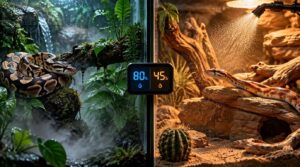
How do you pick the right humidity method for your setup? Start with your snake’s species-specific needs. Tropical species like ball pythons need sustained 70–90% RH during sheds, so a fogger’s fine vapor works well. Desert species only need brief moisture spikes, where short misting bursts are more efficient. Before investing in either method, it’s worth asking whether snakes need a fogger for humidity at all, since some setups do fine with misting alone.
Then match the method to your reptile enclosure:
- Tight, well-sealed enclosures trap vapor easily, so use short fogging cycles to avoid soggy substrate.
- Mesh-heavy or arboreal setups lose humidity fast, so longer or more frequent misting keeps levels stable.
- Deep coconut fiber substrate holds moisture longer, letting you shorten cycles either way.
Top 4 Snake Humidity Systems
If you’ve decided between a fogger and a mister, the next step is picking a reliable unit. The four systems below cover both categories, so you can match hardware to your snake’s humidity needs and your enclosure setup. Each one earns its place on this list for build quality, control options, and owner feedback.
1. Coospider 3.8L Reptile Ultrasonic Fogger Mister
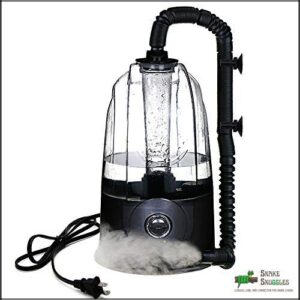
If you want a set-and-forget feel without the price of a full misting rig, the Coospider 3.8L fogger delivers. Its ultrasonic nebulizer pushes up to 380ml per hour through an adjustable hose (1.5 to 6.3 feet), so you can aim fog exactly where your snake needs it.
You get real staying power: up to 26 hours per fill at medium output, or 10 hours at max, all under 35dB. Dry-off protection shuts it down when the tank runs empty.
The catch? There’s no timer or hygrometer, so you control run times manually. Some owners report leaks or failures within months, and you’ll need distilled water plus regular nebulizer plate cleaning to prevent mineral buildup.
- Long runtime of up to 26 hours per fill at medium output, or 10 hours at maximum
- Quiet operation below 35dB, so nighttime humidity cycles won’t disturb your animals
- Adjustable hose (1.5 to 6.3 feet) with suction cups lets you direct fog precisely where it’s needed
- No timer or humidity monitoring, so you have to control run times manually
- Some owners report leaks or unit failures within just a few months
- Requires distilled water and regular nebulizer plate cleaning to prevent mineral buildup
2. MistKing Advanced Misting System
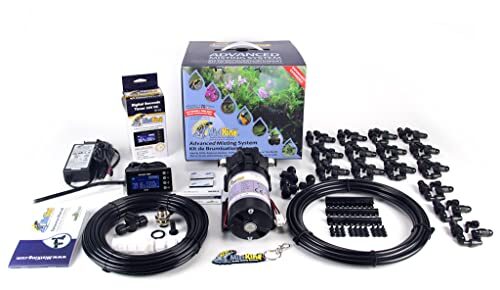
Picture a chameleon enclosure in a dry apartment: you set the MistKing Pro to run four short cycles daily, and RH holds near 70%.
This unit uses a 125psi diaphragm pump that grips 10 to 70+ nozzles, so it scales from a single vivarium to a rack system. Its 50-micron droplets create an extremely fine mist that won’t soak substrate.
You get 35 feet of 1/4" tubing, 15 feet of 3/8", plus 12 "T" and 3 "L" fittings. Note the manufacturer doesn’t recommend setups under 15 nozzles.
- 125psi diaphragm pump scales from 10 to 70 nozzles, so it grows with your collection
- 50-micron droplets produce an extremely fine mist that raises humidity without soaking substrate
- Generous tubing and fittings included—35 feet of 1/4", 15 feet of 3/8", plus 12 "T" and 3 "L" sets
- Manufacturer doesn’t recommend setups under 15 nozzles, limiting small single-tank use
- Actual nozzle capacity varies with system complexity, so real-world performance may differ
- The listed model number MKAMS5-125-300 doesn’t match the product title, which can cause ordering confusion
3. REPTI ZOO 10L Reptile Fogger System
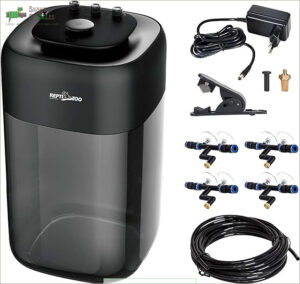
A ten-liter reservoir sits quietly beside your enclosure, feeding a steady stream of mist through four nozzles for days without a refill. That’s the main appeal of the REPTI ZOO 10L system.
You can refill directly into the main unit without removing the bucket, and a visual water level indicator shows remaining capacity at a glance. The diaphragm silent pump keeps noise low, while adjustable spray flow and internal backwatering limit dripping to under one drop when spraying stops. With 360-degree nozzles and support for up to 20 connections, one unit can handle multiple enclosures. Just note the caveats: some users report units failing around a month in, plus occasional leakage at the quick-connect fittings.
- Large 10L (2.6-gallon) tank refills directly into the main unit without removing the bucket, with a visual water level indicator.
- Diaphragm silent pump and adjustable spray flow keep operation quiet with minimal dripping when spraying stops.
- 360-degree nozzles and support for up to 20 connections let one unit service multiple enclosures.
- Some users report units failing after roughly a month of use, raising durability concerns.
- Mixed feedback on spray performance, with some units failing to mist at all.
- Leakage reported at the quick-connect fittings and occasional water dripping from the pump bottom.
4. MistKing 22252 Ultimate Misting System
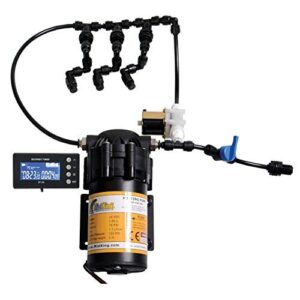
If you’re scaling up to a large enclosure, the MistKing 22252 Top Tier is built to grow with you. Its 75 PSI pump won’t burn out if it runs dry, and a zip-drip solenoid drains the tubing after each mist, so no water pools on your snake’s hide.
You get a programmable seconds timer with manual override, 25 feet of opaque tubing, and 50-micron mist. It grips up to 20 nozzles. Use distilled water and expect some rhythmic pump noise.
- 75 PSI pump runs dry without damage, protecting the system from burnout
- Zip-drip solenoid valve drains tubing after each mist to prevent dripping and water pooling
- Supports up to 20 nozzles and delivers a fine 50-micron mist with 25 feet of tubing included
- Requires distilled or rain water to avoid mineral buildup
- Timer programming interface can be confusing to use
- Pump produces rhythmic noise that may be noticeable in quiet rooms
Safe Setup, Control, and Maintenance

A humidifier that runs unattended is only as safe as its setup. Seal every cable and tube with drip loops, and place your humidity device on the end opposite the heat source so condensation never forms on your snake.
You’ll get the most reliable results with an external humidistat wired to a controller, keeping humidity levels within ±5% of your target. Program proportional duty cycles, like 30 seconds on and 10 minutes off, then adjust to your enclosure’s volume. Add fail-safes: a high-humidity alarm at ±10% and a water-level sensor that shuts everything down when the reservoir runs dry.
| Task | Frequency |
|---|---|
| Clean nozzle orifice | Monthly |
| Descale unit | Every 4–8 weeks |
| Sanitize enclosure | Monthly |
| Replace mister/fogger head | Every 6–12 months |
| Check sensor drift | Weekly |
Always use filtered water, log your readings, and rinse surfaces before reintroducing your snake.
Frequently Asked Questions (FAQs)
Are foggers or misters better?
Funny how the "simple" humidity question has no simple answer. Neither wins outright: foggers deliver uniform humidity levels in tall snake enclosures, while misting systems give you precise control in larger setups. Your species, enclosure, and climate decide.
Do snakes need a misting system?
A ball python keeper I know raises humidity twice daily with a hand sprayer, and it works fine. So no, you don’t need a misting system, though it helps with consistency.
Is a mister or fogger better for ball pythons?
Want steady ambient moisture or quick surface wetness? For a ball python, a reptile mister usually wins: it delivers fast humidity control, wets the humid hide directly, and cycles off, preventing the constant dampness that breeds mold.
Should I use a mister or fogger for my chameleon?
For your chameleon, use a mister. It delivers pulsed droplets for drinking and controlled humidity levels without soaking the enclosure. Add a timed fogger only for morning humidity spikes, and always maintain strong ventilation.
Can a fogger replace a snakes water bowl?
No. A reptile fogger raises ambient humidity through water vapor, but snakes drink from standing water, not airborne microdroplets. Always keep a separate, accessible water bowl in the reptile enclosure to support proper reptile hydration.
Do misting nozzles create escape points for snakes?
Yes, misting nozzles can create escape points if placed near lid seals or door gaps. Wet surfaces make edges slippery and easier for snakes to exploit, so careful nozzle placement matters in your enclosure setup.
Why does reservoir water type affect fogger lifespan?
Tap water doesn’t look harmful, but mineral deposits from calcium and silica accumulate on transducers fast. These deposits stress the diaphragm during ultrasonic vibrations, accelerating wear. Using filtered water or distilled extends your fogger’s lifespan.
How often should misting nozzles be descaled?
How often you’ll descale depends on your water source. With tap water, aim for every one to three months. Hard water or visible white crust calls for descaling within two weeks of noticing reduced spray.
What happens if a fogger reservoir runs dry?
Like a flame starved of oxygen, your fogger cuts out the instant its reservoir empties. The transducer idles hot, mist output stops completely, and low-water protection mode kicks in, pausing all humidity until you refill.
Conclusion
Most respiratory infections in captive snakes trace back to chronically wet substrate, not occasional spikes in humidity. That single fact reframes the fogger vs misting system for snakes debate. Foggers suit rainforest species needing steady ambient moisture. Misters work better where surfaces must dry between cycles to stay clean.
Match your method to your species, verify with a hygrometer, and keep your equipment maintained. Consistent, controlled humidity separates a thriving snake from a sick one.