This site is supported by our readers. We may earn a commission, at no cost to you, if you purchase through links.
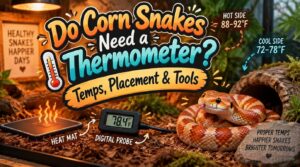
Your corn snake can’t tell you it’s too cold. It just slows down, stops digesting, and waits for a problem you can’t see. That’s why the answer to do corn snakes need a thermometer is an unqualified yes.
Snakes self-regulate by moving between warm and cool zones, but that only works if those zones actually exist. A heat mat without a thermometer is a guess, and a thermostat without a verified reading is a guess with extra steps. A five-degree drift is enough to disrupt digestion.
Here’s exactly where to place sensors, which tools to trust, and how to verify every reading.
Table Of Contents
- Key Takeaways
- Do Corn Snakes Need a Thermometer?
- What Temperatures Do Corn Snakes Need?
- Where Should Thermometers Be Placed?
- Which Thermometer Works Best?
- Why is a Thermostat Also Essential?
- Frequently Asked Questions (FAQs)
- How cold is too cold for a corn snake?
- Is 80 degrees too hot for a corn snake?
- How long can corn snakes go without heat?
- Do corn snakes need a heat lamp at night?
- Can I use one thermometer for the whole enclosure?
- How often should I check my corn snakes temperatures?
- Do corn snakes need heat during power outages?
- What signs show my corn snake is too cold?
- Should thermometer readings change with the seasons?
- Conclusion
Key Takeaways
- Corn snakes need thermometers because they can’t self-report temperature problems—only measured readings confirm your heat sources are actually hitting the 88–92°F basking surface and 75–80°F cool side your snake needs to digest and stay healthy.
- Use two thermometers, not one: an infrared or probe thermometer on the basking surface and a digital probe tracking cool-side air at snake level, since a single reading can’t verify both ends of the gradient.
- A thermostat is essential backup, not a replacement—it caps heat spikes, compensates for room temperature swings, and cuts power during sensor or heater failures, but its readings still need independent verification.
- Check temperatures daily and recalibrate quarterly, because even a 5°F drift can disrupt digestion, and nighttime drops to 64–72°F must be tracked separately from daytime readings.
Do Corn Snakes Need a Thermometer?
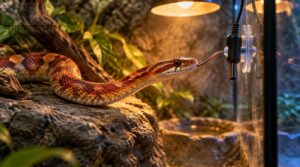
Why guess when you can measure? A thermometer isn’t optional for corn snake care; it’s the only way to confirm your enclosure is actually doing what you think it is.
For a full breakdown of the ideal temperature gradient, this guide to corn snake natural habitat temperatures covers what to aim for.
Why guess when you can measure—a thermometer is essential proof your corn snake’s enclosure is truly working
Heat sources warm surfaces unevenly. A lamp or under-tank heater can run for hours and still leave critical temperature zones dangerously off-target. Without a thermometer, you’re operating on assumption, and your snake pays the price through sluggish digestion, stress, or worse.
Temperature monitoring also catches problems your thermostat can miss. A thermostat controls heat based on its sensor’s input, but if that sensor drifts or sits in the wrong spot, temperature stability across the enclosure breaks down. An independent thermometer is your verification layer. It confirms what the thermostat assumes.
What Temperatures Do Corn Snakes Need?
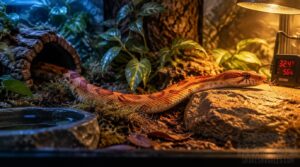
Corn snakes need a defined temperature gradient to regulate their metabolism, digest food, and stay healthy. Getting this wrong isn’t just uncomfortable for them—it leads to serious health problems.
There are two key areas to understand: warm and cool zone targets and how temperatures should shift between day and night.
Warm and Cool Zones
At any given moment, your corn snake needs access to a clear temperature gradient running across the enclosure, not pinned to a single zone. Heat lamp placement creates the warm side, where air hits 85–90°F and the basking surface reaches 88–92°F. The cool side holds at 75–80°F.
If you’re struggling to keep those numbers steady through seasonal swings, a solid corn snake temperature and humidity guide can help you troubleshoot before your snake’s appetite or shedding suffers.
Thermal zoning makes this possible. Without both ends defined, your snake can’t self-regulate.
Day and Night Temperatures
That gradient isn’t a 24-hour constant. Your day-night cycle should shift: daytime temperatures hold the basking temperature at 88–92°F while the cool side sits at 75–80°F, then nighttime temperatures drop to 64–72°F across the whole enclosure.
This natural cooling mirrors what your snake experiences in the wild. Track both phases with separate readings, because a single daytime check hides overnight swings.
Where Should Thermometers Be Placed?
Placement makes or breaks your temperature readings. A thermometer in the wrong spot gives you false numbers, and false numbers lead to a sick snake. Here’s exactly where to measure in your enclosure.
Our guide to heating a snake terrarium properly walks through probe placement step by step, so you can double-check your setup before trusting a single reading.
Basking Surface Measurements
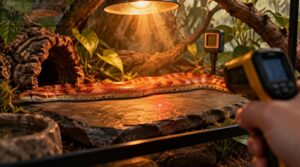
Picture your snake stretched flat on slate, belly soaking up heat you can’t see. That’s why you measure the surface temperature, not the air. Get it right with this routine:
- Use an infrared thermometer on the basking spot.
- Aim at the surface center, never edges.
- Match probe placement to mid-body height.
- Check twice daily.
- Log readings; drift over 5°F means adjust.
Your basking temperature should hold at 85–90°F. Verify with a second sensor, and calibrate tile against a known thermometer.
Cool-side Air Readings
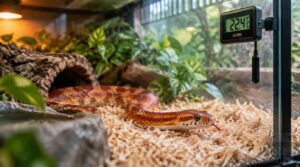
Because your snake lives in the air, not on a thermometer screen, you must measure cool-side air temperature at snake level, roughly 15–20 cm above the substrate. Aim for 24–28°C (75–82°F).
Keep the probe in open airflow, away from decor and radiant heat, and use a digital thermometer accurate to ±0.5°C. Day-to-night swings beyond ±2–3°C signal poor ventilation.
Which Thermometer Works Best?
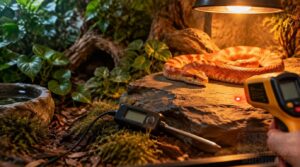
When you pick a thermometer, match it to the job. A digital probe thermometer with a metal probe wins for surface work. Press the probe directly onto the basking spot or substrate, and you’ll get a true contact reading. Keep your probe placement consistent so your numbers mean something over time.
An infrared thermometer works fast, but it reads surfaces only, never air. It can also misfire through glass, so point it at the basking surface with a clear line of sight and cross-check it against your probe.
The best setup uses both: a probe at the basking spot and a second digital unit tracking cool-side air temperatures. Calibrate each thermometer quarterly against a known reference. Accurate temperature monitoring depends on it.
Why is a Thermostat Also Essential?
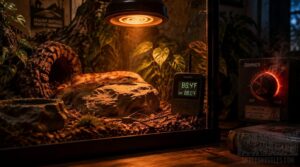
A dimmer dial left unchecked is like a stove burner you never watch. It heats fine, until one afternoon it doesn’t, and your basking spot turns into a cooktop. A thermostat stops that. It reads your sensor and adjusts power automatically, holding your gradient steady while you sleep, work, or travel.
Here’s what it does for you:
- Caps heat output at your set point, so a stuck lamp can’t spike past safe limits
- Compensates for cold snaps, drafty rooms, and door openings within minutes
- Protects during failures, with a safety cutoff if the sensor faults or the heater misbehaves
Match the tool to the setup. A mechanical thermostat controls simple heat mats; a proportional thermostat smooths output for bulbs and ceramic emitters, extending lamp life. Keep your thermostat calibration honest with a second thermometer, and verify your thermostat setup seasonally.
Frequently Asked Questions (FAQs)
How cold is too cold for a corn snake?
Ironically, a corn snake can’t tell you it’s freezing. Anything below 70°F is too cold. Sustained exposure risks temperature stress, suppressed digestion, and illness. Keep your ambient temperature 75–82°F for safe thermal comfort.
Is 80 degrees too hot for a corn snake?
No, it’s a drop in the bucket of your snake’s needs. 80°F sits within the warm zone, not beyond it. Just confirm whether that’s air or basking temperature, and keep your cool side in the 70s.
How long can corn snakes go without heat?
Corn snakes tolerate roughly 24 hours without heat if your room stays near 70°F. Beyond that, their metabolic rate stalls, digestion fails, and temperature stress sets in. Cooler rooms cut that window fast.
Do corn snakes need a heat lamp at night?
Not necessarily. If your enclosure stays between 70–75°F overnight, skip the heat source. But when temperatures fall lower, use a low-output heat source paired with a thermostat, and confirm it with your temperature monitoring.
Can I use one thermometer for the whole enclosure?
Technically yes, but you’ll get one misleading number. A single reading can’t verify both ends of your thermal gradient. Use two digital thermometers, one per temperature zone, so your thermostat’s heat distribution stays honest.
How often should I check my corn snakes temperatures?
Check temperatures at least daily. Re-check more often after any change, like a new bulb or moved décor, until readings stabilize. Even with a digital thermometer and thermostat, verify actual values periodically.
Do corn snakes need heat during power outages?
When the grid fails, your heat source goes dark like a snuffed candle. Yes, your snake still needs warmth. Use a generator or battery backup to hold the safe temperature range and prevent dangerous cooling.
What signs show my corn snake is too cold?
A cold corn snake is a car idling on an empty tank. Watch for lethargy beyond normal rest, refusal to bask, slowed digestion after meals, stuck shed, and snake stress signs like open-mouth breathing.
Should thermometer readings change with the seasons?
Ironically, your snake’s needs don’t change, but your room does. Make seasonal adjustments to lighting, not essential temps. Your thermostats and calibration handle temperature fluctuation, keeping the gradient stable year-round.
Conclusion
Picture a corn snake curled on a cool substrate, meal undigested for a week, while its owner insists the heat mat "feels warm." That snake isn’t sick. It’s cold. This is why the answer to do corn snakes need a thermometer in their enclosure will always be yes.
Gut feeling fails. Instruments don’t. Place your sensors, verify your readings, pair everything with a reliable thermostat, and your snake gets the one thing it can’t negotiate for: consistency.