This site is supported by our readers. We may earn a commission, at no cost to you, if you purchase through links.

A corn snake that stops eating, sits motionless for days, or develops a rattling wheeze didn’t fail you overnight. Improper enclosure temperatures set that decline in motion weeks earlier, silently disrupting digestion and immune function before any symptom appeared.
Corn snakes can’t regulate their own body heat. Every biological process they run, from breaking down a mouse to fighting off bacteria, depends entirely on the thermal environment you build and maintain. Get it wrong by even a few degrees, and the damage compounds faster than most keepers expect.
Knowing how to maintain consistent heat for your corn snake is the difference between a thriving animal and an expensive vet visit.
Table Of Contents
- Key Takeaways
- Set The Correct Temperature Gradient
- Choose The Right Heating Equipment
- Install and Regulate Heat Sources
- Monitor Both Enclosure Temperature Zones
- Prevent Heat Swings and Equipment Failures
- Frequently Asked Questions (FAQs)
- How hot is too hot for a cornsnake?
- Is 90 degrees too hot for a snake?
- How long can corn snakes go without heat?
- What temperature is too cold for corn snakes?
- How does room temperature affect enclosure heating settings?
- Does substrate depth impact heat mat effectiveness?
- Do corn snakes need adjusted heat during brumation?
- How does feeding frequency relate to heat requirements?
- What behavioral signs indicate a corn snake is too cold?
- Conclusion
Key Takeaways
- Corn snakes can’t self-regulate body temperature, so every biological process — digestion, immunity, recovery — depends entirely on the thermal environment you build and maintain.
- A proper enclosure requires distinct temperature zones: a basking surface at 32–34°C, a warm side at 28–32°C, and a cool side at 22–26°C, all verified with a dual-probe thermometer, not guesswork.
- Every heat source — mat, ceramic emitter, or deep-heat projector — must be paired with a proportional thermostat and a correctly placed probe, or temperature spikes will undermine the gradient no matter how well you position the equipment.
- Immune function begins dropping within 48 hours of sustained temperature errors, so consistent monitoring, weekly log checks, and a backup heat source on a separate circuit aren’t optional — they’re what keeps your snake alive.
Set The Correct Temperature Gradient
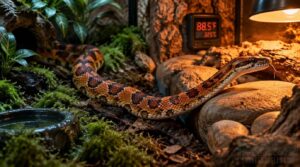
Getting the temperature gradient right is the foundation of proper corn snake care. Your enclosure needs distinct temperature zones — a warm side, a basking spot, and a cool retreat — so your snake can regulate its body temperature on its own terms. Here’s what each zone requires.
For a full breakdown of how to set up each zone correctly, corn snake temperature and humidity requirements covers the exact ranges your enclosure needs to hit.
Basking and Warm-side Targets
For consistent thermoregulation, your corn snake’s basking surface temperature needs to hit 32-34°C for one to four hours each day.
- Keep the warm side surface steady between 28-32°C
- Set your thermostat cutoff so the heat lamp doesn’t spike past 34°C
- Verify temperatures with an infrared thermometer, not just a probe
A stable temperature gradient begins with getting these targets right.
Cool-side and Nighttime Limits
Once the warm side is locked in, the cool zone temperature completes your thermal gradient across enclosure. Target 22-26°C during the day and avoid sustained readings above 28°C on this side.
Monitoring both ends consistently is key — these snake enclosure thermal gradient setup tips can help you fine-tune placement and avoid temperature creep on the cool side.
| Period | Cool-side Target |
|---|---|
| Daytime | 22-26°C |
| Nighttime | 20-24°C |
| Minimum floor | 20°C |
For temperature stability at night, allow a passive 2-4°C drop and keep nighttime warmth above 20°C.
Choose The Right Heating Equipment
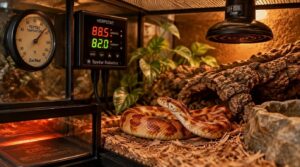
Once you’ve set your temperature targets, your next step is choosing equipment that can actually hold them. Not all heat sources work the same way, and the wrong choice leads to unstable gradients no matter how carefully you position it. The options below cover the two main categories you’ll be working with.
For a deeper look at how different heat sources perform across species with varying gradient needs, the boa constrictor species care guide walks through equipment choices that consistently deliver stable, reliable warmth.
Heat Mats and Thermostats
Without a thermostat, standard heat mats can reach surface temps above 40°C, nearly double the safe limit. Pair every mat with a proportional thermostat and place the probe on the mat surface, not in substrate.
It’ll keep your temperature gradient stable and heat regulation accurate. Daily temperature monitoring for two weeks confirms the warm side holds at 28 to 32°C.
Ceramic and Deep-heat Options
Beyond heat mats, a ceramic heat emitter or deep heat projector extends your temperature gradient options. You’ll still need a thermostat for accurate heat regulation.
- Rate your deep heat projector at 20-40 W per 30-40 L enclosure.
- Keep ceramic panels 5-10 mm above substrate.
- Place probes within 5 cm of each heat source.
- Set thermostat cutoffs at ±2°C of your target.
Install and Regulate Heat Sources
Position your heat mat under one end of the enclosure, covering one-third of the floor. This creates a temperature gradient from warm to cool, giving your corn snake room to thermoregulate.
For snakes in colder environments, choosing the right heat mat for cold-climate corn snakes ensures the warm end stays consistently within the ideal 80–85°F range.
Connect the mat to a thermostat and place the probe directly on the mat’s surface, not through the substrate. The thermostat reads that point and cycles heat on and off to hold your setpoint. If the probe sits loosely or shifts, the warm side won’t hold temperature. Secure it with tape.
Set your target basking surface temperature to 85-88°F. Before finalizing placement, verify the actual surface reading with a digital probe or infrared gun. These thermometer options confirm the thermostat is sensing the right spot.
Monitor Both Enclosure Temperature Zones
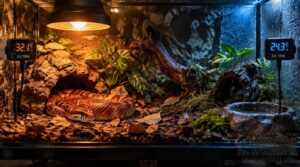
Since a single probe tells you almost nothing about your actual temperature gradient, use at least two sensors: one at the warm end and one at the cool end, both placed where your snake’s body rests. A dual-probe reptile thermometer lets you monitor both ends simultaneously, so you catch gradient shifts the moment they happen.
Check your cool side temperature as a stability indicator. If it’s drifting upward while the warm side holds steady, your gradient is collapsing, even if your basking surface temperature looks correct. Compare both readings against ambient air temperature to distinguish overall enclosure drift from localized heater issues.
Keep temperature logs, even brief ones. Drift is far easier to catch in records than by eyeballing in the moment. After any decor change or substrate swap, re-check both zones.
Prevent Heat Swings and Equipment Failures
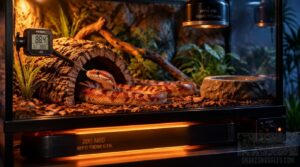
Around 90% of reptile emergencies stem from husbandry failures, and heating tops the list. Your proportional thermostat adjusts output gradually, preventing the hard on/off cycling that drives temperature spikes. Place the probe at the warm-side surface so it reads what your corn snake actually contacts, not ambient air.
90% of reptile emergencies trace back to husbandry failures — and heating leads every time
Keep a secondary heat source on a separate circuit. If your primary heater dies overnight, you’ll have a window to respond.
Check temperature logs weekly. Drift outside your temperature gradient builds silently.
Unstable heat creates real consequences:
- Immune function drops within days
- Digestion halts the moment temps fall
- Respiratory infections develop in weeks
- Recovery takes months you can’t get back
A heat source guard prevents substrate from disrupting probe contact.
Frequently Asked Questions (FAQs)
How hot is too hot for a cornsnake?
Your corn snake’s basking spot should stay between 82–88°F (28–31°C). Repeatedly hitting above 95°F (35°C) risks overheating behaviors and skin damage. Always measure at the surface your snake can physically touch, not the ambient air.
Is 90 degrees too hot for a snake?
Say your basking spot reads 90°F but the cool side climbs to 82°F. That’s the real problem. 90°F sits within the safe temperature range only when a proper temperature gradient and thermostat both hold steady.
How long can corn snakes go without heat?
Your corn snake can tolerate a few hours without heat if room temperature stays above 65°F. Below that, digestion stalls and health risks rise fast. Duration always depends on ambient temperature, not a fixed window.
A reliable thermometer takes the guesswork out, showing exactly when your enclosure’s temperatures start slipping into risky territory.
What temperature is too cold for corn snakes?
Below 78°F at the basking spot, your snake can’t digest food reliably. If the entire enclosure drops uniformly into the low 70s°F and stays there, you’ve lost the thermal gradient and thermoregulation breaks down fast.
How does room temperature affect enclosure heating settings?
Think of your enclosure as reactive. When ambient temperature drops, your thermostat setpoint must rise 2–4°C to sustain the correct temperature gradient. Cooler rooms also reduce heat mat efficiency, so always plan for seasonal adjustments.
Does substrate depth impact heat mat effectiveness?
Substrate depth directly affects your heat mat’s effectiveness. Aim for 2-4 cm of cover; shallower layers create hot spots while deeper substrate traps heat too long, disrupting your temperature gradient and undermining consistent heat distribution.
Do corn snakes need adjusted heat during brumation?
What does seasonal cooling actually mean for your snake? Yes, they do need adjusted heat. Reduce cool-side temps by 6–12°F during brumation, but always keep overnight lows above 65°F to avoid stress and feeding issues.
How does feeding frequency relate to heat requirements?
Feeding raises your snake’s metabolic rate temporarily. More frequent meals mean more overlapping digestion windows, so your temperature gradient must stay consistent longer. Any instability during those windows directly reduces digestive efficiency and slows processing.
What behavioral signs indicate a corn snake is too cold?
A cold corn snake is like a clock slowly winding down. Look for reduced tongue flicking, lethargy, and food refusal.
Wobbling or open-mouth breathing confirms your basking spot temperature has dropped well below safe levels.
Maintaining a warm side temperature gradient of 75–85°F is essential to keeping your corn snake active and healthy.
Conclusion
Studies suggest that immune function in reptiles drops measurably within 48 hours of sustained temperature errors. Your corn snake doesn’t show symptoms that fast, but the damage starts immediately.
Knowing how to maintain consistent heat for your corn snake means building a reliable system, not just placing a mat. Choose calibrated equipment, verify both zones with a quality thermometer, and check your setup regularly.
The gradient you build keeps your snake alive. Build it right.