This site is supported by our readers. We may earn a commission, at no cost to you, if you purchase through links.
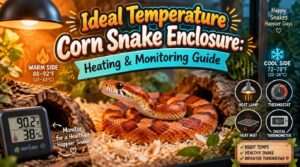
Corn snakes can’t shiver, sweat, or crank up a thermostat. They rely entirely on their environment to digest food, fight off illness, and simply function, which means getting the ideal temperature corn snake enclosure wrong doesn’t just cause discomfort; it shuts down their metabolism.
A snake sitting on the cool side all day isn’t being shy. It’s telling you something is off. Temperature misreads are one of the most common causes of feeding refusals and respiratory infections in captive corn snakes.
This guide cuts through the guesswork with practical setup tips, the right tools, and clear behavioral cues to keep your snake thriving.
Table Of Contents
- Key Takeaways
- What is The Ideal Corn Snake Enclosure Temperature?
- How to Create a Safe Temperature Gradient
- Which Heating Method is Best for Corn Snakes?
- How to Monitor and Control Enclosure Temperatures
- Is Your Corn Snake Too Hot or Cold?
- Frequently Asked Questions (FAQs)
- Is 90 too hot for a corn snake?
- Is 70 degrees too cold for a corn snake?
- Should you mist a corn snake?
- What temperature should my vivarium be for a corn snake?
- Is 90 degrees too hot for a corn snake?
- Can a corn snake survive in 70 degrees?
- Do Corn Snakes need a heat lamp or mat?
- How to keep corn snake tank warm at night?
- Is 60 degrees too cold for a corn snake?
- Do corn snakes need a heat lamp or mat?
- Conclusion
Key Takeaways
- Corn snakes can’t self-regulate body heat, so your enclosure must provide a continuous temperature gradient — warm side at 82–85°F, cool side at 68–72°F — or their digestion and immune system break down.
- Your snake’s behavior is the most reliable thermometer you have: constant hiding, glass-surfing, or avoiding the basking spot all signal that your temperatures are off.
- A thermostat isn’t optional — it’s what keeps your warm and cool zones stable around the clock, including the natural 5–8°F overnight drop your snake’s body expects.
- Letting temps fall to or below 70°F doesn’t just make your snake uncomfortable; it shuts down digestion entirely and turns every meal into a health risk.
What is The Ideal Corn Snake Enclosure Temperature?
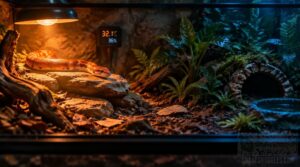
Think of your corn snake’s enclosure as a personal climate control system, not a single fixed temperature. Corn snakes are ectotherms, meaning they regulate body heat by moving across a temperature gradient rather than staying put. Your job is to give them that choice.
For a full breakdown of ideal warm and cool zones, corn snake temperature control and gradient setup walks you through exactly what that balance looks like in practice.
Target a basking temperature of 82–85°F on the warm side, and let the cool side stay close to ambient room temperature, usually around 68–72°F. At night, a natural drop to 70–75°F across the enclosure mimics the cooling cycle they’d experience outdoors. Running a thermostat keeps those zones consistent without constant adjustments on your end.
Nail these numbers, and you’re setting your corn snake up for solid digestion, a healthy immune system, and genuinely natural behavior.
How to Create a Safe Temperature Gradient
Getting those numbers right is one thing; building the actual thermal gradient is another. The goal is a smooth, continuous slide from your warm side to your cool side, not two isolated temperature zones with a dead zone sitting between them.
Set it up with three principles:
- Position your heat source at one end only, letting warmth radiate naturally across the enclosure’s full length.
- Aim for a 10–15°F difference between the warmest and coolest points.
- Place hides at both ends so your snake can choose its preferred temperature without giving up cover.
Your corn snake will signal that the gradient’s working by spending time near the basking spot after meals, then retreating to the cool side between activity periods.
Pairing this behavior with proper feeding practices—like those covered in the corn snake temperature and feeding guide—helps you catch early signs of stress before they become health issues.
Which Heating Method is Best for Corn Snakes?
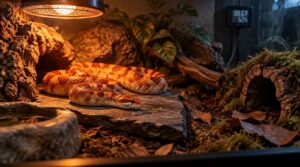
Not all heat sources are created equal, and choosing the right one can make or break your thermal gradient. Each option comes with its own trade-offs in cost, installation, and how well it mimics your corn snake’s natural environment. Here’s a breakdown of the main heating methods worth considering.
Heat Lamps Vs Heat Mats
A heat lamp running at 50 watts can create a basking temperature of 30°C within minutes, while heat mats take considerably longer to reach target surface temps.
Mats warm the substrate through direct contact and use less electricity overall.
Both approaches work, but you’ll need a thermostat either way to maintain a safe temperature gradient without overheating your corn snake.
Deep Heat Projectors
Beyond lamps and mats, a deep heat projector warms your corn snake’s substrate to around 35-40°C with no visible light, giving you a cleaner thermal gradient setup.
This makes deep heat projectors especially effective for replicating the natural temperature ranges corn snakes experience in the wild, where warmth radiates from sun-baked ground rather than overhead light.
What sets it apart:
- Penetrates hides for heat distribution uniformity
- Hits basking temperature without bright light
- Surface stays safe below 45-50°C
- Allows temperature monitoring via thermostat
- Works through day and night cycles
Safe Heater Placement
The secret to good heat lamp placement is asymmetry. Your heat source placement should always favor one end of the tank rather than the center, which naturally shapes the whole thermal gradient setup.
Keep the fixture high enough that your snake can’t press against it directly, and pair it with thermostat use to hold the basking spot temperature steady.
How to Monitor and Control Enclosure Temperatures
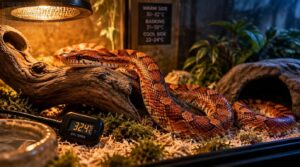
Getting temperatures right is only half the battle—knowing they’re right is where most keepers slip up. The good news is that monitoring and controlling your corn snake’s enclosure comes down to just a few key things you’ll want to get sorted. Here’s what to focus on.
Thermometer Placement
Your temperature zones need their own reliable reporters. Use digital probe thermometers at snake eye level, one at each end of the enclosure, and don’t position them under the lamp’s base or you’ll get skewed readings.
Monitoring your basking spot temperature against your cool zone temperature is real thermal zone monitoring, and it tells you what your snake actually experiences.
Thermostat Setup
Imagine your corn snake stretched out perfectly across its basking rock, every degree dialed in. A proportional thermostat makes that happen, continuously reading and adjusting output to keep your temperature gradient rock-solid.
Set a safety cutoff at 38°C so thermal cycling stays safe. Back it up with a mechanical thermostat for solid temperature monitoring if the primary controller ever fails.
Day and Night Adjustments
Corn snakes naturally experience a 5-8°C daily swing in the wild. Replicate that at home:
- Drop nighttime temperatures to 22-25°C
- Run your heat lamp for 10-12 hours daily
- Use a thermostat to shift temps gradually
- Keep the basking spot at 28-30°C during the day
- Track your temperature gradient over 24 hours
Get that cycle right and your snake thrives.
Is Your Corn Snake Too Hot or Cold?
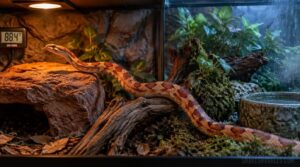
Your snake’s behavior is basically a live readout of how well your setup’s working. If they’re constantly pressed against the glass on the cool side or hiding all day without ever visiting the basking spot, the warm side probably isn’t warm enough to feel rewarding. Flip that around: a snake that keeps flattening its body against the enclosure walls is trying to shed heat fast, a classic sign the warm side is running too hot.
Your corn snake’s behavior is a live readout of whether your temperatures are dialed in
A healthy corn snake moves between zones with purpose. They’ll bask, digest, then cruise back to cool down. That natural back-and-forth tells you your temperature gradient is doing its job. If your thermostat’s dialed in and your snake’s behaving normally, you’re getting it right.
Frequently Asked Questions (FAQs)
Is 90 too hot for a corn snake?
Not necessarily. On the warm side basking surface, 90°F fits right within the 85 to 90 degrees Fahrenheit target range. Real problems only arise if that heat spreads everywhere, completely eliminating your essential temperature gradient.
Is 70 degrees too cold for a corn snake?
Does that sound way too low? It absolutely is. Seventy degrees falls well short of the warm side basking surface target. Your snake can’t properly thermoregulate without a full temperature gradient reaching into the mid-80s°F.
Should you mist a corn snake?
Misting isn’t necessary if your enclosure already maintains stable humidity levels through a water dish and substrate. Skip the spray bottle unless your snake is shedding, and even then, a damp hide works better overall.
What temperature should my vivarium be for a corn snake?
Think of your vivarium like a two-zone climate system. Your basking temperature should hit 28-30°C (82-86°F), while the cool zone needs to settle at 21-24°C (70-75°F), creating the temperature gradient your corn snake depends on.
Is 90 degrees too hot for a corn snake?
At 90°F, you’re right at the maximum safe basking temperature for corn snakes. That’s fine as a brief peak, but your basking area temperature should ideally sit between 80 and 85°F most of the day.
Can a corn snake survive in 70 degrees?
Survive? Yes, but only just. A constant 70°F grinds your corn snake’s metabolism to a slow, painful halt, stalling digestion and its feeding response. Build a temperature gradient with a warm basking spot around 85°F.
Do Corn Snakes need a heat lamp or mat?
Heat lamps are your best choice here. They produce natural IR heat, warming your corn snake far more effectively than under tank heat mats, which work fine as backup but shouldn’t be your primary source.
How to keep corn snake tank warm at night?
Nights don’t need to be stressful. Run a ceramic heat emitter or under tank heat mat on a thermostat, targeting 72–78°F. A slight ambient temperature drop overnight is perfectly fine, just never dip below 68°F.
Is 60 degrees too cold for a corn snake?
Yes, 60°F is dangerously cold for your corn snake. At that level, digestion shuts down and illness risk spikes fast.
Get it back up to 72 to 78 degrees on the cool side at minimum.
Maintaining a proper warm and cool temperature gradient allows your snake to thermoregulate naturally, supporting digestion, shedding, and overall health.
Do corn snakes need a heat lamp or mat?
Both work, but a heat lamp does more. It creates a proper basking spot and a natural thermal gradient, giving your corn snake the distinct temperature zones it needs to effectively regulate its body heat.
Conclusion
Below 70°F, a corn snake’s digestion effectively shuts down, turning a perfect meal into a health risk. That’s why the ideal temperature corn snake enclosure isn’t just a comfort upgrade; it’s a biological necessity.
A proper gradient isn’t complicated once your setup runs smoothly. Read your snake’s behavior, check your thermometers regularly, and adjust before problems start. Nail those temperatures, and your snake gets to do what it does best: eat well, explore, and thrive.