This site is supported by our readers. We may earn a commission, at no cost to you, if you purchase through links.

A boa that’s too small for its meal will pay for it. A rat that’s too big can come back up, and that regurgitation risk costs your snake weeks of recovery.
Here’s the problem. Most keepers eyeball it. They grab a rodent that looks right and hope. A 3 kg boa needs 300 to 450 grams of prey, yet a skinny juvenile needs a much smaller meal than a plump one the same length.
So what size feeder rodent for my boa constrictor is a measurement question, not a guess. Width, weight, and life stage all matter. Get them right, and every feeding stays safe.
Table Of Contents
- Key Takeaways
- What Size Rodent Should My Boa Eat?
- Choose Between Mice and Rats for Boas
- Adjust Feeder Size as Your Boa Grows
- Select and Prepare Appropriately Sized Frozen-Thawed Rodents
- Is Your Boa’s Feeder Rodent Too Large?
- Frequently Asked Questions (FAQs)
- What size mouse is best for feeding snakes?
- When to feed your snake bigger mice?
- What happens if I feed my snake too big of a rat?
- How do I tell what size rat to feed my ball python?
- Can I feed my boa live rodents instead?
- What should I do if my boa refuses food?
- Why does my boa regurgitate its meal after eating?
- How long should I wait before handling after feeding?
- Is it safe to feed my boa wild-caught rodents?
- Conclusion
Key Takeaways
- Size your boa’s meal by measuring, not eyeballing: the prey should be about 70 to 85 percent as wide as your snake’s thickest point, and never wider than it.
- Check weight too, since each meal should come in around 10 to 15 percent of your boa’s body weight (so a 3 kg boa gets 300 to 450 g), and you should weigh your snake monthly to keep that number current.
- Start with mice for young boas, move to rats as your snake grows, and step up only one size every 2 to 3 weeks, because skipping steps invites regurgitation.
- Stalling at the head or throat, regurgitation, or lethargy lasting past 48 hours means the prey was too big, so drop down a size and wait 24 to 48 hours before handling after any meal.
What Size Rodent Should My Boa Eat?
Feeding your boa the wrong rodent size is a risk you don’t need to take. Two checks keep you on safe ground: prey width against your snake’s body, and prey weight against your snake’s weight. Work through both below before every meal.
Since young boas outgrow their prey quickly, check this boa constrictor feeding guide to move up rodent sizes at the right pace as your snake grows.
Compare Prey Width With Body Width
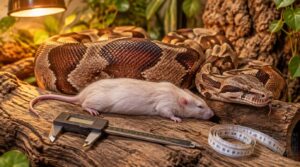
Measuring width beats guessing length every time. Follow the prey girth rule: your boa’s meal should be 70 to 85 percent of its widest body width. Run a head width safety check too. Use a prey neck match and a jaw gape measurement as backups. A pair of digital calipers for snake width gives you an exact reading at the thickest point of the body, so you can pick the right prey size.
Add your boa’s body condition score. Skinny snake? Go narrower. Oversized prey invites regurgitation fast.
Assess Boa Weight and Prey Weight
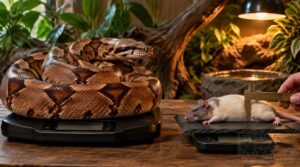
Width tells you what fits. Weight tells you what’s safe.
Before feeding your boa, check the width to see what fits, then check the weight to see what’s safe
Weigh your boa monthly on a calibrated scale. Then run a prey weight percentage calculation: keep each meal at 10 to 15 percent of body weight. A 3 kg boa gets 300 to 450 g. Weighing feeder prey? Use a boa constrictor feeding chart and double-check your prey neck match.
Since adult boas need smaller meals than juveniles, this frozen-thawed boa constrictor feeding guide helps you safely adjust prey size and thawing as your snake grows.
Choose Between Mice and Rats for Boas
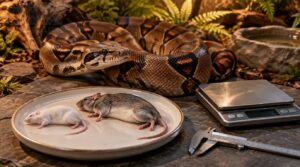
Once you’ve checked width and weight, you face the next call: mice versus rats for boas. Get it wrong and you’ll under-feed or overload your snake.
Here’s the rule of thumb. Juvenile boas eat mice. Bigger boas need rats. Rats pack more calories per gram, so they fuel growth that mice can’t.
Use these checks for smart rodent size selection:
- Pick mice while your boa is small and still growing into its frame.
- Move to rats when mice no longer fill the gape or meet energy needs.
- Match prey weight to your snake’s weight, not its age.
Good prey size regulation and weightbased feeding adjustments keep digestion calm and steady. Choose the proper size of prey for boa, every time.
Adjust Feeder Size as Your Boa Grows
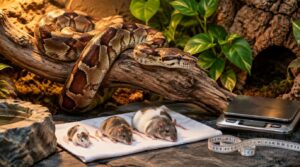
Your boa won’t stay small. Your feeding plan can’t either.
As your boa grows and the seasons change, a boa constrictor feeding schedule by size helps you match prey size and meal frequency to what your snake actually needs.
Hatchling prey sizes start light, then prey size progression follows your snake’s girth. Bump up one step only every 2 to 3 weeks. Skip a step and you risk regurgitation.
| Stage | Typical Prey |
|---|---|
| Hatchling | Mouse, 10–12 g |
| Juvenile | Mouse, 12–25 g |
| Subadult | Small rat, 75–150 g |
| Adult | Rat, 150–250 g |
Juvenile prey sizes, subadult prey sizes, and adult prey sizes all follow the same rule: prey weighs 5 to 10% of your boa’s weight. Weigh your snake monthly.
Watch for prolonged post-feeding lethargy. Anything past 48 hours means digestion struggled. Stalled weight gain? Drop down a size. Log every meal, girth, and any regurgitation. Never rush the climb. Slow wins.
Select and Prepare Appropriately Sized Frozen-Thawed Rodents
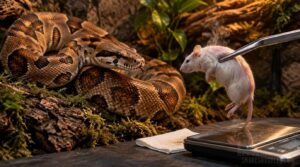
Thawing correctly starts with picking the proper size of prey for boa you own. Match prey girth to your snake’s widest body point, then check frozen feeder options at the weight you need.
Prep takes patience. Follow these steps:
- Thaw fully at room temperature for 60 to 90 minutes.
- Surface-dry the rodent to cut condensation.
- Warm it gently to body temperature. Never hot.
- Test flexibility before you offer it.
Always use feeding tongs. Never feed straight from packaging. Present one rodent on a neutral surface in a quiet enclosure.
Hold prey size steady unless your boa has fasted one to two days. Then log the meal size and date. Skip that record and you’ll just guess blindly next time around.
Is Your Boa’s Feeder Rodent Too Large?
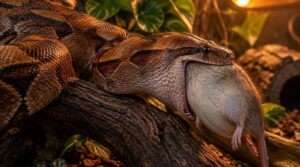
Spotting oversized prey early protects your boa. Watch the swallow. If your boa stalls at the head or throat, the meal’s too big. Don’t wait it out.
Apply the prey girth rule: the rodent shouldn’t be wider than your boa’s thickest body point. Repeated failed attempts mean you’re above the proper size of prey for boa capacity.
| Sign | What You See | Your Move |
|---|---|---|
| Stalling | Long pause at head | Size down |
| Struggling | Gaping, repeated resets | Stop, rest |
| Refusal | Skips next meals | Adjust feeding frequency |
Even adult prey sizes and mature boa feeding ranges need checking. Girth changes, so reassess every time.
Don’t assume last month’s rodent still fits. A healthy boa can be one bad meal from regurgitation.
Frequently Asked Questions (FAQs)
What size mouse is best for feeding snakes?
Match the prey girth rule. Your mouse should be about 60 to 70 percent as wide as your snake’s thickest point. Too small? Step up one size. Too big? That’s a prey size mistake to avoid.
When to feed your snake bigger mice?
Picture a lump stuck in a garden hose. That’s a mouse too big. Weigh your snake monthly. Go bigger when your snake finishes meals fast, and prey sits under the Ten Percent Rule. Respect girth.
What happens if I feed my snake too big of a rat?
Oversized rats are dangerous: expect regurgitation, throat injury, and organ stress.
Check your boa constrictor prey size chart, compare prey girth to body width. Use feeding tongs, and skip anything bulkier than your snake’s midbody.
How do I tell what size rat to feed my ball python?
Choose prey size by matching your python’s widest body point. The rat shouldn’t be thicker.
Confirm with the Ten Percent Rule: proper prey item size weighs about 10% of body weight. Set your feeding schedule.
Can I feed my boa live rodents instead?
Live seems natural, but it isn’t. Live vs frozen-thawed prey favors frozen: rodents bite back.
Feeding a boa baby? Go frozen. Proper size of prey for boa, prey type change, feeding frequency optimization stay simpler.
What should I do if my boa refuses food?
Don’t assume it’s just picky. Check feeding refusal causes first: cool temperatures, oversized prey, cold feeders, stress. Feeding refusal solutions start there.
Then try prey acceptance training, olfactory conditioning in snakes, and feeding enrichment techniques.
Why does my boa regurgitate its meal after eating?
Regurgitation is a warning sign. Usually it’s a prey size mistake: too much prey girth stalls the meal. Cool enclosures, handling after feeding, and rushed feeding frequency do the same. Each one risks esophageal safety in snakes.
How long should I wait before handling after feeding?
Want your boa to keep its meal? Wait 24 to 48 hours before handling after feeding. Use feeding tweezers, respect postmeal handling restrictions, skip enclosure setup changes. Digestive stress hurts.
Go longer after big meals.
Is it safe to feed my boa wild-caught rodents?
Free sounds harmless, but wild-caught rodents aren’t. Parasites, pathogens and poisons hide in them, and no reliable disease screening exists. Stick to proper prey size and safe frozen prey preparation. Keep your feeding enclosure clean.
Conclusion
Feeding a boa by eye is like parking in the dark. You might get lucky. Usually, you won’t.
Before every meal, ask yourself what size feeder rodent for my boa constrictor fits today, then answer with a tape measure and a scale.
Match prey width to the widest part of your boa’s body. Check weight. Size up as your snake grows. Measure right, and every meal stays safe. No guesswork. No regurgitation. Just dinner, done.