This site is supported by our readers. We may earn a commission, at no cost to you, if you purchase through links.

Your ball python strikes, coils, then lets go and slides away. The mouse looked thawed. It felt soft on the outside. But the center was still a cold, hard lump, and your snake knew it.
Frozen feeders fail this way more often than you’d expect. A rodent can seem ready while ice lingers deep inside, and a cold center can make a snake refuse the meal or, in the worst cases, leave you with a spoiled one. Knowing the signs a frozen feeder rodent is properly thawed protects your animal’s health and saves you wasted prey. Here’s how to check each one.
Table Of Contents
- Key Takeaways
- Signs Your Frozen Feeder Rodent is Thawed
- How to Check for a Frozen Core
- How to Safely Finish Thawing Feeder Rodents
- Fully Thawed Versus Warm Enough for Feeding
- When to Discard a Thawed Feeder Rodent
- Frequently Asked Questions (FAQs)
- How do I thaw frozen feeder mice?
- Can you get hantavirus from frozen feeder mice?
- How long does it take for a frozen rat to thaw out?
- How long does it take for a frozen mouse to defrost?
- Can I refreeze a rodent after thawing?
- How long does thawing take for large rats?
- Is microwave thawing safe for feeder rodents?
- What temperature should prey be before feeding?
- How should I handle feeder rodents hygienically?
- Conclusion
Key Takeaways
- You’ll know a frozen feeder is fully thawed when the whole body feels soft, the limbs bend freely, and no ice or frost remains, because a cold, hard center can make your snake refuse the meal.
- You can confirm the center is thawed by pressing the middle of the body, checking for opaque spots under a light, and taking a belly reading with an infrared thermometer, since surface softness alone can fool you.
- You should warm a fully thawed rodent in a sealed bag in water under 105°F until it reaches 98 to 100°F, because a rodent can be soft all the way through and still be too cold for your snake to take.
- You should feed within 24 hours of thawing and discard any prey that smells sour or sat out too long, and never refreeze it or use a microwave, since shortcuts risk bacterial growth, burns, or a ruptured feeder.
Signs Your Frozen Feeder Rodent is Thawed
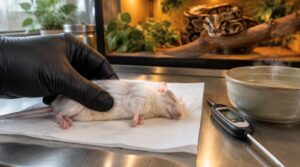
Before you offer a frozen feeder to your snake, you need to confirm it’s fully thawed all the way through. A rodent that looks ready on the outside can still hold ice in its center, which risks a poor feeding response and an unsafe meal. Check for these three signs, and don’t skip any of them.
If you’re unsure how long a rodent needs or how to avoid shortcuts like the microwave, this guide to properly thawing frozen snake food walks through safe, step-by-step methods.
Body Feels Uniformly Soft and Pliable
The Body Feels Uniformly Soft and Pliable when proper thawing technique has worked. Aim for prey body temperature, roughly 98°F, because temperature control protects feeder safety.
Check these four spots:
- Squeeze the head gently; it shouldn’t feel hard.
- Press the chest and ribs.
- Feel the belly for firm lumps.
- Pinch the tail base.
Any hard spot means thawing isn’t finished.
Once the shed finishes, a snake that was cranky beforehand usually settles down, and this guide to pre-shed snake aggression explains why that temporary moodiness happens.
Limbs Move Without Frozen Resistance
Once the torso feels soft, test the limbs. Gently bend a foreleg at the elbow and a hind leg at the knee. They should flex easily, with no catching or brittleness. Stiff joints mean ice remains in the connective tissue, so proper thawing technique isn’t finished.
Compare left and right sides. Uneven movement points to a frozen pocket, which hurts temperature control and feeder safety.
No Visible Ice or Frost
Once the limbs move freely, check the surface. No Visible Ice or Frost should remain on the fur, feet, or tail. A thawed feeder with frosty patches still holds cold spots underneath, since surface ice insulates the tissue below it.
This matters most with cold water thaw and refrigerator thawing. Wet, uniformly dark fur is normal. Icy patches aren’t. Keep thawing, and prioritize bacterial growth prevention by never leaving it at room temperature.
For a step-by-step walkthrough of safe timing and technique, see this guide on how to properly thaw frozen mice before your next feeding.
How to Check for a Frozen Core
Surface checks can fool you, so confirm the center directly. Start with thawing time estimation. If the rodent hasn’t spent at least the minimum time for its size in the fridge, such as 12 hours for an adult mouse, assume it’s still frozen inside.
Then run through these checks:
- Press the middle of the body and feel for any hard, icy lump.
- Hold the rodent up to a light and look for opaque spots, since no ice crystals should show.
- Bend it gently at the spine. The center should flex easily.
- Take a reading with an infrared thermometer, aiming at the belly.
Surface warmth means little, so use internal temperature monitoring if you can. Anything below 32°F (0°C) isn’t done.
How to Safely Finish Thawing Feeder Rodents

Finish thawing with a warm water bath once your feeder is soft from the refrigerator or cold water. Seal it in a leak-proof bag, submerge it in hot tap water below 105°F, and turn it occasionally for 2 to 5 minutes. Aim for a feeding temperature of 98 to 100°F, and confirm the internal temperature with a gentle squeeze and an infrared thermometer.
If you keep a boa, it helps to match the feeder’s size and thawing routine to your snake, and these frozen feeder mice for experienced boa constrictor keepers are a good place to start.
Practice proper hygiene every time. Wash your hands, sanitize surfaces, and use dedicated tongs.
Skip microwaves and hair dryers, since they cook unevenly and can rupture the feeder. Feed promptly, and plan on use within 24 hours of thawing.
Shortcuts cost you:
- A burned animal
- A ruptured feeder
- A refused meal
- A sick pet
- Needless, lingering guilt
Fully Thawed Versus Warm Enough for Feeding

The two checks measure different things, and you need to pass both. Fully thawed rodents are soft and pliable all the way through, but that says nothing about feeding temperature. A rodent can be completely thawed and still sit at 60°F, which many pythons and boas will ignore.
A rodent can be fully thawed yet still too cold for your snake, so soft and pliable never means ready to feed.
Aim for 98–100°F. To warm prey correctly, seal the rodent in a bag and submerge it in warm water, then confirm the internal temperature with a probe thermometer. Stay under 105°F, since hotter prey can cook proteins and burn your snake.
Warm the rodent right before offering it, not hours ahead. If your snake refuses, discard unused prey instead of saving it. Consistency matters, so use the same routine every single time.
When to Discard a Thawed Feeder Rodent

Think of a thawed rodent as a ticking clock, because spoilage starts counting down the moment it softens.
Discard unused prey after 24 hours in the refrigerator, or after 4 to 6 hours in the enclosure. Room temperature thawing invites rapid bacterial growth, so toss any rodent thawed that way and not fed promptly. Never use a microwave either. Hot spots can burn your reptile, and an overheated rodent often has peeling fur or a ruptured stomach.
Trust your nose. A boiled or sour smell means it’s done. Don’t refreeze leftovers, and don’t keep any rodent that touched food surfaces or dirty equipment.
Your routine matters more than any rule: label thaw times, feed immediately, and throw out anything questionable.
Frequently Asked Questions (FAQs)
How do I thaw frozen feeder mice?
Keep mice in a sealed bag. For refrigerator thawing, leave them overnight. For a faster cold water thaw, submerge the bag for an hour.
Practice proper hygiene, wash your hands, and use within 24 hours.
Can you get hantavirus from frozen feeder mice?
It’s possible but unlikely. Hantavirus spreads through inhaled dust from rodent waste, so wear gloves, practice crosscontamination avoidance, and wash your hands promptly. These steps support basic food safety and pathogen prevention during temperature-controlled thawing.
How long does it take for a frozen rat to thaw out?
Cold water thawing takes 1 to 8 hours, depending on size. Change water every 30 minutes.
Refrigerator thawing at 32F to 40F takes 12 to 48 hours. Use temperature monitoring to confirm the center’s thawed.
How long does it take for a frozen mouse to defrost?
Safe thawing takes time. Refrigerator thawing needs several hours, usually overnight, while a cold water thaw takes about 30 to 60 minutes. Either way, you’re protecting wholeprey nutrition and staying safely inside your feeding window.
Can I refreeze a rodent after thawing?
No, don’t refreeze a thawed feeder. Freezing only slows bacterial growth, it doesn’t kill it, so refreezing thawed feeder rodents raises your reptile’s illness risk. Use temperature-controlled thawing, then feed immediately or discard.
How long does thawing take for large rats?
A large rat is a frozen brick that yields slowly.
Plan on 24 to 48 hours in the fridge. A coldwater thaw takes several hours, roomtemperature thawing 4 to 6 hours, so keep temps safe.
Is microwave thawing safe for feeder rodents?
A microwave treats a rodent like a lottery: some patches get cooked, others stay frozen.
Never use microwave thawing. Microwaving frozen rodents creates hot spots, burns risk, and bacterial proliferation risk. Use refrigerator or cold water instead.
What temperature should prey be before feeding?
Your snake’s heat pits work like a thermostat, so warm prey to 95–100°F at the center.
Thaw in fridge, use temperature-controlled thawing, never use microwave, and rely on center temperature monitoring for thermal shock avoidance.
How should I handle feeder rodents hygienically?
Set up a dedicated feeder prep area away from your kitchen, and wear gloves.
Wash hands before and after handling, then sanitize surfaces and tools. Good food hygiene helps you avoid cross-contamination every single time.
Conclusion
Picture the mouse in your palm, soft as a bean bag, limbs swinging loose, not a crystal of frost in sight. That’s what ready feels like.
Learn the signs a frozen feeder rodent is properly thawed, and your checks become routine: press the belly, flex a limb, test the center. Finish thawing in warm water if needed, then offer it warm, never hot. If it smells sour or looks off, toss it. Every single time.