This site is supported by our readers. We may earn a commission, at no cost to you, if you purchase through links.

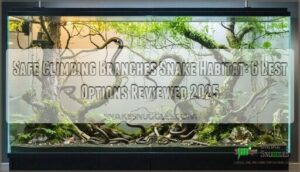
A green tree pythons spends most of its life draped over a single branch. Take that branch away, and your snake stops eating, stops basking, and starts stressing.
Arboreal snakes don’t treat perches as decoration. They use them to thermoregulate, hunt, and feel secure. A branch set at the wrong height or the wrong thickness leaves a 24-inch enclosure functioning like an empty box. Humid air at 60-80% also turns bare wood into a mold risk fast.
The best climbing structures for arboreal snakes solve all three problems at once. Here are six proven options, plus the safety rules that keep them working.
Table Of Contents
- Key Takeaways
- Top 6 Climbing Structures for Arboreal Snakes
- Choose Climbing Structures for Your Snake’s Species
- Select Safe Woods and Artificial Climbing Materials
- Secure Perches for Climbing, Warmth, and Cover
- Clean Climbing Structures and Prevent Mold
- Frequently Asked Questions (FAQs)
- What are some good climbing things for snakes?
- What is the best beginner arboreal snake?
- What surfaces can snakes not climb?
- What snakes are good climbers?
- How often should climbing branches be replaced?
- Can arboreal snakes climb too much?
- What diameter branch suits a juvenile arboreal snake?
- Do arboreal snakes need live plants for climbing?
- How many perches does one enclosure need?
- Conclusion
Key Takeaways
- Your arboreal snake uses perches to regulate its body heat, hunt, and feel secure, so a branch that’s the wrong height or thickness leaves your enclosure working like an empty box.
- You’ll get the best layout by matching perches to your species, with one thick horizontal basking perch for green tree pythons, interconnected angled branches for Amazon tree boas, and sturdier limbs for heavier carpet pythons.
- You should choose reptile-safe woods like manzanita, mopani, or cork bark, avoid cedar, pine, and yew, and anchor every perch firmly so it can’t shift under your snake’s weight.
- You’ll keep perches safe in 60-80% humidity by sealing wood, improving airflow, sanitizing branches every two weeks, and inspecting them often for mold.
Top 6 Climbing Structures for Arboreal Snakes
Your arboreal snake needs safe climbing structures to move, bask, and feel secure. The six options below cover natural branches, bendable vines, and driftwood sets. You’ll see which one fits your enclosure height, species, and setup style.
Before you buy any of these perches, check that your enclosure’s height and cross-ventilation suit a climber, since arboreal snake enclosure requirements vary a lot by species.
1. Exo Terra Forest Branch Large
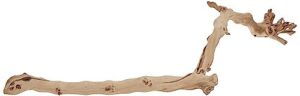
The Exo Terra Forest Branch Large gives your arboreal snake a natural, three-dimensional climbing path. Each branch is imported hardwood in light and dark brown, and no two match. Shape and size vary, so expect differences from the product photos.
It’s heat treated, which makes it suitable for both rainforest and desert setups. Your snake gets a perch, a basking spot, and cover in one piece.
Check every branch for sharp or pointy bits. Sand them smooth before use. Seal it in humid enclosures to limit mold.
| Best For | Keepers of arboreal reptiles and amphibians, such as geckos, who want a natural climbing branch for a rainforest or desert terrarium. |
|---|---|
| Material | Natural hardwood |
| Size | Varies per branch |
| Weight | N/A |
| Color | Light and dark brown |
| Climbing Use | Climbing exercise for arboreal reptiles |
| Main Drawback | May mold if unsealed |
| Additional Features |
|
- Heat-treated hardwood with a three-dimensional shape gives climbing exercise and suits both rainforest and desert setups.
- The light and dark brown coloring looks like aged hardwood and adds a natural look to the enclosure.
- It can also be used in enclosures for tarantulas, crabs, hamsters, and geckos.
- Color and shape vary naturally, so your branch may look different from the product photos.
- It may develop mold in humid environments if it isn’t sealed.
- It may need sanding to remove sharp or pointy bits before use.
2. Hamiledyi Bendable Terrarium Vines Set
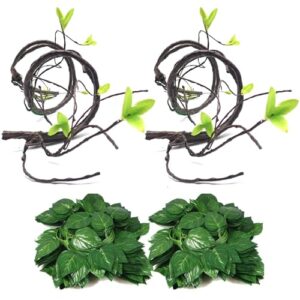
If you want a lighter option, the Hamiledyi Bendable Terrarium Vines Set gives you full control over the layout. Each vine has a bendable iron wire center wrapped in soft PU, so you twist it into the exact shape your enclosure needs.
The set includes a 43.3in (110cm) branch vine, reptile leaves, and 85cm plastic hanging leaves with suction cups. It gives your snake climbing paths and cover.
Rinse it before use, since color may bleed. Check leaves for detachment.
| Best For | Reptile and amphibian keepers who want lightweight, shapeable vines to build climbing paths and cover in a naturalistic, rainforest-style terrarium. |
|---|---|
| Material | PU, plastic and silk |
| Size | 3″D x 4″W x 8″H |
| Weight | N/A |
| Color | Green |
| Climbing Use | Climbing and cover for reptiles |
| Main Drawback | Color bleeding, material separation |
| Additional Features |
|
- Bendable, twistable vines can be shaped to fit your enclosure layout
- Provides climbing paths and cover for snakes and other reptiles and amphibians
- Life-like green look creates a naturalistic rainforest appearance
- Color may bleed when first exposed to water, so rinse before use
- Leaves may arrive crumpled or detached from shipping
- Some users report durability issues with the material separating
3. EONMIR 8-Foot Reptile Habitat Vine
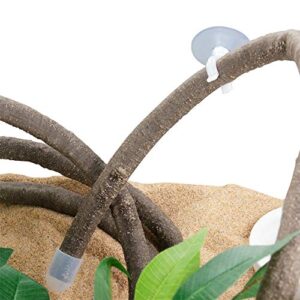
If you need more reach, the EONMIR 8-Foot Reptile Habitat Vine covers it. It runs about 8 feet (2.5 meters) long and roughly 1.5 cm thick. PU wraps an iron center, so you bend it, twist it, and keep the shape.
Corn snakes especially appreciate that kind of shaping, and this guide to climbing branches corn snakes need explains how to arrange them for exercise and security.
Combine it with other vines to build 3-D climbing structures across your enclosure. The package includes 1 vine and 6 suction cups.
Check the grip first, since some users report poor sticking to glass. Skip it for large ball pythons (10-15 lbs) unless you secure it.
| Best For | Owners of arboreal lizards, chameleons, geckos, and tree frogs who want a bendable, 8-foot vine they can shape into 3-D climbing structures in an indoor enclosure. |
|---|---|
| Material | PU and iron metal |
| Size | 8 ft long, 1.5 cm diameter |
| Weight | N/A |
| Color | N/A |
| Climbing Use | Arboreal lizards, chameleons, geckos, frogs |
| Main Drawback | Weak suction, thin for large animals |
| Additional Features |
|
- Bends and twists easily and holds its shape, thanks to PU wrapped around an iron core
- Roughly 8 feet (2.5 meters) long, and it can be combined with other vines to build 3-D habitat structures
- Comes with 1 vine and 6 suction cups, and it works for both decoration and extra living space
- Suction cup grip varies, and some users report poor sticking to glass
- Some users find it too thin (about 1.5 cm) for larger animals
- May not reliably support heavier animals, such as large ball pythons (10–15 lbs), without extra securing
4. PINVNBY Natural Driftwood 3-Piece Set
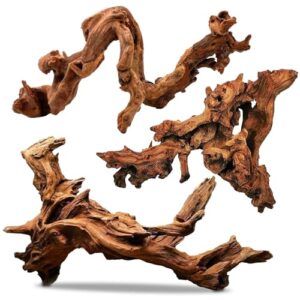
If you’d rather skip the manufactured look, the PINVNBY Natural Driftwood 3-Piece Set gives you real wood. Each piece runs 7 to 11 inches long. The set weighs about 2 pounds, so it’s easy to position. The pieces are selected Mopani wood, and they work as climbing and basking perches.
Pairing perches like these with a well-planned enclosure is easier on the wallet once you see a breakdown of snake housing costs.
Prep matters. Boil the wood first to improve sinkability and cut tannin release, which can stain water reddish-brown. Weight it down if it floats. Then anchor every piece firmly before your snake climbs.
| Best For | Aquarium and reptile keepers who want real, hand-selected Mopani wood for climbing, basking, or building moss trees, and who don’t mind prepping it first. |
|---|---|
| Material | Mopani wood |
| Size | 7-11 inches per piece |
| Weight | 2 pounds |
| Color | N/A |
| Climbing Use | Climbing and basking in reptile tanks |
| Main Drawback | Needs pretreatment, releases tannins |
| Additional Features |
|
- Natural Mopani wood, selected by hand, gives tanks an authentic look rather than a manufactured one
- Pieces measure 7-11 inches long, which suits both aquarium and reptile tank setups
- Works for several uses, including climbing and basking perches, moss trees, and a natural growing environment for fish
- Needs pretreatment such as boiling to improve sinkability
- May float at first and need weighting down to stay submerged
- Releases tannins that can turn water reddish-brown until the wood is treated
5. BNOSDM Natural Reptile Climbing Branches 3PCS
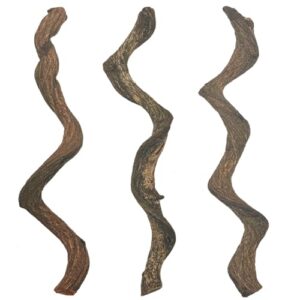
Vine branches give your arboreal snake a natural climbing route, and this 3-piece set delivers that at roughly 16 inches per piece. Each one is hand-selected natural wood, so no two shapes match. Expect 17 x 0.8 x 0.8 inches and about 10.55 ounces per branch.
Width and length vary with natural growth, and some buyers say the branches run thin. Check the diameter against your snake’s body before you commit.
Watch for mold resistance. Inspect every branch regularly, and clean it before problems spread.
| Best For | Owners of lizards, geckos, and chameleons who want natural-looking climbing branches for desert, tropical, or glass enclosures. |
|---|---|
| Material | Natural vine wood |
| Size | 16-17 inches long |
| Weight | 10.55 ounces |
| Color | N/A |
| Climbing Use | Climbing for lizards, geckos, chameleons |
| Main Drawback | Thin branches, mold concerns |
| Additional Features |
|
- Made from natural vine branches, so each piece has a unique shape
- Hand-selected for climbing suitability and texture
- Gives reptiles natural texture for basking and exercise
- Branches vary in width and length because of natural growth
- Some customers report the branches are thinner than expected
- Mold resistance is a concern based on user feedback
6. Natural Forest Branch Reptile Decor 3PCS
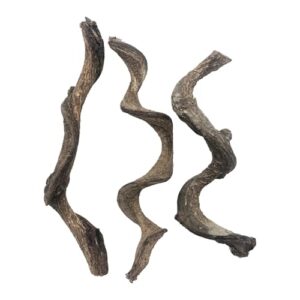
Vine branches give your arboreal snake a climbing route with real grip. This 3-piece set uses natural vine wood, so every branch has its own bends and knots. Each piece runs about 12.99 inches long, with a diameter of 0.39 to 0.79 inches. The whole set weighs 5.93 ounces.
Use it in desert, tropical, or glass enclosures. The irregular shapes fit in anywhere.
Check your fit first. Sizes vary, and some buyers report smaller branches than advertised. Watch for mold, too.
| Best For | Owners of arboreal snakes, geckos, or other climbing reptiles who want natural, irregular branches to add grip and variety to a desert, tropical, or glass enclosure. |
|---|---|
| Material | Natural vine wood |
| Size | 12.99 inches long |
| Weight | 5.93 ounces |
| Color | Brown |
| Climbing Use | Climbing and basking for many reptiles |
| Main Drawback | Smaller than advertised, mold concerns |
| Additional Features |
|
- Natural vine wood gives each branch unique bends and textured grip for climbing and basking.
- The irregular shapes blend into desert, tropical, or glass enclosures.
- The 3-piece set suits many reptiles, including lizards, bearded dragons, geckos, chameleons, snakes, and frogs.
- Size and thickness vary because of natural growth, so fit is not guaranteed.
- Some buyers report the branches are smaller than advertised.
- Mold has been reported, so the branches need watching.
Choose Climbing Structures for Your Snake’s Species
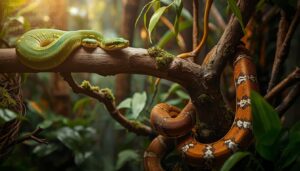
Picture a green tree python draped over one thick branch, motionless, while an Amazon tree boa below it threads through a tangle of angled limbs. Same hobby, opposite needs.
A green tree python rests motionless on one thick branch while an Amazon tree boa winds through angled limbs, showing how different arboreal snakes’ needs can be
Your snake’s species decides your layout. Match the climbing structures to its habits, and arboreal snakes will use every inch of vertical space.
- Green tree pythons: Offer one primary horizontal perch at basking height, with cooler perches below.
- Amazon tree boas: Build interconnected branches at varied angles so they can explore.
- Carpet pythons: Choose thicker, sturdier branches for their heavier build.
- Height: Give adult green tree pythons at least 24 inches, and carpet pythons and boas more.
- Humidity control: Keep 60-80% humidity, so pick perches that resist mold.
Always weigh species specific enclosure needs before you buy. Mounting every branch with aquarium-safe silicone or stainless steel hardware keeps secure branch mounting methods from failing under your snake’s weight.
Select Safe Woods and Artificial Climbing Materials
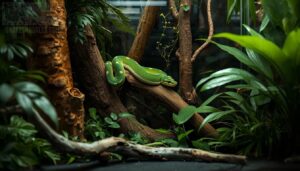
Say you grab a cedar branch from a craft store for your green tree python. Within days, your snake’s breathing turns wheezy. Aromatic oils did that.
Choose climbing structures for pet snakes carefully. Avoid toxic woods like cedar, pine, and yew. Pick reptile-safe materials instead: manzanita, mopani, cork bark, or maple.
Artificial vines work too. Resin and plastic bend easily, wipe clean fast, and never rot. They’re ideal for vertical enrichment in tall enclosures.
Collected wood needs prep. Strip the bark, then bake it at 200°F for two hours or boil it. Cool it fully before use.
Skip grapevine in humid setups because it molds fast. Save it for dry enclosures with humidity control between 30-50%. Match wood to climate.
Secure Perches for Climbing, Warmth, and Cover
Wobbly perches fail snakes fast. Build secure perches first, because everything else depends on them.
Anchor every branch so it can’t shift under your snake’s weight. Test structural integrity by pushing hard. Silicone artificial pieces in place, then hide the joints with substrate.
- Put your main perch in the upper third, where temperature gradients of 85 to 90°F form a basking zone.
- Add mid and low perches so your snake can climb toward or away from heat.
- Match diameter to your snake’s thickest coil.
Respect snake grip texture preference. Manzanita and citrus wood beat slick PVC every time.
Try branch angle optimization. Keep perches horizontal or sloped, then wrap them in foliage so your snake touches cover on several sides.
Clean Climbing Structures and Prevent Mold
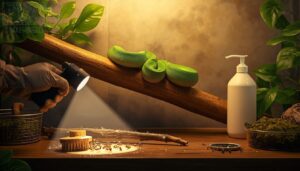
Mold loves a warm, damp branch as much as your snake does. Strong mold prevention in terrariums starts with a simple reptile disinfection protocol.
Plan biweekly sanitization. Scrub each branch with a 5% bleach solution, rinse thoroughly, then dry it in the sun for several days. Wipe off existing mold with white vinegar before sealing. Bake wood at 200-250°F for 30-60 minutes, then seal it with polyurethane.
Humidity control matters just as much. Improve airflow, keep humid hide moss damp but not wet, and add springtails to eat mold and debris. Refill the water bowl daily with fresh dechlorinated water.
Inspect daily with a flashlight. Check the top and underside of every branch for fuzzy black, green, or white growth.
Frequently Asked Questions (FAQs)
What are some good climbing things for snakes?
Start with natural branches like Exo Terra Forest Branch Large, or bendable vines like Hamiledyi.
These climbing structures for pet snakes add vertical enrichment and branching complexity.
Choose safe reptile materials, anchor everything firmly, and match diameter to your snake’s body.
What is the best beginner arboreal snake?
Want a snake that climbs without demanding a giant setup? Pick a spotted python. They’re calm, hardy, and stay around 110–140 cm. Add low branches and cork bark, and they’ll use every inch of vertical space.
What surfaces can snakes not climb?
Most escapes happen at corners, not flat panels. Snakes can’t climb clean, dry glass walls or acrylic panels.
Smooth surfaces and polyethylene surfaces work too. These low-friction materials give scales nothing to grip, unless scratched.
What snakes are good climbers?
Picture a green tree python coiled on a branch, tail anchored, head cocked toward the canopy. That’s your standard.
Arboreal snakes like green tree pythons, emerald tree boas, Amazon tree boas, and Asian vine snakes climb best. Corn and rat snakes climb readily too.
How often should climbing branches be replaced?
Trust is a bridge. Weekly structural inspections, biweekly sanitization with 5 bleach solution, and reptile habitat safety standards guide your reptile enclosure maintenance schedule. Replace wood every 6-12 months, vines every 3-6, moldy branches immediately.
Can arboreal snakes climb too much?
Your snake would climb to the moon if it could. Arboreal snake behavior includes vertical space utilization, but nonstop climbing signals stress. Fix climbing branch spacing, humidity control at 30-50%, and temperature gradients of 85-90F.
What diameter branch suits a juvenile arboreal snake?
Your juvenile arboreal snake doesn’t need a tree trunk, just a branch it can actually hold. Match branch diameter to its body width at mid-length, or slightly wider. You’ll usually land around 5 to 2 cm.
Do arboreal snakes need live plants for climbing?
A forest holds up its canopy with trunks, not leaves. Your snake needs the same: sturdy load-bearing perches, not live plants. Secure branches and vines work fine for climbing structures, and you can add foliage later for cover.
How many perches does one enclosure need?
Three perches is the ideal count, spaced 6–8 inches apart. That maximizes vertical space utilization.
Use adjustable branches for canopy habitat replication, climbing pathway customization, and multispecies vertical thermoregulation. Never go below two perches, though.
Conclusion
Picture your snake at dusk, coiled along a branch warmed by the lamp, perfectly still. That calm isn’t accidental.
The best climbing structures for arboreal snakes give you control over three things: height, grip, and cleanliness. Match diameter to your snake’s body, anchor every perch so it won’t shift, and scrub wood before mold gets a foothold. Do that, and your enclosure stops being a box. It becomes a territory your snake wants to live in.