This site is supported by our readers. We may earn a commission, at no cost to you, if you purchase through links.

A ball python can sit in a 40-gallon tank for months and look perfectly fine. Then the refusals to eat start, the shed comes off in patches, and you realize the enclosure was failing it the whole time.
Most health problems in captive snakes trace back to husbandry, not genetics or bad luck. A basking spot that’s too weak, humidity that swings with the weather, or a cage sized for a hatchling can quietly undermine everything else you do right.
Setting up reptile enclosures properly means getting the thermal gradient, airflow, and layout correct before your snake ever arrives. Here’s how to build one that works.
Table Of Contents
- Key Takeaways
- Choosing The Right Reptile Enclosure for Your Snake
- Setting Up Safe Reptile Heating and Lighting
- Adding Snake-Safe Substrate, Hides, Water, and Enrichment
- Balancing Humidity and Ventilation for Your Snake’s Species
- Testing, Monitoring, and Cleaning Your Reptile Enclosure
- Frequently Asked Questions (FAQs)
- How to set up a reptile enclosure?
- What do you put in the bottom of a reptile tank?
- How to stack reptile enclosures?
- How much ventilation does a reptile enclosure need?
- How do I build a reptile enclosure?
- How do I choose a pet reptile enclosure?
- How do I create a perfect reptile habitat?
- How do I set up a reptile terrarium?
- How big should a reptile enclosure be?
- How do you protect a reptile enclosure?
- Conclusion
Key Takeaways
- Size your enclosure for your snake’s adult length—about one body length long, half as wide, and one-third as tall for terrestrial species—prioritizing floor space over volume, and choose PVC for tropical species since it holds heat and humidity better than glass or screen.
- Build a real thermal gradient with a 105°F+ basking spot verified by infrared thermometer, an 85–90°F warm side, and a 75–80°F cool retreat, always run heaters through a pulse proportional thermostat (never straight into the wall) and guard them so your snake can’t touch them.
- Match humidity to your species’ range—desert 30–50%, subtropical 60–80%, tropical 80–90%—using moisture-retentive substrate like cypress mulch, a damp sphagnum humid hide, and low intake/high exhaust vents to balance moisture with airflow, while avoiding pine and cedar entirely.
- Test the empty enclosure for 24 hours before your snake arrives, monitor temperatures and humidity with separate digital devices (wireless sensors can alert you to drift), and follow a routine of daily spot-cleaning plus a monthly deep clean.
Choosing The Right Reptile Enclosure for Your Snake
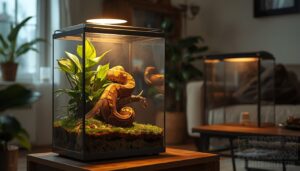
Your snake’s enclosure is the foundation of everything else you’ll build, so it’s worth getting right the first time.
Before you buy anything, a snake habitat setup cost breakdown can show you what heating, hides, and substrate really add up to.
Once the basics are covered, you can make the space feel more like home by creating a natural snake environment with hides, climbing branches, and substrate that encourage natural behavior.
The right enclosure depends on your snake’s adult size, its natural history, and how much room it needs to stretch, climb, and thermoregulate.
Below, you’ll find the key factors to weigh as you choose between the main options available.
Adult Size and Enclosure Dimensions
The first rule of good reptile enclosure design is planning for your snake’s adult size, not its current length. Measure the total body length of the species you keep, then choose an enclosure at least that long, half as wide, and one-third as tall for terrestrial snakes. Prioritize floor space over volume so your snake can thermoregulate along a proper gradient.
When selecting a habitat, also consider reptile enclosure materials and security to guarantee non-toxic, escape-proof construction that helps your snake’s long-term health.
Materials, Ventilation, and Escape-Proof Access
Now pick the right material. PVC enclosures hold heat and humidity well, resist mold, and stay lightweight, making them ideal for tropical species like ball pythons. Glass works for leopard geckos and corn snakes if you manage moisture. Avoid screen cages for humidity-loving snakes; save them for chameleons needing maximum airflow.
If you’re still comparing options, this guide to the best snake enclosures for beginners breaks down which setups keep humidity steady and are easiest to maintain.
Position side vents for balanced enclosure ventilation, preventing stagnation without pulling moisture out. Skip full screen tops, which create a chimney effect.
Setting Up Safe Reptile Heating and Lighting
Snakes can’t regulate their own body temperature, so your heating and lighting setup does that job for them. Getting it right prevents burns, stress, and long-term health problems. Here’s what you need to know about temperature zones, heat sources and thermostats, and UVB and daylight cycles.
Warm and Cool Temperature Zones
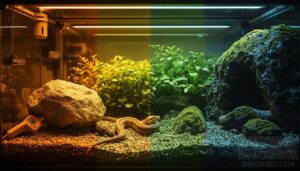
Hot side, cool side, nowhere to hide. Your snake needs a proper temperature gradient to thrive, not one lukewarm tub. Build three distinct zones it can move between freely.
Your snake needs a hot side, a cool side, and a temperature gradient to move between, not one lukewarm tub
- Basking area: 105°F+, verified with an infrared gun
- Warm ambient side: 85°F–90°F
- Cool retreat: 75°F–80°F
Mount heat far to one side, never centered. A delta under 10°F means your thermal gradient has failed. Let nighttime temps drop naturally.
Pairing that overnight drop with a thermostat-controlled setup keeps the gradient steady, and this guide on whether ball pythons need a heat mat explains how.
Heat Sources, Thermostats, and Guards

Next come the heat sources, thermostats, and guards that keep that temperature gradient steady.
Mount a ceramic heat emitter in a dome lamp with a ceramic fitting. Plug it into a pulse proportional thermostat, never straight into the wall.
Emitters get dangerously hot, so add a safety cage. Never place any heater where your snake can reach it, even guarded.
Species-Appropriate UVB and Daylight Cycles

You don’t need identical UVB lighting for every snake, so start with species-specific guidance. Diurnal species benefit most, while nocturnal ones need only low output. Mount the tube 9 to 15 inches above, with no glass between, and leave a shaded retreat.
Keep a steady photoperiod cycle of 10 to 12 hours, lights off at night, and replace bulbs yearly.
Adding Snake-Safe Substrate, Hides, Water, and Enrichment
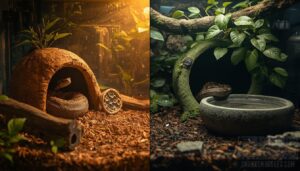
The right reptile substrate sets the tone for everything else inside your reptile enclosure. Cypress mulch holds moisture and resists mold, but sift out sharp chunks for hatchlings. Skip pine and cedar, since their oils can harm your snake’s lungs and nervous system.
Give your snake two snug reptile hides, one on the warm end and one on the cool end. Your snake should touch the sides when coiled.
Place a heavy water bowl on the cool end, large enough for a full soak, and refill it daily.
Good enclosure enrichment pays off in moments like these:
- Seeing your snake feel truly secure.
- Watching it climb with steady confidence.
- Finding it relaxed inside its hide.
- Spotting a clean, easy shed.
Balancing Humidity and Ventilation for Your Snake’s Species
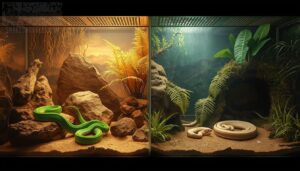
Too dry and your snake sheds in patches; too damp and scale rot sets in. Good humidity control sits between those extremes, and it starts with your species. Check the species pillar guides for exact ranges, then build a thermal gradient setup that gives your snake a wetter side and a drier side.
| Snake type | Humidity | Example |
|---|---|---|
| Desert | 30-50% | Sand boa |
| Subtropical | 60-80% | Wolf snake |
| Tropical | 80-90% | Green tree python |
Add a humid hide with damp sphagnum moss on the warm side, but not directly over the heat source. Set your water bowl over warmer areas too. Reptile ventilation prevents mold and respiratory trouble, so adjust vent size instead of blocking it. Enclosure humidity control always balances moisture with airflow.
Testing, Monitoring, and Cleaning Your Reptile Enclosure

Picture a new ball python enclosure on Friday evening. By Sunday, the basking spot reads 112°F because the thermostat probe sits too far from the heat lamp.
Testing, Monitoring, and Cleaning Your Reptile Enclosure prevents that kind of surprise. Test the Empty Enclosure First, running everything for 24 hours before your snake moves in.
Use a digital thermometer and hygrometer, placing the hygrometer partway up the side for average humidity. Check basking and ambient temperatures separately, and compare two devices if readings disagree.
Wireless sensors like Govee or SensorPush send alerts when numbers drift, which helps while you’re away. Then build an enclosure cleaning schedule: spot-clean waste daily, refill water, and deep clean monthly. Always rinse all décor thoroughly afterward.
Frequently Asked Questions (FAQs)
How to set up a reptile enclosure?
It’s not as complicated as it sounds.
Pick a roomy reptile enclosure, create temperature zones with a basking area at one end, connect a thermostat, add safe substrate options, two hides, and fresh water daily.
What do you put in the bottom of a reptile tank?
At the bottom of your tank, you’ll layer moisture-retentive substrate like coconut coir for tropical species, aspen shavings for burrowers, or reptile carpet. Avoid cedar, pine, and calcium sand, which cause impaction risks.
How to stack reptile enclosures?
Picture a tidy wall of glass and mesh, each enclosure level and secure, with warm air moving freely through the gaps. You can stack safely if you follow a few firm rules.
Only stack the same brand and model, since compatible dimensions and locking spacers join units without gaps. Never exceed three enclosures high for 4’x2’x2′ sizes, because extra height invites wobbling.
Reinforced bases must hold up to 100 lbs per unit, and spacers or support bars prevent sliding, tipping, and bowing. Those gaps also let you route wires, probes, and monitoring gear cleanly.
Skip belly heat between stacked units; heat buildup creates fire risk. Use overhead heat sources with clear ventilation space, and give each enclosure its own thermostat so temperature zones and your thermal gradient stay independent.
How much ventilation does a reptile enclosure need?
Ventilation can make or break your snake’s health, so get it right! Aim for 1–2 air changes per hour for desert species, 3–5 ACH for tropical ones. Keep intake vents low, exhaust high.
How do I build a reptile enclosure?
Think of it as building your snake a miniature world. Start with an escape-proof tank sized to adult dimensions, add substrate safety with 3-4 inch bedding, hides in both temperature zones, secure placement of heat and UVB, then monitor daily.
How do I choose a pet reptile enclosure?
Pick a reptile enclosure sized to your snake’s species and adult length. Choose PVC, glass, or wood, prioritize suitable ventilation and secure locks, and plan for future growth plus easy cleaning access.
How do I create a perfect reptile habitat?
A ball python thrives in a PVC enclosure with a 90°F basking surface and 75°F cool side. Balance temperature zones, UVB lighting, hide placement, appropriate substrate, and humidity regulation, monitoring everything with reliable thermometers and hygrometers.
How do I set up a reptile terrarium?
Picture a sun-warmed forest floor inside glass. Your snake needs that: pick a secure enclosure, layer natural substrate safety for reptiles, set hides, climbing decor, and water, then dial in temperature and humidity, lighting and ultraviolet provision, monitoring daily.
How big should a reptile enclosure be?
Size depends on the species, not a single rule. Your snake’s enclosure should be at least one full body length long, with width, height, and floor space matched to whether it’s terrestrial, arboreal, or semi-aquatic.
How do you protect a reptile enclosure?
Protecting your enclosure starts with an escapeproof design: lock the lid with clips or padlocks, seal gaps with silicone, and audit monthly. Check heating elements for electrical safety, keep monitors accurate, and follow a regular enclosure cleaning schedule.
Conclusion
A snake enclosure is like a well-run kitchen: everything within reach, everything doing its job.
When you nail setting up reptile enclosures before your snake arrives, you prevent the slow failures that show up months later as skipped meals and bad sheds.
Check your temps daily, watch your humidity, and adjust as you learn your animal’s habits.
Do that, and you’re not just keeping a snake alive. You’re giving it a home where it thrives.
- https://toxirium.com/how-to-achieve-perfect-reptile-temperature-gradients-the-2026-guide
- https://currumbinvetservices.com.au/creating-the-ideal-lighting-temperature-conditions-for-your-pet-reptile
- https://peqaboo.com/knowledge/en/guides/reptile-temperature-gradients-hot-side-cool-side-and-why-it-matters