This site is supported by our readers. We may earn a commission, at no cost to you, if you purchase through links.

Your snake can’t make its own heat. Ever. A ball python parked in a 70°F enclosure will stop digesting its meal, and a stalled meal can turn into a regurgitated one.
That’s why snake enclosure heaters for reptile beginners matter more than any other piece of gear you’ll buy. Get it right and your snake thrives. Get it wrong and you risk burns, fires, or a slow decline you won’t spot until it’s serious.
The good news? Safe heating comes down to a few choices: the right gradient, the right heater type, the right wattage, and a thermostat. Here’s how to nail each one.
Table Of Contents
- Key Takeaways
- Set Species-Specific Snake Enclosure Temperature Gradients
- Compare Snake Enclosure Heaters for Beginners
- Match Heater Wattage to Your Enclosure
- Install Snake Heaters and Thermostats Safely
- Monitor Temperatures and Troubleshoot Snake Heating
- Frequently Asked Questions (FAQs)
- What is the best way to heat a snake enclosure?
- What are some good heaters for snakes?
- Is 90 degrees too hot for a snake?
- How long can my snake go without heat?
- How often should I replace my snakes heater?
- Can I use a regular household bulb for heating?
- Should my snakes heater stay on at night?
- Do baby snakes need different heating than adults?
- How can I reduce heating costs for multiple enclosures?
- Conclusion
Key Takeaways
- Your snake can’t make its own heat, so give it a warm end and a cool end (about 88–92°F and 75–80°F) and let it choose where to be.
- Run every heater through a proportional thermostat with the probe on the basking surface (a heater with no thermostat is a burn and fire risk).
- Match wattage to your enclosure’s size, material, and room temperature (then go one step higher) and let the thermostat hold the temperature (an undersized heater leaves your snake cold).
- Guard every heater, keep safe clearances, and check both ends of the enclosure daily with an infrared gun (surface temperature is what your snake actually feels).
Set Species-Specific Snake Enclosure Temperature Gradients
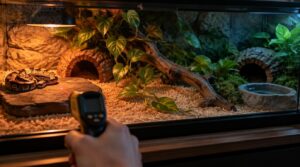
A snake doesn’t care about your thermostat setting. It cares about choices. Give it a warm end, a cool end, and a clear path between them, and it’ll regulate itself like a pro. That’s a temperature gradient, and it’s the whole point of your heating system.
If you’re setting up your first enclosure, this guide to reptile heat lamps for first-time snake owners shows how to place one so the warm end stays warm and the cool end stays cool.
A snake doesn’t need your thermostat setting; it needs a warm end, a cool end, and the freedom to choose between them
Start with species-specific targets. Ball pythons need a basking spot of 88–92°F and a cool side of 75–80°F. Corn snakes want 85–88°F warm, 75–82°F cool. Rosy boas run hotter at 90–95°F, with a cooler 70–75°F side.
Heat one end only. Keep at least a 10°F difference between thermal zones, and put a hide on each side so your snake never has to choose between safety and warmth.
Trust an infrared gun, not stick-on guesswork.
Compare Snake Enclosure Heaters for Beginners
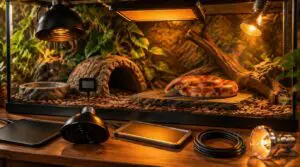
Not every heater suits a first-time keeper. Some run too hot, some barely warm the glass, and a few demand more babysitting than you’d expect. Here are five options, ranked by how they behave in a beginner’s setup.
Halogen Basking Lamps
deliver focused heat fast. Their shortwave infrared reaches deeper than ordinary bulbs, and the white light sets a day cycle. Pair one with a dimming thermostat, never on/off.
- Mount it in a ceramic socket.
- Add a wire guard.
- Probe the basking spot directly.
Keep a separate night heater. Safety first, always.
Deep Heat Projectors
Need heat without the glow? A deep heat projector is your answer. This infrared heat emitter pumps out infrared-B and infrared-C, warming your snake’s body and its hides directly, not the air around it. Zero visible light means nights stay dark.
If your setup houses a desert species, pairing the emitter with the right heat lamps for desert snakes helps you hit those hotter basking temperatures safely.
Screw it into a ceramic socket, run it through a dimming thermostat, and keep thermal safety tight.
Ceramic Heat Emitters
Want heat without the glow? A ceramic heat emitter is the classic pick. It gives off infrared-C only, so your snake gets steady warmth around the clock and the room stays dark.
Mount it over one end for a proper temperature gradient. Use a ceramic socket, a guard, and a proportional thermostat. That’s thermal safety sorted. Because these units reach surface temperatures of 200-500°F (95-260°C), keep flammable materials well clear and review ceramic heat emitter safety before you set one up.
Radiant Heat Panels
Panels are the quiet achievers of snake heating. A radiant heat panel mounts overhead, glows with no light, and keeps surfaces touch-safe.
Your setup needs:
- Lens at least 6 inches above substrate
- A proportional thermostat, since the thermal fuse isn’t one
- Smart heat source placement for a true thermal gradient
Skip guesswork. Practice temperature monitoring and follow safety precautions.
Heat Mats and Their Limitations
Heat mats get recommended to beginners constantly. Here’s the catch: a heat mat warms surfaces, not air, so it can’t build a real thermal gradient on its own. Snakes may over-bask on it and burn.
Mount any undertank heater outside the enclosure, covering only a third to half the floor. Always run a thermostat. Temperature monitoring and strict safety precautions aren’t optional.
Match Heater Wattage to Your Enclosure
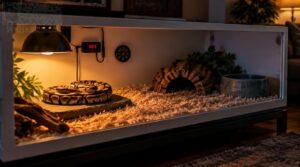
Picture a ball python in a 4-foot PVC cage with a 60W bulb. Room’s at 68°F. The warm side never tops 82°F, and your snake sulks in the corner. Sound familiar? The bulb wasn’t broken. It was undersized.
Wattage depends on three things: enclosure size, material, and the gap between your room and your target temperature gradient. Glass and screen tops bleed heat. PVC and wood hold it. Heavy ventilation can raise your needs by up to 50%.
As a starting point, use 60W for 10 to 20 gallons, 100W for a 40-gallon breeder, and 150W for a 4-foot PVC cage. Then buy one step higher and run it through a thermostat. Pick a heater with built-in thermal cutoffs, too.
Install Snake Heaters and Thermostats Safely
A heater without a thermostat is a fire waiting for a bad day. Getting the install right takes two checks: how your thermostat and probe work together, and how you shield and space every heat source. Work through both below and your snake gets steady warmth with no surprises.
Thermostat Compatibility and Probe Placement
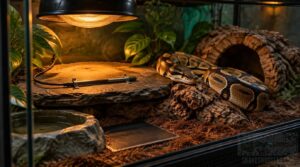
Plug in the wrong thermostat and you’ve built a very expensive fire hazard. Match the control method first.
- Pair a pulse proportional thermostat with a ceramic heat emitter.
- Use on/off for a heat mat.
- Keep total wattage under 80% of the rating.
- Mount the probe on the basking surface, secured with clips.
Smart probe placement keeps your digital thermostat honest.
Heater Guards and Safe Clearances
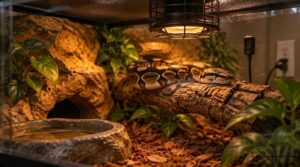
Your snake can’t tell a heater from a warm rock. It’ll climb it, wrap it, and sleep on it.
Fit a heat guard over every heater your snake can reach, and fasten it. Keep heat lamps 6 inches above its highest reach, and ceramic emitters 12 to 18 inches away. Follow safety precautions: use a GFCI outlet and a thermostat.
Monitor Temperatures and Troubleshoot Snake Heating
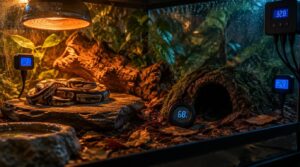
A heater you can’t verify is a heater you’re guessing about. Next, you’ll learn how to check both sides of the enclosure, manage humidity as the heat runs, fix overheating or weak warmth, and keep your snake safe when the power drops. Master these four, and you’ll catch problems before your snake ever feels them.
Warm-Side and Cool-Side Temperature Checks
Think your setup is dialed in? Prove it.
Check both ends of the thermal gradient daily. Aim a temp gun at the basking spot, then probe the cool hide. Ball pythons want 90-92°F warm, 78-80°F cool.
Don’t trust ambient air readings. Surface temperature is what your snake feels. Recheck whenever room temperature shifts.
Humidity Management With Heating
Heat dries air. Fast.
Your heater changes relative humidity more than you’d think. Ceramic heat emitters and radiant panels are the worst offenders. Halogen lamps and deep heat projectors dry less. Heat mats barely touch it.
Fix it without wrecking your thermal gradient. Park the water bowl on the warm side. Check a hygrometer daily. Never sacrifice the basking surface.
Overheating and Insufficient Warmth
Dry air isn’t your only heat problem. Sometimes the numbers swing the other way.
Overheating usually comes from oversized wattage, direct sunlight, or a hot room. Cut power, move your snake somewhere cooler, and offer room-temperature water.
Too cold? Check heater size, placement, and thermostat probe position. Still cool? Test equipment with an independent thermometer. Keep temperature consistency steady.
Backup Heating During Power Outages
Cold is one thing. No power is another. A power outage won’t wait for your plan.
Build your backup heating now:
- Portable power station for low-wattage heaters
- UPS for your thermostat
- 72-hour heat packs wrapped in towels
- Insulated enclosure with blankets
- Alert system that texts you when power drops
Test everything before winter. Your snake will quietly thank you later.
Frequently Asked Questions (FAQs)
What is the best way to heat a snake enclosure?
Picture a desert at noon: scorching rock on one side, cool shade on the other. Your snake enclosure heating setup should copy that. Use one thermostat-controlled heater on one side, creating a true temperature gradient.
What are some good heaters for snakes?
Want heat that won’t cook your snake? Start with a ceramic heat emitter on a thermostat for steady, lightless warmth. Add a heat lamp for basking spots, and a heat mat for small tanks.
Is 90 degrees too hot for a snake?
Not for most snakes. A 90°F warm side temperature is right for ball pythons. Just keep it as a spot, not the whole enclosure. Use a thermostat on the heat source, and keep the cool side lower for safety.
How long can my snake go without heat?
Most healthy adult snakes handle a day or two without heat if your room temperature stays above 70°F. Below that, trouble starts fast. Juveniles and recently fed snakes? Restore heat within hours.
How often should I replace my snakes heater?
Your heater is a quiet employee that never takes a day off. Replace it by type: halogen lamps and deep heat projectors yearly at most, ceramic emitters near 10,000 hours, mats after five years. Retire any heater showing damage or weak output immediately.
Can I use a regular household bulb for heating?
Think a regular household bulb works as snake heating equipment? Not really. It mostly throws light, not usable basking heat, and it overheats the air. Skip it. Reptile-specific bulbs give safer temperature control and electrical safety.
Should my snakes heater stay on at night?
Wondering if the heater should stay on overnight? Only when the room gets cold. Let your thermostat decide, keeping temperature above your species’ minimum.
Skip the night bulb; lightless heat is far better for safety.
Do baby snakes need different heating than adults?
A hatchling is a tiny furnace that runs out of fuel overnight. Keep your temperature gradient steady, never below 75°F at night. Juvenile and adult snakes cope with cooler nights, so belly heat and heating equipment can switch off.
How can I reduce heating costs for multiple enclosures?
Stop heating every tub on its own. One heat cable or heat tape run on a single thermostat beats a pile of individual heat mats. Insulate the rack, and your energy efficiency jumps.
Conclusion
Picture a first-time keeper who plugs in a heat mat, skips the thermostat, and goes to bed. By morning, the mat has run hot and scorched the belly of a sleeping corn snake.
Don’t be that keeper. Pick snake enclosure heaters for reptile beginners that suit your species, size the wattage to your tank, and wire everything through a proper thermostat. Check both ends daily.
Your snake can’t regulate itself. You can. That’s the job.