This site is supported by our readers. We may earn a commission, at no cost to you, if you purchase through links.

A snake that can’t regulate its body temperature can’t digest its last meal, fight off infection, or behave normally—and the heating setup you build determines whether that happens. Unlike mammals, snakes depend entirely on external heat sources to drive nearly every biological process, from breaking down a mouse to mounting an immune response.
Get the temperatures wrong, and you won’t always see the problem coming; the snake simply stops thriving in ways that are easy to miss until the damage is done.
Snake enclosure heating recommendations exist on a spectrum from basic to precise, and knowing where your species falls on that spectrum makes all the difference.
What follows covers the complete setup—gradients, heat sources, thermostats, and safety measures built around real temperature targets, not guesswork.
Table Of Contents
- Key Takeaways
- Set The Right Temperature Gradient
- Match Heating to Snake Species
- Choose The Best Heat Source
- Control Heat With Thermostats
- Monitor Temperatures and Adjust Daily
- Prevent Burns, Fires, and Heat Loss
- Frequently Asked Questions (FAQs)
- How warm should my snake enclosure be?
- How do I heat my snake enclosure?
- How do you protect a snake enclosure from overheating?
- How do you heat a snake?
- How do you keep a snake warm?
- How do you care for a snake enclosure?
- Can a snake enclosure heat a snag?
- What is the best heat source for a snake enclosure?
- What temperature should my snake enclosure be?
- What is the best way to heat a snake tank?
- Conclusion
Key Takeaways
- proper temperature gradient — warm side at 88–92°F, cool side at 75–80°F — isn’t just about comfort; it drives every biological process your snake depends on, from digestion to immune response.
- heat source needs a thermostat, because an unregulated heater can spike temperatures fast enough to harm your snake before you even notice something’s wrong.
- heat source choice should match your species and enclosure size — ceramic heat emitters, radiant panels, heat mats, and basking lamps each serve a distinct purpose, and no single option works for every setup.
- temperature monitoring across all three zones — basking spot, ambient mid-zone, and cool side — is the only way to catch problems like overheating or cold spots before your snake pays the price.
Set The Right Temperature Gradient
Getting the temperature gradient right is the foundation of everything else in your snake’s enclosure. Without a proper warm side and cool side, your snake can’t regulate its own body the way it needs to.
For a deeper look at dialing in those zones, optimal snake room temperatures and humidity walks you through exactly what your setup needs.
Here’s what you need to know to set those temperatures correctly.
Warm Side and Cool Side Targets
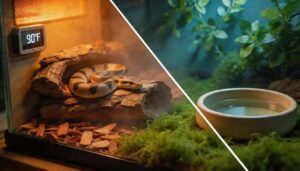
Think of your enclosure as a sliding scale, not a fixed point. Your snake moves across it to self‑regulate throughout the day.
Strong species gradient targets usually look like this:
- Warm side range: 88–92°F for most colubrids
- Cool side range: 75–80°F for tropical species
- Temperature differential: aim for 12–15°F minimum
- Heat pocket placement: one end only
- Temperature monitoring: check both zones daily
Maintaining the cool side temperature range of 72–80°F helps regulate metabolism.
Ideal Basking Spot Temperatures
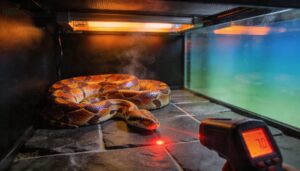
The basking spot isn’t the same as your warm-side air temperature — surface temperature accuracy matters most here. Measure directly on the substrate where your snake rests using infrared gun checks.
Ball pythons need a basking surface of 95–104°F; corn snakes do well around 90°F. Basking substrate choice affects spot temperature uniformity, so tile or slate holds heat more evenly than loose material.
Daytime Versus Nighttime Temperature Drops

Once you’ve nailed your basking spot, don’t forget what happens after lights-out.
A nighttime drop of 5–10°F helps circadian rhythm impact and healthy metabolic rate variation — ball pythons do well cooling to 24–26°C, while corn snakes can dip to 22–25°C.
Use nighttime heating with a thermostat’s night-drop timing feature for smooth day/night temperature control without sudden thermal gradient disruptions.
Juvenile Versus Adult Heating Needs
Age matters more than you’d think when setting up a temperature gradient. Juveniles have less Thermal Mass, so they lose heat faster and hit dangerous temperatures sooner.
Keep their Growth Rate Temperature 2–4°F warmer than adults, tighten your Safety Margin around the heat source, size Heat Spot Size carefully, and prioritize Feeding Heat consistency — small bodies leave little room for error.
Why Gradients Support Digestion and Metabolism
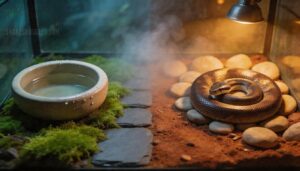
A temperature gradient does more than prevent overheating — it drives digestion. When your snake moves into the warm zone, rising body temperature triggers an Enzyme Activity Rate increase and a Gut Motility Boost, speeding nutrient breakdown.
A snake’s temperature gradient doesn’t just prevent overheating — it powers digestion itself
Thermoregulatory Behavior lets it self-regulate Metabolic Energy Allocation, shifting between active digestion and rest.
Without that range, Nutrient Absorption Efficiency drops, and food just sits there.
Match Heating to Snake Species
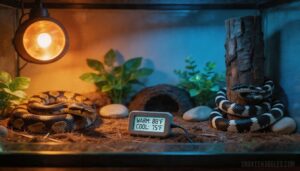
Not every snake wants the same temperature, and getting this wrong can stress your animal fast. A ball python and a desert kingsnake have different ideas of "comfortable," so your heating setup needs to match the species, not just the enclosure size.
Here’s what the numbers look like for the most common pet snakes.
Ball Python Heating Recommendations
Ball pythons are surprisingly sensitive to temperature swings, so getting the gradient right matters more than most beginners expect. Maintain the warm side between 86–90°F and the cool side at 72–80°F.
A thermostat-controlled heat source — whether a heat mat or overhead emitter — ensures heat retention and energy efficiency. Thermal imaging can help verify your gradient before your snake ever moves in.
Boa Constrictor Temperature Needs
Boas run a bit warmer than ball pythons, so maintain a temperature gradient spanning 75–80°F on the cool side to 86–90°F on the warm end. Behavioral thermoregulation naturally guides them between zones, but size impact significantly influences enclosure conditions. Larger boas require more even heat distribution across their habitat.
Pair your heat source with a thermostat to ensure precision and stability. Always account for seasonal shifts and humidity interaction, as these factors directly affect thermal consistency. This integrated approach maintains optimal conditions for the snake’s health.
Corn Snake Enclosure Heating Ranges
Corn snakes are more forgiving than many species, but that doesn’t mean guesswork is acceptable.
Keep the cool side between 75–82°F and the warm side at 80–85°F, with a basking spot near 90°F. A clear thermal gradient matters more than chasing a single number.
For the specific bulb wattages, fixture heights, and light-dark cycles that make this gradient easy to maintain, check out this ball python habitat lighting guide.
Match your heat source to enclosure size scaling, and always log readings for reliable temperature log analysis.
Tropical Versus Desert Species Differences
Tropical and desert snakes live by completely different rules.
Tropical species like green tree pythons need steady warmth around 85–90°F with humidity levels of 60–80%, making microhabitat design and substrate selection critical — think moist moss and dense foliage.
Desert species rely on a sharp thermal gradient, with basking zones hitting 90–95°F, while energy conservation drives their distinct activity patterns during cooler nights.
Adjusting Heat for Natural Habitat Style
Mimicking your snake’s native climate isn’t just good practice — it’s the difference between a thriving animal and a stressed one. Match your heat source placement and substrate choices to replicate natural microclimate zones.
- Account for Seasonal Temperature Shifts by adjusting ambient temperature a few degrees in cooler months
- Use moisture-retaining substrates for Humidity Temperature Balance in tropical setups
- Layer your thermal gradient stability with multiple heat zones for desert species needing sharp basking contrasts
Choose The Best Heat Source
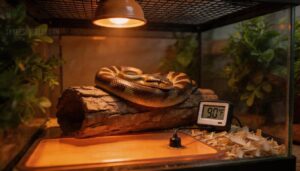
Not all heat sources work the same way, and picking the wrong one can throw off your entire setup. Each option has a specific job — some warm the air, some heat surfaces, and some do both.
Here’s a look at the most common choices and how they fit into a well-balanced enclosure.
Heat Mats and Under-tank Heaters
Heat mats and undertank heaters deliver steady belly heat from below — exactly how snakes absorb warmth in the wild. Cover only 30–40% of the floor to maintain proper heat distribution uniformity across warm and cool zones.
Mounting techniques matter: raise the enclosure slightly so heat doesn’t get trapped underneath. Always pair with a digital thermostat, since unregulated pads ignore substrate compatibility issues and risk burns.
Ceramic Heat Emitters for Ambient Warmth
While heat mats handle belly warmth, ceramic heat emitters take care of the air. They produce infrared heat without any visible light, making them a reliable nighttime ambient heat source that won’t disrupt your snake’s light cycle.
Choose wattage — 60 W, 100 W, or 150 W — based on enclosure size.
They’re humidity compatible, so tropical setups stay safe.
Always use a porcelain socket and thermostat.
Radiant Heat Panels for Even Heating
Radiant heat panels mount overhead and use a metal face — usually steel or aluminum — to spread warmth evenly across the enclosure. That broad heat spread eliminates hot spots, supporting a stable temperature gradient from one end to the other.
Their installation layout, ceiling-mounted or suspended, keeps floor space clear. Pairing them with a dimming thermostat ensures reliable temperature control and delivers real efficiency gains.
Heat Lamps and Halogen Basking Bulbs
Unlike panels, a heat lamp or halogen flood light creates a concentrated basking spot your snake can move toward or away from, giving it real control over its temperature gradient.
Halogen bulbs range from 25W to 100W, offer spectrum influence that mimics daylight, and work well with dimmable fixtures for precise output.
Manage glare, reduction, bulb longevity, and energy usage with a paired thermostat.
When to Combine Multiple Heat Sources
Sometimes combining multiple heat sources safely in reptile habitats requires pairing a heat mat for steady floor warmth with a ceramic emitter for ambient coverage. This load sharing prevents peak demand backup failures by distributing the workload.
Smart source switching via a dual-zone thermostat maintains a reliable cut-off temperature while creating energy-saving synergy. It ensures seamless operation by managing both heat sources simultaneously.
Proper integration ensures heat source compatibility with thermostats across your entire setup, guaranteeing consistent and safe temperature regulation throughout the habitat.
Why Heat Rocks Should Be Avoided
Heat rocks seem convenient, but they’re one of the most dangerous choices for reptile health. They heat only the contact surface, creating Direct Contact Risks that lead to serious burns — often before your snake even reacts.
They also cause:
- Burn risk from unregulated surface temperatures
- Behavioral Stress from inconsistent thermal gradients
- Energy Inefficiency with poor whole-enclosure coverage
- Maintenance Challenges due to frequent device failures and lacking reliable overheat protection or thermal cutoffs
These Long-Term Health consequences aren’t worth it.
Control Heat With Thermostats
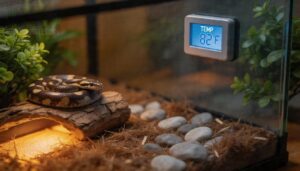
A heater without a thermostat is like a car with no brakes — it just keeps going until something goes wrong. Getting the temperature right means picking the thermostat that actually matches how your heater works.
Here’s what you need to know about each type.
Why Every Heater Needs a Thermostat
A heater without a thermostat is like a car with no brakes — it keeps going until something breaks. Your temperature control system needs that stopping point.
Without automatic shutoff, even a correctly sized heat source can spike dangerously and stress your system.
| What Thermostats Do | Why It Matters |
|---|---|
| Temperature Consistency | Prevents dangerous spikes |
| Energy Conservation | Stops unnecessary running |
| Safety Redundancy | Cuts power at set limits |
| Power Monitoring | Reduces electrical risk |
On/off Thermostats for Heat Mats
On/off thermostats are the simplest match for heat mats in a reptile enclosure — they either send full power or cut it completely. Cycling behavior keeps temperature control straightforward without complicated settings.
Wattage matching carefully; most units top out at 100–300W, though some handle up to 1,000W. Staying within load capacity limits activates built-in safety cutoff features, protecting both your mat and your snake.
Dimming Thermostats for Lamps and CHEs
Unlike on/off units, dimming thermostats follow a smooth power curve — gradually raising or lowering output instead of hard‑cycling. That makes them ideal for heat lamps and ceramic heat emitters (CHEs).
Keep these compatibility points in mind:
- Match heater wattage to thermostat capacity (some require a 40W minimum load)
- Verify your unit’s maximum rating (600W or 300W depending on model)
- Place the probe near — not under — the basking lamp
- Enable day/night dual set-points for natural temperature cycles
- Check for thermostat firmware updates to maintain accurate dimming power curves
Pulse Proportional Thermostats for Precision
Pulse proportional thermostats work differently from basic on/off units — instead of cutting power entirely, they use Pulse Timing Mechanics to send rapid bursts of power, adjusting frequency based on Real-Time Probe Feedback. This keeps temperature swings tight, making them the go-to for Precision Heat Mat Control and Ceramic Heater Compatibility.
For desert species needing 35–40°C, choose a High-Range Thermostat Settings model for accurate snake thermoregulation.
Day and Night Thermostat Settings
Most modern thermostats support Dual Setpoint Programming, letting you set separate daytime and nighttime temperatures automatically. For snakes, Daytime Setback Scheduling keeps warm zones at target levels, while a Nighttime Setback Range drops temps 5–10°F to mimic natural cycles.
This day/night temperature control also improves Energy Savings Estimation — consistent Thermostat Ramp Rate adjustments reduce unnecessary heat output without stressing your animal.
Safe Thermostat Probe Placement
Once your day/night settings are dialed in, where you place the probe determines whether those settings actually work. Keep the temperature sensor at snake level — not against the glass, which gives false air readings.
Use cable ties for Cable Tie Securing on branches or hides.
Substrate Insulation Tips matter too: don’t bury the probe deeper than half an inch.
Run Position Verification Checks weekly.
Monitor Temperatures and Adjust Daily
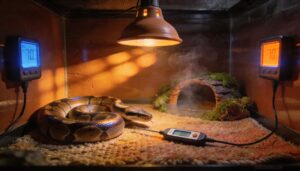
Getting the heat right doesn’t stop once your setup is running. Temperatures shift with the seasons, your room conditions, and even the time of day, so checking in daily keeps your snake safe.
Here’s what you need to monitor and how to stay ahead of problems before they start.
Best Thermometers for Snake Enclosures
Digital thermometers with probe accuracy within ±1°F are your best bet for snake enclosures. Models like Zoo Med’s digital probe reads from -10°F to 140°F, covering every realistic setup.
Water resistance matters too — probes that handle damp substrate or misting systems won’t fail on you.
For serious monitoring, temperature data loggers and wireless thermometers with wireless connectivity track shifts around the clock.
Don’t skip calibration methods to keep readings honest.
Where to Place Temperature Probes
Once you have reliable thermometers, placement makes or breaks your readings.
Put your Warm Hide Probe on the hide floor where your snake actually rests — centered, not at the edge. Mount your Cool Side Probe on the substrate opposite the heat source. For the Basking Surface Probe, secure it directly on the basking surface using a Secure Mounting Technique like zip ties.
Avoid Glass Contact entirely — it skews every reading.
Checking Basking, Ambient, and Cool Zones
Think of your enclosure as a map with three checkpoints: the basking spot, ambient temperature mid-zone, and cold side of the enclosure.
Use Infrared Surface Checks for basking surfaces, probes for air zones.
Multi-Point Mapping across the temperature gradient reveals hot pockets or cold gaps.
Log findings on a Temperature Log Sheet, run a Probe Calibration Routine weekly, and add Nighttime Cool Monitoring to confirm that thermal comfort zones hold after lights drop.
Spotting Overheating and Underheating Early
Your snake’s behavior is often the first thermometer you have. Watch for these Behavioral Red Flags, Respiratory Indicators, and Posture Changes before temperature spikes show on your thermometer:
- Overheating: glass-surfing, open-mouth breathing, or gaping
- Underheating: lethargy, regurgitation, disrupted Feeding Patterns
- Urgent Emergency Signs: disorientation, tremors, or seizures
Temperature data loggers catch temperature fluctuation mitigation needs overnight, where heat source redundancy becomes critical.
Seasonal and Room-temperature Adjustments
Room temperature is the silent variable that shifts your whole gradient without touching a single setting. Seasonal temperature adjustments aren’t optional — they’re part of routine care.
| Season | Priority Action |
|---|---|
| Winter | Winter Insulation Strategies + lightless heat source |
| Summer | Summer Cooling Techniques via room-level AC |
| Spring/Fall | Seasonal Thermostat Programming for transitional swings |
| Year-round | Room Climate Stabilization through Ambient Temperature Buffering |
Check your thermostat and temperature monitoring tools after every major weather shift.
Prevent Burns, Fires, and Heat Loss
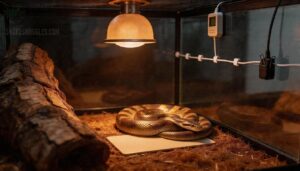
Getting the heat right is only half the job — keeping it safe is the other half. A few small mistakes with wiring, placement, or insulation can put your snake at risk and create real hazards in your home.
Here’s what you need to check and set up correctly.
Safe Placement of Heating Equipment
Where you place your heating equipment matters just as much as which heater you choose. Poor positioning causes burns, fires, and cold spots — all avoidable with a few simple rules.
- Heat Pad Alignment: Position under-tank heaters on the warm end only, covering one-third of the floor with proper clearance from substrate edges.
- Elevated Lamp Mounting: Mount overhead lamps above the screen top, keeping adequate distance from the basking surface.
- Non-combustible Base: Rest enclosures on flat, fire-safe surfaces — never carpet or wood furniture — using rubber feet for underside ventilation.
- Secure Wiring Channels: Route cords through cable organizers, away from high-traffic areas and water sources.
- Electrical Safety: Plug heaters directly into wall outlets, matching wattage to outlet capacity to prevent overloads.
Protective Guards for Overhead Heaters
Overhead heat lamps can burn your snake before you even notice the problem. Fitting a guard with proper Guard Clearance — at least 75 mm on all sides — keeps your animal safe without smothering Airflow Optimization around the bulb.
Choose steel or stainless mesh with a 25 mm Mesh Aperture, and select a Material Heat Resistance coating rated for high temperatures.
For Mounting Maintenance, hook‑on designs let you remove the guard quickly for cleaning your overhead heating system.
Avoiding Overloaded Outlets and Bad Wiring
A single overloaded outlet is one of the most fire hazards in reptile keeping. Every heat source draws continuous current, so Circuit Load Management matters — plugging multiple heaters into one outlet creates dangerous heat buildup at the receptacle itself.
Watch for these electrical safety red flags:
- A warm outlet or wall plate signals electrical overload
- Avoid Extension Cord Use for permanent heat source setups
- Make sure Proper Grounding and correct Wiring Gauge Selection on all circuits
- Outlet Heat Detection and frequent breaker trips both demand immediate action for fire safety and electrical shock prevention
Inspecting Cords, Sockets, and Heaters Regularly
Wiring problems rarely announce themselves loudly. That’s why a monthly inspection routine catches cord wear signs, plug integrity checks, and socket scorch detection before they become emergencies.
| What to Check | Warning Sign | Action |
|---|---|---|
| Cord | Fraying, stiffness, burn marks | Replace immediately |
| Plug/Socket | Scorch marks, loose blades | Stop use, inspect wiring |
| Heater surface | Cracks, melted plastic | Remove from service |
Any heater surface damage means the unit is done.
Insulating The Enclosure for Efficiency
Good wiring habits get you far, but keeping heat inside the enclosure is just as important. Continuous insulation on exterior walls cuts heat loss at night substantially, improving ambient heat retention without pushing your heater to work overtime.
Here’s what actually works for thermal insulation:
- Apply foam board (polystyrene or polyisocyanurate) to exterior walls for moisture resistant materials with high thermal insulation value.
- Use continuous insulation without gaps—breaks create thermal bridges that bleed warmth straight through the frame.
- Seal every seam with caulk for proper air barrier sealing, since air leakage often moves more heat than conduction.
- Add a foil-faced reflective insulation layer facing an air gap to reflect radiant heat back inward.
- Practice thermal bridge mitigation by avoiding metal screws or clips that conduct heat out through the shell.
Together, these steps support real energy efficiency.
Reducing Drafts and Stabilizing Heat Retention
Once the walls are insulated, don’t let drafts undo that work. Seal enclosure gaps around cable cutouts and vents with caulk, apply weatherstripping to access doors, and install draft stoppers where airflow sneaks under panels. Use heat-holding materials like PVC or thick substrate to slow heat loss at night.
Balanced ventilation airflow keeps the thermal gradient stable without constantly fighting room drafts.
Frequently Asked Questions (FAQs)
How warm should my snake enclosure be?
Your snake’s temperature range depends on the species, but most captive snakes need an ambient temperature between 75–90 °F, with a clear thermal gradient from cool to warm, so reptile thermoregulation works naturally.
How do I heat my snake enclosure?
Heating your enclosure comes down to matching the right heat sources to your species, controlling them with a thermostat, and monitoring temperatures daily across warm, cool, and basking zones.
How do you protect a snake enclosure from overheating?
Overheating can turn your enclosure into a death trap within hours.
Use a thermostat with automatic power cutoff, maintain ventilation flow management, and monitor thermal buffer zones daily for temperature stability.
How do you heat a snake?
You heat a snake by creating a temperature gradient — a warm side around 88–92 °F and a cool side near 76–80 °F — using a reliable heat source controlled by a thermostat.
How do you keep a snake warm?
Keep your snake warm by maintaining a temperature gradient — warm side at 80–90 °F, cool side at 75–80 °F — using reliable heat sources like ceramic heat emitters or heat mats, controlled by a thermostat.
How do you care for a snake enclosure?
Caring for a snake enclosure means balancing humidity management, substrate selection, water dish maintenance, and a stable temperature gradient — all within an enclosure size that gives your snake genuine room to thrive.
Can a snake enclosure heat a snag?
No, a snake enclosure isn’t designed to heat a snag.
Thermal mass impact and material conductivity affect surface temperature variance, so snag burn prevention matters — always monitor airflow patterns and thermal gradient carefully.
What is the best heat source for a snake enclosure?
No single heat source wins for every setup.
Ceramic heat emitters, radiant heat panels, heat lamps, and heat mats each serve a different purpose — your best choice depends on species, enclosure size, and energy efficiency goals.
What temperature should my snake enclosure be?
Get this wrong by even a few degrees, and your snake pays the price.
Most setups need a warm side of 82–90°F and a cool side around 72–80°F, with species-specific requirements guiding every adjustment.
What is the best way to heat a snake tank?
The best heat source depends on your setup, but ceramic heat emitters paired with a thermostat deliver reliable, energy-efficient warmth and consistent heat distribution across the temperature gradient without disrupting your snake’s day-night cycle.
Conclusion
Precise, purposeful planning separates snakes that merely survive from those that genuinely thrive.
Your snake enclosure heating recommendations aren’t just a checklist—they’re the foundation of every biological process happening inside that enclosure, from the first swallow to the last shed.
Get your gradient right, match your heat source to your species, and never skip the thermostat.
Temperature isn’t background noise in your snake’s life.
It’s the signal everything else runs on.