This site is supported by our readers. We may earn a commission, at no cost to you, if you purchase through links.

Corn snakes escape more often than any other beginner snake—not because they’re aggressive, but because owners underestimate them. Behind those calm, docile eyes lives a methodical problem-solver that will test every gap in an improperly secured lid.
That reputation for escaping is actually the first thing this corn snake care guide teaches you: respect the setup before you respect the snake.
Get the enclosure right, nail the temperatures, feed on schedule, and you’ll have a companion that can outlive a family dog by a decade.
Everything else falls into place once you understand the fundamentals.
Table Of Contents
- Key Takeaways
- Is a Corn Snake Right?
- Set Up The Enclosure
- Control Heat, Light, Humidity
- Feed Your Corn Snake
- Keep Your Corn Snake Healthy
- Frequently Asked Questions (FAQs)
- How to take care of a corn snake for beginners?
- How do you care for a corn snake?
- How does poor care affect corn snakes?
- Do corn snakes need a hide?
- Do corn snakes need light?
- Are corn snakes hard to care for?
- What do corn snakes need in their tank?
- Do corn snakes need a heat lamp?
- What is the lifespan of a corn snake?
- What not to do with a corn snake?
- Conclusion
Key Takeaways
- Corn snakes are methodical escape artists, so a locking lid with an audible click isn’t optional — it’s the first thing you set up before your snake ever comes home.
- With a lifespan of 15 to 25 years, a corn snake outlasts most dogs, so be honest with yourself about that commitment before you fall for those calm, docile eyes.
- Keeping humidity between 40–60% daily — bumped to 70% during shedding — is what stands between a clean shed and a stuck one, which is called dysecdysis and causes real harm.
- Feeding prey no wider than 1.5 times your snake’s body diameter, thawed fully in warm water (never microwaved), and offered with tongs keeps your snake safe at every life stage.
Is a Corn Snake Right?
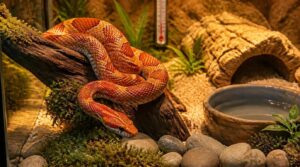
Corn snakes are one of the best first reptiles you can own — but "best" only holds true if the match is right. Before you bring one home, it helps to honestly weigh a few key factors. Here’s what you need to keep in mind.
If you decide it’s the right fit, picking up a complete corn snake starter kit takes a lot of the guesswork out of getting set up properly.
Beginner-friendly Traits
Corn snakes might just be the most beginner-friendly species in the reptile world. They tolerate handling well, calm quickly in your hands, and rarely show aggression.
Their enclosure setup is straightforward, feeding schedules are predictable, and they don’t need specialized equipment. If you’re new to snake keeping, this species makes the learning curve feel manageable from day one.
Lifespan Commitment
Before you fall in love with the beginner-friendly side, consider the bigger picture: corn snakes live 15 to 25 years in captivity. That’s a decade-long dedication — longer than most dogs. This isn’t a starter pet you outgrow. It’s a lifelong responsibility that deserves honest reflection before you bring one home.
Corn snakes live up to 25 years — a lifelong commitment that outlasts most dogs and demands honest reflection before day one
Adult Size Expectations
Size is the next thing worth knowing.
Adult corn snakes commonly reach 4 to 6 feet, with females growing larger than males — a difference called sexual dimorphism. Males usually stay between 3 and 4.5 feet.
Most snakes hit their adult size by age 3 to 4, though diet, temperature, and enclosure size all shape that outcome.
Temperament and Handling
Knowing your snake’s size is one thing — knowing how it’ll behave in your hands is another.
Corn snakes are calm and docile by nature, making them a top pick for first-time keepers. Most tolerate handling well, especially when you start young and keep sessions short — around 5 to 10 minutes, two or three times a week for hatchlings.
Legal Ownership Checks
Before you bring a corn snake home, it’s worth spending five minutes checking whether your state or city actually allows you to keep one. Ownership is restricted or prohibited in some U.S. states, so contact your local wildlife agency or check their website directly.
Local ordinances can be stricter than state law, so verify both levels before buying.
Set Up The Enclosure
Getting the enclosure right from the start makes everything else easier. A few key decisions — tank size, lid security, substrate — set the foundation for a healthy, stress-free snake. Here’s what you need to get it done right.
Tank Size by Age
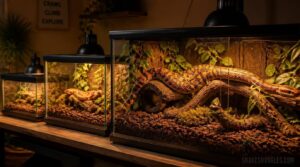
Think of your enclosure as a home that grows with your snake. Hatchlings start in a 20-gallon tank — that’s plenty of room for the first few months.
As your snake outgrows that starter tank, you’ll also want to fine-tune its care routine — corn snake diet and habitat essentials cover everything from calcium dusting to upgrading enclosures at the right time.
By six months, upgrade to a 40-gallon breeder. Adults reaching four to five feet do best in a 55–75-gallon enclosure, giving them space to stretch, coil, and climb comfortably.
Secure Locking Lid
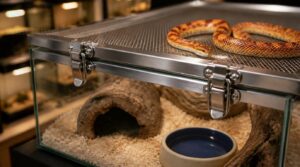
Corn snakes are notorious escape artists — a secure locking lid is non-negotiable for your enclosure setup.
- Choose latches with an audible click to confirm full closure
- Look for corrosion-resistant metal or durable plastic components
- Prioritize multi-point locking for stronger escape prevention
- Check gasket seal integrity monthly to maintain a tight fit
- Replace worn parts promptly to uphold solid latch security levels
Safe Substrate Choices
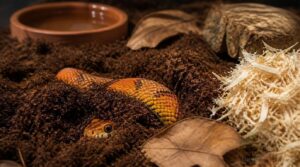
What’s actually on the floor of that enclosure matters more than you might think. Substrate selection shapes humidity, comfort, and safety all at once.
Aspen shavings are a reliable go-to — they’re dry, easy to spot‑clean, and support light burrowing. Coconut fiber excels at substrate moisture retention, hovering around 40–60%, which helps during shed season.
Avoid pine, cedar, or sand entirely — they’re genuinely harmful.
Coconut coir is a renewable choice among eco‑friendly substrate options.
Hides and Climbing Décor
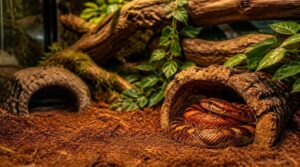
Your corn snake needs more than empty floor space — hides and climbing décor turn a bare tank into a real home.
- Snug hide fit: 2–3 body widths tall, opening around 4 inches for adults
- One hide per temperature zone: warm side and cool side
- Secure branches: anchored, rated 2x the snake’s weight
- Safe materials: nonporous resin or sealed wood
- Varied textures: bark, smooth plastic, rock surfaces
Water Bowl Placement
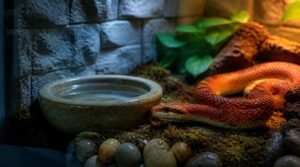
Where you place the water bowl matters more than most new keepers expect.
Set it on the cool side of the enclosure, away from direct heat. A shallow dish — about 1 inch deep — limits humidity spikes. Position it near a wall so your snake drinks without feeling exposed, and use a heavy ceramic or stainless bowl to prevent tipping.
Control Heat, Light, Humidity
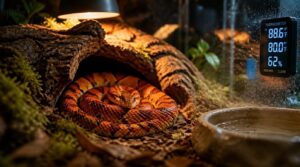
Getting the temperature and humidity just right inside your corn snake’s enclosure is one of the most important things you’ll do as an owner. A few key settings work together to keep your snake healthy, comfortable, and ready to thrive. Here’s what you need to dial in.
Warm Side Temperatures
Getting the warm side right is the single most important thing you can do to keep your corn snake’s digestion and immune system working the way they should. Your snake can’t generate its own body heat — that’s what thermoregulation means — so it relies on a basking spot of 85–90 °F to stay healthy.
Cool Side Temperatures
Just as important as that warm basking spot, your snake also needs a cool retreat — usually 72–78 °F — where it can lower its body temperature whenever it needs to. This temperature gradient is how thermoregulation actually works: your snake moves between zones to self‑regulate.
Without a proper cool side, it simply has no way to cool down.
Night Temperature Drops
Once the lights go out, your snake’s environment should cool off a bit too — dropping to somewhere between 68–75 °F overnight is perfectly normal and actually mimics what happens in nature. Nocturnal thermoregulation slows your snake’s metabolism, supporting proper digestion and rest.
Set your thermostat to reflect this night drop automatically, so you’re never manually adjusting.
Humidity for Shedding
Humidity is the other half of the climate equation — and your snake will make it obvious when you’ve got it wrong. Keep humidity at 40–60% day-to-day, then bump it to around 70% during shedding. A stuck shed — called dysecdysis — usually means the air was too dry. Here’s how to manage it:
- Use a digital hygrometer to monitor levels accurately
- Mist lightly or add damp moss to raise moisture during a shedding cycle
- Soak your snake for 15–20 minutes if shed gets stuck
- Avoid over-misting — excess humidity causes scale rot
UVB and Day Cycle
Corn snakes don’t strictly require UVB, but offering low-output UVB lighting enhances Vitamin D3 synthesis and healthier calcium absorption. Replace bulbs every 6–12 months — they degrade invisibly. Pair lighting with a 12-hour day/night cycle, using dawn/dusk simulation to ease transitions. Keep the photoperiod consistent; irregular light disrupts feeding and digestion.
| Setting | Recommendation |
|---|---|
| UVB wavelength | 290–320 nm |
| Daily photoperiod | 10–12 hours |
| Bulb replacement | Every 6–12 months |
| Dawn/dusk shift | Gradual dimming preferred |
| Placement | Warm/basking side only |
Feed Your Corn Snake
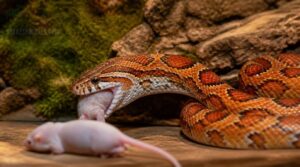
Feeding your corn snake correctly is one of the most important parts of keeping it healthy long-term. Get the prey size, schedule, and prep right, and you’ll avoid most of the common problems new owners run into. Here’s exactly what you need to know.
Prey Size Guidelines
The rule of thumb is simple: prey should never exceed 1.5× your snake’s body diameter at its widest point. Offering anything larger risks regurgitation or internal impaction — both stressful and potentially dangerous. When in doubt, size down. A slightly smaller meal is always safer than one that’s too big.
Hatchling Feeding Schedule
Young corn snakes are tiny but hungry little machines, and getting their feeding schedule right from day one sets the foundation for a long, healthy life. Offer your hatchling one pinkie mouse every 5–7 days.
Always use feeding tongs — never your fingers.
Thaw prey completely in warm water first, and occasionally dust it with calcium powder.
Juvenile Feeding Schedule
As your corn snake sheds its hatchling days and enters the juvenile stage, its appetite kicks into a noticeably higher gear.
Upgrade from pinkies to fuzzy or small hopper mice, offered once a week. Always use tongs, thaw prey fully in warm water, and dust occasionally with calcium powder.
Discard anything uneaten — never refreeze thawed prey.
Adult Feeding Schedule
Your adult corn snake‘s metabolism has finally hit its stride — and that means you can actually dial back the feeding frequency without any guilt.
Offer adult mice or small rats every 10–14 days. Prey shouldn’t exceed 1.5 times your snake’s widest point.
Dust occasionally with calcium powder to fill nutritional gaps.
Thawing Frozen Prey Safely
Now that you know what to feed and how often, let’s make sure that frozen mouse actually reaches your snake the right way.
Never microwave frozen prey. Instead, seal it in a zip-lock bag and soak it in warm water for 20–30 minutes. Before offering it, check that the prey feels warm throughout — not cold in the middle. Always use feeding tongs, and discard any uneaten prey immediately.
Keep Your Corn Snake Healthy
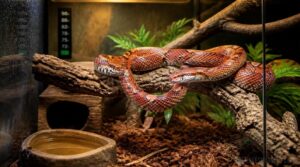
Keeping your corn snake healthy comes down to a handful of habits you’ll build into your routine. From handling and cleaning to spotting early warning signs, each step plays a real role in how long and well your snake lives. Here’s what you need to stay on top of.
Safe Handling Steps
Once you’ve earned your corn snake’s trust, picking it up the right way makes all the difference between a calm, curious snake and one that’s stressed and ready to bolt.
Always wash your hands first — food smells trigger feeding responses. Scoop from below, support the full body, and watch for tight coiling or frantic movement, which signals stress. Keep early sessions to 10–15 minutes.
Cleaning and Sanitation
Good handling habits mean nothing if you’re placing your snake back into a dirty enclosure. A simple routine cleaning schedule keeps bacteria, mold, and odor from taking hold.
Spot-clean waste daily, do a full enclosure wipe-down weekly using a 3% bleach solution, and replace substrate monthly. Always rinse surfaces completely — residue irritates skin.
Change water every 2–3 days, using a dedicated bowl brush to prevent biofilm buildup.
Shedding Problem Fixes
Even with a spotless tank, shedding problems can still sneak up on you — and how you handle them makes all the difference.
Dysecdysis — incomplete or stuck shedding — usually comes down to humidity. If your enclosure drops below 40%, your snake’s old skin dries out before it can slide off cleanly. During the active shed cycle, bump humidity to around 70%.
A complete guide to the snake shedding process can help you recognize early warning signs before dysecdysis becomes a serious problem.
Watch for these warning signs:
- Dull, bluish eyes or skin
- Shed coming off in small, torn pieces
- Retained skin around the eyes or tail tip
- Your snake rubbing obsessively against décor
If you spot retained skin, don’t pull it off. Instead, soak your snake in shallow, lukewarm water for 15–20 minutes. The moisture loosens stuck patches safely. A damp hide box works well for prevention — just pack it with moistened sphagnum moss.
Common Illness Signs
Catching illness early is one of the most important skills you’ll develop as a corn snake owner — and it’s easier than you might think once you know what to look for.
| Warning Sign | Likely Cause |
|---|---|
| Wheezing, open-mouth breathing | Respiratory infection |
| Red, swollen gum tissue | Mouth rot |
| Tiny moving dots on scales | Mite infestation |
| Lethargy, refusing food | Infection or stress |
Scale rot appears as discolored, soft patches on the belly — usually from excess moisture. Trust your instincts: if something looks off, it probably is.
When to Call a Vet
Knowing when to pick up the phone and call a vet is just as important as everything else you’ve learned about caring for your corn snake.
If you notice wheezing or open-mouth breathing, respiratory distress, scale rot, pustular dermatitis, prolonged appetite loss, unusual lethargy, or cloudy eyes that persist after a shed — don’t wait.
Book an annual check-up, too.
Frequently Asked Questions (FAQs)
How to take care of a corn snake for beginners?
Taking care of a corn snake is surprisingly manageable. They’re calm, handleable, and eat pre-frozen mice on a simple schedule. Keep their enclosure warm, humid, and escape-proof, and they’ll thrive.
How do you care for a corn snake?
Caring for a corn snake means getting five things right: enclosure setup, feeding, temperature, humidity, and health monitoring. Nail those, and you’ll have a thriving snake for 15–20 years.
How does poor care affect corn snakes?
Poor care doesn’t just make a corn snake uncomfortable — it shortens its life. Retained shed, scale rot, respiratory infections, and nutritional deficiencies all trace back to wrong humidity, dirty enclosures, or an unbalanced diet.
Do corn snakes need a hide?
Yes, corn snakes absolutely need hides. Without a secure hideout box, your snake will stay stressed and may refuse food. Hides support thermoregulation, shedding, and behavioral health — they’re non-negotiable in any enclosure.
Do corn snakes need light?
Light isn’t make-or-break for corn snakes, but a consistent 12-hour cycle matters. It helps maintain their circadian rhythm and feeding patterns. UVB isn’t required, though some keepers add low-intensity UVB for enrichment.
Are corn snakes hard to care for?
Corn snakes are one of the easiest reptiles to keep. They need basic feeding every one to two weeks, a simple temperature gradient, and routine cleaning — nothing that’ll overwhelm a first-time owner.
What do corn snakes need in their tank?
Your corn snake needs a secure tank, proper hides on both sides, safe substrate 2–4 inches deep, a water dish, and a reliable thermal gradient from warm to cool.
Do corn snakes need a heat lamp?
A heat lamp sounds fancy, but corn snakes don’t actually need one. A heat mat or ceramic heat emitter works better — paired with a thermostat to prevent dangerous overheating.
What is the lifespan of a corn snake?
A captive corn snake can share your life for 15 to 25 years — sometimes longer. That’s a real long-term commitment, so make sure you’re ready before bringing one home.
If you’re weighing your options, beginner-friendly small snake species like the western hognose offer that same decades-long companionship with an extra dash of personality.
What not to do with a corn snake?
Most mistakes happen in clusters. Use only safe substrates like aspen or cypress, never cedar. Don’t handle during shedding. Lock the enclosure. Ignore wheezing or appetite loss, and you’ll regret it.
Conclusion
Steady setups, smart schedules, and secure lids—that’s the real foundation of every successful corn snake care guide. Get those three things right, and you’re not just keeping a snake alive; you’re building a lasting relationship with an animal that can share your home for 20 years.
Watch for shed problems, weigh your snake monthly, and call a vet at the first sign of illness.
Simple habits, practiced consistently, turn a beginner into a keeper.