This site is supported by our readers. We may earn a commission, at no cost to you, if you purchase through links.
Your ball python can live in an undersized cage for years without showing obvious distress, but that doesn’t mean it’s thriving. Many keepers use enclosures that meet the bare minimum—just enough space for the snake to curl up and hide—while wondering why their python rarely explores or seems lethargic.
The truth is, proper python enclosure dimensions aren’t just about fitting your snake inside four walls; they’re about creating an environment where your python can stretch fully, thermoregulate effectively, and engage in natural behaviors that keep it mentally and physically healthy.
Getting the measurements right from the start prevents the expensive hassle of upgrading enclosures later and gives your snake the foundation it needs for a long, active life.
Table Of Contents
- Key Takeaways
- Recommended Python Enclosure Dimensions
- Measuring Your Ball Python for Proper Fit
- Factors Influencing Enclosure Size Choice
- Setting Up The Ideal Ball Python Habitat
- Top 4 Products for Python Enclosure Setup
- Frequently Asked Questions (FAQs)
- How big should an enclosure be for a python?
- Is a 40 gallon terrarium good for a ball python?
- How big should a ball python enclosure be?
- Who makes a Python enclosure?
- Which ball python enclosure is right for You?
- Do ball pythons need enclosures?
- How big should a python enclosure be?
- How big should a carpet python enclosure be?
- Can a ball python live in a 20 gallon tank?
- Is a 75 gallon tank good for a ball python?
- Conclusion
Key Takeaways
- Your ball python needs an enclosure at least 4x2x2 feet (roughly 60 gallons) as an adult, with dimensions based on the formula: 0.9x snake length by 0.45x width by 0.3x height to allow full stretching and proper thermoregulation.
- Enclosure size directly impacts your snake’s health and behavior—too small restricts natural movement and shedding quality, while too large without proper hides actually increases stress rather than reducing it.
- You’ll need to upgrade enclosures as your python grows, measuring your snake every two months and planning for tank expansion when length exceeds 80% of current enclosure size, with females requiring slightly larger spaces than males.
- Proper habitat setup requires more than just size—you need vertical climbing space, distinct temperature zones (88-92°F warm side, 75-80°F cool side), humidity control at 50-60% (70-75% during shedding), and strategic placement of hides, branches, and water bowls to create functional microclimates.
Recommended Python Enclosure Dimensions
Getting your ball python’s enclosure size right isn’t just about squeezing them into a box—it’s about giving them enough room to stretch, climb, and thrive. The standard rule is simple: your enclosure should be at least 0.9 times your snake’s length by 0.45 times wide by 0.3 times tall, with a 4x2x2-foot minimum for most adults.
To make sure your setup supports all aspects of their health, keep an eye on signs of a healthy ball python shedding as proper space and humidity both play a role.
Let’s break down exactly what size you need based on your python’s age, sex, and length.
Getting the measurements right matters—here’s a complete guide to choosing the right water bowl size for your ball python based on these factors.
Minimum Size Requirements for Ball Pythons
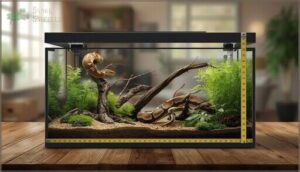
Your ball python needs an enclosure that allows full stretching and natural movement. For adults, aim for a minimum length of 36 inches, though 48 inches is better for larger snakes.
Many breeders who offer ball pythons for sale near you can also recommend trusted enclosure brands based on your snake’s adult size.
Width should be at least 18 inches for proper humidity control and ventilation systems, while 12 inches of enclosure depth permits climbing structures.
Paired with a consistent feeding schedule—typically every 7–10 days for adults, as detailed in this comprehensive boa constrictor feeding guide—these dimensions ensure your snake thrives both physically and behaviorally.
This tank size ensures your snake’s comfort and reduces stress throughout snake growth stages.
For more guidance on setting up the ideal habitat, check out this children’s python size and care guide.
Ideal Enclosure Size by Snake Age and Sex
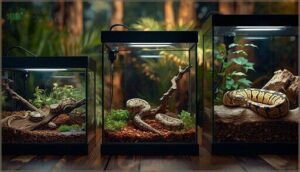
As your ball python matures from juvenile to adult (around 2 to 3 years), you’ll notice sex differences become important for enclosure scaling.
Juveniles under one year thrive in 12-18 inch setups, while subadults need 24-36 inches. Adult females require slightly larger footprints than males due to broader body girth, so plan your reptile enclosure setup with these age factors and snake growth rates in mind.
Why Length, Width, and Height Matter
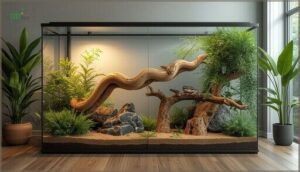
Each dimension of your python’s enclosure fulfills a distinct purpose—length lets them stretch fully, width facilitates side-to-side movement and temperature gradients, and height offers climbing opportunities that mimic their semi-arboreal nature.
Proper enclosure depth creates thermal zones you can’t achieve in shallow tanks, while vertical exploration satisfies their climbing needs.
Balancing these factors ensures snake comfort and space efficiency in your reptile enclosure setup.
Calculating Enclosure Size Based on Snake Length
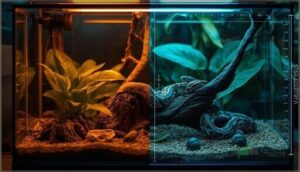
To size your snake enclosure correctly, multiply your ball python’s length by 1.5—that’s your minimum tank size. A 24-inch juvenile needs at least 36 inches of enclosure space, while a 4-foot adult requires 5–6 feet.
Consider growth rate considerations when planning: stock 20–30% larger to accommodate climbing structure needs and thermal gradient management as your snake matures.
Measuring Your Ball Python for Proper Fit
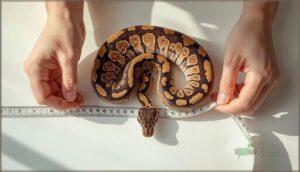
Getting the right enclosure starts with knowing exactly how big your ball python is right now. You’ll need to take a proper measurement from nose to tail tip, then apply the sizing formula to determine what dimensions your snake actually needs.
Let’s walk through the measuring process, how to adjust as your python grows, and how to plan ahead for their adult size.
How to Accurately Measure Your Snake
You’ll need the right tools and technique to get an accurate snake length measurement. Grab a flexible measuring tape—like the kind used for sewing—and gently restrain your ball python on a flat surface. Here’s your measurement checklist:
- Position the snake straight from nose tip to tail tip without forcing bends or curves.
- Measure three times and calculate the average to reduce position errors.
- Record both length and girth in millimeters or inches with the date for growth tracking.
- Cross-check these numbers against enclosure size formulas to verify proper tank dimensions.
This accurate scaling process helps you determine the right snake habitat as your reptile grows. Proper reptile handling during measurement keeps stress low and your python comfortable throughout the process.
Adjusting Enclosure Size as Your Python Grows
Growth stage determines when you’ll need habitat expansion for your ball python. Regularly resize enclosures when snake length exceeds 80% of current tank size. Hatchlings up to 12 inches need 18-inch minimum reptile enclosure dimensions, while snakes reaching 24–36 inches require proportionally larger tanks. Don’t skimp on climbing space—add 12–18 inches of vertical height and maintain adequate substrate depth during each enclosure resizing to prevent stress.
| Snake Length | Minimum Enclosure Length | Vertical Height Needed |
|---|---|---|
| Up to 12 inches | 18 inches | 8–10 inches |
| 24–36 inches | 24–36 inches | 12–15 inches |
| Adult (36+ inches) | 48+ inches | 12–18 inches |
| Mature Female (60 inches) | 54+ inches | 18+ inches |
Considering Growth Patterns in Enclosure Planning
Anticipating your ball python’s growth rate prevents costly enclosure scaling mistakes down the road. Males often reach their maximum length within 18–24 months, while females continue snake development for three to four years.
Track measurements every two months and plan adaptive design upgrades before your snake outgrows its tank size. This proactive approach to reptile enclosure planning saves money and reduces relocation stress markedly.
Factors Influencing Enclosure Size Choice
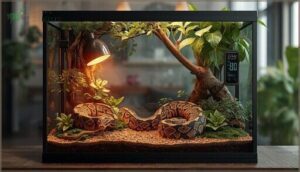
Choosing the right enclosure size isn’t just about your snake’s length—you need to factor in how you’ll manage heat, humidity, and your python’s natural behaviors. The heating method you use can shift your space requirements, while vertical room affects whether your snake gets enough exercise and stimulation.
Let’s look at three key factors that should influence your final decision on enclosure dimensions.
Impact of Heating and Humidity on Dimensions
Your heating method and humidity control directly shape how much space your ball python truly needs. When you install heat sources, you’re creating thermal gradients that require enough enclosure height and floor area for your snake to move between warm and cool zones comfortably.
Higher humidity environments demand extra volume to prevent condensation buildup and support proper thermoregulation, making climate management inseparable from choosing the right enclosure size.
Importance of Vertical Space for Climbing
Ball pythons aren’t strictly ground-dwellers, and vertical enrichment plays a bigger role in reptile habitat design than many keepers realize. When you add climbing structures like sturdy branches to your enclosure size planning, you’re supporting natural climbing behavior and snake exercise.
Multiple height zones help your ball python regulate body temperature while reducing stress through escape routes and hiding spots above ground level.
Proper climbing safety means secure, textured perches that prevent slips and encourage exploration, especially in growing juveniles showing arboreal needs.
Effects of Enclosure Size on Behavior and Health
Your ball python’s enclosure size directly shapes its daily stress reduction and overall snake wellbeing—too small restricts natural movement, while too large without proper hides can actually increase anxiety.
The right enclosure size reduces stress, but too much space without hides can make your ball python anxious
Consider these health outcomes tied to environmental factors in snake habitat creation:
- Behavioral enrichment improves when horizontal space allows full-body stretching and exploration
- Thermoregulation succeeds with adequate room for distinct temperature zones
- Muscular development relies on vertical climbing opportunities in reptile care
- Shedding quality correlates with proper humidity distribution across your ball python’s enclosure size
Setting Up The Ideal Ball Python Habitat
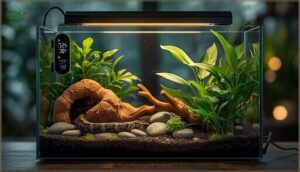
Once you’ve chosen the right enclosure size, you’ll need to set it up in a way that keeps your ball python healthy and comfortable. This means creating a layout that provides proper hiding spots, climbing opportunities, and a stable environment with the right temperature and humidity levels.
Let’s walk through the essential elements that turn an empty tank into a thriving habitat for your snake.
Creating a Functional Layout Within The Enclosure
Your ball python habitat functions like a well-designed apartment—every zone needs purpose. Position hides to optimize concealment while keeping quick access for handling, reducing stress.
Create climbing structures with stable branches spaced for three-dimensional movement, especially near warm zones to support thermal gradients.
Layer substrate thoughtfully: shallow beneath hides prevents entrapment, yet deep enough elsewhere for humidity control and sensory enrichment.
Placement of Hides, Branches, and Water Bowl
Once you’ve organized zones, pin down specifics. Position hides off the warm side—at least two total, one warm and one cool—so your Ball Python can thermoregulate without excessive climbing.
Secure branches with varied diameters to support full body weight, creating vertical Climbing Structures near heat zones.
Place the water bowl away from heat sources to prevent soaking substrate, ensuring depth allows comfortable coiling while maintaining dry and damp microclimates for shedding.
Maintaining Proper Temperature and Humidity Gradients
After arranging hides and water, focus on Temperature Control through Gradient Monitoring. Install at least two calibrated thermometers—one on the warm side (88°F–92°F), one on the cool side (75°F–80°F)—and check substrate-level readings at hide height. Pair your heating source with a reliable thermostat to prevent spikes.
For Humidity Management, aim for 50%–60% ambient, raising it to 70%–75% during shedding using moisture-retaining substrate and climate regulation adjustments.
Top 4 Products for Python Enclosure Setup
Getting your ball python’s enclosure right means having the right tools and materials from the start. You don’t need to overthink it, but choosing quality products makes a real difference in maintaining temperature, humidity, and overall habitat health.
Here are four reliable products that’ll help you set up a safe, functional enclosure your snake will thrive in.
1. Repti Zoo Glass Terrarium Tank
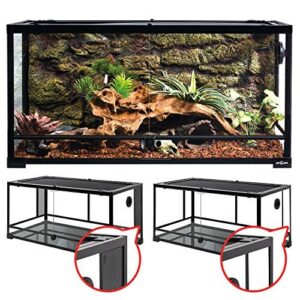
When you’re ready to invest in quality terrarium construction, the Repti Zoo glass terrarium delivers on both function and durability. This 50-gallon tank measures 36″L x 18″W x 17.75″H, meeting the minimum 4x2x2 requirements for ball pythons while incorporating thoughtful reptile enclosure design features.
The tempered glass construction ensures long-lasting use, and dual front doors prevent escapes during feeding. Tank ventilation comes from both a full screen top and adjustable side vents, letting you fine-tune airflow.
The raised, waterproof bottom accommodates substrate heaters perfectly, making terrarium setup straightforward for beginners and experienced keepers alike.
| Best For | Reptile keepers who need a durable 50-gallon enclosure with flexible ventilation options and compatibility with heating equipment for species like ball pythons, bearded dragons, and tortoises. |
|---|---|
| Primary Use | Reptile housing |
| Material Type | Tempered glass |
| Target Animals | Snakes, lizards, tortoises |
| Key Benefit | Versatile habitat control |
| Setup Difficulty | Moderate assembly required |
| Durability Concern | Sharp glass edges |
| Additional Features |
|
- Tempered glass construction with a waterproof, raised base that works with under-tank heaters and supports both desert and rainforest setups
- Dual front doors that open separately to reduce escape risk during feeding and maintenance, plus an anti-escape lock for added security
- Adjustable ventilation through screen top and side vents with closable wire inlets, making it easy to control airflow and humidity levels
- Assembly required and some users report the tank feels slightly flimsy or arrives with broken corner pieces
- Sharp glass edges require careful handling during setup and cleaning
- Tempered glass cannot be drilled or modified, limiting customization options for advanced keepers
2. Aiicioo Reptile Heat Pad Thermostat
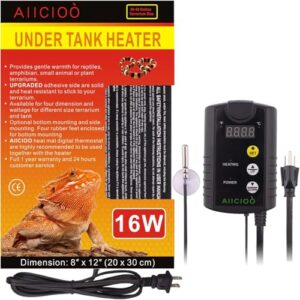
Proper temperature control starts with reliable equipment, which is why the Aiicioo under-tank heat mat and thermostat combo earns its place in your setup. This 8-watt, 6″x8″ heating pad works well for smaller tanks or supplemental belly heat, paired with a digital thermostat offering temperature control from 68°F to 108°F.
You’ll mount the heat mat outside the enclosure—bottom or side—while placing the temperature probe inside near the heated zone. The thermostat settings let you dial in precise heat distribution, and the LCD display confirms when your reptile heating system cycles on and off for stable pad installation performance.
| Best For | Small reptile owners who need reliable temperature control for terrariums under 20 gallons and want an affordable heating solution with digital precision. |
|---|---|
| Primary Use | Terrarium heating |
| Material Type | Adhesive heating pad |
| Target Animals | Hermit crabs, lizards, snakes |
| Key Benefit | Temperature regulation |
| Setup Difficulty | Easy 3-button setup |
| Durability Concern | Units may last under 1 year |
| Additional Features |
|
- Digital thermostat gives you precise temperature control (68-108°F) with an LCD display that shows exactly when heating cycles on and off
- Flexible mounting options let you attach the pad to the bottom or side of your tank, and the rubber feet prevent heat buildup underneath
- Strong user ratings (4.4/5 stars with grade A review authenticity) suggest the combo delivers consistent performance for small enclosures
- The 8-watt, 6×8 inch pad won’t provide enough heat for larger tanks or animals that need higher baseline temperatures
- Adhesive backing can fail over time, with some users reporting the pad comes unstuck from the glass
- Durability concerns pop up in reviews, with some units failing before hitting the one-year mark
3. ReptiChip Coconut Reptile Substrate
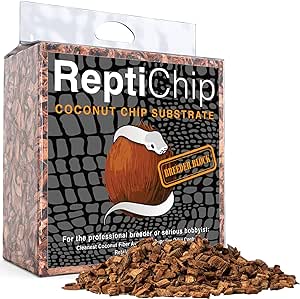
A thick layer of coconut husk bedding anchors ball python care and maintenance because it locks in substrate moisture without turning soggy. ReptiChip’s compressed 72-quart brick expands into 10 pounds of eco-friendly options that support humidity control between 50 and 60 percent—exactly where your snake thrives.
The triple-washed chips resist odor, stay dust-free, and let you spot-clean soiled areas instead of replacing the entire enclosure design and setup. You’ll maintain steady reptile health while simplifying your reptile care routine in reptile enclosures.
| Best For | Ball python owners and reptile keepers who need reliable humidity control and easy spot-cleaning in bioactive or naturalistic enclosures. |
|---|---|
| Primary Use | Reptile bedding |
| Material Type | Organic coconut fiber |
| Target Animals | Ball pythons, turtles, tortoises |
| Key Benefit | Humidity retention |
| Setup Difficulty | Simple water activation |
| Durability Concern | Bags may be dusty |
| Additional Features |
|
- Expands from a compact 72-quart brick into 10 pounds of substrate, giving you plenty of bedding while saving storage space.
- Triple-washed coconut chips stay dust-free and control odor through natural micro-pores, making maintenance easier between full changes.
- Holds humidity steady at 50–60% without getting waterlogged, which is perfect for ball pythons and other tropical reptiles.
- Some users report inconsistent odor control despite the marketing claims.
- Costs more than basic substrate options you’d find at most pet stores.
- Can take a while to fully hydrate if you don’t use a watering hose, and occasional bags arrive dusty.
4. ReptiSafe Water Conditioner for Reptiles
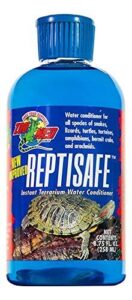
Tap water carries chlorine and chloramines that threaten reptile health, so DBDPet’s ReptiSafe removes those irritants while detoxifying ammonia—a critical dechlorination process for water quality in ball python care.
You’ll add just two drops per cup to your snake’s bowl, securing aquatic safety and supporting animal welfare every time you refresh drinking water. The 8.75-ounce bottle treats roughly 258 gallons, making pet snake care and maintenance simpler.
Chemical removal this straightforward protects your python’s skin during soaks and keeps hydration worry-free in snake care and maintenance routines.
| Best For | Ball python owners who use tap water in bowls or soaking tubs and want a simple, affordable way to remove chlorine and ammonia without complicated dosing. |
|---|---|
| Primary Use | Water conditioning |
| Material Type | Liquid solution |
| Target Animals | Reptiles, amphibians, turtles |
| Key Benefit | Water detoxification |
| Setup Difficulty | Easy liquid application |
| Durability Concern | Bottle top may leak |
| Additional Features |
|
- Super easy dosing—just 2 drops per cup for drinking bowls or 1 teaspoon per 5 gallons for soaks
- One 8.75 oz bottle treats around 258 gallons, so it lasts a long time and saves money
- Removes chlorine, chloramines, and ammonia while adding electrolytes that support hydration and healthy shedding
- Bottle cap can leak over time and waste product if you’re not careful with storage
- Nozzle sometimes clogs and needs cleaning, which is annoying when you’re just trying to treat water quickly
- Not strictly necessary for all snake setups—some keepers use untreated tap water without issues, especially in areas with minimal chlorine
Frequently Asked Questions (FAQs)
How big should an enclosure be for a python?
Your python needs an enclosure where length plus width equals or exceeds the snake’s body length, allowing full stretching.
A 4-foot ball python thrives in a 4x2x2-foot habitat minimum. For ideal care, consider the recommended terrarium size guidelines.
Is a 40 gallon terrarium good for a ball python?
A 40-gallon terrarium works temporarily for juveniles, but most adult ball pythons outgrow it quickly.
You’ll need at least 4×2×2 feet—roughly 60 gallons—to maintain proper temperature gradients and humidity control as your snake grows.
How big should a ball python enclosure be?
Your adult ball python needs at least a 40-gallon enclosure (36×18×12 inches), but larger is better.
Climbing space, thermal gradients, and proper humidity all depend on adequate habitat size as your snake growth continues.
Who makes a Python enclosure?
Several reptile manufacturers and terrarium brands produce snake enclosures, including glass aquarium builders and PVC cage specialists.
Pet supply retailers stock these animal enclosures, while custom enclosures offer customized enclosure design for specific needs.
Which ball python enclosure is right for You?
Your choice hinges on three things: the enclosure materials you prefer, how much environmental control you want, and your snake’s behavior.
PVC excels at holding humidity and temperature steady, while glass offers better visibility but demands more work.
Do ball pythons need enclosures?
Yes, ball pythons need enclosures for thermal regulation, humidity control, and snake safety. A secure enclosure provides escape prevention while maintaining proper environmental conditions essential for your reptile’s health and well-being.
How big should a python enclosure be?
Your ball python’s enclosure should measure at least 36 inches long, 18 inches wide, and 12 inches tall—roughly 40 gallons—to support healthy snake growth, proper temperature gradients, and essential climbing needs.
How big should a carpet python enclosure be?
A carpet python enclosure should measure at least 6 x 3 x 3 feet for adults, with vertical space for climbing structures essential to proper habitat design and accommodating snake growth in this semi-arboreal species.
Proper reptile care guides are necessary for creating an ideal environment.
Can a ball python live in a 20 gallon tank?
A 20-gallon tank works temporarily for hatchlings under 18 inches, but you’ll need to upgrade as your ball python grows.
Adults require larger enclosures—ideally 40+ gallons—to support proper temperature gradients and natural movement patterns.
Is a 75 gallon tank good for a ball python?
As the saying goes, bigger isn’t always better. A 75-gallon tank can work for adult ball pythons when properly furnished with multiple hides, adequate substrate, and controlled humidity—but dimensions matter more than volume alone.
Conclusion
Think of your python’s enclosure like a pair of shoes—wearing the wrong size won’t cripple you immediately, but it’ll change how you move through the world. The right python enclosure dimensions transform your snake’s daily experience from mere survival to genuine comfort.
Measure carefully, plan for growth, and prioritize functional space over aesthetic appeal. Your python can’t ask for more room, but its behavior will tell you everything you need to know about whether you got it right.