This site is supported by our readers. We may earn a commission, at no cost to you, if you purchase through links.

A boa that refuses a meal after a week of waiting can make even a seasoned keeper second-guess everything. Most of the time, the snake isn’t the problem. The prey is too big, too cold, or fed on the wrong schedule.
Your boa’s growth runs on small numbers: a 10 to 15 percent meal-to-body-weight ratio, a 98 to 100 °F feeder, a 12 to 48 hour thaw. Miss them and you get regurgitation, refusals, or a snake that stays too thin or too heavy.
This feeding a boa constrictor guide shows you how to time each meal, match prey to your snake, and pick the right frozen products.
Table Of Contents
- Key Takeaways
- Boa Constrictor Feeding Schedules by Age and Size
- Choosing The Right Prey Size and Type for Your Boa
- How to Feed Your Boa Frozen-Thawed Prey Safely
- Monitoring Boa Body Condition and Preventing Feeding Problems
- Top 10 Frozen Prey Products for Boa Constrictors
- 1. Strike Large Frozen Rats Snake Food
- 2. Frozen Feeder Mice for Snakes Reptiles
- 3. MiceDirect Frozen Small Rats Snake Food
- 4. MiceDirect Premium Frozen Jumbo Rat Feeders
- 5. Frozen Weanling Mice Snake Feeders
- 6. Frozen Mice Small Adult Snake Feeders
- 7. STRIKE Medium Frozen Rats Snake Food
- 8. Strike Jumbo Frozen Rats Snake Food
- 9. MiceDirect Frozen Weanling Rats Reptile Food
- 10. Strike Frozen Rats Snake Food
- Frequently Asked Questions (FAQs)
- What is the recommended feeding schedule for a boa constrictor?
- How long can a boa go without food?
- What is the best food for a boa constrictor?
- Can I feed my snake 2 days in a row?
- Can boa constrictors eat live prey safely?
- How long after feeding should I handle my boa?
- Do boas need UV lighting in their enclosure?
- What causes a boa to refuse food?
- Can I feed multiple prey items per feeding?
- Why is my boa refusing food?
- Conclusion
Key Takeaways
- Size each meal by your boa’s body, not the calendar: choose prey no wider than your snake’s thickest point and under 10 to 15 percent of its body weight, and let your scale overrule the feeding schedule.
- Your boa’s intervals stretch as it grows, from every 10 to 14 days as a baby to every 3 to 4 weeks as an adult, and it should move from mice to weaned rats as it outgrows jumbo mice.
- Thaw frozen prey in the fridge (12 to 24 hours for mice, 24 to 48 for rats), warm it to 98 to 100°F, never microwave or refreeze it, and skip live prey, which can bite and cause fatal infections.
- Track your boa’s body condition and weight over time, since refusals, regurgitation, or steady weight loss usually point to prey that’s too big or too cold, temperature or stress problems, or illness, and ongoing symptoms call for a reptile vet.
Boa Constrictor Feeding Schedules by Age and Size

The right boa constrictor feeding schedule depends on your snake’s age, size, and sex, so you’ll adjust it as your boa grows.
Neonates usually eat every five to seven days, while adults can stretch to every few weeks, and this boa constrictor feeding schedule guide shows how to fine-tune those intervals.
Feed babies up to 12 months every 10 to 12 days. From 12 to 18 months, go every 12 to 14 days. Once your juvenile hits 18 to 24 months, stretch meals to every 2 to 3 weeks.
An adult boa over three years needs a meal every 3 to 4 weeks. Females usually eat every 2 to 3 weeks, while males, which carry more fat and grow slower, wait 3 to 4.
Always base each meal on prey weight relative to your boa’s body weight, about 10 to 15 percent, and let your scale overrule the calendar. Checking for a square, groove-backed body shape helps you tell a healthy boa from an overweight one with ring-shaped fat deposits or an underweight one with a visible spine.
Choosing The Right Prey Size and Type for Your Boa
Prey that’s too big or too small is one of the most common feeding mistakes, and it’s easy to avoid once you know what to measure.
Below, you’ll learn how to match prey width and weight to your boa, how sizes change as your snake grows, and when to pick mice or rats.
Get these three points right, and you’ll keep your boa’s feedings safe and predictable.
Prey Width And Weight
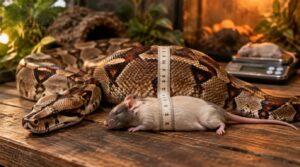
Width decides everything. Measure your boa’s thickest point, then pick prey no wider than that. A boa with a 1.5-inch midsection gets 1.5-inch prey, however manageable a bigger rodent looks.
Measure your boa’s thickest point, then choose prey no wider than that, however manageable a bigger rodent looks
Check prey weight too: keep each meal under 10% of her body weight. A 900 g adult tops out near 90 g. Oversized prey causes regurgitation, so trust the width rule first.
Prey Sizes By Age

Match prey size to your boa’s growth stages, not the calendar. Check prey weight too.
- Neonates: pinky or fuzzy mice every 10 to 14 days.
- Six to 12 months: hopper to adult mice.
- Juvenile, 1 to 2 years: weaned to small rats.
- Adult: medium to large rats, fed every 4 to 8 weeks.
A subtle lump means the meal fit.
Mice Versus Rats

Mice are fine early on, but they run fatter and lower in calcium than rats. Once your boa outgrows jumbo mice (about 30 to 35 g), switch to weaned rats at 35 to 45 g.
One rat beats several mice: fewer thaws, fewer refusals, and more nutrition per meal. Follow these feeding guidelines and your boa constrictor feeding schedule stays simple.
How to Feed Your Boa Frozen-Thawed Prey Safely

Thaw frozen prey in the refrigerator and you’ve handled the biggest part of frozen prey safety. Keep the sealed bag at 32–40°F, and give mice 12–24 hours and rats 24–48 hours. Open any vacuum bag first, since sealed bags make prey bleed during prey thawing.
Need it faster? Submerge a leak-proof bag in cold water and swap the water every 20–30 minutes. Never use a microwave, because it cooks unevenly and ruptures prey.
Good temperature control finishes the job:
- Warm thawed prey to 98–100°F in a sealed bag of warm water.
- Check the head and chest for ice.
- Pat the prey dry, then use tongs for safe handling.
Use it within 24 hours, never refreeze it, and ask about gutloading.
Monitoring Boa Body Condition and Preventing Feeding Problems

Every healthy boa carries a gently rounded body condition, with no sharp spine ridge and no bulging sides. Check it monthly, and pair it with weight monitoring on a digital scale. Record the date, weight, and any feeding or shedding event, because a single number tells you little.
Watch the trend. Steady loss points to underfeeding or illness, and a bigger meal won’t fix it. Fast gain, rolling fat, or skin folds signal overfeeding, so shrink the prey or stretch the interval.
Treat these as health indicators: refusals outside shedding, regurgitation, and a triangular cross-section. Check your temperatures, limit handling around meals, and don’t re-offer food right after a refusal. Recurrent regurgitation or ongoing loss calls for a reptile vet.
Top 10 Frozen Prey Products for Boa Constrictors
You’ve covered schedules, prey sizing, and safe thawing, so now it’s time to stock your freezer.
The list below ranks frozen prey products by how well they match the sizes your boa will need as it grows. Use it to pick the right rat or mouse for your snake’s current weight and mid-body width.
1. Strike Large Frozen Rats Snake Food

Is your boa outgrowing its medium rats? Then it’s time to size up.
Strike Large Frozen Rats weigh 180–249 g and measure 6.5+ inches, so each one gives a big, growing boa a substantial, protein-rich meal. These rats are fully weaned and furred, which means you’re offering real whole prey, and your snake must be able to handle it.
Strike raises them on clean bedding with fresh air and nutritious food, then packages them at a USDA-certified facility. The resealable, aluminum-laminated bag keeps them fresh, but you’ll need freezer space.
Always thaw completely before feeding. A partly frozen rat can injure your snake, and that’s an easy mistake to avoid. Check the rat’s size against your boa’s girth first, too.
| Best For | Owners of large, growing snakes like boas who are ready to move up from medium rats and can safely handle whole prey. |
|---|---|
| Prey Type | Frozen rats |
| Prey Size | 180–249 g, 6.5+ inches |
| Pack Size | N/A |
| Brand | Strike |
| Origin | USDA-certified facility |
| Storage | Freezer, resealable bag |
| Additional Features |
|
- Large, fully weaned and furred rats (180–249 g) give a substantial, protein-rich meal.
- Raised on clean bedding with fresh air and nutritious food, then packaged at a USDA-certified facility.
- The resealable aluminum-laminated bag helps keep the rats fresh.
- Requires freezer space to keep the rats fresh.
- Must be thawed completely before feeding, since a partly frozen rat can injure your snake.
- Not suitable for snakes smaller than 6.5 inches or those unable to handle whole prey, so you’ll need to check the rat’s size against your snake’s girth first.
2. Frozen Feeder Mice for Snakes Reptiles
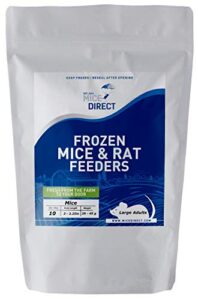
Picture a 50-count bag of mice, each one tucked tight and frozen solid, sitting in your freezer like a loaded magazine. That’s this pack: 3–3.25 inch mice from MiceDirect, raised on a Georgia farm and fed a formulated diet.
They suit juvenile boas and smaller adults, and they work for ball pythons too. Frozen prey also removes bite-wound risk, and freezing kills parasites live mice can carry.
Store them at 0°F and use them within 12 months. When it’s feeding day, thaw a mouse in the fridge, then warm the sealed bag in water to 98–100°F. Never microwave it, and never refreeze a thawed mouse.
Check the head and hips; they’re the thickest spots and must feel warm. Wash your hands.
| Best For | Reptile keepers with freezer space who feed juvenile to adult snakes like ball pythons and boas and want a bulk supply of frozen mice to cut down on store trips. |
|---|---|
| Prey Type | Frozen mice |
| Prey Size | 3–3.25 inches |
| Pack Size | 50 count |
| Brand | MiceDirect |
| Origin | Georgia farm |
| Storage | Freezer at 0°F |
| Additional Features |
|
- Each mouse measures 3–3.25 inches, giving a consistent size for a range of reptiles.
- Frozen prey removes the bite-wound risk of live mice and kills parasites they can carry.
- The 50-count resealable bag supports a steady feeding routine with fewer reorders.
- It needs freezer storage, so it won’t work for keepers without enough freezer space.
- Some reptiles prefer live prey and may refuse frozen mice.
- Some buyers report soiled or damaged mice in shipments, which can affect whether a snake will eat them.
3. MiceDirect Frozen Small Rats Snake Food

Is your boa ready to leave mice behind? These small rats make the jump easy.
Each pack holds 75 frozen feeder rats, 4.5 to 6 inches long and roughly 45 to 70 grams, so one prey item replaces several mice per meal.
They’re raised on Mazuri zoological feed in Cleveland, Georgia, never from lab surplus. Humane CO₂ euthanasia and flash-freezing lock in nutrition, with no artificial ingredients. At $99.97, the pack keeps your freezer stocked for weeks.
Skip them for small or juvenile boas. Keep the bag sealed and frozen, since quality holds about 12 months. Thaw in a sealed bag in warm water or the refrigerator, then warm before feeding. Never microwave.
| Best For | Owners of adult boas, ball pythons, and other larger reptiles who want to stock their freezer with consistently sized feeder rats and make fewer trips to the pet store. |
|---|---|
| Prey Type | Frozen rats |
| Prey Size | 4.5–6 inches, 45–70 g |
| Pack Size | 75 count |
| Brand | MiceDirect |
| Origin | Cleveland, Georgia |
| Storage | Frozen, resealable pack |
| Additional Features |
|
- Each pack holds 75 frozen rats, 4.5 to 6 inches long, so one prey item can replace several mice per meal.
- The rats are farm-raised in Georgia on Mazuri zoological feed, with no artificial ingredients.
- The resealable pack keeps your freezer stocked for weeks, and quality holds for about 12 months when kept frozen.
- They are not suitable for small or juvenile reptiles because of their size.
- They must stay frozen, so you need enough freezer space for a 75-count pack.
- At $99.97 up front, the pack is a sizable purchase, and the rats need to be thawed and warmed before each feeding.
4. MiceDirect Premium Frozen Jumbo Rat Feeders

Is your boa big enough for a 300 g meal? Only a few are.
MiceDirect Premium Frozen Jumbo Rat Feeders come in 10-count packs, and each rat weighs 275 to 374.99 g and measures about 9 to 10 inches. They’re farm-raised in Cleveland, Georgia, on Mazuri zoological-grade feed, with no artificial ingredients or flavors added.
Size matters here. A jumbo rat fits only very large adult boas, so check it against your snake’s girth and body weight first. Many keepers feed adults smaller rats instead.
Orders arrive frozen on dry ice. Store them in your freezer, then thaw overnight in the fridge before feeding. Don’t refreeze anything you’ve thawed.
| Best For | Keepers of very large adult boas or similarly big snakes that can handle a 275 to 375 g frozen rat in a single meal. |
|---|---|
| Prey Type | Frozen rats |
| Prey Size | 275–374.99 g, 9–10 inches |
| Pack Size | 10 count |
| Brand | MiceDirect |
| Origin | Cleveland, Georgia |
| Storage | Freezer storage |
| Additional Features |
|
- Made with no artificial ingredients or flavors, and the rats are fed Mazuri zoological-grade feed.
- Each pack holds 10 jumbo rats and arrives frozen on dry ice, so they stay fresh in transit.
- Trusted by zoos and tens of thousands of customers, with an average delivery time of about one week.
- The rats are too large for most snakes and reptiles, so many adult boas will need a smaller size.
- They need freezer space for storage and must be thawed overnight in the fridge before feeding.
- Thawed rats can’t be refrozen, which could waste food if you thaw more than you need.
5. Frozen Weanling Mice Snake Feeders

Not every boa is ready for a jumbo rat, and young ones start much smaller. Weanling mice weigh roughly 13 to 18 g, which suits boas of about 91 to 170 g.
Each pack holds 20 frozen mice, raised in Cleveland, Georgia, on Mazuri zoological grade feed and humanely euthanized with CO2. They arrive on dry ice, so freeze them right away.
Match the prey to your snake’s thickest body point. A mouse should be no wider than that girth, and about 10 to 15% of your boa’s weight. For a 100 to 130 g juvenile boa, that’s one weanling every 7 days.
Thaw overnight in the fridge, then offer with tongs.
| Best For | Keepers of adult sand boas, adult corn snakes, adult milk snakes, juvenile red tail boas, or juvenile ball pythons who want a humanely euthanized, ready-to-thaw feeder. |
|---|---|
| Prey Type | Frozen mice |
| Prey Size | 13–18 g weanling |
| Pack Size | 20 count |
| Brand | MiceDirect |
| Origin | Cleveland, Georgia |
| Storage | Freezer, dry ice shipping |
| Additional Features |
|
- Domestically raised in Cleveland, GA on Mazuri zoological grade feed and humanely euthanized with CO2
- Frozen format cuts handling time, since you only need to thaw overnight in the fridge and offer with tongs
- The weanling size suits both juvenile and adult snakes on the listed species
- May be too small for large adult snakes
- Arrives on dry ice, so you need to handle it carefully and have freezer space ready right away
- Only suitable for the listed snake species, not other reptiles
6. Frozen Mice Small Adult Snake Feeders

Once your boa outgrows weanlings but isn’t ready for rats, small adult mice fill the gap. They suit yearlings roughly 150 to 400 g, and each 25-count pack is raised in Cleveland, Georgia, on Mazuri feed.
Because their bones are fully calcified, you get a 1.4:1 calcium-to-phosphorus ratio, which helps steady growth. Match each mouse to your boa’s widest body point so it never exceeds that girth.
They arrive on dry ice and aren’t individually wrapped, so separate them manually and keep the rest hard frozen. Thaw one overnight in the fridge, warm in water for 10 to 20 minutes, then offer with tongs every 10 to 14 days.
| Best For | Boa owners with yearlings around 150 to 400 g who have outgrown weanling mice but aren’t ready for rats. |
|---|---|
| Prey Type | Frozen mice |
| Prey Size | Small adult mice |
| Pack Size | 25 count |
| Brand | MiceDirect |
| Origin | Cleveland, Georgia |
| Storage | Hard frozen, dry ice shipping |
| Additional Features |
|
- Raised in Cleveland, Georgia, on zoo-grade Mazuri feed, with a humane CO2 euthanasia process.
- Fully calcified bones give a 1.4:1 calcium-to-phosphorus ratio, which supports steady growth.
- Ships in a cooler with dry ice and keeps well when hard frozen, which suits bulk feeding.
- The mice aren’t individually wrapped, so you have to separate them by hand.
- They must stay hard frozen in your freezer to keep their quality.
- They may be too large for very small snake species that need smaller prey.
7. STRIKE Medium Frozen Rats Snake Food
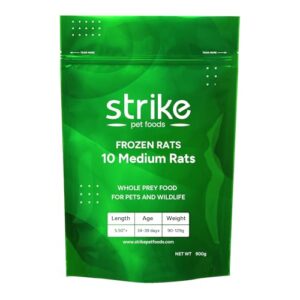
Once your boa tops 400 g and small mice stop filling its girth, step up to STRIKE Medium Frozen Rats. Each one weighs 90 to 129 grams, measures 5.5 inches or longer, and comes from rats 34 to 39 days old. They’re weaned and fully furred, so they deliver more calories per meal than mice.
Match the rat to your snake’s widest body point. If it’s a touch small, offer two rather than forcing one oversized meal, which invites regurgitation.
The resealable aluminum-laminated bag keeps the rest hard frozen, so portion what you need. Thaw in the fridge, warm the rat in water, then offer it with tongs every 10 to 21 days. Never refreeze thawed prey.
| Best For | Owners of boas and similar snakes that have outgrown mice and need a fully furred, weaned rat in the 90 to 129 gram range. |
|---|---|
| Prey Type | Frozen rats |
| Prey Size | 90–129 g, 5.5+ inches |
| Pack Size | N/A |
| Brand | Strike |
| Origin | USDA-certified facility |
| Storage | Freezer, resealable bag |
| Additional Features |
|
- Each rat is 90 to 129 grams, at least 5.5 inches long, and comes from rats 34 to 39 days old, so it gives larger snakes more calories per meal than mice.
- Resealable aluminum-laminated bags keep the remaining rats frozen, so you can portion only what you need.
- The rats are whole frozen feeders with no artificial ingredients, raised on clean bedding and nutritious food and packaged in a USDA-certified facility.
- They must stay frozen, so you need freezer space and have to thaw and warm each rat before feeding.
- The size range is narrow, so a snake with a smaller girth may not suit them, and you may need to offer two rats rather than one oversized one.
- They are meant for reptiles and are not suitable for other pets without proper acclimation.
8. Strike Jumbo Frozen Rats Snake Food

Once your boa passes 6 feet and outgrows large rats, Strike Jumbo Frozen Rats are the next step. Each one weighs 350+ grams and measures 8+ inches, with full fur, so a single rat makes a complete meal for a big adult female.
Check the fit first. The rat should never exceed your snake’s widest mid-body girth, and you should see only a mild lump after eating. Fully grown boas over 3 years old eat every 3 to 4 weeks, so you won’t need to feed often.
They ship from a USDA-certified breeding facility in resealable aluminum-laminated bags, so you can portion meals and keep the rest hard frozen.
| Best For | Owners of large adult boas, especially big females over 6 feet, who have outgrown large rats and want a convenient, full-size frozen meal. |
|---|---|
| Prey Type | Frozen rats |
| Prey Size | 350+ g, 8+ inches |
| Pack Size | N/A |
| Brand | Strike |
| Origin | USDA-certified facility |
| Storage | Freezer, resealable bag |
| Additional Features |
|
- Each rat weighs 350 grams and measures 8 inches, making a complete meal for a big adult snake
- Comes from a USDA-certified breeding facility, with no artificial ingredients
- Resealable aluminum-laminated bags let you portion meals and keep the rest frozen for 75 days
- Needs freezer storage to stay frozen
- May be too large for small snake species
- Not suitable for snakes with dietary restrictions on fur or size
9. MiceDirect Frozen Weanling Rats Reptile Food

A 10-pack of MiceDirect Frozen Weanling Rats (Model 10RW) fills the gap between mice and small rats, and it suits your subadult boa well. Each rat weighs 30–44.99 grams, so the prey stays close to your snake’s mid-body width. That’s the prey width rule at work, and it keeps jumbo feeders from overwhelming a younger constrictor.
These rats are farm-raised in Georgia on Mazuri 6F zoological-grade feed, then humanely euthanized with CO₂ and flash-frozen.
Thaw them in warm water or at room temperature. Never microwave them, and don’t hand-feed, since your boa can learn to link hands with food.
You’ll pay $99.97 per pack. Shipping uses dry ice and FedEx, and delivery takes about one week, so order ahead. You’ll need freezer space for storage. Note that this product suits only reptiles and snakes, not other household pets.
| Best For | Owners of subadult boas and similar constrictors who want a frozen, humanely prepared feeder that falls between mice and small rats. |
|---|---|
| Prey Type | Frozen rats |
| Prey Size | 30–44.99 g |
| Pack Size | 10 count |
| Brand | MiceDirect |
| Origin | Georgia farm |
| Storage | Freezer, dry ice shipping |
| Additional Features |
|
- Humanely euthanized with CO₂ and raised on Mazuri 6F zoological-grade feed
- Each rat weighs 30–44.99 grams, which suits a subadult boa’s mid-body width
- Frozen format is convenient to handle and keeps quality high
- Needs freezer space for storage
- Delivery takes about one week, so you have to order ahead
- At $99.97 per 10-pack, it is not a cheap option, and it only suits reptiles and snakes
10. Strike Frozen Rats Snake Food
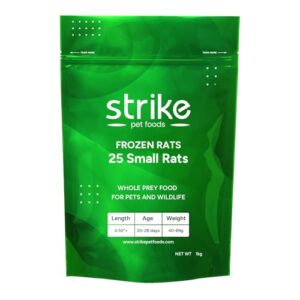
The Strike Frozen Rats line spans every size from pinky to jumbo, roughly 9 to 350+ grams, so you can match prey to your boa’s girth as it grows. Each rat ships frozen in a resealable aluminum-laminated bag, packaged at a USDA-certified breeding facility.
Small rats weigh 40 to 69 grams and measure 4.5+ inches, a good fit for smaller boas. Because the rats are raised on clean bedding with nutritious food, they deliver the protein, calcium, and phosphorus that support bone, muscle, and skin health.
Thaw each rat in the refrigerator, then finish in warm water. Never microwave it. Keep the bag below 0°F until thawing day, and use opened bags soon, since resealing won’t preserve prey forever.
| Best For | Snake owners, especially those with small to mid-size boas, who want a convenient, frozen, ready-to-thaw prey option that is packaged at a USDA-certified facility. |
|---|---|
| Prey Type | Frozen rats |
| Prey Size | 40–69 g, 4.5+ inches |
| Pack Size | N/A |
| Brand | Strike |
| Origin | USDA-certified facility |
| Storage | Freezer, resealable bag |
| Additional Features |
|
- Comes frozen in resealable aluminum-laminated bags, which cuts down on handling and helps keep the prey fresh
- Raised on clean bedding with nutritious food, so it supports bone, muscle, and skin health
- Sold in sizes from pinky to jumbo, so you can match prey to your snake as it grows
- Needs continuous freezer storage to maintain quality
- Opened bags have a limited shelf life, since the resealable bag doesn’t preserve prey forever
- Ranked 1,082 in reptile food, which points to niche availability and demand
Frequently Asked Questions (FAQs)
What is the recommended feeding schedule for a boa constrictor?
Your boa’s feeding schedule depends on age. Feed juveniles every 7 to 14 days, then stretch feeding intervals to every 2 to 4 weeks for subadults and 4 to 8 weeks for adults, slowing further during seasonal feeding in winter.
How long can a boa go without food?
Your boa skips winter meals yet holds weight. Normal! Seasonal feeding, brumation fasting and metabolic slowdown let healthy adults go months without food. Juveniles can’t. Revisit your feeding schedule and feeding intervals after two weeks.
What is the best food for a boa constrictor?
Think of prey selection as matching a key to a lock. The best boa diet is whole frozen-thawed rat, sized to your snake’s mid-body width. Mice suit hatchlings, but rats cover everything afterward.
Can I feed my snake 2 days in a row?
You fed your yearling a rat Monday and wondered about Tuesday. Skip it.
Back-to-back meals are overfeeding, and your feeding schedule needs longer feeding intervals so digestion finishes. Keep prey size modest, feeding frequency low.
Can boa constrictors eat live prey safely?
Your boa constrictor kills for a living, yet a mere rat can win.
Live prey bites back, and infected wounds can kill. Choose frozen-thawed, match prey sizing, follow your feeding schedule, and track health indicators.
How long after feeding should I handle my boa?
Wait at least 48 hours before handling your boa. Digestion needs calm. Skip handling until the prey lump smooths out, especially after big meals. Postfeeding care prevents regurgitation and fits any boa constrictor feeding schedule.
Do boas need UV lighting in their enclosure?
Your boa constrictor can survive without UVB lighting, but it’ll do better with it. A low-output tube, run on a 12-hour cycle, helps with vitamin D3, calcium use, and basking. Replace the bulb yearly.
What causes a boa to refuse food?
Food refusal usually traces back to temperature, stress, or timing. Check your warm side first, then prey size and handling stress.
Shedding, breeding, and winter cause fasts. Two missed meals in young boas suggest illness.
Can I feed multiple prey items per feeding?
Offering five mice sounds generous, yet it’s extra bone and overfeeding. Choose one larger prey item matched to your boa’s prey size, and respect its feeding frequency. Prey selection beats cramming; protect your feeding schedule.
Why is my boa refusing food?
Your boa starves itself while you panic, and that’s often normal. Feeding refusal usually traces to stress reduction failures, poor temperature regulation, or a shed.
Check weekly weight and health indicators, then fix prey selection.
Conclusion
Why do some boas thrive while others sulk, stall, or spit up their meals? Precision, mostly. This feeding a boa constrictor guide comes down to a few habits you can repeat: match prey to girth, keep the 10 to 15 percent ratio, thaw fully, and warm the feeder to 98 to 100 °F.
Watch your snake’s body condition, adjust as it grows, and trust the numbers. Get them right, and every meal becomes pleasantly routine.